Digital transformation has become one of the most critical success factors for modern businesses. In 2026, organizations that continue relying on outdated systems, manual processes, and disconnected tools are rapidly losing competitiveness. Customers expect speed, personalization, and seamless digital experiences, and businesses that fail to deliver these expectations are often replaced by more agile competitors.
This guide explains what digital transformation really means, why it matters today, and the seven most important signs that indicate your business urgently needs it.
What is digital transformation and why is it important for businesses today?

Digital transformation refers to the complete integration of digital technologies into every area of a business. It is not limited to using new software or tools—it is about fundamentally changing how a business operates, delivers value, and interacts with customers.
In today’s business environment, digital transformation is important because markets are becoming more competitive, customer expectations are rising, and data-driven decision-making has become essential. Businesses that do not modernize their systems often struggle with inefficiency, slow growth, and reduced customer satisfaction.
What does digital transformation actually include?
Digital transformation covers a wide range of changes across technology, processes, and business models. It typically includes:
Replacing manual workflows with automated systems
Using cloud-based platforms for flexibility and scalability
Implementing data analytics tools for better decision-making
Enhancing customer experience through digital channels
Integrating artificial intelligence to improve efficiency and personalization
For example, a traditional retail store adopting online ordering systems, digital payment methods, and automated inventory tracking is actively undergoing digital transformation.
How do cloud, AI, and automation fit into digital transformation?
Cloud computing, artificial intelligence, and automation are the core technologies driving digital transformation in modern businesses.
Cloud computing allows businesses to store data securely, scale operations easily, and access systems from anywhere without heavy infrastructure costs.
Artificial intelligence helps analyze large amounts of data, predict customer behavior, and personalize user experiences.
Automation removes repetitive tasks from human workload, improves accuracy, and increases overall productivity.
When combined, these technologies create a business environment that is faster, smarter, and more efficient.
What industries benefit the most from digital transformation?
Almost every industry benefits from Digital transformation , but some sectors experience more visible improvements:
Retail businesses improve customer experience through e-commerce and personalized recommendations
Healthcare organizations use digital records, telemedicine, and AI-powered diagnostics
Financial institutions implement fraud detection systems and digital banking platforms
Manufacturing companies adopt smart factories and IoT-based monitoring systems
Even small and medium-sized businesses benefit by improving efficiency, reducing costs, and reaching more customers through digital platforms.
Why are traditional business models becoming outdated?
Traditional business models are becoming less effective because they rely heavily on manual processes, outdated systems, and limited data usage. In contrast, modern markets require speed, adaptability, and real-time decision-making.
Businesses that continue using outdated models often struggle with slow operations, poor customer experience, and inability to compete with digitally advanced organizations.
How customer expectations have changed in the digital era
Customer expectations have significantly evolved over the last decade. Today’s customers expect:
Instant responses to queries
Smooth mobile and web experiences
Personalized product or service recommendations
24/7 availability through digital channels
If a business fails to meet these expectations, customers quickly switch to competitors that offer better digital experiences.
What role does data play in modern business growth?
Data has become one of the most valuable assets in modern business operations. It helps organizations understand customer behavior, track performance, and make informed decisions.
With proper data usage, businesses can:
Identify trends and patterns in customer behavior
Improve marketing strategies
Optimize operations and reduce inefficiencies
Predict future demand and market shifts
Without effective data management, businesses are forced to make decisions based on assumptions rather than facts.
What are the 7 clear signs your business needs digital transformation?
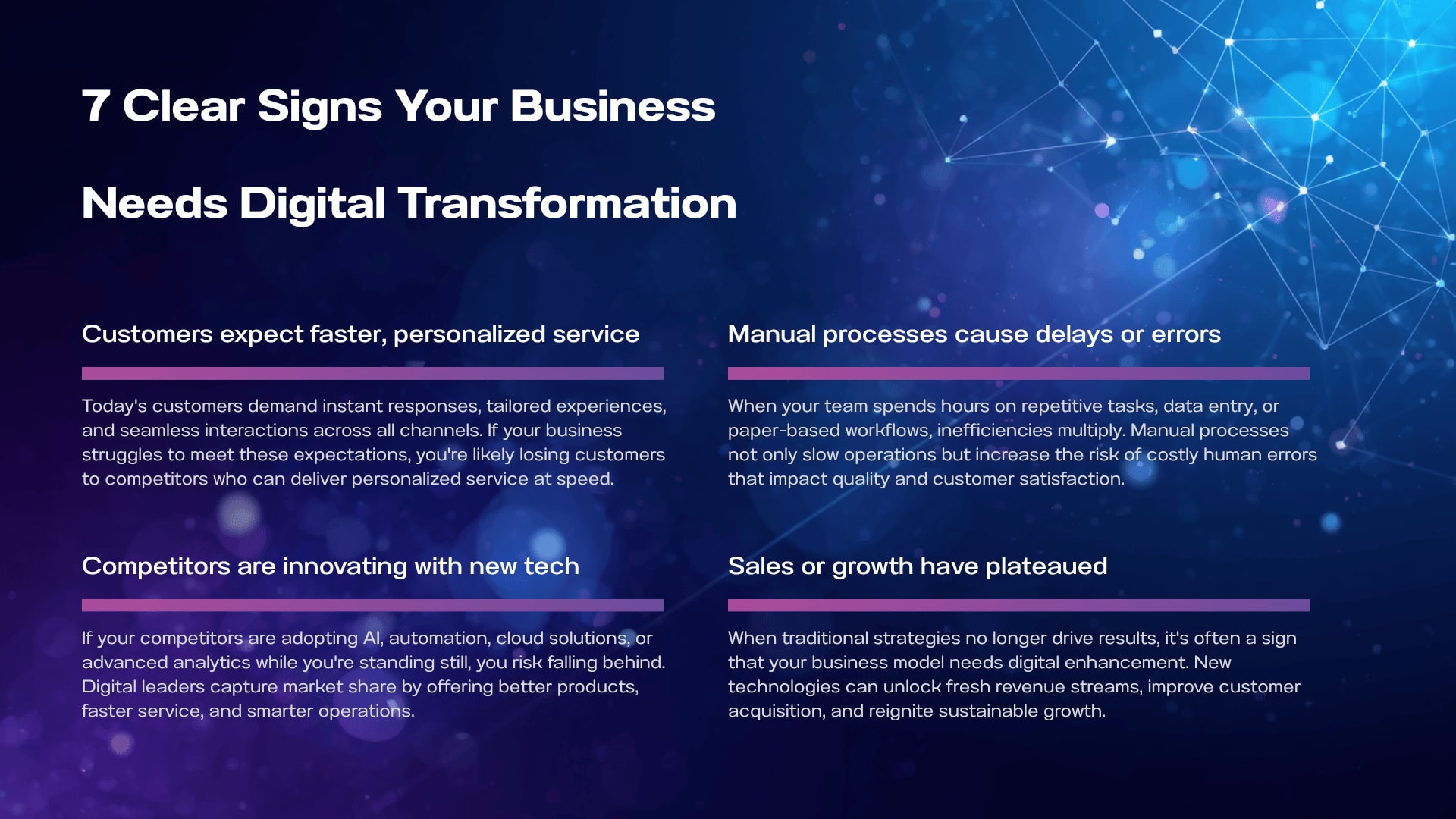
Many businesses fail to recognize early warning signs that indicate the need for Digital transformation . The following seven signs are strong indicators that change is necessary.
1. Is your business struggling with inefficient manual processes?
One of the most obvious signs is heavy dependence on manual work. If employees are spending a large amount of time on repetitive tasks, it is a clear indication that systems need modernization.
Common examples include:
Manual data entry into spreadsheets
Paper-based approvals and documentation
Repetitive reporting tasks
Handled inventory tracking without automation
These processes not only waste time but also increase the chances of human error and reduce overall efficiency.
Automation improves productivity by streamlining workflows, reducing manual effort, and allowing employees to focus on more strategic tasks such as planning and customer engagement.
2. Are your customer experiences falling behind competitors?
Customer experience plays a major role in business success. If customers find your services slow, inconsistent, or difficult to access, it is a strong warning sign.
Indicators of poor digital customer experience include:
Slow-loading websites
Lack of mobile optimization
Delayed responses from support teams
No personalized communication or offers
Digital tools such as CRM systems, chatbots, and AI-driven personalization help businesses improve engagement, respond faster, and create a smoother customer journey.
3. Is your data scattered and difficult to manage?
When data is stored across multiple systems or departments, it becomes difficult to manage and analyze effectively. This is known as data silos.
Problems caused by data silos include:
Inconsistent or duplicate information
Poor coordination between departments
Delayed reporting and insights
Difficulty in decision-making
Centralized data systems solve these issues by bringing all information into one platform. This improves accuracy, enhances collaboration, and enables real-time insights.
4. Are your competitors adopting advanced technologies faster?
If competitors are implementing new technologies while your business remains static, you risk losing market position.
Risks of falling behind include:
Reduced customer base
Lower brand visibility
Decreased operational efficiency
Loss of innovation opportunities
Digital leaders outperform traditional businesses by using automation, analytics, and AI to operate faster, smarter, and more efficiently.
5. Is your team struggling with collaboration and communication?
Poor communication and collaboration are major obstacles in modern business environments, especially with remote and hybrid work setups.
Common challenges include:
Miscommunication between teams
Delayed project updates
Lack of visibility into tasks
Inefficient coordination
Tools such as cloud-based project management systems, video conferencing platforms, and collaboration apps significantly improve productivity and teamwork.
6. Are operational costs increasing without visible growth?
Rising costs without proportional business growth often indicate inefficiencies in operations.
Hidden costs include:
Maintenance of outdated systems
High manual labor expenses
Inefficient workflows
Time lost due to slow processes
Digital transformation helps reduce these costs by automating tasks, improving resource utilization, and increasing overall operational efficiency.
7. Is your business unable to scale efficiently?
Scalability is essential for long-term growth. If your business struggles to handle increased demand, it may be due to outdated systems.
Limitations of legacy systems include:
Difficulty handling large volumes of data
High cost of upgrades
Lack of integration with modern tools
Inflexibility in operations
Digital transformation enables scalability through cloud infrastructure, automated systems, and flexible software solutions that grow with your business.
How can businesses successfully start their digital transformation journey?

Starting a Digital transformation journey requires careful planning, the right technology choices, and a strong focus on people and processes.
What are the first steps to implementing digital transformation?
The first step is understanding the current state of the business and identifying gaps.
Conducting a digital audit includes:
Reviewing existing systems and processes
Identifying inefficiencies and bottlenecks
Analyzing customer experience gaps
Evaluating digital readiness
After this, businesses should set clear goals such as improving efficiency, reducing costs, or enhancing customer experience.
Which technologies should businesses invest in first?
The most important foundational technologies include:
CRM systems for managing customer relationships
ERP systems for integrating business processes
Cloud platforms for scalability and flexibility
Small businesses should start with simple, cost-effective tools, while larger organizations may require more advanced and customized solutions.
How can businesses ensure a smooth transition?
Successful transformation depends not only on technology but also on people and processes.
Key strategies include:
Providing proper employee training
Managing change effectively within teams
Implementing changes gradually instead of all at once
Encouraging a digital-first mindset
Common mistakes such as poor planning, lack of communication, or over-investment in unnecessary tools should be avoided.
Why should businesses partner with digital experts?
Working with experienced professionals can significantly speed up the transformation process and reduce risks.
Benefits of expert support include:
Better technology selection
Faster implementation
Reduced operational errors
Strategic guidance tailored to business needs
Businesses looking for professional assistance in Digital transformation can explore expert solutions at
https://www.amzsoftinnovexa.com/
Final Thoughts
Digital transformation is no longer a future strategy—it is a present necessity. Businesses in 2026 must adapt to changing customer expectations, evolving technologies, and increasing competition.
Organizations that fail to modernize often face declining performance, while those that embrace Digital transformation gain efficiency, scalability, and long-term growth.
Recognizing the early signs and taking action at the right time can determine whether a business survives or thrives in the digital economy.
Tags
Amzsoft Innovexa
Engineering and delivery notes from the Amzsoft Innovexa team — fintech platforms, AI automation, and product engineering.