A business can use artificial intelligence to analyze thousands of records, draft marketing content, identify patterns, and automate repetitive tasks. However, deciding which insights matter, understanding customer emotions, handling unexpected challenges, and taking responsibility for important decisions still require human involvement.
This is where the discussion around AI vs Human Intelligence becomes important. Businesses do not simply need to decide whether artificial intelligence is better than people. They need to understand which tasks benefit from automation, where human judgment is essential, and how both capabilities can work together.
Artificial intelligence has become useful across marketing, customer support, software development, finance, business operations, and many other areas. Machine learning can identify patterns in data, while generative AI can help create text, images, summaries, and software code. These capabilities can support employees and help organizations explore new ways of working.
Human intelligence contributes a different set of strengths, including emotional understanding, critical thinking, contextual judgment, ethical reasoning, and the ability to navigate complex social situations.
The most effective business strategy is not necessarily to choose AI over people or people over AI. AI vs Human Intelligence It is to combine technological capabilities with human expertise, clear responsibilities, and appropriate safeguards. Understanding this relationship can help businesses make more informed technology decisions, improve workflows, and pursue digital transformation without overlooking the people who make those systems valuable.
What Is the Difference Between AI and Human Intelligence?
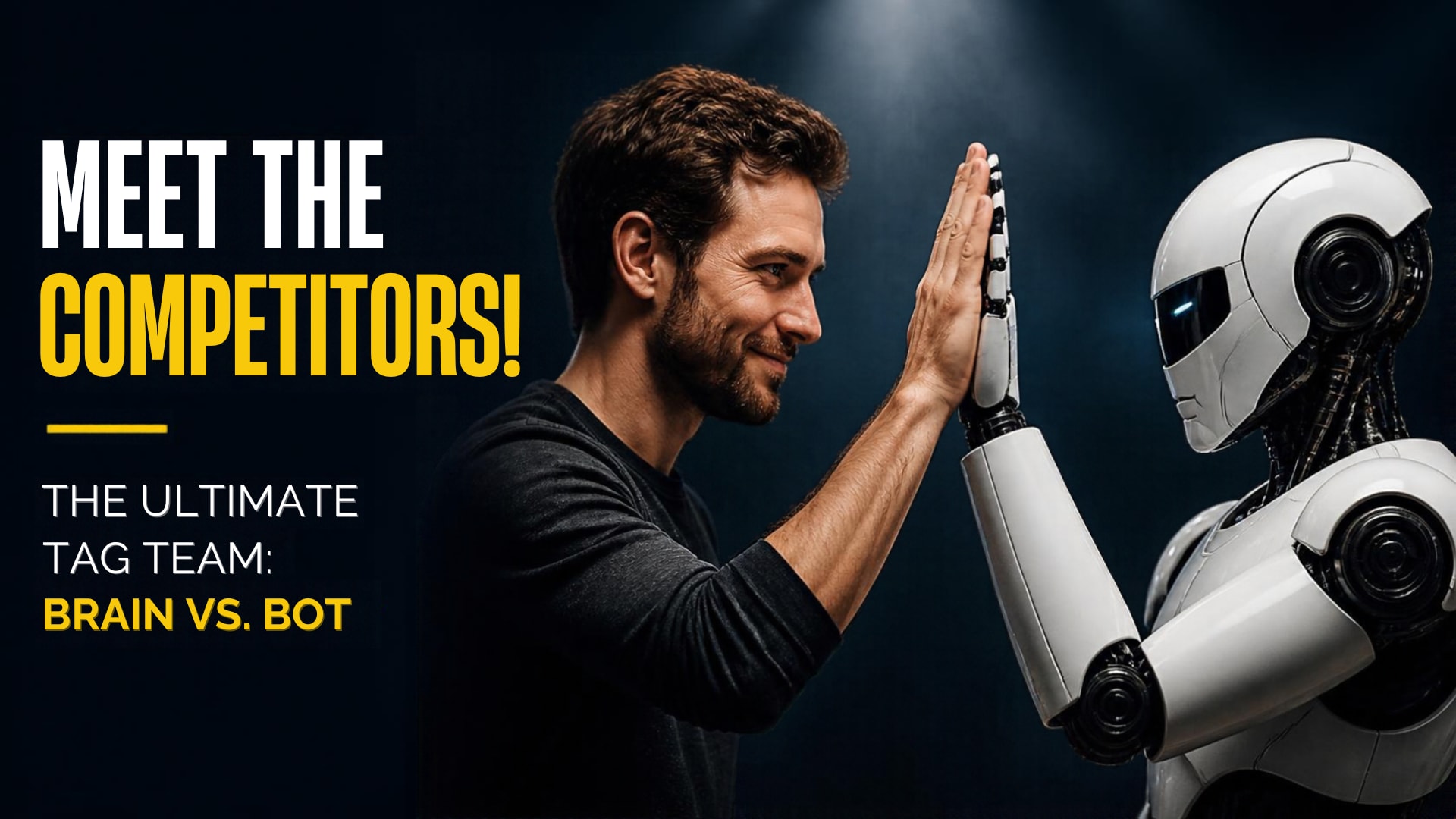
Artificial intelligence and human intelligence are different forms of problem-solving. AI systems use algorithms, learned patterns, and available data to generate predictions, recommendations, or outputs. Human intelligence combines learning, reasoning, experience, emotional awareness, contextual understanding, and judgment. AI can be useful for defined tasks, while people bring broader understanding of goals, relationships, and consequences. Their relative effectiveness depends on the task and its environment.
Understanding Artificial Intelligence
Artificial intelligence refers to computer systems designed to perform tasks that typically involve capabilities associated with human intelligence. These tasks may include recognizing patterns, processing language, classifying information, making predictions, and generating content.
AI does not operate through a single method. Different systems are designed for different purposes, and their capabilities depend on their architecture, training, data, and operating conditions.
Three important concepts help explain how AI works.
Machine learning is a branch of AI in which systems learn patterns from data rather than relying exclusively on manually written rules. For example, a machine-learning system may examine historical sales information to estimate future demand. The quality of its predictions depends partly on the data, assumptions, and conditions under which it operates.
Natural language processing (NLP) enables computer systems to process and work with human language. It supports applications such as document classification, language translation, text analysis, and conversational interfaces.
Generative AI produces new content, such as written text, images, summaries, and computer code, based on patterns learned during training and the information supplied in a particular interaction.
These technologies can support business activities, but their outputs should not automatically be treated as facts. A generative AI tool may produce a convincing explanation that contains an incorrect detail. A forecasting system may identify a historical pattern that no longer applies because market conditions have changed.
For this reason, organizations should evaluate AI according to its intended purpose rather than assuming that one system can perform every task equally well.
Understanding Human Intelligence
Human intelligence involves the ability to learn from experience, reason through unfamiliar situations, understand context, solve problems, and adapt behavior to changing circumstances.
People draw on more than information alone. They can consider social relationships, personal experiences, cultural expectations, organizational priorities, and consequences that may not be clearly represented in a dataset.
For example, a business manager may notice that customer complaints have increased. An analytical system might identify a connection between the complaints and a recent website update. A human manager can also speak with employees, consider customer expectations, investigate communication failures, and evaluate whether the problem reflects a wider change in the business.
Human intelligence includes several capabilities that are especially valuable in professional settings:
Critical thinking: Examining information, questioning assumptions, and evaluating evidence before reaching a conclusion.
Emotional intelligence: Recognizing emotions and responding appropriately to the feelings and concerns of others.
Contextual understanding: Interpreting information according to the circumstances in which it appears.
Ethical reasoning: Considering fairness, responsibility, privacy, and the possible consequences of an action.
Social collaboration: Negotiating differences, building trust, resolving conflict, and coordinating with other people.
Strategic thinking: Connecting immediate decisions with long-term objectives and changing business conditions.
Human judgment is not perfect. People can make mistakes, overlook evidence, rely on personal biases, or become overwhelmed by large volumes of information. Human intelligence can also be affected by fatigue, incomplete knowledge, and conflicting priorities.
The goal is therefore not to treat human decisions as automatically correct. It is to combine the strengths of people and technology while introducing appropriate checks for the limitations of both.
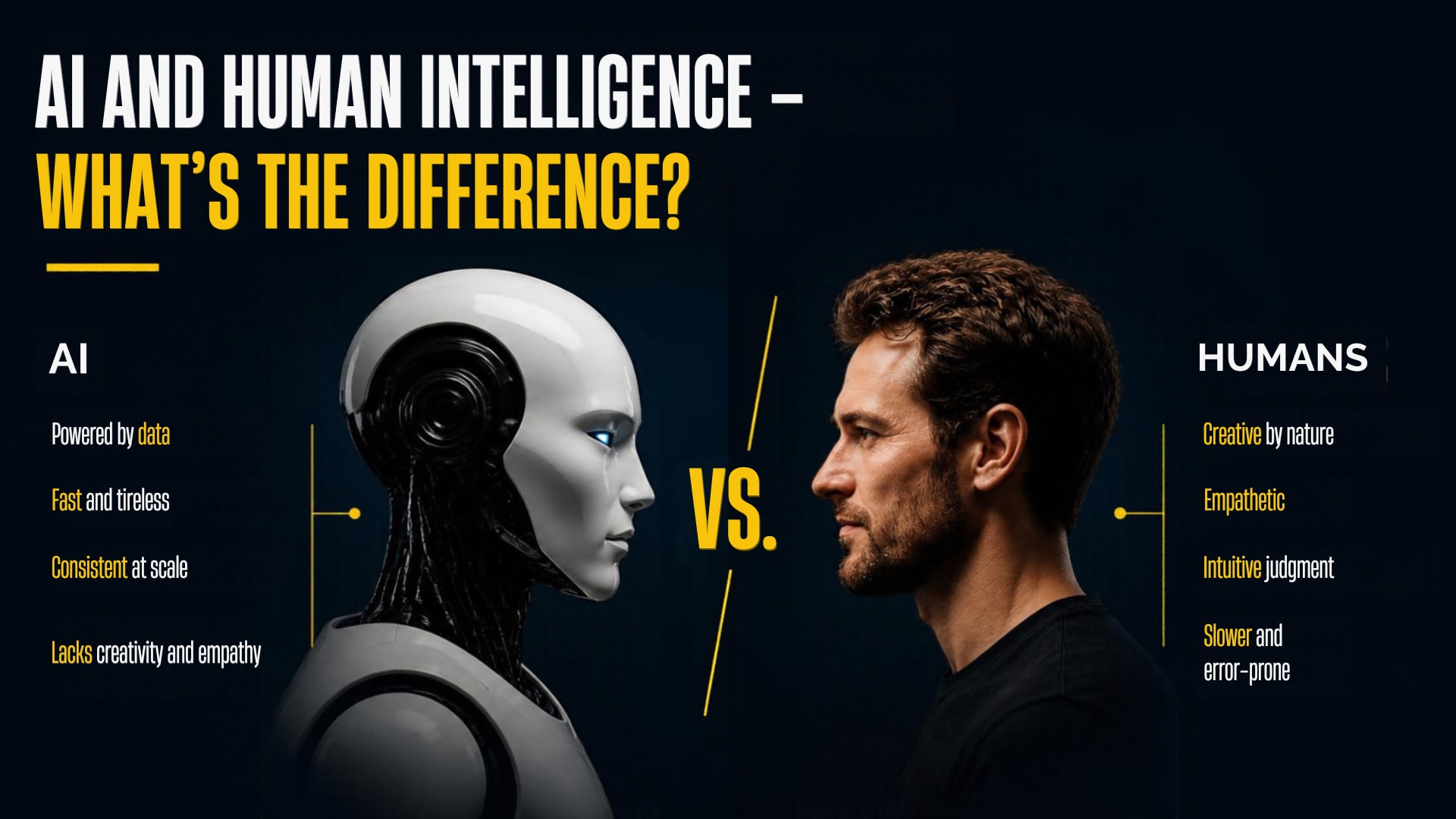
AI vs Human Intelligence: Key Differences
The comparison between artificial intelligence and human intelligence becomes clearer when specific business activities are considered. Neither has a universal advantage across every situation.
Area
Artificial intelligence
Human intelligence
Data processing
Can process large datasets when the system and infrastructure support the task
Can interpret data while considering experience, objectives, and context
Repetitive tasks
Can automate structured, repeatable activities
Can manage exceptions and improve processes
Learning
Depends on training, system design, feedback, and updates
Can learn through experience, observation, education, and reflection
Creativity
Can generate ideas and variations based on learned patterns
Can connect lived experience, original goals, intuition, and imagination
Emotional understanding
Can identify certain emotional signals but may misinterpret them
Can use empathy, social awareness, and relationship history
Decision-making
Can provide predictions and recommendations within defined conditions
Can weigh broader consequences, uncertainty, and competing priorities
Adaptability
Depends on capabilities, data, configuration, and available feedback
Can often adjust behavior in unfamiliar situations using general reasoning
Accountability
Requires clearly defined human and organizational responsibility
People can be assigned responsibility for decisions and actions
Consistency
Can apply configured rules consistently, although system outputs may still vary or contain errors
Can adapt decisions but may be affected by fatigue, bias, and individual differences
This comparison is not a fixed ranking. A well-designed AI system may outperform a person on a particular data-processing task, while an experienced professional may be better equipped to handle a sensitive negotiation. A human analyst may also use AI to examine more evidence before making a decision.
The important question is not simply which one is better. It is which combination produces a reliable, useful, and responsible result for the particular business requirement.
How AI Processes Information Differently From People
AI systems generally operate according to computational methods, learned representations, rules, and statistical relationships. Their outputs are shaped by the information available to them and the design of the system.
Human reasoning can draw on personal experience, general knowledge, physical surroundings, social relationships, and an understanding of what matters in a specific situation. People can also recognize that a question is based on a false assumption and decide that it needs to be reframed.
Consider a retailer preparing for a major seasonal sale.
An AI-supported forecasting system might analyze previous sales, inventory levels, website traffic, and promotional performance. AI vs Human Intelligence , It could suggest which products may experience higher demand.
A human operations manager could then consider additional factors, such as a supplier's recent delivery problems, a local event, a change in customer preferences, or a product launch that has no historical equivalent.
The manager might accept the recommendation, modify it, or request more information.
In this example, AI supports information processing, while human intelligence adds contextual judgment. Both contribute to the quality of the decision.
AI vs Human Creativity: What Makes Them Different?
AI can produce creative-looking outputs, including advertising concepts, illustrations, slogans, product descriptions, and alternative design ideas. It can help professionals explore multiple directions without developing every variation manually.
However, generating a new combination of existing patterns is not identical to human creative experience. People bring personal motivations, cultural understanding, emotional experiences, and an awareness of how an idea may affect a particular audience.
For example, a marketing team developing a campaign for a financial service could use generative AI to draft several headline concepts. The tool may offer different tones, structures, and messages.
A human marketer must still determine which concept is appropriate for the intended audience. The marketer needs to consider trust, cultural sensitivity, regulatory requirements, the brand's identity, and whether the message makes a promise the business can support.
The same principle applies to design and product development. AI can help explore layouts, generate prototypes, or summarize user feedback. Human designers and product teams remain important for understanding user needs, choosing a meaningful direction, and deciding what should actually be built.
AI can expand the range of ideas available to a team, while human creativity helps determine which ideas are meaningful, appropriate, and worth pursuing.
Neither approach guarantees an original or successful result. AI-generated content can be repetitive or inaccurate, while human-created work can also be unoriginal or poorly suited to its audience.
Can AI Think Like a Human?
AI can perform certain tasks associated with reasoning, including comparing alternatives, explaining relationships, solving structured problems, and producing step-by-step responses. However, these capabilities do not establish that AI thinks or experiences the world in the same way as a human being.
A conversational AI system can discuss emotions without having human emotional experiences. It can explain an ethical principle without independently assuming the social responsibilities associated with applying that principle.
This distinction matters when businesses interpret AI outputs.
Suppose a company uses an AI assistant to respond to customers who are unhappy about a delayed order. The system may generate a polite apology and explain the next steps. Yet it may not have complete information about the customer's history, the operational reason for the delay, or the business's authority to offer compensation.
A human employee can examine the circumstances, recognize when the standard response is inadequate, and determine whether escalation is necessary.
AI may simulate aspects of conversation and reasoning, but businesses should assess what a system can reliably do rather than assuming that conversational fluency means human-like understanding.
Learning, Adaptability, and Problem-Solving
Humans and AI systems can both improve their performance, but they do not necessarily learn in the same way.
AI models are trained using data and computational methods. Depending on the system, improvement may require additional training, updated information, configuration changes, or feedback from users and evaluators. Some systems can adapt within a limited workflow, while others remain relatively fixed after deployment.
People can learn from direct experience, informal conversations, observation, and reflection. AI vs Human Intelligence They may also transfer lessons from one situation to a different problem, even when the new situation looks unfamiliar.
Consider a software development team discovering that a feature behaves differently for a particular group of users.
An AI coding assistant may help locate relevant code, suggest possible causes, or generate test cases. Developers can use these suggestions while investigating the underlying problem. They may also need to understand the product architecture, business rules, security implications, and the way the feature interacts with other systems.
The AI tool can accelerate parts of the investigation, but its suggestions require testing and technical judgment.
The same pattern applies to operations, marketing, and customer service. AI can support the search for answers, while people evaluate whether those answers solve the actual problem.
Emotional Intelligence and Human Judgment
Emotional intelligence plays an important role in decisions involving people, relationships, trust, and conflict.
An AI system may classify the tone of a message, detect certain emotional expressions, or suggest an empathetic response. Such capabilities can be useful, but the system may misunderstand sarcasm, cultural differences, personal circumstances, or the significance of an earlier interaction.
A customer who writes a short complaint may be frustrated because of several previous failures. Treating the message as an isolated request could result in a response that is technically correct but emotionally inappropriate.
A human support professional can review the history, acknowledge the customer's concern, explain what can realistically be done, and take responsibility for the next step.
Human judgment also matters in internal business situations. Managers may need to communicate organizational changes, resolve disagreements, support employees facing difficulties, or balance individual needs against business requirements.
AI can assist with preparing documents, organizing feedback, and identifying themes. It should not be assumed to replace the human responsibility involved in sensitive interactions.
Why AI Accuracy Depends on Context
One common misunderstanding in the AI vs human intelligence debate is that AI systems are either accurate or inaccurate as a whole.
In practice, reliability depends on the task, the quality and relevance of the data, the system's design, and the conditions under which it is used.
A classification tool may work well for a clearly defined set of product categories but struggle when presented with unfamiliar products. A language model may summarize a document accurately but invent details when asked to provide information that the document does not contain.
Human professionals also face limitations. A person may misread a report, overlook a critical detail, or make a confident decision based on outdated information.
A reliable business process therefore includes verification. Important outputs can be checked against original documents, calculations can be independently tested, and uncertain recommendations can be reviewed before action is taken.
The appropriate level of checking depends on the consequences of a mistake. A minor formatting error does not require the same review as an error affecting a financial transaction, a hiring decision, or a customer's confidential information.
Understanding these differences creates a stronger foundation for using AI responsibly in the workplace.
Why Do Businesses Need Both AI and Human Intelligence?
Businesses need both AI and human intelligence because technology can support information processing and repetitive workflows, while people provide judgment, accountability, relationship-building, and strategic direction. Combining them can help teams handle routine work more efficiently and devote more attention to complex problems. The benefits depend on choosing appropriate use cases, checking system outputs, and designing workflows that allow people to intervene when necessary.
How Human-AI Collaboration Can Improve Business Productivity
Human-AI collaboration means designing work so that people and AI systems contribute where each is useful. It does not mean introducing AI into every department or automating a task simply because a tool is available.
The starting point should be a clear business problem.
For example, a growing company may spend considerable time preparing weekly performance reports. Employees collect figures from different sources, organize spreadsheets, calculate changes, and write summaries for managers.
An appropriate AI-supported workflow might automate parts of the data preparation and summarization process. Employees could then spend more time checking unusual results, investigating the reasons behind changes, and recommending actions.
The value comes from improving the overall process rather than merely adding another tool.
A well-designed human-AI workflow can support productivity in several ways:
Reduce repetitive manual activities where automation is reliable.
Help employees find and organize relevant information.
Generate initial drafts, summaries, and alternative ideas.
Identify patterns that deserve further investigation.
Support consistent execution of clearly defined procedures.
Give professionals more time for complex work and customer relationships.
Help teams manage increasing workloads when the underlying process is suitable for automation.
These benefits are not automatic. Poorly configured systems may create extra review work, generate errors, or require expensive maintenance. Employees may also need training before they can use new tools effectively.
Before adopting AI, businesses should identify the existing bottleneck, understand its causes, and decide how success will be measured.

Benefits of AI in Business Operations
Business operations often involve repeatable processes, structured information, and routine decisions. These characteristics can make certain activities suitable for AI assistance or conventional automation.
Examples include organizing incoming requests, extracting information from documents, preparing internal summaries, routing support tickets, and identifying unusual patterns in operational data.
However, not every operational problem requires AI. A simple rule-based workflow may be sufficient when the task follows predictable conditions. More advanced AI may be useful when the system needs to interpret natural language or work with information that does not follow a fixed structure.
Consider a company receiving hundreds of customer inquiries through its website and social media channels.
A conversational AI system could classify questions, provide answers from approved information, collect basic details, and route more complicated requests to the appropriate team. Human employees could then focus on complaints, unusual cases, negotiations, and situations requiring personal attention.
The workflow may reduce the amount of manual sorting required, but its actual value depends on the quality of the answers, the volume of requests, the escalation process, and customer expectations.
Businesses should also consider what happens when the system cannot confidently answer a question. An effective workflow should provide a clear route to human assistance rather than leaving customers trapped in repeated automated responses.
AI vs Human Decision-Making in Business
AI can support business decisions by organizing evidence, estimating possible outcomes, and comparing scenarios. Human decision-makers contribute knowledge of business priorities, organizational constraints, ethical considerations, and the consequences of different choices.
The most suitable division of responsibility depends on the significance of the decision.
For routine, low-risk activities, a business may allow a properly tested system to perform certain actions automatically. For higher-impact decisions, AI may be more appropriate as an advisory tool, with an authorized person responsible for reviewing the evidence and approving the outcome.
Imagine an ecommerce business deciding which products need additional inventory.
An AI forecasting tool may estimate demand using historical sales, seasonality, current stock, and available market information. An operations manager can then assess supplier reliability, storage capacity, cash-flow limitations, and the consequences of ordering too much or too little stock.
The system supports the analysis, but the manager evaluates the recommendation in the broader business context.
A practical decision-making process should include three questions:
What evidence supports the recommendation? The team should understand which information was used and whether important data is missing.
What happens if the recommendation is wrong? The potential financial, operational, customer, or legal consequences determine how much review is needed.
Who is responsible for the final action? Accountability should be established before the system is deployed.
This approach avoids treating automated recommendations as instructions that must be followed without question.
AI and Human Collaboration in Marketing
Marketing is a useful example of how AI and human expertise can complement one another.
Marketing teams work with customer research, content creation, search engine optimization, advertising, campaign reporting, and conversion analysis. Some of these activities involve repetitive work or large volumes of information, while others depend heavily on positioning, communication, creativity, and audience understanding.
AI tools can assist with:
Organizing keyword research and identifying related search topics.
Creating initial content outlines and draft variations.
Summarizing customer feedback and campaign reports.
Generating alternative headlines and advertising concepts.
Categorizing marketing inquiries and organizing leads.
Supporting repetitive reporting and workflow tasks.
Human marketers still need to evaluate whether the output matches the audience's needs and the brand's objectives.
For example, an AI tool may generate ten blog titles around a business software topic. A marketer can compare them against search intent, the company's expertise, the competition, and the questions potential customers are asking.
The marketer must also ensure that the resulting article contains accurate information and does not make unsupported product claims.
Search engine optimization requires similar judgment. AI can help organize keyword ideas and identify potential content gaps, but a human SEO professional must assess whether the proposed content is genuinely useful, technically feasible, and relevant to the website's audience.
The same applies to paid advertising. AI may help generate copy variations or analyze campaign data, but campaign strategy still requires decisions about targeting, budgets, offers, landing pages, and acceptable business risk.
For companies exploring AI-supported marketing and digital growth, Amzsoft Innovexa offers services across SEO, GEO/AEO, PPC, social media, content, branding, and conversion rate optimization. Its official website provides further information about its capabilities.
The broader lesson is that AI can assist with marketing execution, but human understanding remains important for deciding what a business should communicate and why.
AI in Customer Support and Customer Experience
Customer support requires a balance between speed, consistency, and understanding.
Some customer requests are straightforward. Customers may ask about business hours, delivery procedures, product features, or account setup. A properly configured AI assistant can answer these questions using approved information.
Other requests require a more careful approach. A customer may be dealing with a billing dispute, a failed transaction, repeated service problems, or an urgent issue. These situations may require investigation, discretion, or authorization that an automated system does not have.
A human-AI support workflow can divide responsibilities according to the nature of the request.
AI handles initial assistance
Classifies inquiries, answers supported FAQs, collects relevant information, and routes requests.
People handle complex situations
Investigate exceptions, resolve sensitive complaints, exercise judgment, and approve appropriate actions.
Both contribute to improvement
Teams review recurring issues, improve approved answers, and refine escalation rules.
This arrangement can help businesses handle routine inquiries while preserving access to human support.
The quality of the experience depends on several details: whether the AI has current information, whether it clearly identifies its limitations, how quickly requests reach employees, and whether employees receive enough context to continue the conversation.
For businesses that receive inquiries across several channels, Amzsoft Innovexa's AI automation services describe conversational automation involving website chat, WhatsApp, Instagram, Facebook, lead capture, and human handoff.
Businesses evaluating these capabilities should determine which interactions can safely be automated and which should remain under direct human control.
AI in Software Development and Technology Teams
AI-assisted software development can help programmers explore solutions, generate code drafts, explain unfamiliar functions, prepare documentation, and identify potential defects.
These capabilities can be useful during development, but generated code still needs careful evaluation. Code that looks correct may contain security weaknesses, incorrect assumptions, performance problems, or incompatibilities with the existing application.
Human developers contribute architectural understanding, technical judgment, and responsibility for the behavior of the complete product.
For example, a startup may need to add a reporting feature to its internal software. An AI coding assistant could help generate a first version of the data-processing function and suggest possible tests.
Developers would still need to verify the calculations, check access permissions, evaluate performance, and confirm that the feature follows the application's existing design.
They must also consider how the new feature affects users and other parts of the system.
A similar distinction applies to debugging. AI can suggest likely causes of an error, but developers must test those explanations against actual system behavior. Applying a suggested fix without understanding the problem may introduce new defects.
AI should therefore be treated as a development aid rather than a substitute for software engineering discipline.
Businesses planning new applications or modernizing existing platforms can review Amzsoft Innovexa's software and technology services, including custom software, web platforms, cloud and DevOps, and AI automation. The appropriate service depends on the project's requirements rather than on AI adoption alone.
AI in Recruitment and Human Resources
Recruitment involves administrative work as well as decisions that affect people's livelihoods. This makes it particularly important to distinguish assistance from authority.
AI may help organize applications, schedule interviews, prepare job descriptions, or summarize information provided by candidates. These tasks can reduce administrative effort when implemented carefully.
However, automated systems can also reproduce patterns of bias found in historical data or apply criteria that disadvantage certain candidates. An apparently neutral ranking may not reflect the actual requirements of the role.
Human review is therefore essential when AI contributes to employment-related decisions.
Recruiters and hiring managers should verify the relevance of evaluation criteria, protect candidate information, check for unfair outcomes, and maintain a transparent decision-making process. High-impact decisions should not rely solely on an automated score without appropriate evaluation and safeguards.
For example, an AI system might help a recruiter organize applications by stated experience and qualifications. A hiring manager must still assess the criteria's relevance, consider candidates fairly, and make the hiring decision through an appropriate process.
The same principle applies to performance management, employee evaluation, and workplace monitoring. Convenience should not override privacy, fairness, or accountability.
AI in Financial Planning and Business Forecasting
Financial planning requires careful handling of assumptions, uncertainty, and consequences.
AI-supported systems may help organize financial records, compare scenarios, identify unusual transactions, or estimate future demand and cash flow. These capabilities can support analysts and business managers, but forecasts should not be treated as guaranteed outcomes.
Suppose a small business is deciding whether to open a second location. An analytical tool might help compare expected sales, costs, seasonal patterns, and alternative scenarios.
A human decision-maker must also evaluate the reliability of the assumptions, local market conditions, available capital, staffing requirements, and the consequences of an unsuccessful expansion.
Financial decisions can have significant effects on employees, customers, investors, and the continued operation of a company. Human oversight is especially important when recommendations involve substantial financial commitments or regulatory obligations.
Businesses should preserve clear records of important assumptions, review the underlying evidence, and test how recommendations change under different conditions.
AI for Small Businesses, Startups, and Growing Companies
Small businesses do not need to build sophisticated AI systems to benefit from the technology. A practical starting point is to identify repetitive work that consumes time without requiring complex human judgment.
For example, a small ecommerce business may use AI to draft product descriptions, organize customer inquiries, summarize sales information, or prepare a first version of an email campaign.
A professional services firm may use it to summarize meeting notes, categorize incoming requests, or create an initial outline for a client proposal.
A startup might use AI-assisted coding tools to explore a prototype before committing to a larger development project.
Each example requires human review appropriate to the task. Product descriptions must be accurate, confidential meeting information must be handled appropriately, and generated code must be tested before deployment.
Smaller organizations should also consider the ongoing cost of subscriptions, integrations, training, monitoring, and employee time spent reviewing outputs.
The most useful solution is not necessarily the most advanced one. A simple tool that solves a genuine problem may deliver more practical value than a complex platform that introduces unnecessary work.
Real-World Challenges of Combining AI and Human Intelligence
Although human-AI collaboration can be valuable, businesses should not assume that combining the two automatically improves results.
Several challenges deserve attention.
Incorrect AI outputs: Systems can generate inaccurate information or misleading recommendations. Review procedures should match the risk of the task.
Automation bias: Employees may trust an automated recommendation because it appears confident or technically sophisticated. Teams should be encouraged to question outputs and examine the evidence.
Overdependence on tools: If employees stop developing their own expertise, they may become less capable of recognizing errors or handling situations outside the automated workflow.
Integration difficulties: AI systems may not work smoothly with existing software, data sources, or internal procedures. Poor integration can create duplicate work and inconsistent records.
Privacy and security: Sensitive customer, employee, financial, or business information may be exposed if tools are selected or configured without adequate safeguards.
Unclear accountability: Problems can arise when employees, managers, vendors, and system owners have not agreed on who is responsible for reviewing outputs and approving actions.
Implementation costs: Licensing, development, infrastructure, maintenance, and training can reduce the value of a solution if the business problem is poorly defined.
A successful implementation addresses these challenges before they become operational problems. Organizations should test systems, define responsibilities, train employees, and establish processes for reporting and correcting mistakes.
Why Human Oversight Remains Essential
Human oversight means that people have an appropriate role in evaluating, supervising, or intervening in an AI-supported process. The amount of oversight should reflect the system's purpose and the potential consequences of failure.
For low-risk tasks, a business might periodically sample outputs and monitor performance. For sensitive customer interactions, financial decisions, recruitment, or other high-impact activities, stronger controls may be necessary.
Oversight can include:
Reviewing outputs against approved information.
Testing system performance using representative examples.
Escalating uncertain or unusual situations.
Limiting the actions an automated system can perform.
Maintaining records of important decisions.
Monitoring errors, complaints, and unexpected behavior.
Providing a clear route for human intervention.
Updating procedures when business conditions change.
Human oversight should be meaningful rather than symbolic. An employee who must approve hundreds of complex recommendations in a few minutes may not have a realistic opportunity to assess them.
Businesses should design workflows that give reviewers enough information, time, authority, and training to make informed decisions.
The NIST AI Risk Management Framework offers guidance for organizations seeking to manage AI risks and incorporate trustworthiness into the design, evaluation, and use of AI systems. Its approach emphasizes that appropriate risk management depends on the context in which a system operates.
This is particularly relevant to companies that want the benefits of AI while maintaining reliability, security, fairness, and accountability.
How Can Businesses Build an Effective Human-AI Collaboration Strategy?
Businesses can build an effective human-AI collaboration strategy by starting with a clearly defined problem, selecting an appropriate solution, assigning responsibilities, and measuring results. They should introduce automation gradually, protect sensitive information, train employees, and establish human review wherever errors could have significant consequences. The objective is to improve business processes responsibly, not to adopt AI simply because it is available.
Step 1: Identify Business Problems Before Selecting AI Tools
The first step is to understand what the organization actually needs to improve.
Businesses sometimes begin by selecting an AI tool and then searching for tasks that could use it. This approach can lead to unnecessary subscriptions, complicated workflows, and disappointing results.
A more practical approach begins with an examination of current operations.
Managers should identify activities that consume significant employee time, create repeated errors, delay customer responses, or require employees to process large amounts of information manually.
For example, a company may discover that its sales team spends several hours each week transferring information from incoming inquiries into a customer relationship management system. The actual problem is repetitive data entry, not a general lack of artificial intelligence.
A suitable automation workflow might extract approved information from inquiries and prepare records for review. The sales team can then spend more time understanding customer needs and developing relationships.
Before proceeding, the company should document:
The process that needs improvement.
The people currently responsible for the work.
The main source of delays or errors.
The information required to complete the task.
The consequences of an incorrect result.
The expected improvement and how it will be measured.
This assessment helps determine whether AI is appropriate or whether a simpler process improvement would be more effective.
Step 2: Decide Which Tasks Should Be Automated
Not every task should be automated to the same degree. Businesses should consider the structure of the task, the quality of available information, and the potential impact of mistakes.
A useful starting point is to divide activities into three groups.
Suitable for routine automation
Examples include formatting standard reports, sorting requests, extracting defined fields, and routing inquiries under established rules.
Suitable for AI assistance with review
Examples include preparing content drafts, summarizing documents, suggesting code, analyzing customer feedback, and supporting forecasting.
Requires careful human control
Examples include sensitive employment decisions, complex financial approvals, significant legal judgments, and serious customer complaints.
These categories are starting points, not universal rules. A routine task can become high-risk if it involves confidential information or affects an important customer decision.
For instance, extracting invoice details may be suitable for automation, but approving a large payment based on those details requires stronger verification and authorization.
Businesses should also distinguish AI from conventional automation. A fixed workflow that transfers information between systems may not require a generative AI model. Selecting the simplest reliable method can reduce implementation complexity.
Step 3: Evaluate AI Tools Carefully
Once a business problem has been defined, the next step is to compare possible solutions.
A tool should be assessed according to its capabilities, limitations, security requirements, integration options, cost, and suitability for the intended users.
Important evaluation questions include:
Does the tool support the actual task?
Can its outputs be checked against reliable information?
What data does it receive, process, and retain?
Does it integrate with the existing business software?
Can access be restricted according to employee responsibilities?
What happens when the tool fails or produces an uncertain answer?
What training and technical support will be required?
How will the organization monitor ongoing performance?
A demonstration is not enough to establish that a system will work reliably in a real business environment. Companies should test tools with representative examples, including unusual situations and likely failure cases.
For example, a business evaluating an AI customer support assistant should test ordinary questions, ambiguous requests, outdated information, and complaints that require a human employee.
The evaluation should also examine whether the system correctly identifies when it cannot provide a suitable answer.
Organizations should avoid selecting tools based only on the number of features or the popularity of a provider. The right choice depends on the specific business need.
Step 4: Build the Workflow Around People and Technology
Effective AI implementation requires more than installing software. The surrounding workflow determines how information moves between systems, employees, and customers.
Consider a business that wants to automate incoming sales inquiries.
A practical workflow could follow these stages:
An inquiry arrives through an approved communication channel.
An AI system classifies the request and extracts relevant information.
The system prepares a suggested response or routes the inquiry to the appropriate team.
A human employee reviews requests that require judgment or authorization.
The approved action is recorded in the relevant business system.
Managers monitor performance and correct recurring problems.
The organization should define what the AI system can do independently and which actions require approval.
It should also establish fallback procedures. If the system is unavailable, produces unreliable results, or encounters an unfamiliar situation, employees need a clear way to continue the process.
This is particularly important when AI connects with customer records, financial systems, business applications, or communication channels. Automated actions should be limited to the permissions necessary for the task.
A carefully designed workflow can make collaboration more dependable while reducing the risk of employees having to repair avoidable mistakes.
Step 5: Protect Data Privacy and Information Security
AI implementation often involves information that businesses have a responsibility to protect.
This may include customer contact details, employee records, financial information, confidential documents, source code, or internal strategy materials.
Before employees enter information into an AI tool, the organization should understand the provider's data-handling practices and the terms governing the use of that information.
Key safeguards include:
Establishing clear rules about which information can be shared with each tool.
Using approved business accounts and access controls.
Restricting access to confidential records.
Reviewing retention, deletion, and data-processing policies.
Protecting systems through appropriate security measures.
Checking vendor requirements and relevant legal obligations.
Training employees to recognize privacy and security risks.
Maintaining a process for reporting suspected incidents.
Businesses should not assume that every AI tool handles information in the same way. Privacy controls, retention practices, access permissions, and available security features vary between products and configurations.
Organizations operating across India, the United States, the UAE, or other markets should assess the laws and contractual requirements relevant to their activities and the data they process.
Security also matters when AI systems can take actions rather than simply produce text. Access should be limited, important actions should be logged where appropriate, and sensitive operations should have suitable authorization controls.
The goal is to make AI useful without exposing business information to unnecessary risk.
Step 6: Train Employees to Work Effectively With AI
Employee training is a central part of successful AI adoption.
Even a capable tool may produce disappointing results if employees do not understand how to use it, verify its outputs, or recognize its limitations.
Training should explain the purpose of the tool, the tasks it supports, the information it may access, and the responsibilities that remain with employees.
For example, marketing employees may learn how to use AI for initial research and content drafts while checking factual claims, brand guidelines, and source material before publication.
Developers may learn to use coding assistants while reviewing generated code, testing changes, and protecting confidential information.
Customer support employees may learn how to review suggested responses, recognize sensitive situations, and transfer conversations to the appropriate person.
Training should also help employees understand that an AI-generated answer is not automatically correct merely because it sounds confident.
A practical training program can include:
Demonstrations using real business workflows.
Exercises involving incorrect or incomplete outputs.
Guidance on privacy and approved tool usage.
Clear escalation and approval procedures.
Opportunities for employees to share feedback.
Periodic updates as systems and processes change.
Businesses should also explain how AI adoption will affect responsibilities and work practices. Employees who understand the purpose of a change are better positioned to identify useful applications and report problems.
Step 7: Measure Results and Improve the System
AI implementation should be evaluated using business outcomes rather than assumptions about what the technology can achieve.
Before introducing a tool, businesses should establish a baseline. This might include the time required to complete a task, the number of errors, the average response time, or the amount of manual work involved.
After implementation, the same measures can help determine whether the change has produced a meaningful improvement.
Useful measures may include:
Time saved: How much employee time is required to complete the task before and after implementation?
Output quality: Are the results accurate, complete, and suitable for their intended use?
Error rate: How frequently does the system generate mistakes or require correction?
Customer experience: Are customers receiving helpful responses and appropriate support?
Employee experience: Does the workflow reduce unnecessary work or introduce additional burdens?
Total cost: Do licensing, integration, training, maintenance, and review costs justify the benefits?
Risk and compliance: Are privacy controls, approval requirements, and relevant procedures being followed?
The measures should reflect the purpose of the system. A customer support assistant should not be evaluated only by how many messages it handles. The quality of its responses and the number of unresolved problems also matter.
Similarly, a content generation tool should not be judged only by how quickly it creates drafts. Accuracy, originality, editorial quality, and usefulness to readers remain important.
If a system performs poorly, the organization should investigate the cause. The solution may involve improving source data, adjusting instructions, changing the workflow, providing additional training, or discontinuing the tool.
Step 8: Establish Responsible AI Governance
AI governance refers to the policies, responsibilities, and controls an organization uses to manage AI throughout its lifecycle.
It helps businesses establish consistent expectations for selecting, developing, deploying, monitoring, and updating AI systems.
A governance process does not need to be unnecessarily complicated. Smaller organizations can begin with a written policy and clearly assigned responsibilities, then introduce stronger controls as their use of AI expands.
A practical framework should address the following areas.
Ownership: Assign responsibility for each AI-supported process, including who approves important changes and who responds to failures.
Risk assessment: Evaluate possible harms before introducing a system and revisit the assessment when its purpose or operating conditions change.
Transparency: Ensure employees understand when AI is being used and when its outputs require review. Disclose AI involvement to customers where appropriate.
Fairness: Check whether automated decisions or recommendations create unfair outcomes for particular groups.
Security and privacy: Apply suitable controls to information, access, storage, and automated actions.
Monitoring: Review performance, complaints, errors, and changes in operating conditions.
Incident response: Establish procedures for pausing an automated process, investigating problems, correcting errors, and informing the appropriate stakeholders.
The NIST AI Risk Management Framework is a useful reference for this work. It organizes risk management around activities for governing, mapping, measuring, and managing AI risks.
Organizations can adapt the guidance to their size, sector, and use cases rather than treating AI governance as a one-size-fits-all checklist.
Step 9: Start With a Pilot Project
Businesses can reduce implementation uncertainty by testing AI in a limited, well-defined workflow before expanding its use.
A pilot project allows the team to evaluate performance, gather employee feedback, identify integration problems, and estimate ongoing costs without immediately changing an entire department.
For example, a business could begin by using AI to categorize internal support requests. The team could compare the results against human classifications and measure how often the system makes errors.
If the pilot performs well under realistic conditions, the organization can consider expanding its use. If it performs poorly, the team can adjust the approach or select a different solution.
A useful pilot should have:
A specific problem and clearly defined scope.
A baseline for measuring existing performance.
Defined success criteria and acceptable error levels.
Representative test data.
Assigned owners and reviewers.
Appropriate privacy and security controls.
A documented decision about whether to expand, modify, or stop the project.
Starting small also helps employees build confidence through practical experience. It allows the business to learn which activities benefit from automation and which still depend heavily on human expertise.
The Role of Technology Partners in Human-AI Collaboration
Some businesses have the internal expertise to evaluate and implement AI independently. Others may need help with software development, integrations, workflow design, infrastructure, or technical planning.
A technology partner can help an organization translate business requirements into a practical implementation plan, provided that the scope, responsibilities, and expected deliverables are clearly defined.
Relevant support may include:
Assessing existing business processes and technical requirements.
Developing custom software for specific operational needs.
Integrating applications and business data.
Implementing suitable AI-assisted workflows.
Designing customer-facing digital experiences.
Evaluating cloud infrastructure and operational requirements.
Testing systems and planning ongoing maintenance.
The choice of partner should depend on the project's complexity, internal capabilities, security needs, and long-term support requirements.
Businesses should ask potential partners about their implementation approach, testing procedures, data-handling practices, integration experience, documentation, and arrangements for maintenance. They should also confirm which features are included in the proposed scope rather than assuming that every AI capability is available.
For organizations exploring these requirements, Amzsoft Innovexa provides information about software development, AI automation, cloud and DevOps, fintech platforms, and digital marketing services. Its AI automation hub is particularly relevant to businesses evaluating conversational workflows and human handoff.
The appropriate implementation will depend on the organization's objectives and the capabilities that can be verified for the selected solution.
The Future of AI and Human Intelligence
The future of AI and human intelligence is likely to involve changing combinations of automation, analytical assistance, and human decision-making. However, the exact impact will differ across industries, organizations, occupations, and individual tasks.
Some responsibilities may become more automated, while other roles may change as employees begin using AI to support their work. New requirements may also emerge around evaluating outputs, managing systems, protecting data, and coordinating automated workflows.
Businesses should avoid assuming that every job will disappear or that every employee will benefit equally from AI adoption. Outcomes will depend on the technology, the way organizations implement it, the needs of customers, and the skills available within the workforce.
Human skills such as critical thinking, communication, adaptability, ethical reasoning, and problem-solving remain valuable because they help people evaluate information and respond to situations that do not fit established procedures.
Technical skills are also important. Employees who understand how to use AI tools appropriately, check their limitations, and connect them with existing workflows may be better prepared for changing work requirements.
Organizations can support this transition through continuous learning, transparent communication, and opportunities for employees to participate in improving processes.
The central principle remains straightforward: AI can change how work is performed, but businesses still need to decide what work matters, what outcomes are acceptable, and how technology should serve their broader objectives.
Conclusion: Why Businesses Should Combine AI With Human Expertise
The comparison of AI vs Human Intelligence is most useful when it moves beyond the idea of choosing a winner.
AI can help businesses process information, generate content, identify patterns, and automate suitable tasks. Human intelligence contributes contextual understanding, creativity, empathy, strategic judgment, and responsibility for decisions.
Both have limitations. AI can produce incorrect outputs or struggle with unfamiliar circumstances, while people can make mistakes, overlook evidence, and become overwhelmed by repetitive work. The answer is not to trust one blindly, but to design processes that use each appropriately.
Businesses should start with a genuine operational need, select tools carefully, protect information, train employees, and measure results. Human oversight should be built into workflows wherever decisions require judgment or mistakes could have serious consequences.
Organizations that take this balanced approach can explore the benefits of AI without losing sight of quality, accountability, customer trust, and employee expertise.
For businesses considering their next steps, technology should support a clear business strategy rather than replace it. By combining appropriate AI capabilities with human knowledge and responsible implementation, organizations can build workflows that are more useful, adaptable, and aligned with long-term business goals.
Frequently Asked Questions
1. What is the main difference between AI and human intelligence?
AI uses computational methods and learned patterns to perform tasks such as analyzing information, generating content, and making predictions. Human intelligence combines reasoning, experience, emotional awareness, and contextual understanding. AI can be valuable for defined tasks, while people contribute broader judgment and accountability. Their effectiveness depends on the problem and the circumstances.
2. Can AI completely replace human intelligence?
AI can automate some tasks previously performed by people, but it cannot be assumed to replace every aspect of human intelligence. Businesses still need people to evaluate complex situations, establish priorities, manage relationships, and take responsibility for important decisions. The impact of AI depends on the occupation, the tasks involved, and how the technology is implemented.
3. Is AI more accurate than humans?
AI can be more accurate than people on particular tasks when it is appropriately designed, trained, and evaluated. However, performance varies with data quality, task complexity, and operating conditions. Humans also make mistakes. Businesses should compare actual performance and use verification procedures that reflect the consequences of incorrect results.
4. Can artificial intelligence think like a human?
AI can perform certain reasoning-related tasks and generate responses that resemble human communication. However, these abilities do not establish that AI experiences emotions, understands situations exactly as people do, or assumes human responsibilities. Businesses should evaluate AI according to its demonstrated capabilities rather than treating fluent responses as proof of human-like understanding.
5. Why do businesses need both AI and human intelligence?
Businesses need both because AI can support data processing, repetitive tasks, and information analysis, while people provide strategic judgment, empathy, contextual understanding, and accountability. Combining these capabilities can help employees focus on more complex responsibilities. The benefits depend on choosing appropriate tasks and maintaining effective supervision.
6. Which business tasks are best suited to AI?
AI may be useful for preparing document summaries, classifying inquiries, generating content drafts, analyzing data, assisting with software development, and supporting routine customer interactions. Suitability depends on the quality of the available information, the reliability of the system, and the consequences of errors. Sensitive or high-impact decisions generally require stronger human oversight.
7. What are the biggest risks of relying on AI?
Important risks include incorrect outputs, biased results, data privacy concerns, security vulnerabilities, excessive reliance on automated recommendations, and unclear accountability. Integration costs and employee training requirements can also affect the value of an AI project. Businesses should assess these risks before implementation and establish monitoring, review, and incident-response procedures.
8. How can companies maintain human oversight of AI systems?
Companies can define which actions AI may perform independently and which require approval. They should provide employees with access to supporting information, establish escalation procedures, monitor errors, and document responsibility for important decisions. Oversight should be proportionate to the potential consequences of failure and provide reviewers with sufficient time and authority to intervene.
9. How can small businesses start using AI responsibly?
Small businesses can begin with one repetitive, low-risk task, such as organizing inquiries or preparing initial content drafts. They should select an appropriate tool, avoid sharing sensitive information without suitable safeguards, review outputs, and measure results against existing performance. Expanding gradually allows the business to identify practical benefits and limitations before making a larger investment.
10. What skills will remain valuable as AI adoption grows?
Critical thinking, communication, emotional intelligence, creativity, ethical reasoning, adaptability, and problem-solving remain valuable because they help people evaluate information and navigate complex situations. Technical literacy is also important, including the ability to use AI tools, verify their outputs, understand limitations, and integrate technology into business workflows responsibly.
Tags
Amzsoft Innovexa
Engineering and delivery notes from the Amzsoft Innovexa team — fintech platforms, AI automation, and product engineering.