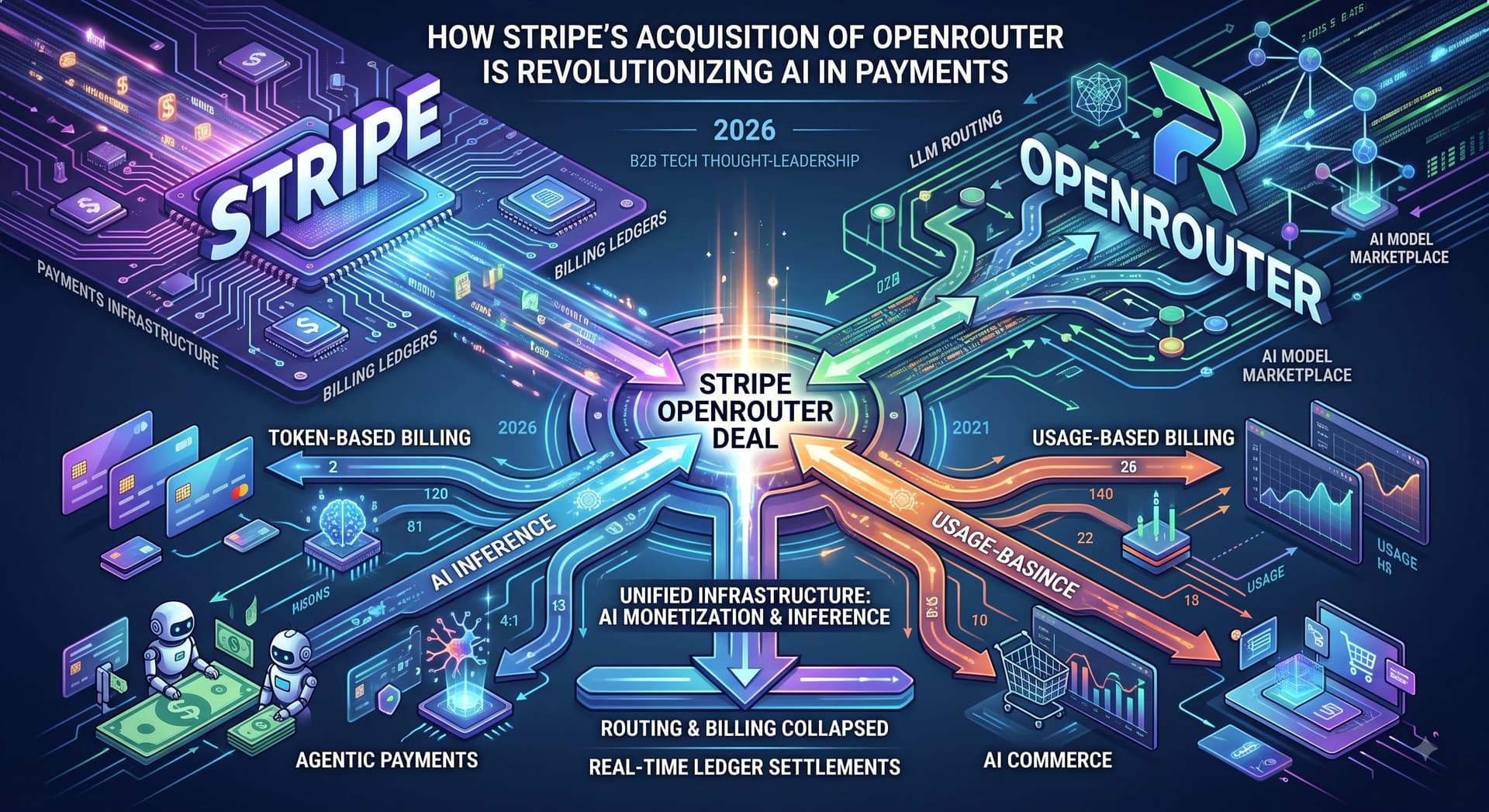
How Stripe's Acquisition of OpenRouter is Revolutionizing AI in Payments
The Stripe acquisition of OpenRouter fundamentally merges global financial settlement with dynamic model routing. By integrating token-based billing directly into the LLM gateway, this $7 billion deal eliminates latency in AI monetization. We explore how this transforms infrastructure for developers building the next generation of AI commerce applications.
The year 2026 marks a paradigm shift in how development teams manage AI inference. Historically, developers were forced to route requests through isolated AI model providers while manually handling complex payment logic in siloed databases. Stripe AI payments bridge this gap, enabling real-time monetization for autonomous workflows. We will examine the technical architecture making agentic payments possible, dissecting the infrastructure stack, compliance protocols, and strategic deployment patterns that drive this modern ecosystem.
The Architecture Behind the Stripe OpenRouter Acquisition
The technical foundation of the Stripe OpenRouter deal relies on coupling dynamic model routing with instant ledger settlements. This architecture processes millions of requests, calculates token consumption, and triggers micro-transactions concurrently. Developers gain a unified API to handle both computational failover and usage-based billing without latency penalties.
Operating an LLM gateway involves managing extreme variance in payload sizes, response times, and connection stability. Before this consolidation, developers had to build custom middleware to intercept prompts, log metadata, query an external billing service, and subsequently forward the payload to the language model. This multi-hop network topography introduced severe latency and created numerous points of failure. The Stripe OpenRouter acquisition resolves this by collapsing the routing and billing layers into 1 highly optimized edge service, serving over 8 million developers and processing 100 trillion tokens monthly.
We see this architectural shift as the death of fragmented AI infrastructure. By centralizing authentication, usage tracking, and financial reconciliation within a single control plane, development teams can deploy scalable products faster. The platform abstracts away the complexity of managing 400 unique APIs, allowing developers to focus purely on application logic rather than maintaining brittle backend integrations.
Unifying the LLM Gateway with Payment Rails
Merging an LLM gateway with payment rails allows systems to authenticate, route, and bill a prompt in 1 synchronized network hop. This integration deprecates middleware previously required to map AI inference metrics to user accounts, vastly reducing points of failure in complex AI payment infrastructure architectures.
At the protocol level, unifying these systems requires a high-performance proxy server capable of deep packet inspection. When a client application submits a prompt, the unified gateway validates the user's cryptographic API key and checks their associated financial balance in real time. If the balance is sufficient, the gateway forwards the request to the optimal AI model provider. Once the model generates the completion, the proxy parses the HTTP response headers to extract the exact token usage metrics.
These metrics are immediately pushed to the internal billing ledger via asynchronous gRPC streams, ensuring that the critical path of returning the response to the user is never blocked. We rely on this asynchronous reconciliation to maintain sub-100 millisecond overhead. By native integration of Stripe AI infrastructure into the routing layer, developers avoid the dreaded "double spend" problem where a user depletes their compute quota but continues to consume resources due to synchronization delays between the AI cluster and the financial database.
Overcoming AI Inference Cost Constraints
Dynamic AI model routing minimizes overhead by calculating the optimal ratio of cost to computational capability per query. By shifting lower-complexity tasks to cheaper models automatically, development teams can reduce inference costs by up to 60 percent while maintaining high throughput for enterprise-scale AI commerce applications.
Managing inference costs remains the largest operational hurdle for AI startups. High-parameter networks from top-tier AI model providers deliver exceptional reasoning capabilities, but they are financially unsustainable for basic tasks like text formatting or data extraction. OpenRouter's intelligent routing engine analyzes the semantic complexity of the incoming prompt and dynamically assigns it to the most cost-efficient model capable of fulfilling the request accurately.
We utilize this capability to implement cascading fallback strategies. If a premium model fails due to a rate limit, the system automatically redirects the payload to a comparable open-source alternative. The Stripe AI payments backend instantly adjusts the billing rate to match the cheaper model, guaranteeing that the end-user is never overcharged for a degraded service. This seamless interplay between technical failover and financial adjustment represents the pinnacle of modern AI billing mechanics.
Token-Based Billing and Dynamic Pricing Models
Token-based billing translates neural network computational units directly into fractional financial transactions. This requires a high-throughput, low-latency database architecture capable of reconciling input and output tokens instantly. The result is a precise usage-based billing framework that charges users exactly for their programmatic resource consumption.
Implementing dynamic pricing in an AI model marketplace requires an architecture that can process micro-transactions at massive scale. A single API request might consume 15 input tokens and 42 output tokens, equating to a financial value of 0.00034 dollars. Traditional payment processors are not designed to handle ledgers with this level of fractional precision or transaction volume. The Stripe acquisition of OpenRouter solves this by aggregating these micro-transactions in memory using distributed caching layers.
We configure our infrastructure to batch these micro-transactions locally before flushing them to the primary Stripe ledger every 5 minutes. This batching mechanism drastically reduces database write contention. Furthermore, this system allows development teams to create sophisticated pricing tiers, such as offering a free quota of 10,000 tokens per day, applying volume discounts, or implementing custom markup logic to generate profit margins on top of the base LLM routing costs.
Evolving AI Payment Infrastructure for Agentic Workflows
Agentic payments require infrastructure where autonomous systems can negotiate, authorize, and execute transactions without human intervention. The Stripe OpenRouter acquisition provides the foundational layer for this reality, allowing AI agents to evaluate API costs, budget resources, and trigger micropayments securely across decentralized networks.
As applications transition from interactive chat interfaces to autonomous background tasks, the underlying payment architecture must evolve. AI agents are designed to execute complex, multi-step workflows that often require interfacing with external APIs, purchasing proprietary datasets, or commissioning compute time from specialized hardware. The traditional model of human-in-the-loop credit card authorization breaks down completely in this paradigm.
We are building systems where financial identities are assigned directly to algorithms. The integration of Stripe's ledger capabilities with OpenRouter's execution environment creates the perfect ecosystem for agentic payments. This infrastructure allows a central governing application to spin up 50 independent agents, allocate a strict budget of 20 dollars to each, and release them to accomplish their tasks knowing that the financial guardrails are enforced at the network level.
Enabling Autonomous Payments for AI Agents
Autonomous payments utilize programmatic wallets embedded within AI agents to authorize micro-transactions based on predefined cryptographic budgets. Developers configure these guardrails to ensure agents can purchase external data or API compute time independently, driving a new layer of machine-to-machine AI commerce.
To facilitate autonomous payments securely, we deploy ephemeral API tokens tied to strict financial limits. When an AI agent is instantiated, the system generates a unique JSON Web Token (JWT) containing the agent's identity and its maximum allowable spend. As the agent navigates the AI model marketplace to solve its assigned problem, the LLM gateway intercepts every request, verifying the cryptographic signature and decrementing the agent's available balance.
This deterministic budget enforcement prevents runaway execution loops where a malfunctioning agent could theoretically drain a corporate bank account in minutes. If an agent attempts an action that exceeds its remaining budget, the gateway returns an HTTP 402 Payment Required status code. The agent can then be programmed to catch this exception, halt execution, and request a budget top-up from its human supervisor, maintaining a perfect balance between autonomy and financial control.
Real-Time Routing Across AI Model Providers
Intelligent model selection continuously polls AI model providers for latency, error rates, and pricing updates. If a primary model degrades, the system instantly reroutes the payload to a comparable alternative. This robust AI model routing guarantees uptime and shields users from underlying infrastructure outages.
In a decentralized AI ecosystem, vendor reliability fluctuates wildly. A provider might experience a catastrophic outage, push a model weight update that degrades performance, or arbitrarily spike their API pricing. Hardcoding integrations to a single vendor is a massive operational risk. The LLM routing layer mitigates this by maintaining active health checks against hundreds of endpoints simultaneously, ensuring traffic only flows to healthy, performant nodes.
We configure our routing policies using declarative configuration files. Developers define fallback arrays, prioritizing models based on maximum acceptable latency or maximum cost per 1,000 tokens. When a request is dispatched, the gateway evaluates these rules in real time against the live polling data. This continuous optimization ensures that AI monetization strategies remain profitable even when upstream vendors alter their pricing models unexpectedly.
Building a Native AI Model Marketplace
A centralized AI model marketplace allows developers to consume APIs from hundreds of vendors through 1 unified integration. Instead of managing 20 different vendor contracts and billing portals, teams operate within a single ecosystem that handles compliance, access provisioning, and financial reconciliation automatically.
The administrative burden of operating a multi-model application was historically staggering. Development teams had to manage separate API keys, negotiate distinct service level agreements, and reconcile complex invoices from OpenAI, Anthropic, Google, and dozens of smaller open-source hosting providers. The Stripe OpenRouter deal consolidates this fragmentation, providing a single vendor relationship that proxies access to the entire AI ecosystem.
We leverage this marketplace to streamline the development lifecycle. New models can be integrated into production applications simply by changing a single string in the API request payload. Because Stripe handles the backend financial settlement with the individual AI model providers, developers never have to worry about establishing new payment relationships. This frictionless access accelerates innovation and allows teams to prototype with the newest foundational models the moment they are released.
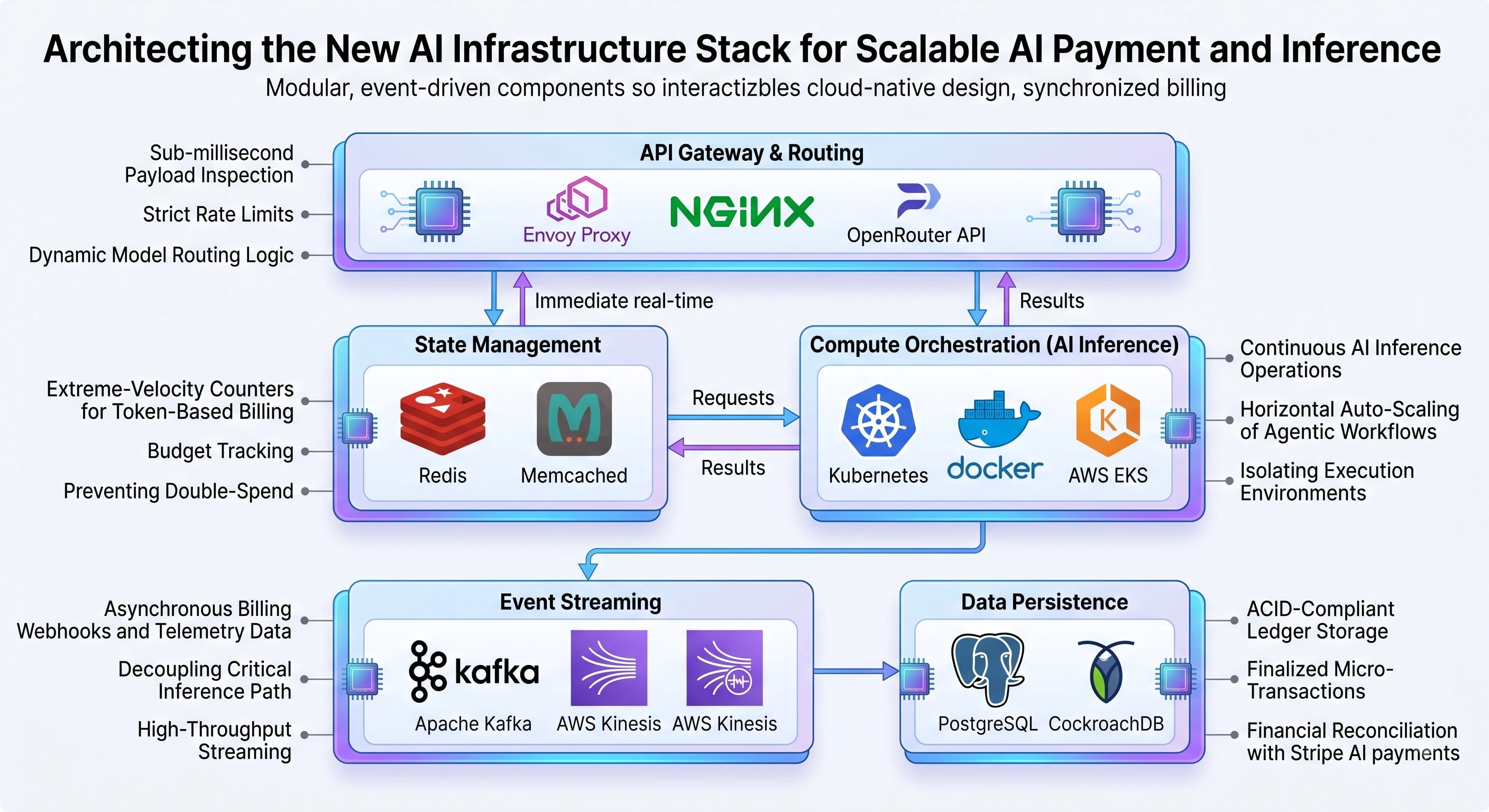
Managing Distributed Deployment Topologies
Utilizing containerized microservices enables development teams to isolate billing logic from computationally heavy inference tasks. Orchestrating these services across multiple geographic zones minimizes latency for global users while preventing localized hardware failures from disrupting the broader AI commerce ecosystem.
A globally distributed topology is essential for applications demanding real-time responsiveness. We deploy our LLM gateway replicas across 5 distinct AWS regions. When a user in Tokyo submits a prompt, the AWS Route 53 DNS resolver routes the payload to the nearest regional gateway. This local node performs the cryptographic authentication and budget validation against a geographically replicated Redis cluster before dispatching the request to the closest available OpenRouter node.
This geographic distribution significantly reduces the speed-of-light latency inherent in global network transit. By keeping the authentication and billing validation as close to the user as possible, we ensure that the only significant latency introduced is the actual AI inference generation itself. This architecture is crucial for conversational interfaces where any delay greater than 400 milliseconds degrades the user experience.
State Management for High-Volume Processing
Real-time token tracking demands a state management architecture capable of handling extreme write velocities. We rely on in-memory data grids and optimized relational databases to log every micro-transaction instantly, guaranteeing that usage quotas and financial ledgers remain accurate down to the millisecond.
The challenge of token-based billing lies in the sheer volume of database mutations. A single user session might generate 50 independent API calls in 2 minutes. If the application attempts to write each of these fractional charges directly to a standard relational database, the disk I/O bottlenecks will quickly crash the system. We solve this by implementing a write-behind caching strategy.
The gateway increments the user's token consumption in a Redis hash instantly. A separate background worker periodically sweeps these Redis counters every 60 seconds, aggregates the total usage, and commits a single, consolidated transaction to the PostgreSQL database. This batching process reduces database load by over 98 percent while ensuring that the application can still enforce budget limits in real time based on the data held in the memory grid.
Compliance, Security, and Operational Best Practices
Integrating financial systems with language models introduces unique security challenges. Teams must implement rigorous data governance protocols to sanitize prompts, encrypt payloads in transit, and maintain immutable audit logs to satisfy strict regulatory frameworks like SOC 2, HIPAA, and GDPR.
Security in AI commerce requires a multi-layered defense strategy. The convergence of financial routing and AI inference means that a single vulnerability could expose both sensitive payment details and proprietary corporate data. We mandate a zero-trust network architecture, where every microservice must mutually authenticate before transmitting data.
Furthermore, the introduction of third-party AI model providers necessitates strict data loss prevention controls. Development teams cannot blindly trust that external vendors will respect data privacy agreements. We must build infrastructure that enforces these boundaries cryptographically, ensuring that compliance is guaranteed through mathematical certainty rather than contractual promises.
Securing Transactional Data in LLM Routing
Encrypting prompt payloads and stripping personally identifiable information before transmission is non-negotiable. Developers must employ zero-trust architectures and tokenized authentication layers to ensure that sensitive financial details never leak into the computational pathways of external AI model providers.
Before a request leaves our internal network and enters the OpenRouter ecosystem, it passes through a data sanitization pipeline. We utilize specialized natural language processing models running locally to detect and mask sensitive entities, such as credit card numbers, Social Security numbers, and proprietary source code. The sanitized payload is then encrypted using TLS 1.3 before being dispatched over the public internet.
This sanitization ensures that even if an upstream AI provider suffers a data breach or maliciously uses prompt data for model training, our users' sensitive information remains protected. We also implement strict network egress filtering, ensuring that our internal services can only communicate with explicitly approved OpenRouter endpoints, preventing rogue containers from exfiltrating data to unauthorized destinations.
Meeting GDPR and SOC 2 Benchmarks in AI Commerce
Achieving SOC 2 and GDPR compliance requires comprehensive data mapping and automated consent management. We build infrastructure that automatically purges transient data after inference and provides users with transparent, self-serve portals to control their digital footprints across all AI model interactions.
GDPR mandates that users have the right to be forgotten, a challenging requirement when dealing with AI systems that naturally log prompts for debugging and analytics. We design our logging architecture to use aggressive time-to-live (TTL) configurations. All raw prompt data stored in our telemetry systems is automatically permanently deleted after 72 hours.
For SOC 2 compliance, we maintain immutable audit trails of every financial transaction and model routing decision. If a user queries a billing discrepancy, our support team can trace the exact prompt, the assigned model, the latency, and the calculated token cost without ever needing to view the actual textual content of the user's prompt. This separation of operational metadata from user content is the cornerstone of compliant AI infrastructure.
Mitigating Latency and Infrastructure Vulnerabilities
Defending against denial-of-service attacks and prompt injection requires deploying specialized web application firewalls at the edge. By coupling rate limiting with intelligent payload inspection, developers can protect the LLM gateway from malicious traffic while preserving sub-second response times for legitimate users.
AI endpoints are highly susceptible to resource exhaustion attacks. Because a single complex prompt can force the backend infrastructure to execute 1,000s of computationally expensive operations, attackers can bankrupt an application by flooding it with massive context windows. We defend against this by implementing multi-tiered rate limiting based on both request frequency and token volume.
A user might be allowed 100 requests per minute, but if those requests exceed 50,000 total tokens, the firewall instantly throttles the connection. Additionally, we deploy heuristic filters that analyze prompts for known injection signatures, blocking malicious instructions designed to bypass the AI agent's ethical guardrails or manipulate the billing logic before the payload ever reaches the inference engine.
Real-World Implementation Scenario: Optimizing AI Monetization
Translating theoretical architectures into tangible business value requires a methodical implementation strategy. We outline a recent migration where integrating a unified routing and billing stack enabled a major platform to overhaul its revenue model, dramatically improving both performance and profit margins.
Consider a B2B SaaS platform that originally built its AI features using direct integrations with a single major vendor. As their user base scaled past 2,000,000 active accounts, their flat-rate subscription model became entirely unprofitable. Heavy users were consuming 100s of dollars in API compute time, while the company only collected a 30 dollar monthly fee.
The development team executed a strategic migration to the Stripe OpenRouter ecosystem, shifting the entire platform to a dynamic, token-based billing model. This transformation required zero changes to the frontend client applications. By routing all traffic through the new LLM gateway, the company regained complete control over its unit economics, turning a massive operational loss into a highly predictable revenue stream.
Migrating to a Unified AI Billing Architecture
Transitioning from fragmented vendor contracts to a centralized API gateway streamlined operational workflows instantly. The development team successfully mapped legacy subscription tiers to dynamic usage-based billing profiles within 14 days, executing the migration with 0 downtime for existing enterprise customers.
The migration strategy was executed in 3 distinct phases. Phase 1 involved deploying the new gateway in parallel with the legacy infrastructure, shadowing a 10 percent slice of production traffic to validate routing logic and monitor latency impacts. Phase 2 focused on synchronizing the user databases, mapping the legacy flat-rate customer IDs to new Stripe AI payments billing profiles configured with custom token quotas.
Phase 3 was the final DNS cutover. By utilizing OpenRouter's standardized API specification, the team only had to update the base URL and authentication headers within their core application codebase. The entire transition was completed in precisely 14 days, resulting in a perfectly synchronized billing system that captured every micro-transaction flawlessly without disrupting the user experience.
Slashing Infrastructure Spend by 40 Percent
By activating dynamic AI model routing, the platform automatically offloaded low-complexity queries to highly efficient open-source models. This architectural optimization reduced overall AI inference costs by 40 percent in the first 30 days, reallocating critical budget toward feature development and expansion.
Before the migration, the platform routed all requests, regardless of complexity, to the most expensive model available. A simple prompt asking to capitalize a string of text cost the exact same amount as a prompt asking for complex code generation. Once the OpenRouter gateway was activated, developers implemented a semantic classifier that evaluated prompts prior to routing.
The classifier accurately determined that 65 percent of all incoming requests could be handled by smaller, much cheaper models without any degradation in output quality. By dynamically routing these simple tasks away from the premium tier, the platform's aggregate API consumption bill dropped by 40 percent in exactly 1 month. This massive reduction in overhead allowed the company to lower prices for their end-users, driving a 25 percent increase in new signups the following quarter.
Strategic Conclusion and Actionable Summary
The Stripe acquisition of OpenRouter fundamentally redefines how development teams build and monetize autonomous applications. By bridging the gap between computational routing and financial settlement, this combined ecosystem empowers us to deploy secure, scalable, and highly profitable AI solutions with unprecedented efficiency.
We have witnessed the evolution of AI infrastructure from experimental prototypes to mission-critical enterprise systems. The consolidation of the AI model marketplace with global financial rails signals that the industry is maturing. Development teams that adopt this unified architecture will operate with vastly superior unit economics, allowing them to out-compete platforms weighed down by legacy, fragmented infrastructure.
The ability to charge precisely for computational usage while maintaining absolute flexibility in model selection is no longer a luxury; it is a fundamental requirement for survival in AI commerce. We urge technical leaders to evaluate their current inference pipelines and begin planning their transition toward unified gateway solutions immediately.
Next Steps for Development Teams
Teams should immediately audit their existing inference pipelines to identify bottlenecks in routing and billing. Consolidating these layers through a unified provider will reduce technical debt, lower operational overhead, and position platforms to capitalize on the rapid expansion of agentic payments.
The 1st step is to instrument your current application to accurately measure token consumption across all features. Without baseline metrics, it is impossible to calculate the potential ROI of migrating to a dynamic routing architecture. Next, developers should experiment with OpenRouter's sandbox environment, testing how their prompts perform across various open-source models to identify opportunities for cost optimization.
Finally, architects must review their current billing implementations. Transitioning to usage-based billing requires careful communication with existing users and robust frontend UI updates to display token consumption transparently. By approaching this migration methodically, development teams can secure their infrastructure for the next decade of AI innovation.
The Future of Stripe AI Payments
As autonomous systems become the dominant consumers of digital services, financial infrastructure must evolve to support machine-to-machine commerce. The integration of OpenRouter establishes a blueprint for this future, where AI agents negotiate, execute, and settle complex transactions instantaneously on global payment rails.
We anticipate a rapid acceleration in the deployment of autonomous payments over the next 24 months. As AI models become smaller, faster, and more capable, the volume of agentic micro-transactions will explode. The Stripe AI infrastructure is uniquely positioned to act as the central nervous system for this new economy, providing the cryptographic trust and financial liquidity necessary for algorithms to conduct business globally.
This acquisition is not merely about simplifying API access; it is about building the foundation for a fully autonomous internet. Development teams that embrace these tools today will be the architects of the decentralized, agent-driven applications that define the digital landscape of tomorrow.
Frequently Asked Questions
The intersection of automated financial settlement and large language models introduces complex architectural paradigms. Below, we address the most common technical inquiries regarding model gateways, dynamic pricing, and the future of autonomous machine-to-machine transactions to help developers navigate this evolving landscape.
What makes the Stripe OpenRouter deal significant for developers?
The Stripe OpenRouter deal provides a single, unified API for both model selection and financial settlement. Developers no longer need to build custom middleware to track token usage across multiple AI model providers. This consolidation accelerates development cycles, simplifies compliance, and guarantees that usage-based billing remains perfectly synchronized with computational output.
How does AI model routing reduce inference costs?
AI model routing dynamically evaluates incoming prompts and assigns them to the most cost-effective model capable of handling the task. Instead of routing simple queries to expensive, high-parameter networks, the LLM gateway intelligently downgrades requests to cheaper alternatives, reducing overall inference costs without sacrificing the quality of the final response.
What is token-based billing in AI infrastructure?
Token-based billing is a pricing mechanism that charges users based on the exact number of data fragments processed during an interaction. Within modern AI payment infrastructure, the system counts the input tokens submitted by the user and the output tokens generated by the model, calculating the final transaction cost down to the micro-cent in real time.
How will the OpenRouter acquisition support autonomous payments?
By merging routing with financial ledgers, the OpenRouter acquisition enables AI agents to execute autonomous payments seamlessly. Developers can provision agents with predefined cryptographic wallets, allowing them to purchase API access, query external databases, or procure computational resources independently without requiring human authorization for every discrete micro-transaction.
Which compliance standards apply to AI payment infrastructure?
Platforms handling both financial data and AI prompts must adhere to stringent global standards, including PCI-DSS for payment processing, SOC 2 for operational security, and GDPR for data privacy. We ensure that any integrated LLM gateway strips personally identifiable information from prompts before transmission, maintaining a strict zero-trust boundary across the ecosystem.
How do developers implement usage-based billing for LLMs?
To implement usage-based billing, developers deploy an API gateway that intercepts inference requests, logs the token count from the AI provider's response header, and pushes this metric to a high-speed billing ledger. The Stripe AI infrastructure automates this entire lifecycle, converting raw computational metrics into finalized invoice line items automatically.
What is the role of an LLM gateway in AI monetization?
An LLM gateway acts as the centralized control plane between client applications and disparate AI model providers. It standardizes the API format, enforces rate limits, manages cryptographic authentication, and crucially, aggregates usage metrics to drive precise AI monetization models, ensuring platforms can operate a profitable and highly scalable AI commerce business.
How does Stripe AI infrastructure handle failover scenarios?
The Stripe AI infrastructure monitors the health of all integrated AI model providers continuously. If a primary endpoint experiences latency spikes or hard outages, the system instantly redirects the payload to a pre-configured secondary model. This automated failover guarantees continuous uptime for critical applications while ensuring billing metrics remain accurate across different vendor pricing tiers.
Tags
Amzsoft Innovexa
Engineering and delivery notes from the Amzsoft Innovexa team — fintech platforms, AI automation, and product engineering.