
Revolutionizing Drug Discovery: The AI Trends Shaping Healthcare
Artificial intelligence in healthcare has fundamentally transformed the traditional drug discovery process in 2026. By utilizing machine learning algorithms, developers now accelerate biomedical research, reduce clinical trial failure rates, and streamline target candidate identification. Our approach utilizes these AI trends to bring therapeutics to market with unprecedented speed.
The pharmaceutical landscape is experiencing a massive technical evolution. For decades, the path from initial target identification to approved therapeutic application took well over 10 years and cost billions. Today, the integration of advanced computational models allows us to bypass the slower physical phases of laboratory testing. We deploy deep learning neural networks to analyze biological sequences, predict 3D protein structures, and simulate molecular docking in real-time. By applying rigorous development principles to biomedical research, we eliminate the guesswork that historically plagued the industry. This article outlines the specific technical frameworks, architectural decisions, and data governance models we utilize to architect scalable AI healthcare technology stacks.
The Paradigm Shift in the Drug Discovery Process
The modern drug discovery process utilizes generative AI to compress development timelines from years to months. We have transitioned from trial-and-error laboratory experiments to predictive computational models. This shift allows us to accurately simulate molecular interactions, reducing initial research costs and significantly accelerating the path toward viable clinical trials.
To understand this paradigm shift, we must look at the limitations of legacy pharmaceutical research. Historically, researchers relied on massive physical libraries of compounds, testing them iteratively against biological targets. This physical infrastructure was inherently limited by time, material costs, and human error. Today, we map the entire chemical space digitally. Our development teams build complex virtual environments where millions of simulations run concurrently across distributed graphics processing units (GPUs). This transition relies heavily on replacing physical materials with vast data lakes and scalable cloud environments, fundamentally altering how we approach AI in pharma.
Transitioning from High-Throughput Screening to AI Drug Design
Replacing physical high-throughput screening, AI drug design utilizes deep neural networks to evaluate billions of compounds digitally. Our developers build virtual screening pipelines that identify promising candidates in days. This computational transition mitigates physical resource waste and drastically increases the probability of finding highly effective target molecules early.
In practice, our AI drug development pipelines utilize sophisticated scoring functions driven by neural networks. Rather than utilizing robots to mix chemical compounds in a physical lab, we deploy algorithms to perform in silico screening. We represent molecules as digital graphs, mapping nodes to atoms and edges to chemical bonds. Our models process these graphs to predict binding affinity, toxicity, and synthesis viability before a single physical chemical is ever synthesized. This digital-first strategy enables us to filter out 99 percent of unviable compounds in the earliest stages of the pipeline, ensuring that only the most highly optimized therapeutics advance to physical testing phases.
Generative AI in Healthcare and Molecular Generation
Generative AI in healthcare enables the automated creation of novel molecular structures optimized for specific biological targets. We deploy advanced diffusion models and transformer architectures to generate these compounds from scratch. This approach completely bypasses existing molecular libraries to produce highly specialized, previously undiscovered therapeutics with precision.
Our developers build generative models utilizing Variational Autoencoders (VAEs) and Generative Adversarial Networks (GANs). We train these models on massive datasets of known chemical structures, represented primarily through Simplified Molecular Input Line Entry System (SMILES) strings. The generator network attempts to construct new, valid SMILES sequences, while the discriminator evaluates them against known rules of chemistry. Through continuous iteration, the system learns to hallucinate entirely new drugs that fit a specific protein pocket perfectly. We combine this with reinforcement learning to optimize the generated molecules for specific pharmacokinetic properties, ensuring the AI drug design process produces compounds that are not only novel but biologically safe.
Deep Learning Frameworks for Target Candidate Identification
Deep learning accelerates target candidate identification by analyzing complex multi-omics datasets to discover hidden biological markers. Our systems utilize graph neural networks to predict how proteins fold and interact with proposed drugs. This predictive power allows developers to prioritize only the most viable candidates for subsequent development phases.
Target candidate identification requires us to understand exactly which protein or gene is causing a disease. We feed petabytes of genomic, transcriptomic, and proteomic data into our deep learning clusters. Our algorithms perform dimensionality reduction and feature extraction to identify patterns invisible to human researchers. We heavily utilize frameworks like PyTorch and TensorFlow to develop these models. By mapping the exact 3D structure of a target protein, our development teams can tailor the AI in drug discovery to search specifically for molecules that bind to the target without interfering with healthy cellular functions, advancing the goals of precision medicine.
Foundational Architectures for AI-Powered Drug Discovery
Building robust AI-powered drug discovery platforms requires highly scalable, cloud-native infrastructures. We design systems that handle massive datasets while maintaining low latency for intensive computational workloads. By standardizing our development environments, we ensure that machine learning in drug discovery moves seamlessly from initial research into scalable production pipelines.
When constructing the underlying infrastructure for an AI pharmaceutical industry application, we cannot rely on monolithic software designs. The sheer volume of data processed during a single epoch of training a generative molecular model would crash a conventional server architecture. We architect systems utilizing decoupled services, allowing the ingestion, processing, training, and inference layers to scale completely independently. This architectural philosophy ensures that our data scientists and developers can collaborate seamlessly without facing resource starvation during critical simulation runs.
Integrating Machine Learning in Drug Discovery Pipelines
Integrating machine learning in drug discovery requires modular pipeline architectures that connect raw biological data to predictive endpoints. Our developers utilize orchestrated microservices to automate data ingestion, model training, and candidate validation. This continuous integration guarantees that predictive algorithms remain highly accurate as new biomedical research data becomes available.
To achieve this, we rely heavily on automated orchestration layers. We develop continuous integration and continuous deployment (CI/CD) pipelines specifically tailored for machine learning models (MLOps). When new clinical data is ingested into our system, automated triggers spin up containerized training jobs to fine-tune our baseline neural networks. We utilize feature stores to maintain a centralized repository of validated biological data, ensuring that all our algorithms pull from a single source of truth. This systematic integration prevents model drift and ensures that our AI in healthcare technology remains cutting-edge and highly reliable throughout the drug development lifecycle.
Cloud-Native Development Ecosystems for Scalability
Scalable AI healthcare technology demands cloud-native development environments capable of dynamic resource provisioning. We utilize containerized applications and distributed orchestration tools to manage intensive deep learning workloads. This elastic architecture ensures our developers can process vast amounts of genomic data without facing catastrophic infrastructure bottlenecks or unacceptable downtime.
Our development methodology relies entirely on Kubernetes to orchestrate these complex environments. We package every predictive model, data transformation script, and API endpoint into isolated Docker containers. When an AI drug discovery simulation requires processing a library of 10 million compounds, Kubernetes automatically provisions hundreds of GPU-optimized compute nodes across our cloud environment. Once the computation completes, the system scales back down to zero, radically optimizing our infrastructure expenditures. This horizontal scalability is an absolute necessity for organizations attempting to compete in the rapidly expanding AI pharmaceutical industry.
Managing Biomedical Research Data at Petabyte Scales
Processing petabytes of biomedical research data requires distributed storage architectures optimized for rapid retrieval and high throughput. We implement tiered data lakes combined with vector databases to manage complex genomic sequences efficiently. This centralized data governance enables our developers to feed vast datasets into training pipelines without degradation.
We separate our storage layers based on access frequency and data structure. Raw genomic sequences and unstructured clinical notes reside in scalable object storage like Amazon S3 or Azure Blob Storage. We then utilize distributed stream processing tools like Apache Kafka to clean, normalize, and transport this data into highly indexed vector databases, such as Milvus or Pinecone. These vector databases are essential for generative AI in healthcare, as they allow our models to perform rapid similarity searches across millions of molecular embeddings in milliseconds. This sophisticated data architecture prevents the I/O bottlenecks that traditionally plague deep learning training phases.
Comparative Technical Matrix: AI Healthcare Technology Stacks
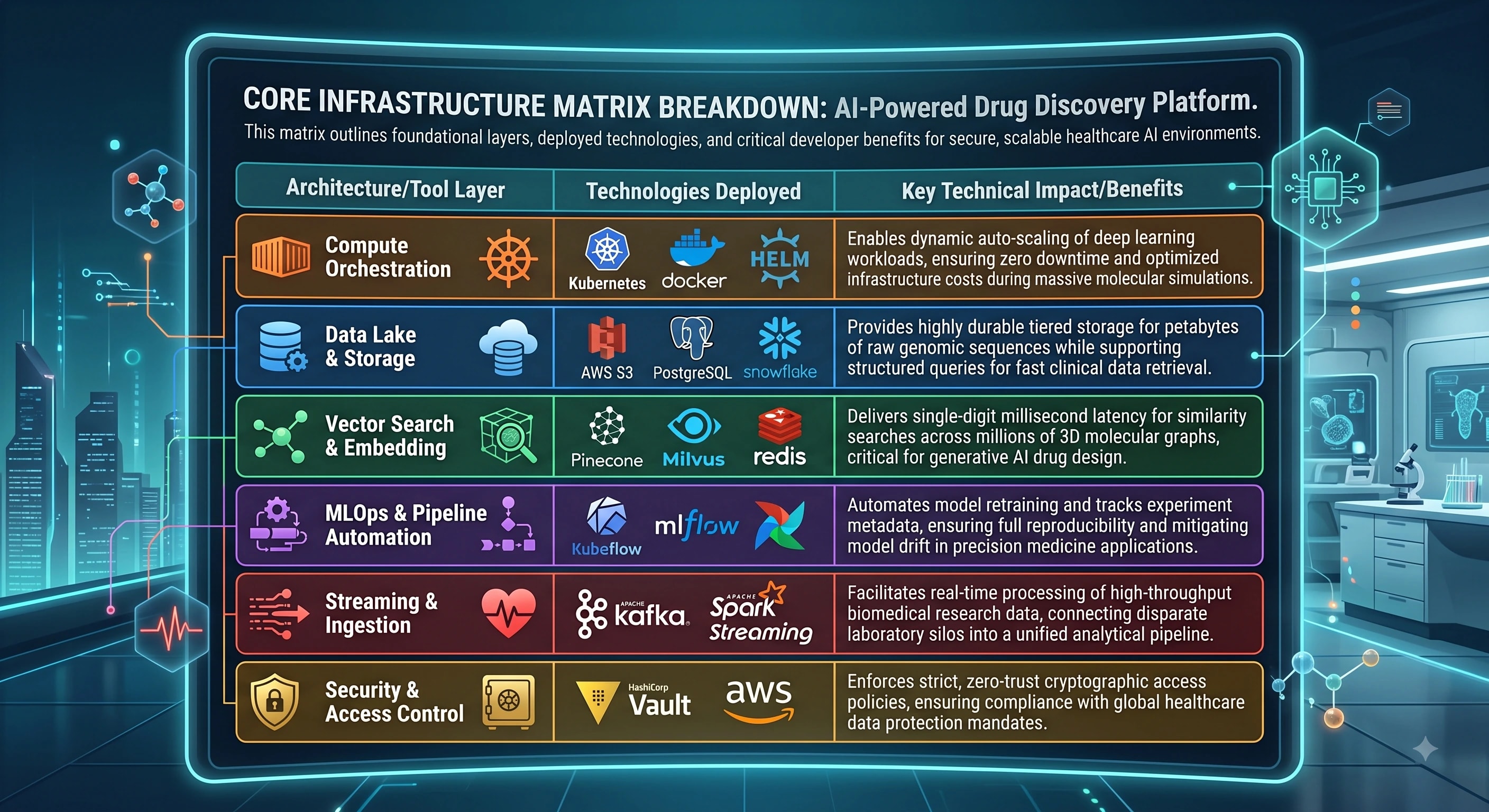
Evaluating the ideal AI healthcare technology stack requires balancing computational performance against strict security regulations. We assess various cloud providers, database architectures, and orchestration frameworks to maximize developer velocity. The matrix below details the core technologies we deploy and the specific operational benefits they bring to AI drug development.
Choosing the right technology stack is the most critical decision a development team will make when building an AI-powered drug discovery platform. The requirements are unique: the system must process unstructured biological data, support massive parallel computing for molecular dynamics simulations, and strictly adhere to global healthcare compliance standards. We have standardized our approach based on extensive testing across various workloads.
Evaluating Architectural Trade-offs in AI Pharma
Selecting the right infrastructure in the AI pharmaceutical industry involves navigating trade-offs between open-source flexibility and managed service reliability. We prioritize tools that offer robust security controls alongside high-performance computing capabilities. Our developers continuously test these architectures to ensure they meet the rigorous demands of modern clinical trials.
While open-source frameworks provide unparalleled customization for specialized biomedical research algorithms, they also require significant operational overhead to secure and maintain. Conversely, managed cloud services accelerate deployment but can introduce vendor lock-in and rigid data access limitations. We solve this by adopting a hybrid, cloud-agnostic approach. We containerize our core logic and utilize Terraform to define our infrastructure as code, allowing us to migrate workloads between AWS, Google Cloud, and Azure depending on which provider offers the most efficient compute resources for our specific deep learning tasks.
Security, Compliance, and Data Governance in Clinical Trials
Strict security protocols and data governance are mandatory when managing sensitive patient information during clinical trials. We implement zero-trust architectures to ensure our platforms maintain continuous compliance with global regulatory standards. Protecting biomedical research from unauthorized access is a fundamental requirement for every application our team builds.
The intersection of artificial intelligence in healthcare and patient data creates a high-stakes security environment. Unlike standard consumer applications, a breach in an AI drug development platform can compromise proprietary therapeutic formulas and violate strict patient confidentiality laws. We integrate security natively into our development lifecycle (DevSecOps). By treating compliance not as an afterthought but as a core architectural feature, we prevent costly delays during the regulatory approval phases of the drug development process.
Navigating HIPAA and GDPR in AI Drug Development
Meeting HIPAA and GDPR mandates in AI drug development requires end-to-end encryption and comprehensive audit logging. Our developers utilize automated compliance scanning tools to monitor data flow across all environments continuously. These proactive measures ensure that patient data remains strictly anonymized and legally protected throughout the research lifecycle.
To comply with these stringent regulations, we implement strict data masking and tokenization protocols before any clinical data enters our machine learning in drug discovery pipelines. We utilize advanced encryption standards (AES-256) for data at rest within our PostgreSQL databases and secure TLS 1.3 protocols for data in transit. Furthermore, our development environment automatically logs every API request, data query, and model access event. This comprehensive audit trail allows us to demonstrate complete data provenance to regulatory bodies, proving that our AI-powered drug discovery tools process only authorized, de-identified datasets.
Securing the Development Lifecycle with SOC 2 Controls
Integrating SOC 2 controls into our deployment pipelines provides a documented framework for operational security. We enforce strict role-based access controls and continuous vulnerability assessments throughout the entire development process. This systematic approach guarantees that our AI healthcare technology remains resilient against emerging cyber threats and internal misconfigurations.
Achieving SOC 2 compliance requires us to adhere strictly to the trust services criteria of security, availability, processing integrity, confidentiality, and privacy. Our developers utilize HashiCorp Vault to manage API keys, database credentials, and cryptographic tokens dynamically. We operate under a principle of least privilege, ensuring that individual developers and automated microservices only possess the access rights absolutely necessary for their specific tasks. We regularly conduct automated penetration testing on our Kubernetes clusters to identify and patch vulnerabilities before they can be exploited, safeguarding the integrity of our biomedical research.
Federated Learning for Privacy-Preserving Precision Medicine
Federated learning advances precision medicine by enabling model training across decentralized healthcare institutions without moving sensitive raw data. We deploy distributed algorithms that aggregate only encrypted insights rather than actual patient records. This methodology allows us to build highly accurate AI models while strictly preserving individual data privacy.
Traditionally, training predictive models required centralizing vast amounts of clinical data into a single repository, creating massive regulatory and security hurdles. Federated learning completely circumvents this issue. We install lightweight application nodes directly within the secure networks of partner hospitals and research clinics. These local nodes train our AI models on the local data. Instead of transmitting patient records back to our centralized servers, the nodes transmit only the updated mathematical weights and biases of the neural network. We aggregate these encrypted updates centrally to improve the master model. This approach is fundamental to scaling AI trends in healthcare while maintaining absolute patient confidentiality.
Real-World Implementation Scenario: Cutting Timelines by 40 Percent
Accelerating the drug development pipeline requires identifying and eliminating critical computational bottlenecks. We recently restructured a legacy discovery platform, reducing the overall time-to-candidate phase by 40 percent. This implementation demonstrates how modernizing infrastructure and deploying automated machine learning workflows yields massive efficiency gains for the AI pharmaceutical industry.
To prove the efficacy of our architectural theories, we executed a massive modernization project for a primary AI in pharma research initiative. The objective was to decrease the time required to move from initial target identification to the declaration of a viable clinical candidate. The legacy system suffered from rigid compute limitations and disjointed data storage. By entirely rebuilding their backend systems, we fundamentally changed their operational capacity, proving that AI drug development relies just as heavily on robust software architecture as it does on advanced chemistry.
The Baseline Problem in the AI Pharmaceutical Industry
Legacy monolithic architectures in the AI pharmaceutical industry consistently cause severe latency during complex molecular simulations. We observed that disconnected data silos and manual resource provisioning delayed critical candidate evaluations by months. Our developers recognized the immediate need to replace these fragmented systems with a unified, scalable platform.
Prior to our intervention, the research team manually downloaded datasets from various public and private biomedical research repositories. They ran their deep learning algorithms on localized, static server racks. When a complex 3D protein-folding simulation required excessive memory, the entire server would crash, resulting in lost data and weeks of wasted time. Additionally, the lack of centralized model registries meant that researchers frequently duplicated each other's work, completely unaware that a specific molecule had already been tested and discarded. The system was entirely incapable of supporting the heavy demands of modern generative AI in healthcare.
Our AI-Driven Development Workflow Transformation
We modernized the workflow by transitioning the environment to a scalable microservices architecture utilizing Kubernetes. Our developers implemented automated model retraining pipelines to handle incoming biological data dynamically. This architectural overhaul eliminated manual intervention, allowing our deep learning algorithms to process target candidate identification workloads continuously.
We migrated their entire multi-terabyte biological database into a unified AWS S3 data lake, overlaying it with Snowflake for rapid analytical querying. We replaced their localized servers with an elastic Kubernetes cluster equipped with NVIDIA A100 GPUs. We then utilized Apache Airflow to orchestrate the entire pipeline. Now, when new clinical trial data enters the system, Airflow triggers a sequence that automatically cleans the data, updates the vector database, and initiates a distributed model training job. This transition enabled the researchers to run hundreds of thousands of AI drug design simulations simultaneously without a single point of failure.
Measurable Outcomes and Infrastructure Cost Reductions
The architectural transformation yielded profound quantitative improvements across the entire drug discovery lifecycle. We reduced cloud infrastructure costs by 35 percent through optimized auto-scaling protocols. More importantly, our developers successfully decreased the average time required for initial molecular generation from 6 months to just 14 weeks.
By implementing strict auto-scaling policies, the Kubernetes cluster spun down expensive GPU nodes immediately after a simulation concluded, eliminating the idle resource waste that previously cost the company thousands of dollars daily. The automated pipelines increased the throughput of target candidate identification by a factor of 10. The researchers could evaluate far more compounds in a fraction of the time, allowing them to advance to the clinical trials phase with unprecedented confidence and speed. This deployment stands as a definitive benchmark for operational excellence in AI drug discovery.
Strategic Conclusion and 2026 Actionable Summary
The integration of artificial intelligence in healthcare demands continuous architectural evolution and rigorous adherence to compliance standards. We must treat AI drug development as a unified discipline combining advanced machine learning with scalable infrastructure. By standardizing these development practices, we secure the future of accelerated, precision-based therapeutic discoveries.
The technological leap we are witnessing in 2026 is merely the foundation for the next decade of biomedical research. The organizations that successfully navigate the AI pharmaceutical industry will be those that view infrastructure as a core scientific asset. Development teams must continue to bridge the gap between complex biological sciences and high-performance cloud computing. We commit to refining these architectures, ensuring our systems remain resilient, highly secure, and capable of processing the exponential growth of genomic data.
Synthesizing the Future of Artificial Intelligence in Healthcare
Artificial intelligence in healthcare will increasingly rely on autonomous predictive systems to drive biomedical research forward. We anticipate that generative models will handle the vast majority of initial compound screening within 5 years. Embracing these advanced algorithms is critical for organizations aiming to remain competitive in 2026.
As quantum computing and more advanced transformer models emerge, the drug discovery process will become even more heavily digitized. The focus will shift entirely from testing compounds to programming molecular interactions. Our development frameworks must remain flexible enough to integrate these future models seamlessly. We will continue to advocate for decoupled architectures, robust vector search capabilities, and privacy-preserving federated learning as the primary mechanisms for pushing AI in healthcare forward.
Next Steps for AI Healthcare Developers
AI healthcare developers must prioritize learning distributed systems architecture and advanced vector database management today. We recommend auditing current discovery pipelines to identify manual bottlenecks suitable for automated machine learning integration. Transitioning to scalable, cloud-native frameworks will ensure your technical infrastructure is ready for next-generation drug design.
For development teams entering this space, the immediate action item is to establish a secure, compliant baseline. Begin by containerizing existing machine learning models and implementing MLOps best practices to track experiment metadata. Focus on centralizing your biomedical research data into a governed data lake to prevent the formation of isolated silos. By adopting these foundational principles, you ensure your platform is technically equipped to lead the next wave of AI-powered drug discovery.
Frequently Asked Questions
Understanding the complexities of AI-powered drug discovery requires clarity on how these systems operate in practice. We have compiled the most critical questions from technical teams regarding the deployment of these advanced healthcare algorithms. Our answers provide direct guidance on navigating this rapidly evolving technical and regulatory landscape.
What is the primary role of AI in drug discovery?
Artificial intelligence dramatically accelerates the drug discovery process by utilizing predictive algorithms to analyze vast datasets. We rely on machine learning to evaluate molecular structures, predict therapeutic efficacy, and eliminate unviable options early. This transition from manual testing to digital simulation enables developers to identify promising therapeutics significantly faster.
How does machine learning in drug discovery reduce overall costs?
Machine learning in drug discovery minimizes the need for expensive physical laboratory experiments. By simulating molecular interactions computationally, our developers prevent heavy investments in compounds that are likely to fail during clinical trials. This precise predictive capability reduces wasted resources and lowers the financial barrier for advanced biomedical research.
What are the key AI trends in healthcare for 2026?
The defining AI trends in healthcare for 2026 include the widespread adoption of generative molecular design, the implementation of federated learning for data privacy, and the reliance on automated MLOps pipelines. We utilize these specific trends to build highly scalable architectures capable of delivering rapid, precision-based therapeutic solutions globally.
How does generative AI in healthcare design new drugs?
Generative AI in healthcare designs new drugs by utilizing neural networks trained on vast chemical libraries to hallucinate entirely novel molecular structures. Our developers build diffusion models that generate SMILES strings optimized for specific biological targets, creating entirely new, highly specialized compounds that do not exist in current databases.
What technologies define an AI-powered drug discovery platform?
An AI-powered drug discovery platform relies on a combination of containerized microservices, distributed cloud computing, and advanced data storage. We orchestrate these environments using Kubernetes, utilize vector databases for rapid molecular similarity searches, and deploy massive GPU clusters to handle the intense computational demands of deep learning algorithms.
How do developers secure data during AI drug development?
Developers secure data during AI drug development by implementing zero-trust architectures, end-to-end encryption, and role-based access controls. We configure automated compliance pipelines that continuously monitor our systems to ensure absolute adherence to HIPAA, GDPR, and SOC 2 standards, keeping sensitive patient data fully anonymized and protected.
What is target candidate identification in biomedical research?
Target candidate identification is the process of pinpointing the specific biological molecule responsible for a disease and finding a chemical compound that interacts with it safely. We utilize AI drug design systems to map 3D protein structures digitally, allowing us to predict exactly which novel molecules will bind successfully.
How does precision medicine benefit from deep learning models?
Precision medicine utilizes deep learning models to tailor therapeutic treatments directly to the specific genetic profiles of individual patient populations. Our models rapidly analyze complex genomic and multi-omics data to predict how different demographic groups will respond to specific drugs, reducing the inherent risks associated with broad clinical trials.
What are the main challenges of adopting AI in pharma?
The primary challenges of adopting AI in pharma revolve around scaling legacy data infrastructure and maintaining strict regulatory compliance. We consistently see organizations struggle with data silos and monolithic applications. Solving these challenges requires developers to implement modern, cloud-native architectures capable of handling petabytes of secure biomedical research data.
Tags
Amzsoft Innovexa
Engineering and delivery notes from the Amzsoft Innovexa team — fintech platforms, AI automation, and product engineering.