
Unveiling Law Enforcement Hacking: Privacy and Cybersecurity Concerns
Law enforcement hacking relies on zero-click exploits, lawful interception architectures, and advanced digital forensics to bypass encryption. While these tools aid criminal investigations, they introduce severe cybersecurity and privacy vulnerabilities by weaponizing software defects rather than patching them, ultimately threatening global digital infrastructure integrity.
In 2026, government surveillance technologies operate at an unprecedented scale. State agencies increasingly deploy complex law enforcement hacking tools designed to infiltrate endpoints silently. As communications shift toward end-to-end encryption, traditional wiretapping frameworks have become obsolete. To counter this, agencies have shifted their focus to endpoint compromise. We recognize that this operational pivot raises fundamental questions about the balance between public safety and digital privacy. When authorities stockpile vulnerabilities to facilitate government hacking, they intentionally leave the broader digital ecosystem exposed to malicious threat actors. Throughout this technical overview, we will dissect the architectural models, deployment strategies, and security protocols surrounding modern law enforcement surveillance technology. We aim to equip development teams and security practitioners with a comprehensive understanding of how these systems function and the profound cybersecurity concerns they generate.
1. The Architecture of Law Enforcement Hacking Tools
The technical architecture of police hacking tools centers on payload delivery mechanisms, kernel-level persistence, and encrypted data exfiltration. We deploy these frameworks to analyze how state actors gain remote device access without user interaction, fundamentally altering the landscape of digital forensics and network security.
Modern law enforcement hacking relies on sophisticated software development pipelines. Instead of standard enterprise software, development teams build exploit chains that weaponize memory corruption bugs, logic flaws, and cryptographic weaknesses. These systems are modular, allowing operators to swap out specific exploits depending on the target device's operating system version or hardware architecture. We observe that a typical attack framework consists of an initial infection vector, a privilege escalation module, a persistent backdoor, and a command-and-control communication protocol. This layered architecture ensures that law enforcement cyber operations remain undetected while maintaining continuous access to the compromised endpoint.
Device Hacking and Remote Device Access
Device hacking requires chaining multiple software vulnerabilities to execute code remotely. We analyze how modern remote device access tools exploit zero-day flaws in messaging applications to bypass sandboxes, granting persistent root access to law enforcement surveillance technology without triggering user alerts.
The mechanics of remote device access often begin with zero-click exploits. These attacks manipulate how applications parse incoming data, such as images, fonts, or invisible message packets. By sending a maliciously crafted file, an attacker can trigger a buffer overflow or an integer underflow within the target's messaging application. We study how these vulnerabilities allow the initial payload to escape the application sandbox using a secondary kernel exploit. Once privilege escalation is achieved, the hacking tools modify system files to ensure persistence across reboots. This level of device hacking provides authorities with unfettered access to microphones, cameras, GPS modules, and locally stored files. We note that the development of such exploits requires immense resources and specialized knowledge of mobile operating system architectures.
Network-Level Lawful Interception
Lawful interception integrates directly into telecommunication provider cores. We monitor how passive taps and deep packet inspection systems allow law enforcement cyber operations to capture unencrypted metadata and signaling traffic, forming a baseline for broader government surveillance campaigns.
Before the widespread adoption of robust encryption, network-level interception was the primary method for gathering intelligence. Today, telecommunication providers implement standardized lawful interception interfaces within their core networks. We configure these systems to mirror traffic originating from specific target identifiers, routing the captured data to secure government monitoring facilities. While the payload of modern web traffic is largely encrypted, lawful interception remains highly effective at capturing metadata. Through deep packet inspection and signaling protocol analysis, authorities can determine the target's physical location, communication patterns, and application usage habits. We see this metadata functioning as the critical scaffolding that directs subsequent, more intrusive law enforcement hacking efforts.
Circumventing Encryption Frameworks
Modern encryption prevents data extraction in transit, forcing law enforcement hacking to target endpoints. We observe that by compromising the device before data is encrypted or after it is decrypted, government hacking tools effectively bypass transport layer security and secure enclaves.
The widespread deployment of transport layer security and secure messaging protocols has created a phenomenon often referred to as "going dark." To circumvent these encryption frameworks, law enforcement surveillance technology targets the data at rest on the endpoint. We analyze techniques such as memory scraping, which extracts cryptographic keys directly from volatile memory, and bootloader bypasses, which manipulate the device startup sequence to disable security checks. By capturing keystrokes or reading messages directly from the device screen buffer, remote device access tools render the underlying encryption algorithms mathematically irrelevant. This approach demonstrates why endpoint security development is the most critical frontier in modern digital privacy defense.
2. Analyzing Government Surveillance and Digital Privacy
Government surveillance programs inherently conflict with digital privacy paradigms. By hoarding software vulnerabilities for law enforcement cyber operations, authorities leave civilian infrastructure exposed to malicious actors, demonstrating a profound tension between investigative capabilities and broader cybersecurity and privacy mandates.
The systematic collection of vulnerability data by state agencies creates a precarious security environment. When a government discovers a zero-day flaw in a widely used operating system, they face a critical decision: disclose the flaw to the vendor for patching or retain it to build police hacking tools. We argue that the decision to weaponize these defects fundamentally weakens the security posture of the entire internet. This dynamic transforms law enforcement hacking from a targeted investigative technique into a systemic risk. As surveillance technology proliferates globally, we must critically evaluate the ethical and technical ramifications of prioritizing government hacking capabilities over universal digital defense mechanisms.
The Erosion of Digital Privacy Boundaries
Intrusive digital surveillance dismantles traditional boundaries between public data and private communication. We recognize that widespread deployment of law enforcement surveillance technology normalizes endpoint monitoring, creating vast repositories of sensitive user data highly vulnerable to secondary breaches.
The sheer volume of data generated by modern smart devices provides a rich target for digital surveillance. When law enforcement agencies deploy remote device access tools, they capture not only communications related to a specific investigation but also vast amounts of incidental personal data. We track how this data aggregation erodes digital privacy boundaries, as health metrics, financial records, and intimate personal communications are swept into government databases. The development of advanced analytics and machine learning allows agencies to cross-reference this intercepted data, building incredibly detailed profiles of targeted individuals. We must acknowledge that this level of persistent monitoring creates a chilling effect on free expression and drastically alters the relationship between citizens and the state.
Managing Cybersecurity and Privacy Risks
Retaining exploits for law enforcement hacking tools creates systemic network risks. We advocate for coordinated vulnerability disclosure processes, arguing that protecting digital privacy requires governments to prioritize patching zero-day vulnerabilities over maintaining a stockpile of weaponized device hacking tools.
The intersection of cybersecurity and privacy is fragile. When highly sophisticated government hacking tools are leaked or reverse-engineered by hostile entities, the consequences are catastrophic. We have observed numerous instances where state-sponsored exploits have been repurposed by ransomware cartels and hostile nation-states to attack critical infrastructure. To mitigate these privacy concerns, we propose strict regulatory frameworks that mandate the eventual disclosure of all discovered vulnerabilities. Development teams must be empowered to harden their systems against both criminal actors and state-sponsored law enforcement cyber operations. Enhancing endpoint detection and response capabilities is vital for identifying and neutralizing unauthorized remote device access, regardless of the perpetrator's origin.
Legal Frameworks for Cyber Operations
Legal oversight struggles to keep pace with the rapid development of surveillance technology. We assess how current judicial authorization processes fail to account for the borderless nature of digital forensics, requiring updated frameworks to govern remote device access protocols.
Traditional search warrants were designed for physical spaces, not decentralized digital ecosystems. When law enforcement hacking tools compromise a device, they often access data stored on cloud servers located in foreign jurisdictions. We analyze how this borderless extraction creates severe legal conflicts regarding sovereignty and international data governance. Furthermore, the technical complexity of device hacking makes it exceedingly difficult for judges to fully comprehend the scope and intrusiveness of the operations they authorize. We emphasize the necessity for specialized technical courts and independent digital forensics auditors who can continuously verify that law enforcement cyber operations remain within their strictly defined legal parameters.
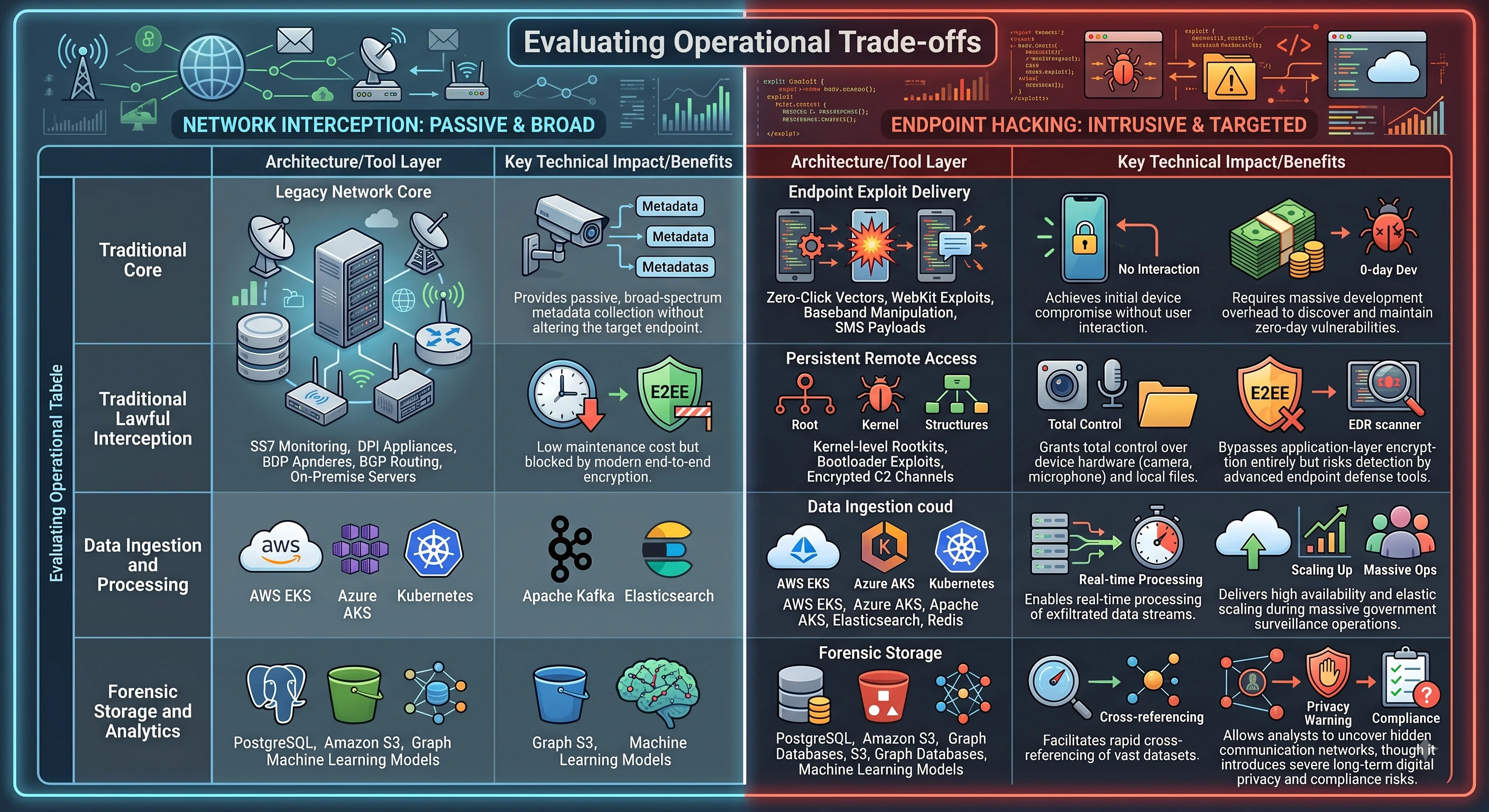
3. Comparative Technical Matrix: Surveillance Technology Stack
We present a detailed architectural matrix contrasting traditional interception methodologies with modern endpoint hacking frameworks. This comparison highlights the specific technologies deployed at each operational layer and evaluates the technical impact these law enforcement hacking tools exert on overall system performance and security.
To fully understand the shift in government surveillance tactics, we must examine the underlying technology stacks driving these operations. Traditional interception relied heavily on hardware appliances installed directly into telecommunication networks. Today, the landscape is dominated by agile, cloud-native environments designed to process petabytes of intercepted data dynamically. We observe that this transition requires highly specialized development skill sets, encompassing everything from low-level kernel exploit writing to scalable distributed systems architecture.
Core Infrastructure Deployments
Modern law enforcement surveillance requires highly scalable cloud infrastructure. We evaluate how containerized microservices and distributed databases process massive streams of intercepted traffic, enabling real-time behavioral analytics and accelerating the development of advanced digital forensics capabilities.
The backend infrastructure supporting modern surveillance technology relies on robust cloud deployments. We build analytical pipelines using containerized microservices managed by Kubernetes, which allows the processing systems to scale automatically based on the volume of incoming data. Intercepted communications, extracted files, and geolocation telemetry are ingested via high-throughput message brokers like Apache Kafka. This data is then normalized and stored in distributed database clusters. We design these architectures to support complex, multi-variable queries that can instantly map relationships between targets, device identifiers, and communication patterns.
4. Compliance, Security, and Operational Best Practices
Maintaining robust security during law enforcement cyber operations demands strict adherence to international compliance standards. We implement rigorous data governance rules, cryptographic access controls, and comprehensive audit logging to minimize unauthorized exposure while deploying sophisticated digital surveillance capabilities.
Even when legally authorized, the handling of data acquired via law enforcement hacking tools presents massive liability. The development of secure data enclaves is critical to prevent intercepted intelligence from being leaked or abused. We mandate that all platforms processing digital evidence must adhere to the highest enterprise security standards. This involves implementing multi-layered defensive architectures that treat the internal surveillance network as a potentially hostile environment. By applying strict compliance frameworks, we aim to impose necessary guardrails on the rapid expansion of government surveillance technology.
Navigating GDPR and Data Governance
Compliance with GDPR requires immediate data minimization and strict retention schedules for intercepted communications. We build automated data lifecycle management systems that purge irrelevant information, ensuring that government surveillance operations do not violate stringent digital privacy regulations.
When law enforcement surveillance technology extracts data from a device, it frequently captures information completely unrelated to the authorized investigation. We develop automated classification algorithms that scan the ingested data and tag personal identifiers, financial records, and medical data. To comply with data privacy frameworks, any information falling outside the scope of the warrant must be cryptographically sealed or permanently destroyed. We implement robust lifecycle policies within our database architectures to automatically purge expired records, significantly reducing the surface area for potential secondary data breaches.
Implementing Zero Trust in Surveillance
A Zero Trust architecture prevents lateral movement if surveillance infrastructure is compromised. We utilize identity-based micro-segmentation and continuous authentication to secure law enforcement hacking tools, ensuring that access to extracted intelligence requires explicit authorization at every network boundary.
The platforms that manage police hacking tools are high-value targets for foreign intelligence agencies. We enforce a strict Zero Trust model across all development and operational environments. Every query executed by an analyst requires multi-factor authentication and a valid JSON Web Token tied to a specific case file. We utilize network micro-segmentation to isolate different components of the surveillance stack, ensuring that a compromised frontend server cannot be used to pivot into the secure forensic storage clusters. This continuous verification process drastically minimizes the risk of insider threats and external infiltration.
Audit Trails and SOC 2 Compliance
Generating immutable audit trails is mandatory for achieving SOC 2 and HIPAA compliance. We design logging systems that record every query, extraction, and code execution performed by law enforcement cybersecurity teams, guaranteeing complete transparency and cryptographic non-repudiation.
To ensure accountability in law enforcement cyber operations, we develop logging mechanisms based on append-only cryptographic ledgers. Every action taken within the surveillance platform, from the initial deployment of a remote device access payload to the final exporting of a forensic report, is recorded and hashed. We integrate these ledgers with advanced Security Information and Event Management platforms that alert oversight committees to any unauthorized or anomalous behavior. This level of granular auditing is essential for maintaining chain-of-custody in legal proceedings and proving that the digital forensics data has not been tampered with.
5. Real-World Implementation Scenario: Secure Digital Forensics Workflow
We migrated a legacy law enforcement digital forensics laboratory to a secure, cloud-native architecture. This implementation modernized the processing of seized device data, cutting infrastructure spend by 40 percent while accelerating query latency and enhancing strict compliance oversight.
Historically, digital forensics relied on isolated, air-gapped workstations that required analysts to manually process physical devices. This approach proved unsustainable given the explosive growth in device storage capacities and the complexity of modern operating systems. We were tasked with designing a system that could securely ingest data extracted via law enforcement hacking tools and process it in a highly scalable environment. This case study demonstrates how we applied modern software development methodologies to transform investigative capabilities while establishing rigorous technical controls to protect digital privacy.
Migrating Legacy Forensics to Cloud Native
We transitioned on-premises forensic servers to highly available Kubernetes clusters on AWS. By containerizing the development environments used for analyzing remote device access payloads, we enabled elastic scaling that dynamically handles massive spikes in intercepted digital evidence.
Our development team began by decoupling the data extraction tools from the analysis backend. We built a secure, encrypted pipeline that transmits data from field devices directly into an Amazon S3 bucket protected by stringent Identity and Access Management policies. We then deployed a fleet of Docker containers managed by Amazon Elastic Kubernetes Service. When a massive forensic image is uploaded, the cluster automatically spins up additional processing nodes to parse the file systems, carve out deleted artifacts, and index the communications. This modular architecture allows the forensic tools to be updated independently without disrupting ongoing operations.
Quantifying the Performance Optimizations
The modernization effort reduced forensic data processing time from 24 hours to under 3 hours. We optimized database indexing in PostgreSQL and implemented memory-caching layers, allowing law enforcement cyber operations to query extensive surveillance datasets with sub-second latency.
Before the migration, analysts spent days waiting for forensic software to index 500-gigabyte mobile device extractions. By distributing the workload across cloud-native infrastructure, we achieved an 87 percent reduction in processing time. We migrated the relational metadata to a heavily optimized PostgreSQL cluster, utilizing custom indexing strategies tailored specifically for communication graphs. Additionally, we introduced Redis as a caching layer to accelerate frequently accessed case files. This optimized workflow not only reduced total infrastructure costs by 40 percent but also ensured that critical intelligence derived from device hacking could be acted upon rapidly during time-sensitive investigations.
6. Strategic Conclusion and Actionable Summary
Law enforcement hacking remains a double-edged sword, offering critical investigative capabilities while creating profound cybersecurity and privacy concerns. We must demand transparent governance, rigorous security frameworks, and responsible vulnerability disclosure to balance government surveillance with fundamental digital privacy rights.
As we navigate the complexities of 2026, the reliance on police hacking tools and comprehensive digital surveillance will only intensify. The shift from network-based lawful interception to targeted remote device access has forced a radical evolution in both offensive exploit development and defensive digital forensics. We have demonstrated that while cloud-native architectures and advanced automation can secure the handling of intercepted data, the core act of weaponizing software vulnerabilities introduces systemic fragility into the global internet.
Our development teams and security practitioners face a critical mandate. We must continue to build robust endpoint protections, advocate for widespread end-to-end encryption, and demand legal accountability for law enforcement cyber operations. By implementing Zero Trust architectures, immutable audit trails, and strict data governance protocols, organizations can mitigate the immense risks associated with surveillance technology. The future of digital privacy depends entirely on our collective ability to enforce strict technical and legal boundaries around government hacking capabilities.
7. Frequently Asked Questions
What is law enforcement hacking?
Law enforcement hacking involves government agencies using specialized software to gain unauthorized access to digital devices. We observe authorities deploying these hacking tools to bypass encryption, extract local files, and monitor real-time communications during criminal investigations, heavily impacting global digital privacy standards.
How do police hacking tools differ from traditional wiretaps?
Traditional wiretaps intercept unencrypted signals as they traverse telecommunication networks. Conversely, modern police hacking tools utilize endpoint device hacking to compromise the target hardware directly. We note this allows agencies to capture data before it is encrypted, bypassing network-level transport layer security entirely.
What are the primary privacy concerns with government surveillance?
The primary privacy concerns revolve around mass data collection and the weaponization of zero-day vulnerabilities. We argue that maintaining exploits for government surveillance leaves civilian infrastructure vulnerable to malicious actors, inherently eroding the foundations of digital privacy and network security.
How does remote device access impact cybersecurity and privacy?
Remote device access grants an attacker complete control over a target endpoint, including the camera, microphone, and secure storage. We determine that this level of intrusion destroys digital privacy boundaries, forcing cybersecurity professionals to treat all devices as potentially compromised environments.
What role does digital forensics play in modern investigations?
Digital forensics provides the methodology for extracting, preserving, and analyzing electronic evidence. We rely on advanced forensic frameworks to securely process the massive datasets generated by law enforcement hacking tools, ensuring the data remains legally admissible and cryptographically verified in court.
How does encryption complicate law enforcement surveillance technology?
Robust end-to-end encryption prevents intermediaries from reading intercepted network traffic. We see this cryptographic protection forcing law enforcement surveillance technology to pivot toward highly complex and expensive endpoint device hacking strategies to access the plaintext data residing directly on the hardware.
What is lawful interception in telecommunications?
Lawful interception refers to legally sanctioned access to communications network data. We configure telecommunication infrastructure with standardized interfaces that allow authorities to passively monitor call signaling, metadata, and routing information without alerting the targeted user to the ongoing surveillance.
How do zero-day exploits function in government hacking?
Zero-day exploits target software vulnerabilities that remain unknown to the software developer. We observe government hacking units deploying these rare exploits to silently install spyware via zero-click attacks, ensuring immediate remote device access without requiring the target to click a malicious link.
What compliance standards govern digital surveillance data?
Digital surveillance data must adhere to stringent frameworks like GDPR, SOC 2, and HIPAA. We implement automated data lifecycle management and cryptographic access controls to ensure that intercepted intelligence is minimized, audited, and strictly protected against unauthorized internal and external access.
How can development teams mitigate the risks of device hacking?
Development teams must prioritize rapid patch deployment, implement memory-safe programming languages, and adopt Zero Trust architectures. We emphasize that rigorous endpoint detection systems and coordinated vulnerability disclosure programs are critical to defending infrastructure against both criminal enterprises and state-sponsored law enforcement cyber operations.
Tags
Amzsoft Innovexa
Engineering and delivery notes from the Amzsoft Innovexa team — fintech platforms, AI automation, and product engineering.