
We’ve worked with enough early-stage startups to know one thing for sure—cloud decisions are rarely as straightforward as they look on paper. Some teams jump in too fast and overpay, others hesitate and lose time building things they didn’t need to build. Somewhere in between is where things actually work.
This guide on Cloud Services for Startups Explained is not theory-heavy or buzzword-packed. It’s grounded in what we’ve seen in real projects—tight budgets, unclear scaling plans, and sometimes, fixing what a previous vendor messed up.
If you’re trying to figure out how cloud actually fits your startup (not just what blogs say), you’re in the right place. This Cloud Services for Startups Explained guide is meant to give you clarity without overcomplicating things.
What Are Cloud Services for Startups Explained Simply
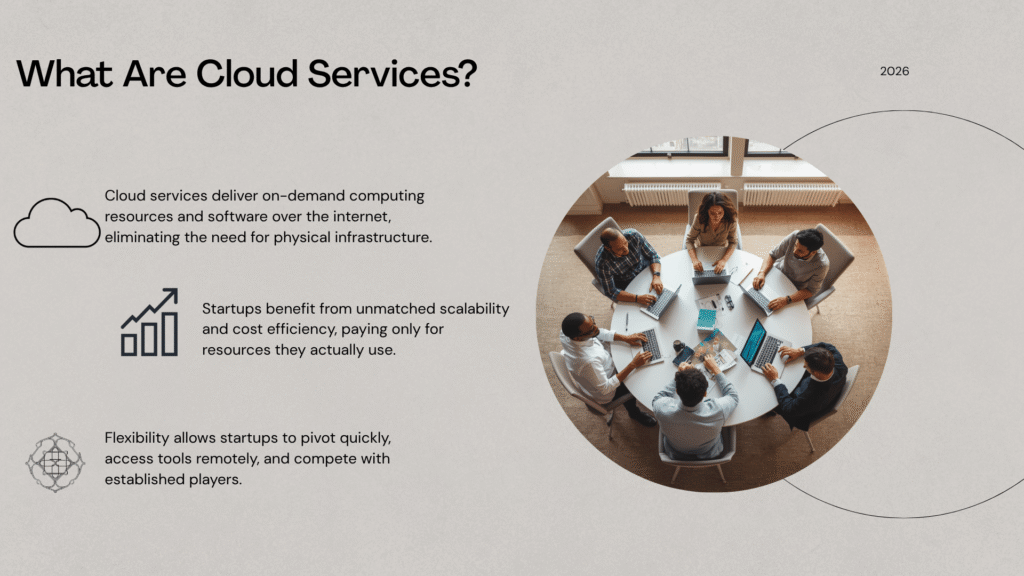
Definition of Cloud Services for Startups
At its core, Cloud Services for Startups Explained means using internet-based systems instead of setting up physical servers or infrastructure yourself. Instead of buying machines, renting office space for them, and hiring people to maintain everything, we access computing resources on demand.
It sounds simple—and it is—but the impact is big. We’ve seen startups cut months of setup time just by moving to cloud-first thinking. That shift alone changes how fast teams can actually build and test ideas.
Cloud services include storage, databases, servers, networking, and software—all delivered over the internet. You pay for what you use, ideally. That “ideally” matters, because mismanagement can still burn money fast if no one is watching usage.
For startups, it’s less about technology and more about removing friction early on. You focus on building your product, not maintaining infrastructure, which is really the whole point behind Cloud Services for Startups Explained.
How Cloud Computing Works in Simple Terms
If we strip it down, cloud computing is basically renting powerful computers somewhere else and accessing them online. That’s it, really.
Instead of running your app on a laptop or an office server, it runs in data centers managed by cloud providers. You deploy code, store data, and scale things up or down as needed without touching physical machines.
We usually explain it to clients like this: imagine plugging your startup into a power grid instead of building your own generator. You only use what you need, when you need it, which is why Cloud Services for Startups Explained makes sense early on.
But here's where things get real—usage-based pricing sounds great until no one is monitoring it. We’ve seen startups accidentally scale costs along with traffic spikes because no alerts were set.
So yes, simple in concept, but it needs discipline in execution. That’s the part most guides skip when explaining Cloud Services for Startups Explained.
Why Startups Prefer Cloud Over Traditional IT
Most startups don’t have the luxury of time or extra capital to experiment with physical infrastructure. Cloud removes that barrier almost immediately.
You don’t need upfront investment in servers. You don’t need to predict future traffic perfectly. And you don’t get stuck with hardware you’ll outgrow in six months, which happens more often than people admit.
We’ve worked with teams who started with traditional setups because it “felt safer,” only to migrate later under pressure. That transition is always more painful than starting right with cloud computing for startups.
Cloud also supports remote teams naturally. In 2026, that’s not optional anymore—it’s expected, especially for distributed teams.
The real reason startups prefer cloud, though, is control. You can build, test, fail, and rebuild quickly without being locked into heavy infrastructure decisions—that’s where Cloud Services for Startups Explained actually proves its value.
Key Benefits of Cloud Services for Startups
Cost Savings and Scalability
Let’s be honest—cloud doesn’t always mean cheaper. It means controllable costs, if handled right, and that’s an important difference.
Startups often assume cloud equals low cost, then forget to shut down unused resources or over-provision servers “just in case.” That’s where bills creep up quietly.
When managed properly, cloud gives you the ability to start small and grow gradually. No massive upfront spending. No wasted capacity sitting idle, which is a core part of cloud services benefits.
We usually guide startups to scale based on real usage, not assumptions. That alone saves more than any discount plan or pricing hack.
Scalability is where cloud shines, though. Traffic spike? Scale up. Quiet period? Scale down. You stay flexible without constant reinvestment, which is central to Cloud Services for Startups Explained.
Flexibility and Remote Accessibility
Cloud gives your team the ability to work from anywhere without breaking systems. That’s a big deal, especially when your developers, designers, and operations team aren’t in the same place.
We’ve seen startups struggle with local server setups where access was restricted or painfully slow. Moving to cloud removed those bottlenecks almost overnight.
It also makes collaboration smoother. Updates happen in real time, deployments don’t depend on physical access, and backups aren’t tied to one location anymore.
Flexibility isn’t just about location—it’s also about adapting quickly. Need to test something new? You spin it up. Didn’t work? You shut it down without long-term consequences.
That kind of flexibility is one of the most practical cloud services benefits startups actually feel day-to-day.
Faster Product Development
Speed matters more than perfection in early stages, and cloud supports that reality without getting in the way.
Instead of waiting weeks to set up environments, we can deploy in hours—or sometimes minutes. That difference compounds over time.
Startups we work with often iterate their product multiple times before finding product-market fit. Cloud infrastructure for startups supports that trial-and-error process naturally.
It also integrates well with development tools, CI/CD pipelines, and testing workflows, making the entire system smoother to manage.
In short, cloud doesn’t build your product—but it removes the friction that slows your team down, which is a big part of Cloud Services for Startups Explained.
Types of Cloud Services Every Startup Should Know

Infrastructure as a Service (IaaS)
IaaS is the most flexible—and sometimes the most misused—type of cloud service in startup cloud solutions. It gives you raw infrastructure like virtual machines, storage, and networking.
You control almost everything, which is great if you know what you’re doing. But we’ve seen startups overcomplicate things by choosing IaaS too early.
It’s like renting land instead of buying a house. You can build exactly what you want, but you’re responsible for everything from setup to maintenance.
Still, for certain use cases, especially custom systems or scaling-heavy applications, it’s incredibly powerful.
It forms the base layer of many cloud infrastructure for startups when used correctly.
When Startups Should Use IaaS
We usually recommend IaaS when startups have specific technical requirements that managed platforms can’t handle easily.
If your product needs deep customization, performance tuning, or a unique architecture, IaaS starts to make sense.
It’s also useful during migrations when you need full control over configurations and environments.
That said, it’s not ideal for small teams without DevOps experience. Managing infrastructure can become a distraction from building the product.
We’ve helped teams move away from IaaS when it started slowing them down instead of helping—which is something to keep in mind when exploring Cloud Services for Startups Explained.
Platform as a Service (PaaS)
PaaS sits somewhere in the middle. You don’t manage servers, but you still control your application and logic.
It’s a practical balance for startups that want to focus on development without worrying about infrastructure management.
You deploy code, and the platform handles scaling, runtime, and environment setup automatically.
There’s less control compared to IaaS, but significantly less overhead too.
For many teams, this becomes the sweet spot in early-stage startup cloud solutions.
Benefits of PaaS for Developers
Developers usually prefer PaaS because it removes repetitive setup work that doesn’t add real value.
We’ve seen teams cut deployment time drastically after switching, which directly improves productivity.
It also reduces configuration errors, which are surprisingly common in fast-moving teams.
For startups, reliability often matters more than full control, especially in early phases.
PaaS allows developers to stay focused on features instead of infrastructure, which aligns well with Cloud Services for Startups Explained.
Software as a Service (SaaS)
SaaS is the easiest entry point into cloud computing for startups. You simply use software over the internet—no setup, no maintenance.
Think tools for communication, CRM, accounting, or analytics. Most startups rely heavily on SaaS without even planning it intentionally.
It’s convenient and quick to adopt, which is why it becomes part of almost every startup cloud solution stack.
However, too many SaaS tools can create fragmentation if not managed properly.
So while it simplifies things, it still needs structure to stay efficient.
Examples of SaaS Tools for Startups
In real startup environments, SaaS shows up in everyday tools like project management platforms, communication apps, CRMs, and analytics systems. Teams usually start small and keep adding tools as new needs come up, which is normal but can get messy over time.
We’ve seen startups end up with overlapping tools doing the same job, paying for multiple subscriptions without realizing the duplication. It doesn’t happen intentionally—it’s just the result of moving fast without reviewing decisions.
The better approach is to stay intentional. Choose tools that actually fit your workflow and integrate properly with each other. SaaS works best when it simplifies your system, not when it becomes another layer to manage within Cloud Services for Startups Explained.
How to Choose the Right Cloud Services for Your Startup
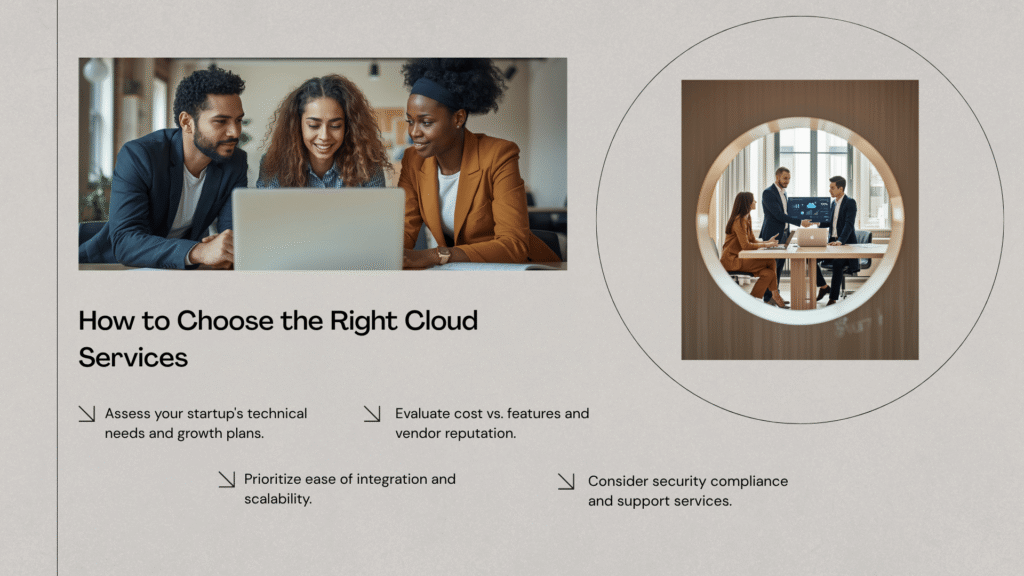
Factors to Consider Before Choosing Cloud Services
Choosing cloud services isn’t just about features—it’s about fit. What works for one startup can easily slow down another if the context is different.
We always start by understanding the product, team size, and expected growth. That gives a clearer direction than following trends blindly.
Rushing into decisions usually leads to rework later, which is both expensive and frustrating.
It’s better to start simple and evolve gradually instead of over-engineering too early.
That approach tends to work best when applying Cloud Services for Startups Explained in real situations.
Budget and Pricing Models
Cloud pricing can be confusing, especially with flexible, usage-based models. It looks simple at first, but it rarely stays that way.
We’ve seen startups caught off guard by rising costs because no one was actively monitoring usage. It’s a common issue.
Setting budgets, alerts, and usage tracking early makes a big difference.
Cost control shouldn’t be reactive—it should be part of your initial setup.
That’s one of the most practical lessons within Cloud Services for Startups Explained.
Security and Data Protection
Security often gets pushed aside until something goes wrong, which is understandable but risky.
Cloud platforms offer strong security tools, but they need to be configured properly. That’s where most issues happen.
We’ve handled cases where simple misconfigurations exposed sensitive data. Not complex failures—just small oversights.
Startups don’t need enterprise-level systems, but they do need the basics done right.
It’s easier to build securely from the start than fix problems later in your cloud infrastructure for startups.
Scalability Needs
Not every startup needs massive scalability from day one, despite what many guides suggest.
What you actually need is the ability to scale when required—not before.
We design systems that grow gradually without forcing early complexity.
Overbuilding wastes resources, while underbuilding limits growth.
Finding that balance is a key part of Cloud Services for Startups Explained.
Common Mistakes Startups Make with Cloud Services
Startups rarely make mistakes because they don’t care—usually, it’s because they’re moving fast and prioritizing product delivery. Cloud decisions quietly take a back seat until issues show up.
One common pattern is overpaying without realizing it. Resources get created, then forgotten. Servers run longer than needed. Storage keeps growing without checks. These things don’t feel urgent, but they add up over time.
Another issue is delaying security. It often gets pushed to “later,” but later tends to mean after something breaks or gets exposed. Small gaps—permissions, backups, configurations—can turn into bigger problems if ignored.
The pattern is simple: small, rushed decisions compound over time. That’s something we repeatedly see when working on Cloud Services for Startups Explained projects.
Best Practices for Using Cloud Services Effectively
Using cloud well isn’t about advanced tools—it’s about consistent habits. The teams that manage cloud effectively usually keep things simple and review regularly.
Monitoring usage is one of the most important habits. Not in a complex way, just enough to know where resources are going and whether they’re needed.
Costs should be visible, not something you discover at the end of the month.
Choosing reliable providers also matters more than it seems. Cheaper options sometimes lead to downtime or poor support, which costs more in the long run.
Good cloud usage is quiet—it doesn’t create surprises. That’s usually a sign your Cloud Services for Startups Explained approach is working.
Why Choosing the Right Technology Partner Matters
Role of Expert Development Teams
A good development team doesn’t just build systems—they help you avoid problems you don’t see yet.
We’ve stepped into projects where cloud setups were already causing issues, and fixing them is always harder than setting things up properly from the beginning.
Experience plays a big role here. Knowing what not to do is just as important as knowing what to build.
Having the right team early saves time, reduces cost leaks, and avoids unnecessary complexity.
It also gives founders some breathing room, which is often overlooked in Cloud Services for Startups Explained discussions.
How Amzsoft Innovexa Helps Startups Scale
At https://www.amzsoftinnovexa.com/, we work with startups that need clarity more than complexity. Most teams come to us after hitting some kind of friction—cost issues, scaling problems, or systems that just don’t feel stable.
We focus on understanding first, then building. No over-engineering, no unnecessary layers. Just systems that actually support growth without becoming a burden later.
We’ve helped startups reduce cloud costs, restructure infrastructure, and rebuild setups that were holding them back. Not dramatic changes—just practical fixes that work.
Every startup evolves, and we plan for that from the beginning. That’s how we approach Cloud Services for Startups Explained in real-world scenarios.
Amzsoft Innovexa Blog
Content creator and technology enthusiast sharing insights on the latest trends and best practices.