How can AI in Marketing help beginners grow their business faster in 2026?
Artificial intelligence is no longer a futuristic concept reserved for large technology companies. In 2026, AI in Marketing has become one of the most practical and accessible tools available to businesses of every size. From local service providers and startups to global brands, organizations are using AI to automate repetitive tasks, personalize customer experiences, improve advertising performance, and make better business decisions.
For beginners, the biggest advantage is simple: AI helps achieve more results with fewer resources.
A small business owner can now create content, analyze customer behavior, optimize advertising campaigns, automate email sequences, and improve local search visibility without hiring a large marketing team. This shift has made Artificial Intelligence Marketing one of the most important business growth trends across the United States, Dubai, and other rapidly growing digital markets.
Businesses that adopt AI-powered marketing strategies early often benefit from:
Faster customer acquisition
Better lead generation
Higher conversion rates
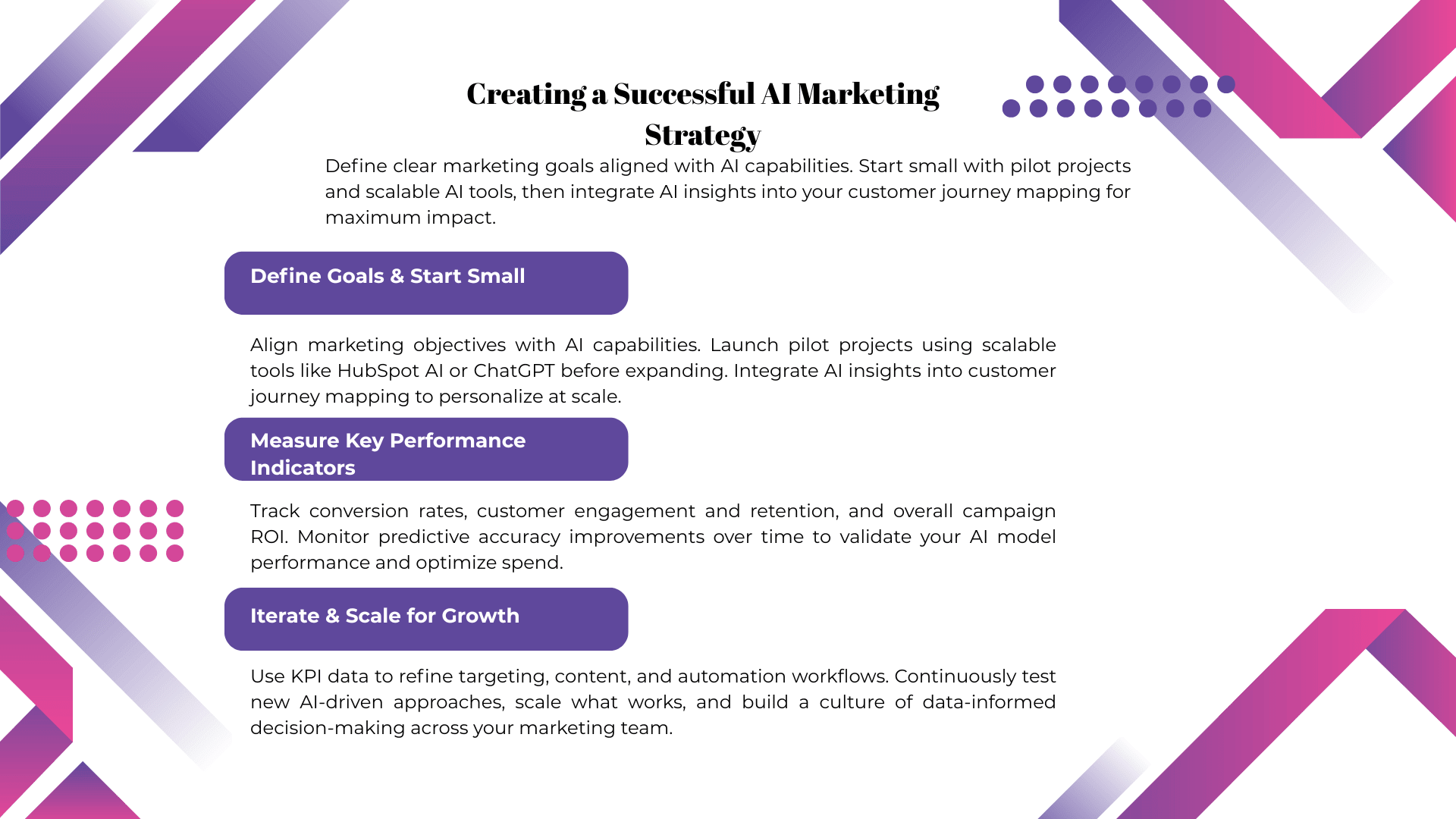
Improved marketing ROI
Enhanced customer personalization
More efficient marketing automation
Better decision-making through AI analytics
Whether the goal is to grow an e-commerce store in Texas, scale a SaaS startup in California, or attract luxury real estate clients in Dubai, AI in Marketing is transforming how businesses connect with customers.
What is AI in Marketing and why are businesses in the USA and Dubai adopting it so quickly?
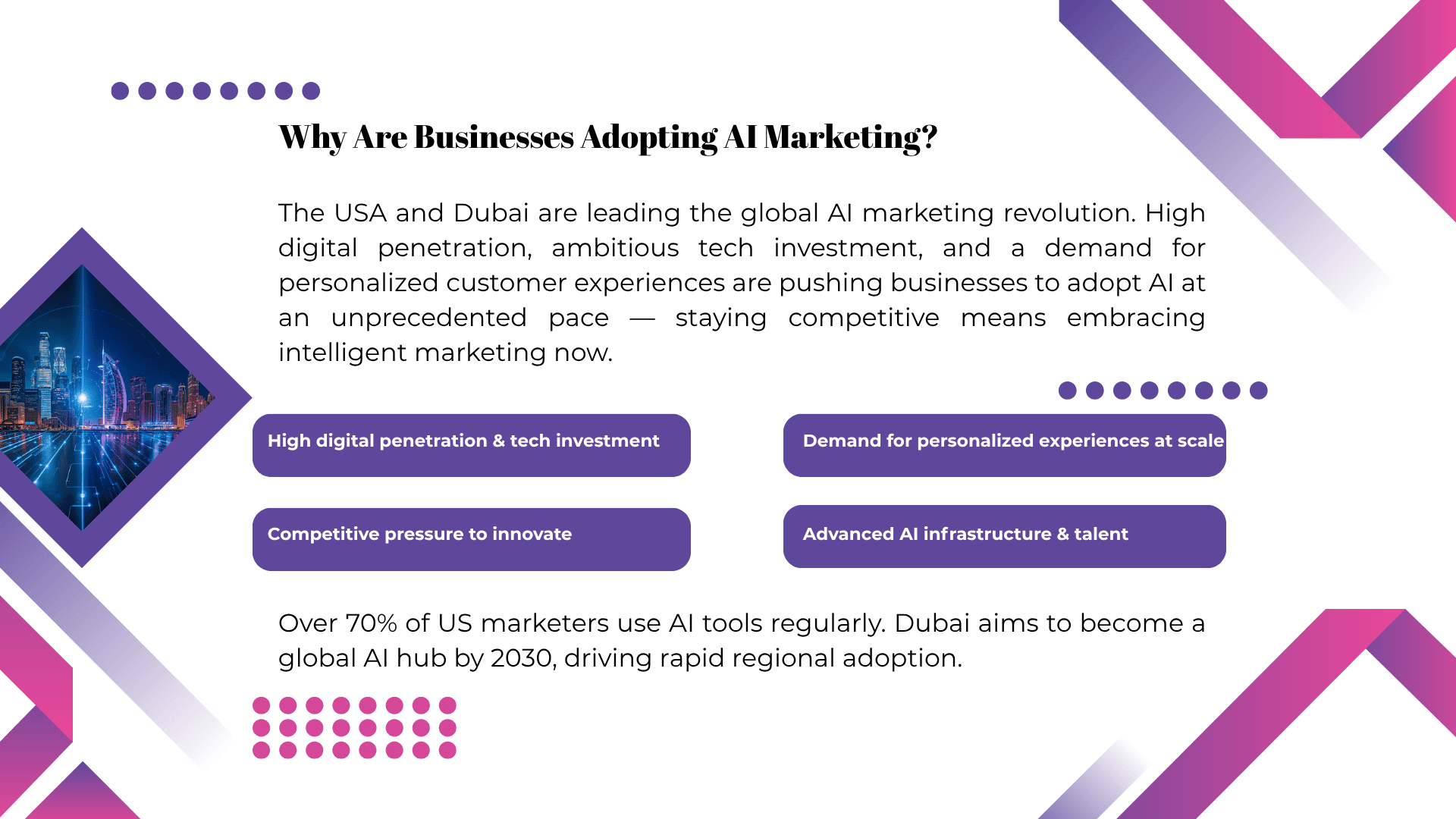
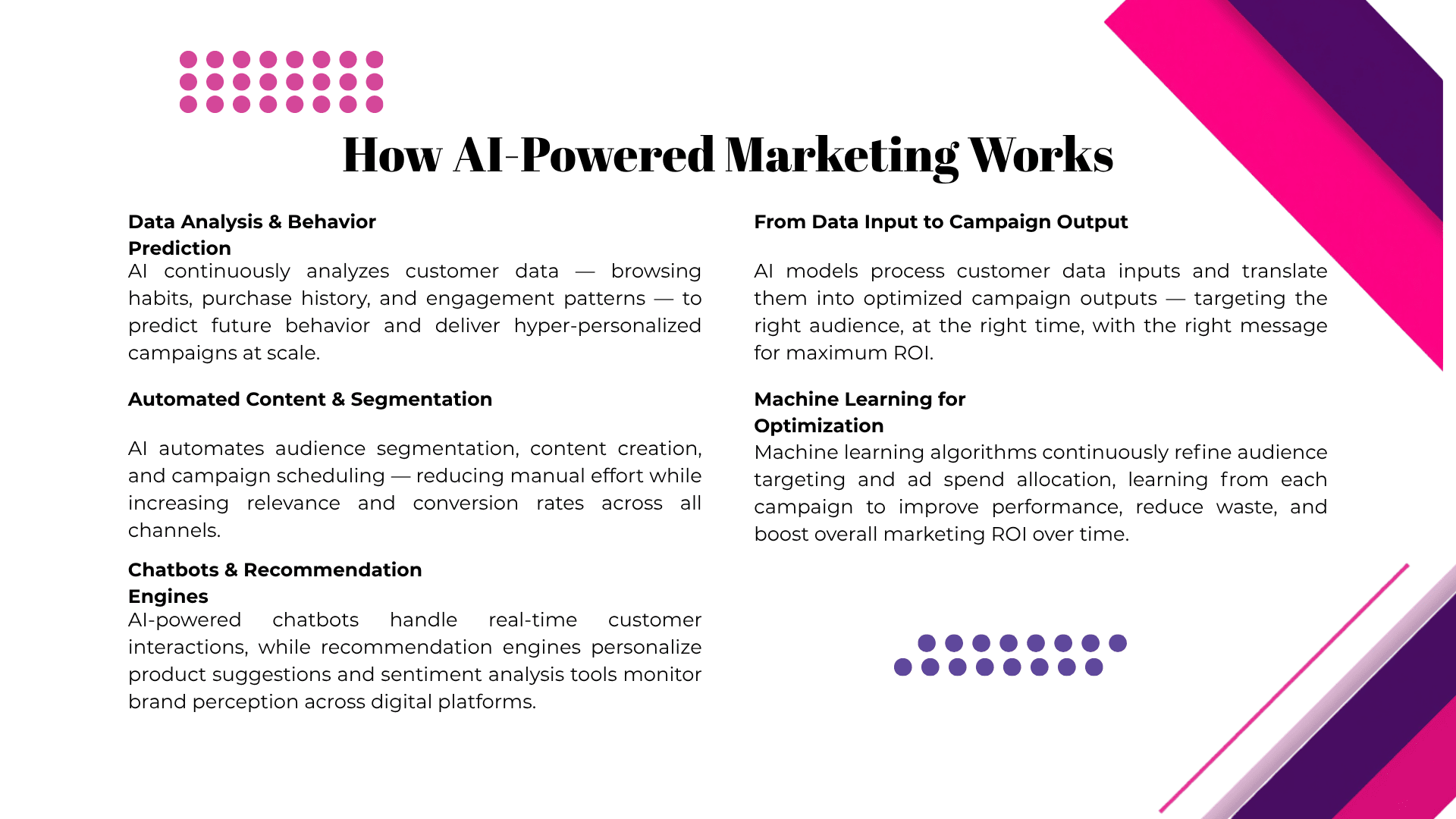
AI in Marketing refers to the use of artificial intelligence technologies to improve marketing activities such as customer targeting, content creation, advertising, analytics, automation, and personalization. Businesses in the USA and Dubai are adopting AI rapidly because it helps reduce costs, improve efficiency, and generate better marketing results at scale.
Artificial intelligence enables marketers to process enormous amounts of customer data and identify patterns that would be difficult or impossible to uncover manually. Instead of relying solely on assumptions, businesses can use predictive insights to make informed decisions.
The growing adoption of AI-powered marketing is being driven by several factors:
Increased competition in digital markets
Rising customer expectations for personalization
Growing volumes of marketing data
Improvements in Generative AI technologies
Greater availability of affordable AI marketing tools
As digital transformation accelerates worldwide, AI is becoming a core component of modern marketing strategies.
What does AI in Marketing mean for beginners?
For beginners, AI in Marketing means using intelligent software to automate tasks, analyze customer behavior, and improve marketing performance without requiring advanced technical skills.
Many newcomers assume AI requires programming knowledge. In reality, most modern AI marketing tools are designed for non-technical users. Business owners, marketers, freelancers, and startups can implement AI solutions through user-friendly platforms.
Some beginner-friendly applications include:
AI content generation
Social media scheduling
Customer segmentation
Email personalization
Advertising optimization
Chatbots and customer support
SEO recommendations
A beginner operating a local HVAC company in Florida, for example, can use AI tools to identify high-performing keywords, generate service pages, automate follow-up emails, and optimize local advertising campaigns.
The same principle applies to a Dubai-based real estate agency seeking international investors. AI can help identify audience interests, personalize communication, and improve lead nurturing efforts.
How is AI different from traditional digital marketing?
The primary difference is that traditional digital marketing relies heavily on manual analysis and human decision-making, while AI-powered marketing uses machine learning and automation to improve efficiency and accuracy.
Traditional MarketingAI in MarketingManual TargetingAutomated TargetingGeneric CampaignsPersonalized CampaignsSlower OptimizationReal-Time OptimizationLimited Data AnalysisPredictive Analytics
Traditional methods often involve reviewing reports manually and making adjustments based on historical performance.
AI systems continuously analyze customer behavior and automatically recommend or implement optimizations.
For example:
Traditional advertising might require weekly campaign adjustments.
AI advertising platforms can optimize bids in real time.
Traditional email marketing often sends identical messages.
AI-powered systems personalize emails for individual recipients.
This allows businesses to respond faster to changing customer behavior.
What is the difference between AI-Powered Marketing and marketing automation?
Although often used interchangeably, AI-powered marketing and marketing automation are not the same.
Marketing automation focuses on executing predefined actions automatically.
Examples include:
Scheduled emails
Automated workflows
CRM triggers
Lead nurturing sequences
AI-powered marketing goes beyond automation by learning from data and making intelligent decisions.
Examples include:
Predicting customer behavior
Dynamic content recommendations
Smart audience segmentation
AI-generated content
Predictive lead scoring
The most successful organizations combine both approaches.
Marketing automation handles repetitive tasks while artificial intelligence improves decision-making.
How has Artificial Intelligence Marketing evolved over the past few years?
Artificial Intelligence Marketing has evolved from a specialized enterprise technology into a mainstream business tool accessible to companies of all sizes.
Just a few years ago, AI was primarily used for basic analytics and recommendation systems. Today, businesses use AI for:
Content creation
Customer service
Advertising optimization
Predictive analytics
Customer journey mapping
Conversational marketing
The introduction of Generative AI has accelerated adoption dramatically.
Businesses can now create:
Blog content
Product descriptions
Email campaigns
Social media posts
Ad copy
Marketing visuals
within minutes rather than hours.
This shift has fundamentally changed how marketing teams operate.
What major AI marketing trends are shaping 2026?
Several important trends are driving AI in Marketing adoption in 2026.
1. Hyper-Personalization
Customers increasingly expect customized experiences. AI analyzes behavioral data to deliver personalized content, recommendations, and offers.
2. Predictive Marketing
Businesses are using predictive analytics to forecast customer behavior and identify purchasing intent before competitors.
3. Conversational AI
Advanced chatbots and virtual assistants are becoming critical customer engagement channels.
4. AI-Powered Search Optimization
Marketing teams are optimizing content not only for search engines but also for AI-generated search results and answer engines.
5. Multi-Channel Automation
AI coordinates customer experiences across:
Websites
Email
Social media
Mobile apps
Paid advertising
This creates more consistent customer journeys.
How is Generative AI Marketing changing content creation?
Generative AI Marketing is transforming content production by enabling businesses to create high-quality content faster and more efficiently.
Content teams can now use AI to support:
Blog writing
Ad copy creation
Product descriptions
Video scripts
Email campaigns
Landing pages
However, the most effective organizations combine AI-generated content with human expertise.
Human marketers remain essential for:
Strategic planning
Brand voice development
Fact verification
Emotional storytelling
Creative direction
The strongest results typically come from collaboration between human expertise and AI efficiency.
Why are businesses in the USA investing heavily in AI marketing solutions?
Businesses across the United States are investing heavily in AI marketing solutions because competition is increasing and customer acquisition costs continue rising.
AI helps companies:
Improve efficiency
Reduce operational costs
Increase revenue
Improve customer retention
Scale marketing efforts
From Silicon Valley SaaS firms to small businesses in Ohio, organizations are using AI to gain competitive advantages.
The U.S. market is particularly suited for AI adoption because of:
Mature digital infrastructure
Strong technology ecosystems
High marketing competition
Large consumer datasets
How does AI help companies compete in saturated U.S. markets?
In highly competitive industries, even small improvements can significantly impact profitability.
AI helps businesses compete by:
Identifying high-value customer segments
Predicting purchase behavior
Improving ad targeting
Reducing acquisition costs
Increasing conversion rates
For example, an e-commerce brand can use predictive marketing models to identify customers most likely to make repeat purchases.
This enables more effective budget allocation and improved ROI.
Which industries in the USA benefit the most from AI-powered marketing?
Several industries are seeing exceptional results from AI adoption.
These include:
E-commerce
SaaS
Healthcare
Financial services
Real estate
Hospitality
Professional services
Marketing agencies
Marketing agencies, in particular, are using AI marketing tools to improve campaign management and deliver faster results for clients.
Why is AI in Marketing becoming essential for businesses in Dubai?
AI in Marketing is becoming increasingly important in Dubai because the city continues positioning itself as a global technology and innovation hub.
Dubai businesses operate in highly competitive sectors including:
Luxury retail
Real estate
Tourism
Hospitality
Financial services
AI provides a significant advantage by enabling personalized customer experiences and data-driven marketing decisions.
How does AI support Dubai's digital transformation initiatives?
Dubai has invested heavily in becoming a smart city and digital economy leader.
AI supports these initiatives through:
Enhanced customer experiences
Smart data analysis
Automated service delivery
Predictive business insights
Improved digital engagement
As businesses align with Dubai's digital transformation goals, AI adoption continues accelerating across industries.
What opportunities does AI create for local businesses targeting Dubai consumers?
AI creates significant opportunities for businesses targeting Dubai's diverse and international customer base.
Key opportunities include:
Multilingual content personalization
Luxury customer segmentation
Tourism-focused targeting
International lead generation
High-end customer journey optimization
For example, a Dubai luxury real estate developer can use AI to identify international investors showing interest in premium properties.
This allows highly targeted marketing campaigns that improve lead quality and sales performance.
Businesses seeking guidance on AI marketing consulting, digital transformation services, marketing automation solutions, and AI-powered business growth strategies often work with experienced providers such as Amzsoft Innovexa. More information is available at https://www.amzsoftinnovexa.com/.
The rapid growth of AI in Marketing across both the USA and Dubai demonstrates that artificial intelligence is no longer optional. It has become a practical business tool capable of helping organizations improve efficiency, enhance customer experiences, and achieve sustainable growth in increasingly competitive markets.
Tags
Amzsoft Innovexa
Engineering and delivery notes from the Amzsoft Innovexa team — fintech platforms, AI automation, and product engineering.