Social media marketing has always involved more than simply publishing posts. Businesses need a clear social media strategy, relevant content, strong visuals, consistent publishing, audience engagement, campaign planning, and regular performance analysis. As the number of channels and content formats continues to grow, many teams are turning to AI Social Media Marketing to make these activities more organized and less repetitive.
AI Social Media Marketing uses artificial intelligence to support tasks such as content planning, idea generation, copywriting, visual creation, campaign organization, social media scheduling, publishing, and workflow automation. The goal is not simply to produce more posts. The real value comes from connecting different marketing activities into a more efficient workflow while keeping human judgment involved.
For a small business, AI can help solve the problem of inconsistent posting. For a startup, it can help organize content across several social networks. For a marketing team, it can reduce repetitive work and create more time for strategy, creative decisions, customer relationships, and performance analysis.
However, automation does not automatically create good marketing. AI-generated content can still be generic, inaccurate, poorly timed, or disconnected from a brand's personality. Businesses therefore need to treat AI as a marketing assistant or workflow system rather than an unquestioned replacement for human expertise.
Google's current guidance also emphasizes the importance of original, useful, people-first content rather than content created primarily to manipulate search rankings. AI can assist content creation, but quality, relevance, accuracy, and value for the audience remain important.
This is where modern AI social media management becomes interesting. Instead of using separate tools for brainstorming, writing, design, scheduling, and campaign planning, businesses can increasingly connect these activities into a single workflow.
What is AI social media marketing and how does it work?
AI Social Media Marketing is the use of artificial intelligence to support and automate parts of social media marketing, including strategy assistance, content creation, campaign planning, scheduling, publishing, and analysis. It helps businesses reduce repetitive work while allowing marketers to retain control over brand direction, approvals, messaging, and important decisions.
Traditional social media marketing often depends on several disconnected steps. A marketer may research an idea, write a caption, create a graphic, resize it for different platforms, prepare a content calendar, schedule the post, publish it, monitor engagement, and later prepare a report.
AI can connect many of these activities.
The basic relationship can be understood as:
AI → social media strategy → content → campaigns → scheduling → publishing → brand consistency → performance
The technology does not eliminate the need for a strategy. Instead, it can help turn an existing strategy into an organized execution process.
How does AI social media marketing work?
A typical AI-powered workflow can begin with business information, audience information, marketing goals, preferred content themes, brand voice, and platform requirements.
The system can then use those inputs to support activities such as:
Generating content ideas
Organizing content pillars
Planning campaigns
Creating captions
Suggesting visual concepts
Repurposing existing content
Preparing platform-specific versions
Building a content calendar
Scheduling posts
Supporting publishing workflows
Reviewing performance information
Identifying opportunities for future content
The exact capabilities depend on the AI social media tool being used. Not every platform performs every task, and businesses should evaluate features according to their actual requirements.
The important change is that AI can move social media work from isolated tasks toward connected workflows.
For example, suppose a software company wants to promote a new feature.
A traditional workflow might look like this:
The marketing manager creates a campaign idea.
A writer creates several captions.
A designer creates social graphics.
Another team member prepares platform variations.
Someone enters everything into a scheduling tool.
The team checks the calendar manually.
Posts are published.
Performance is reviewed later.
With social media marketing automation, some of these steps can become connected.
The campaign goal can inform content ideas. Content ideas can become posts. Posts can be prepared for different channels. Approved content can move into a schedule. Performance information can then inform future planning.
The human team still needs to decide whether the campaign makes sense, whether the message is accurate, whether the creative represents the brand correctly, and whether the final content should be published.
What can AI do for social media marketing?
AI can support a wide range of marketing activities, although the exact functionality differs between platforms.
Common applications include:
Content ideation
Caption drafting
Headline generation
Content repurposing
Campaign planning
Content calendar creation
Social media scheduling
Visual concept development
Audience research assistance
Brand voice guidance
Content organization
Performance analysis
Workflow automation
For example, one long-form article can become several social media ideas. A product announcement can be adapted into different formats. A campaign theme can be expanded into a week's worth of content.
This does not mean every generated post should be published without review.
AI is particularly useful when the task is repetitive, structured, or requires producing multiple variations. Human involvement becomes more important when the task requires judgment, cultural understanding, sensitive communication, originality, or strategic decision-making.
How does AI create social media content?
AI creates social media content by using information such as a business description, campaign objective, audience, topic, brand voice, and platform requirements to generate text or creative concepts. Human review is still important because AI can misunderstand context, produce generic language, or introduce inaccurate information.
AI content creation can start with something very simple.
A business might provide:
Business type
Target audience
Product or service
Main marketing goal
Brand tone
Content topic
Preferred platform
Call to action
The AI system can use these inputs to produce a draft.
The quality of the result depends heavily on the quality of the information provided.
A vague instruction such as "write a post about our business" can produce generic content.
A more structured input such as "create a LinkedIn post explaining how an accounting software company can reduce repetitive reporting work for small finance teams, using a professional and practical tone" provides much more useful direction.
This is one reason AI social media tool matters.
Why does brand information matter when using AI?
AI can generate grammatically correct content without necessarily understanding what makes one company different from another.
Two businesses in the same industry can have completely different personalities.
One may be formal and technical. Another may be friendly and conversational. One may focus on affordability. Another may focus on premium service.
If AI receives clear business information and brand guidelines, its output can become more relevant.
Useful brand information may include:
Brand positioning
Target audience
Services
Products
Preferred tone
Words to use
Words to avoid
Visual identity
Core messages
Campaign objectives
Common customer problems
The more clearly a business defines its communication framework, the easier it becomes to review AI-generated material against that framework.
AI should not become the brand voice by default. The business should define the voice first.
Can AI manage social media accounts?
AI can support parts of social media account management, including content planning, creation, scheduling, publishing, and certain analytical or workflow tasks, depending on the platform and connected tools. However, businesses should retain appropriate human oversight for approvals, sensitive communication, strategic decisions, and account security.
This distinction matters.
"Manage social media" can mean many different things.
It may refer to:
Planning posts
Writing captions
Creating visuals
Scheduling content
Publishing posts
Responding to comments
Managing direct messages
Running advertisements
Analyzing performance
Handling customer complaints
AI may be suitable for some of these activities and less suitable for others.
A business can reasonably automate a repetitive scheduling workflow while still requiring a person to approve posts.
Likewise, AI can help summarize performance data while a marketing manager decides whether the strategy should change.
The strongest approach is usually not "AI does everything."
It is "AI handles appropriate repetitive work while people control important decisions."
What is an AI social media manager?
An AI social media manager is an AI-powered system designed to assist with multiple social media marketing activities rather than performing only one isolated function.
Depending on the product, it may help with:
Planning
Content generation
Campaign organization
Scheduling
Publishing
Repurposing
Workflow management
Performance review
The phrase should not be interpreted as meaning that an AI system has the same judgment, creativity, accountability, or relationship-building ability as an experienced human social media manager.
A human manager understands business priorities, internal politics, customer relationships, unexpected events, and subtle brand considerations that may not be visible to an automated system.
AI can support the manager by reducing the amount of repetitive execution work.
What are the biggest benefits of AI social media marketing?
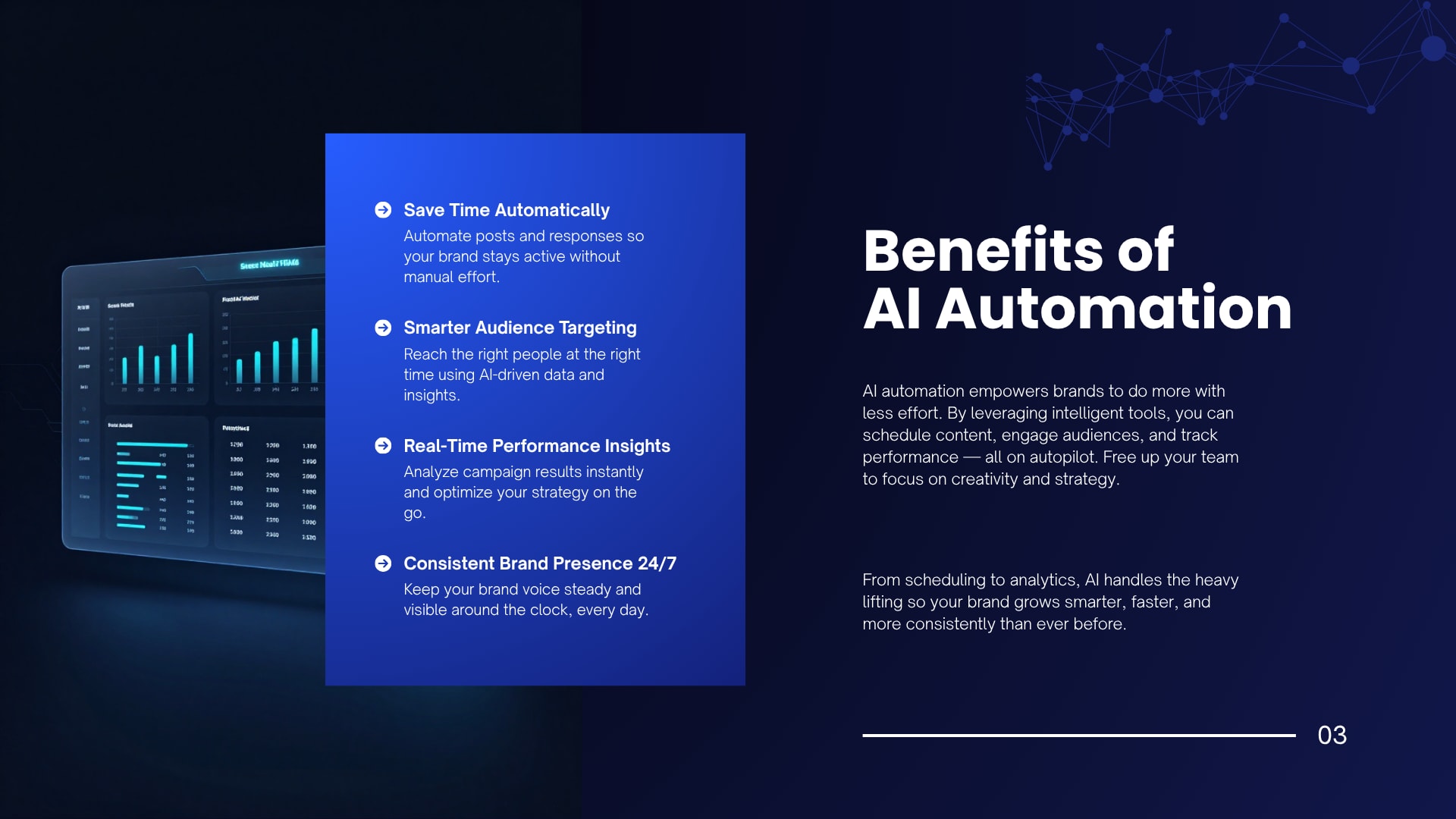
AI Social Media Marketing can provide greater workflow efficiency, faster content production, improved consistency, easier campaign organization, and reduced repetitive work. AI can help teams move from scattered manual tasks toward connected processes while leaving strategic decisions and brand judgment with human marketers.
Several benefits stand out.
Faster content development
More consistent publishing
Easier content planning
Reduced repetitive work
Better organization of campaigns
Easier content repurposing
Support for multiple social channels
More time for strategy and creative work
More structured marketing workflows
The value becomes clearer when looking at everyday marketing problems.
How can AI improve social media consistency?
Consistency is one of the most practical reasons businesses explore automated social media marketing.
A business may have excellent ideas but still struggle to publish regularly because marketing work competes with sales, customer service, operations, product development, and other responsibilities.
A content calendar can solve part of the problem, but maintaining that calendar manually takes time.
AI can assist by helping teams plan content themes, generate drafts, organize posts, and prepare schedules.
For example, a local service business might establish four content pillars:
Educational content
Customer problems
Service explanations
Company updates
Instead of deciding what to post every morning, the marketing team can organize these themes into a weekly structure.
AI can then assist with generating ideas within those boundaries.
The result is not necessarily more creativity. It is less friction.
How can AI reduce repetitive marketing work?
Repetition is where automation can have a practical impact.
Marketing teams often repeat similar activities every week:
Creating captions
Formatting posts
Preparing variations
Scheduling content
Updating calendars
Repurposing existing material
Organizing campaign assets
Preparing basic reports
These tasks still matter, but they do not always require the same level of strategic attention.
When an AI system handles suitable parts of these workflows, marketers can spend more time on activities that require judgment.
For example, instead of spending an hour turning one campaign message into five basic post drafts, a marketer may review AI-generated variations and spend more time improving the campaign concept itself.
That is a better use of automation than simply asking AI to "create viral posts."
How does AI help with content repurposing?
A business rarely needs to create every piece of content from zero.
Existing assets can often be adapted into new formats.
A long article might become:
A LinkedIn post
Several short educational posts
A carousel concept
A short video script
A list of social media tips
A question for audience discussion
A webinar can become multiple educational posts.
A product guide can become a series of social posts.
A frequently asked customer question can become an educational video topic.
This is an area where AI content creation can reduce repetitive writing while helping businesses get more value from content they have already invested in producing.
However, repurposing should not mean copying the same message everywhere.
Each platform has different user expectations.
Why should social content be adapted for each platform?
A post written for LinkedIn may not work well as an Instagram caption.
An X post may need a concise idea.
An Instagram carousel may need a strong visual sequence.
A LinkedIn audience may expect more context.
The goal of automation should therefore be adaptation rather than duplication.
AI can help produce variations, but the marketing team should check whether each version actually fits the platform.
A useful workflow might look like this:
Define the core campaign message.
Identify the audience for each channel.
Create platform-specific content variations.
Review the tone and format.
Approve the content.
Schedule or publish.
Review performance.
This preserves consistency at the campaign level without making every platform look identical.
Traditional vs AI social media marketing
Traditional Social Media MarketingAI Social Media MarketingManual planningAI-assisted planningManual content creationAI-assisted content creationManual schedulingAutomated schedulingSeparate workflowsConnected workflowsMore repetitive workGreater automationManual content repurposingAI-assisted repurposingHuman-led executionHuman-led strategy with AI-assisted execution
The table does not mean traditional marketing is ineffective.
Many successful businesses still use manual processes.
The difference is that AI can make some workflows faster and more connected.
Is AI social media marketing suitable for small businesses?
Yes, AI Social Media Marketing can be useful for small businesses when it addresses a real operational problem, such as limited marketing time, inconsistent publishing, or repetitive content production. Small businesses should start with manageable automation rather than trying to automate every social media activity at once.
A small business often has a very different challenge from a large marketing department.
There may be one person handling:
Social media
Website updates
Customer communication
Email marketing
Content writing
Basic design
For that person, saving time on repetitive tasks can be valuable.
A small business could begin with:
Defining three to five content pillars.
Creating a simple monthly content plan.
Using AI for initial content drafts.
Reviewing every post.
Scheduling approved content.
Monitoring engagement and business outcomes.
This is more realistic than attempting to build a completely autonomous marketing operation immediately.
How can businesses use AI social media marketing without losing authenticity?
Businesses can maintain authenticity by giving AI clear brand guidelines, using real business information, reviewing generated content, adding human insights, adapting posts to each platform, and avoiding generic automated messaging. AI should support the brand's existing personality rather than inventing a personality that does not match the business.
The biggest concern with AI marketing is not automation itself.
It is sameness.
If hundreds of businesses use similar prompts, similar models, and similar instructions, they can end up publishing content that sounds almost identical.
The answer is not to reject AI.
The answer is to improve the inputs and strengthen human review.
How can businesses create a strong AI content workflow?
A practical workflow can be built around five stages:
Strategy
Creation
Review
Publishing
Learning
Strategy
Before AI creates anything, the business should establish:
Marketing objectives
Target audience
Content pillars
Key messages
Brand voice
Campaign priorities
Platforms
Without this foundation, automation can simply create more content without creating better marketing.
Creation
AI can then support content generation.
This may include captions, ideas, scripts, visual concepts, variations, and repurposed content.
The goal is to create useful starting points rather than blindly accept the first output.
Review
Human review is essential.
The reviewer should ask:
Is this accurate?
Does it sound like the brand?
Is the message useful?
Is the claim supported?
Is the tone appropriate?
Does the creative match the brand?
Is the content suitable for the platform?
Publishing
Once approved, content can be scheduled or published through the relevant workflow.
Scheduling helps reduce the pressure of creating and publishing content at the same time.
Learning
Performance data can then inform future planning.
A business can look at:
Engagement
Reach
Saves
Shares
Clicks
Leads
Website visits
Conversions
The exact metrics should depend on the business objective.
A post with many likes is not necessarily more valuable than a post that produces qualified leads.
How can businesses protect their brand voice?
Brand voice should be treated as a system, not a vague instruction.
Instead of telling an AI tool to "sound professional," businesses can define what professional means for their audience.
For example:
Tone:
Clear
Helpful
Confident
Practical
Avoid:
Overly promotional language
Excessive technical jargon
Unrealistic promises
Aggressive sales language
Preferred style:
Short paragraphs
Specific examples
Clear explanations
Practical calls to action
These guidelines give AI more useful boundaries.
Human editing remains valuable because brand voice is not only about vocabulary. It is also about judgment.
What are the limitations of AI social media marketing?
AI social media marketing can produce generic content, misunderstand context, make factual errors, miss emotional nuance, and create posts that feel repetitive when human review is weak. Automation can also publish unsuitable content if workflows are poorly configured. Human oversight, clear approval rules, accurate information, and regular monitoring are therefore essential.
AI has genuine limitations.
Businesses should understand them before increasing automation.
Common limitations include:
Generic writing
Incorrect information
Weak context understanding
Repetitive ideas
Inconsistent brand voice
Poor judgment around sensitive topics
Outdated campaign information
Inappropriate automated responses
Platform-specific limitations
Dependence on accurate input data
A system can be technically efficient and still produce poor marketing.
For example, an automated campaign created before a major company announcement may become inappropriate after circumstances change.
That is why scheduled content should not always be treated as "set and forget."
When should humans always review AI-generated social content?
Human review is particularly important for:
Sensitive topics
Crisis communication
Legal or regulatory claims
Financial claims
Health-related information
Customer complaints
Public apologies
Political or social issues
Major brand announcements
Product claims
Executive communications
The more serious the potential consequences of an error, the more important human oversight becomes.
Can AI automate social media posting?
AI and social media automation tools can automate parts of the publishing process, including preparing content, scheduling posts, and publishing approved material on supported channels. The available automation depends on the platform, permissions, integrations, and tool being used. Businesses should maintain appropriate controls instead of assuming every post should publish automatically.
Scheduling is one of the easiest areas to automate.
A business can prepare several approved posts and place them into a publishing calendar.
The benefit is simple: content does not have to be manually published every day.
But automation should have boundaries.
A sensible workflow might use:
AI draft → human review → approval → scheduled publishing
A more advanced workflow might use different approval levels depending on the content type.
For example:
Educational post: standard approval
Product announcement: manager approval
Sensitive topic: senior approval
Crisis communication: fully human-led
This creates a more responsible automation system.
How can businesses balance automation with human approval?
The best automation workflow is rarely the one with the fewest human interactions.
Instead, it is the one that places human attention where it has the most value.
Routine work can be automated.
Important decisions should remain controlled.
For example:
Automate:
Draft organization
Content calendar updates
Basic formatting
Repetitive variations
Scheduling
Content repurposing
Review manually:
Core campaign strategy
Brand-sensitive content
Major announcements
Claims and facts
Customer complaints
Crisis communication
Final high-priority creative
This approach makes social media automation more practical.
How can AI help businesses build a content calendar?
A content calendar provides structure.
Without one, businesses often fall into a cycle of posting whenever someone has an idea.
AI can help turn broad campaign goals into organized content themes.
For example, a B2B software company might use these content pillars:
Product education
Industry education
Customer problems
Company expertise
Product updates
A weekly calendar could then balance those topics.
AI can help suggest ideas for each pillar, while the marketing team decides which ideas are actually worth publishing.
A good calendar should not exist simply to fill dates.
Every piece of content should have a reason.
How should businesses measure AI social media marketing results?
Businesses should measure AI social media marketing according to the business goal rather than simply counting how much content AI produces. Useful metrics can include engagement, reach, website traffic, leads, conversions, content efficiency, and publishing consistency. The most meaningful metric depends on whether the campaign is focused on awareness, engagement, traffic, or revenue.
For example, a brand-awareness campaign may prioritize:
Reach
Impressions
Video views
Shares
A lead-generation campaign may prioritize:
Clicks
Form submissions
Qualified leads
Conversion rate
A content strategy may prioritize:
Saves
Shares
Returning visitors
Engagement quality
AI should not be judged by how many posts it creates.
It should be judged by whether it helps the business execute its marketing strategy more effectively.
What should a social media performance review include?
A useful review can examine four areas.
1. Content performance
Which topics generated meaningful responses?
2. Audience response
What questions, objections, or interests appeared repeatedly?
3. Business outcomes
Did social activity contribute to traffic, leads, sales, or another defined objective?
4. Workflow efficiency
Did automation actually reduce repetitive work?
The fourth area is often overlooked.
If AI produces hundreds of drafts but the marketing team spends hours correcting them, the workflow may not actually be efficient.
The objective should be better work, not simply more work.
How can startups use AI social media marketing across multiple channels?
Startups often have limited resources but need to establish a recognizable presence quickly.
A startup may need content for LinkedIn, Instagram, Facebook, X, and other platforms while also managing product development and sales.
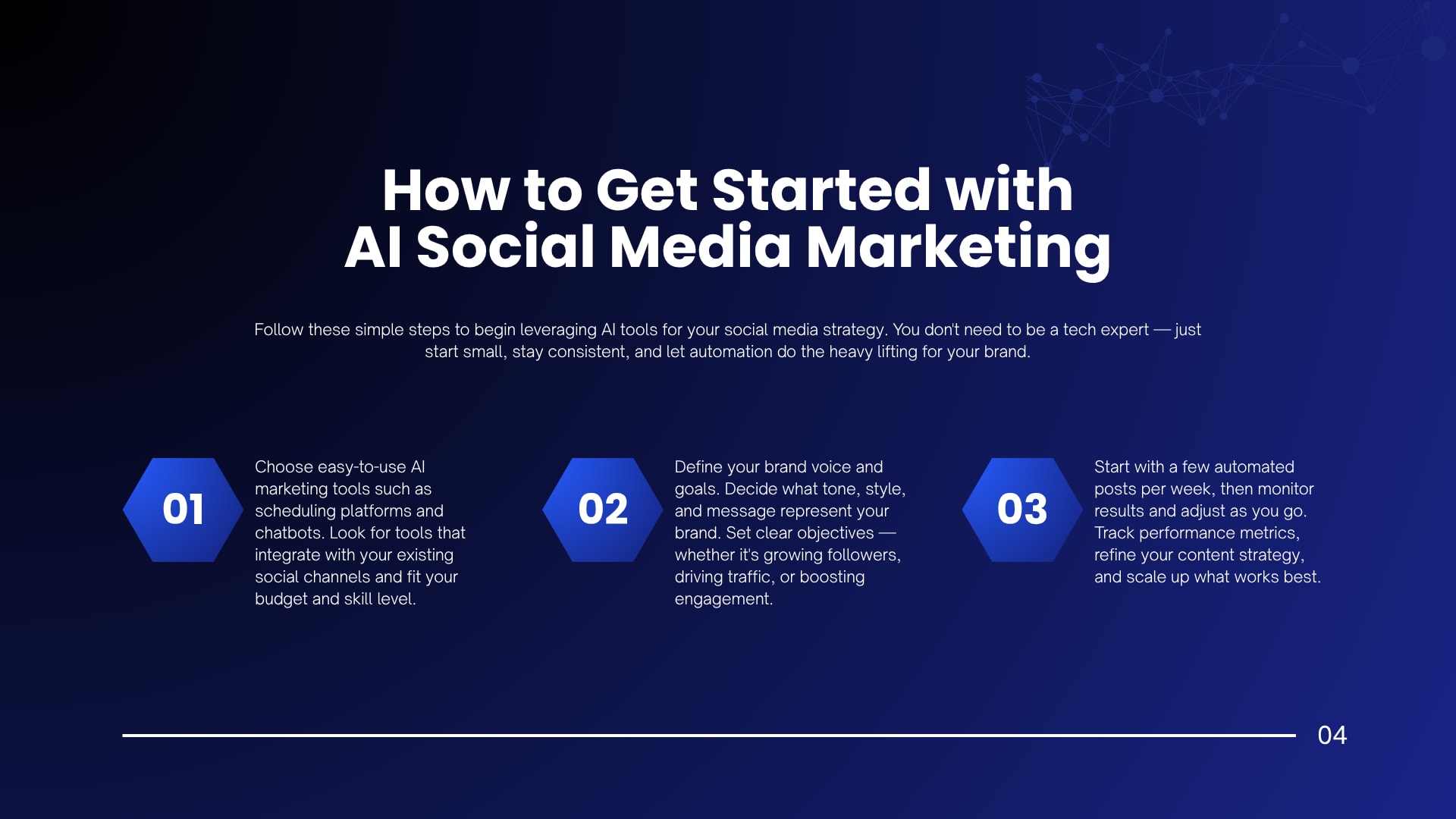
AI can help create a central campaign message and then support platform-specific adaptations.
For example:
Campaign goal: Introduce a new SaaS feature.
LinkedIn: Explain the business problem and feature value.
Instagram: Use a concise visual explanation.
X: Highlight the main benefit in a short post.
Facebook: Provide a broader explanation and call to action.
The core message remains consistent, but the presentation changes.
This is more useful than posting the exact same text everywhere.
How can marketing teams use AI for campaign planning?
Campaign planning can become easier when AI is given structured objectives.
A campaign brief may include:
Campaign goal
Target audience
Offer
Key message
Campaign period
Content pillars
Platforms
Desired action
AI can help turn that information into possible content themes and campaign assets.
A marketer can then refine the strongest ideas.
For example, a product launch might require:
Problem awareness
Product introduction
Feature education
Use case
Social proof
FAQ
Launch announcement
Follow-up content
The campaign becomes a sequence rather than a collection of unrelated posts.
What role do AI agents play in social media marketing?
AI agents are a more advanced development within marketing automation.
A basic AI tool generally waits for an instruction.
An agent-based system may be designed to carry out a sequence of connected tasks within defined boundaries.
In social media marketing, an agent-oriented workflow could potentially connect activities such as planning, content preparation, scheduling, and other repetitive marketing operations.
The important distinction is control.
An AI agent should operate within clearly defined permissions and objectives.
Businesses should understand:
What the agent can access
What actions it can take
What requires approval
What information it uses
How errors are handled
How publishing permissions are controlled
The word "agent" should not automatically be interpreted as "fully autonomous marketing department."
How can businesses choose AI social media tools?
There is no single best AI social media tool for every business.
The right choice depends on workflow, team size, channels, content requirements, approval needs, and budget.
Before selecting a platform, businesses can evaluate:
Supported social networks
Content creation capabilities
Scheduling features
Publishing options
Brand customization
Campaign planning
Visual creation
Analytics
Approval workflows
AI agent functionality
Integrations
Ease of use
Account permissions
A business should first identify its biggest bottleneck.
If the main problem is scheduling, a complex AI platform may be unnecessary.
If the main problem is managing a complete content workflow, a broader platform may make more sense.
How can TheViralMarketing help with AI social media marketing?
TheViralMarketing is an AI social media marketing platform designed to help businesses organize and support social media workflows. Based on the platform information provided for this article, businesses can add brand and business information, define goals and brand direction, plan campaigns, create social content and visuals, schedule content, and publish across supported social channels.
The platform is relevant to businesses that want more of their social media workflow connected in one place rather than relying on completely separate processes.
Its workflow can be understood through several stages.
How does TheViralMarketing use business and brand information?
A useful AI marketing workflow begins with context.
TheViralMarketing allows businesses to provide business information and brand details so that social media activities can be planned around the company's identity and goals.
This matters because AI-generated content is only as useful as the context available to the system.
A business should still define its positioning, audience, goals, and communication preferences clearly.
How can TheViralMarketing support campaign planning?
Campaign planning is different from generating isolated posts.
A campaign has a goal, a message, an audience, and a sequence of content.
TheViralMarketing is positioned to support campaign planning as part of its broader social media workflow.
This can be useful for businesses that want to move from "What should be posted today?" toward a more organized approach.
Instead of treating every post as a separate task, marketing teams can think in terms of campaigns and content themes.
How can TheViralMarketing support content creation?
The platform can support AI-generated social media content and visuals as part of the content workflow.
This can help reduce the time required for initial drafting and creative preparation.
The marketing team should still review the final output.
The purpose is to make content production more efficient, not to remove editorial judgment.
How does scheduling fit into the workflow?
Once content has been reviewed and approved, scheduling can help businesses maintain consistency.
A planned calendar can reduce last-minute publishing and make campaigns easier to coordinate.
For teams managing several social channels, having content organized within a broader workflow can also make the publishing process easier to monitor.
What is Agent Mode?
TheViralMarketing also offers Agent Mode as part of its platform.
Agent-based marketing workflows are becoming increasingly relevant because they can connect multiple tasks instead of treating AI as a simple text-generation tool.
Businesses considering Agent Mode should still understand the specific permissions, workflow controls, and capabilities available to them and use appropriate review processes for important content.
The broader principle remains the same: automation should support marketing objectives rather than become the objective itself.
Who may benefit from TheViralMarketing?
A platform like TheViralMarketing may be relevant to:
Small businesses with limited marketing resources
Startups managing multiple social channels
Marketing teams handling repetitive content workflows
Businesses seeking more consistent publishing
Teams that want AI-assisted campaign planning
Businesses looking to connect content creation and scheduling
It should be evaluated according to the actual workflow requirements of the business.
There is no need to automate tasks that are already simple to manage manually.
What should businesses avoid when using AI marketing automation?
AI becomes less useful when businesses automate without a strategy.
Several mistakes are common.
Automating before defining the brand
If the brand voice is unclear, AI can produce inconsistent communication.
Publishing without review
Automation can make mistakes faster. Speed does not compensate for inaccurate or unsuitable content.
Creating too much content
More posts do not automatically mean better marketing.
Using the same message everywhere
Each social platform has different content expectations.
Ignoring performance
A workflow should evolve based on actual results.
Making unsupported claims
AI can generate confident-sounding statements that have not been verified.
Treating AI as a replacement for strategy
Strategy still requires understanding the business, audience, market, competitors, positioning, and objectives.
How can a business start with AI social media marketing?
A business does not need to automate everything on the first day.
A gradual implementation is usually easier to manage.
Define the social media goal.
The goal might be brand awareness, lead generation, website traffic, community building, product education, or customer engagement.Define content pillars.
Choose a small number of recurring themes, such as education, product, industry insights, customer problems, and company culture.Document the brand voice.
Specify tone, writing style, preferred words, words to avoid, and communication boundaries.Create a content calendar.
Plan content before publishing becomes urgent.Introduce AI into repetitive tasks.
Start with content ideation, drafting, repurposing, or scheduling.Create an approval process.
Decide which content can move quickly and which requires additional review.Track meaningful results.
Measure the metrics connected to the campaign objective.Improve the workflow.
Use performance and team feedback to identify what should be automated further and what should remain human-led.
Why is human oversight still important?
AI can process information quickly, but marketing is not only an information-processing activity.
It involves context.
A human marketer may understand that a particular topic is inappropriate because of an internal company event. A customer complaint may require empathy rather than an automated response. A campaign may need to change because a competitor launched something unexpected.
These situations require judgment.
That is why the strongest AI social media management approach is collaborative.
AI can help with speed, structure, repetition, and scale.
Humans provide:
Strategy
Judgment
Creativity
Context
Accountability
Relationships
Brand leadership
This balance also helps businesses avoid the biggest weakness of automated content: content that technically works but emotionally feels empty.
Is AI replacing social media managers?
AI is more likely to change the role of social media managers than simply eliminate it. As automation handles more repetitive tasks such as drafting, scheduling, and content organization, human marketers can spend more time on strategy, creative direction, audience understanding, brand management, and performance decisions.
The role of a social media professional may gradually become less focused on manual production.
Instead of spending most of the day preparing individual posts, a marketer may spend more time:
Building campaigns
Understanding customers
Reviewing AI output
Managing brand voice
Studying performance
Developing creative concepts
Coordinating marketing activities
Making strategic decisions
This is not a completely new pattern.
Technology has repeatedly changed marketing workflows.
The important skill is learning how to use the technology without losing the fundamentals of marketing.
What does the future of automated social media marketing look like?
The future is likely to involve more connected marketing workflows.
Instead of separate tools for every step, businesses may increasingly work with systems that connect:
Strategy → campaign → content → creative → approval → scheduling → publishing → analytics → optimization
AI agents may also make these workflows more proactive.
However, increased automation will make governance more important, not less.
Businesses will need clear rules around:
Brand voice
Content approval
Platform permissions
Data access
Accuracy
Sensitive topics
Publishing
Human review
The most valuable systems will not necessarily be the ones that automate the greatest number of actions.
They will be the ones that automate useful work while preserving appropriate human control.
Frequently asked questions about AI social media marketing
What is AI social media marketing?
AI Social Media Marketing is the use of artificial intelligence to support social media marketing activities such as content planning, content creation, campaign development, scheduling, publishing, repurposing, and analysis. It can reduce repetitive work and help organize marketing workflows, while strategy, brand direction, and important decisions remain under human control.
How does AI social media marketing work?
AI social media marketing works by using business information, audience details, marketing goals, brand guidelines, and platform requirements to support different stages of the social media workflow. Depending on the tool, AI can help generate ideas, create content, develop visuals, plan campaigns, schedule posts, and support publishing or analysis.
Can AI create social media posts?
Yes. AI can create drafts for captions, posts, scripts, content ideas, and other social media formats. The quality depends on the information and instructions provided. Human review is important because AI can produce generic wording, misunderstand context, or include information that needs verification.
Can AI automate social media publishing?
Yes, supported AI and social media management platforms can automate parts of the publishing process, such as scheduling approved content and publishing it to supported channels. Automation capabilities vary by platform and integration. Businesses should establish appropriate approval controls rather than assuming every AI-generated post should be published automatically.
Is AI social media marketing good for small businesses?
It can be useful for small businesses that struggle with limited marketing time, inconsistent posting, or repetitive content tasks. AI can assist with planning, drafting, repurposing, and scheduling. Small businesses should begin with practical tasks that solve a clear problem instead of trying to automate their entire marketing operation.
What are the limitations of AI social media marketing?
The main limitations include generic content, factual errors, weak contextual understanding, repetitive ideas, inappropriate messaging, and limited judgment around sensitive situations. Automation can also amplify mistakes if content is published without review. Clear brand guidelines, reliable information, approval processes, and human oversight help reduce these risks.
Will AI replace social media managers?
AI is unlikely to make human social media expertise irrelevant. Instead, it can automate parts of the repetitive execution process. Social media professionals can increasingly focus on strategy, creative direction, audience understanding, brand management, campaign decisions, and performance analysis while AI supports production and organization.
How can businesses keep AI-generated content authentic?
Businesses can keep AI-generated content authentic by providing accurate brand information, defining a clear brand voice, using real examples, avoiding generic claims, reviewing content before publishing, and adding human insight. AI should help express the brand's existing identity rather than create an artificial personality disconnected from the business.
Is automated social media marketing completely hands-free?
It should not automatically be treated as completely hands-free. Different platforms and tools provide different levels of automation. More importantly, some marketing decisions require human judgment. A responsible workflow can automate repetitive tasks while keeping approval and oversight for sensitive, strategic, or high-impact content.
How should businesses measure AI social media marketing results?
Businesses should measure results based on the campaign objective. Relevant metrics may include reach, engagement, shares, saves, website traffic, leads, conversions, or publishing efficiency. The number of AI-generated posts is not a meaningful success metric by itself. The key question is whether AI is helping the business achieve its marketing goals more efficiently.
What is the best way to start using AI for social media?
The best approach is gradual. Businesses can begin by defining their goals, content pillars, audience, and brand voice. They can then use AI for one or two repetitive activities, such as content ideation, drafting, repurposing, or scheduling. After reviewing the results, the workflow can be expanded where automation provides genuine value.
Conclusion: Can AI social media marketing really put a brand on autopilot?
AI Social Media Marketing can make social media execution more organized, consistent, and efficient, but "autopilot" should not mean removing humans from the marketing process. AI is most useful when it handles suitable repetitive work while people continue to control strategy, brand voice, quality, context, and important decisions.
The biggest opportunity is not simply generating more social media posts.
It is building a better workflow.
A business can use AI to organize content ideas, support campaign planning, create drafts and visuals, repurpose existing material, schedule approved content, and connect different stages of social media management. That can reduce repetitive work and give marketing teams more time for activities that require genuine judgment.
At the same time, businesses should recognize the limitations. AI can make mistakes. It can sound generic. It can misunderstand context. Automated content can become outdated. And publishing more frequently does not guarantee better business results.
The strongest approach is therefore balanced.
AI can handle repetition.
Humans can provide direction.
AI can generate possibilities.
Humans can decide what is worth publishing.
AI can help organize campaigns.
Humans can understand the business and its customers.
For businesses exploring a more connected workflow, TheViralMarketing can be considered as one practical AI social media marketing solution. Its platform brings together business and brand information, campaign planning, AI-assisted content and visual creation, scheduling, publishing across supported social channels, and Agent Mode within its broader workflow.
Businesses can explore TheViralMarketing and determine whether its current capabilities fit their social media workflow and desired level of automation.
The future of social media marketing is not necessarily about choosing between humans and AI.
It is about using both where each is strongest.
AI can make the process faster.
Human marketers can make it meaningful.
And when automation is guided by a clear strategy, strong brand voice, careful review, and measurable goals, social media marketing can become a more consistent and sustainable part of business growth.
Tags
Admin
Content creator and technology enthusiast sharing insights on the latest trends and best practices.