How AI Is Transforming Social Media Marketing
Artificial intelligence is changing how businesses plan, create, publish, analyze, and optimize social media content. AI social media marketing uses intelligent software to support tasks such as content creation, audience research, scheduling, personalization, campaign planning, customer engagement, and performance analysis. Instead of treating AI as a replacement for marketers, businesses can use it as a productivity layer that reduces repetitive work while leaving strategy and brand judgment to people.
Social media marketing has traditionally required marketers to move between content calendars, design tools, publishing platforms, analytics dashboards, advertising systems, and customer conversations. AI is bringing many of these activities closer together. It can help identify patterns in audience behavior, suggest content ideas, generate first drafts, repurpose existing material, automate repetitive workflows, and highlight performance changes that deserve attention.
The shift is already visible across major social platforms. Meta, for example, has introduced AI-powered tools for content creation, video editing, personalization, and translation. Its AI-powered Reels translation features have expanded across multiple languages, including several Indian languages, showing how artificial intelligence can help creators reach audiences beyond their original language markets.
For businesses, the real opportunity is not simply producing more posts. It is building a smarter social media workflow in which human creativity, customer understanding, and strategic thinking are supported by automation and data.
What Is AI Social Media Marketing?
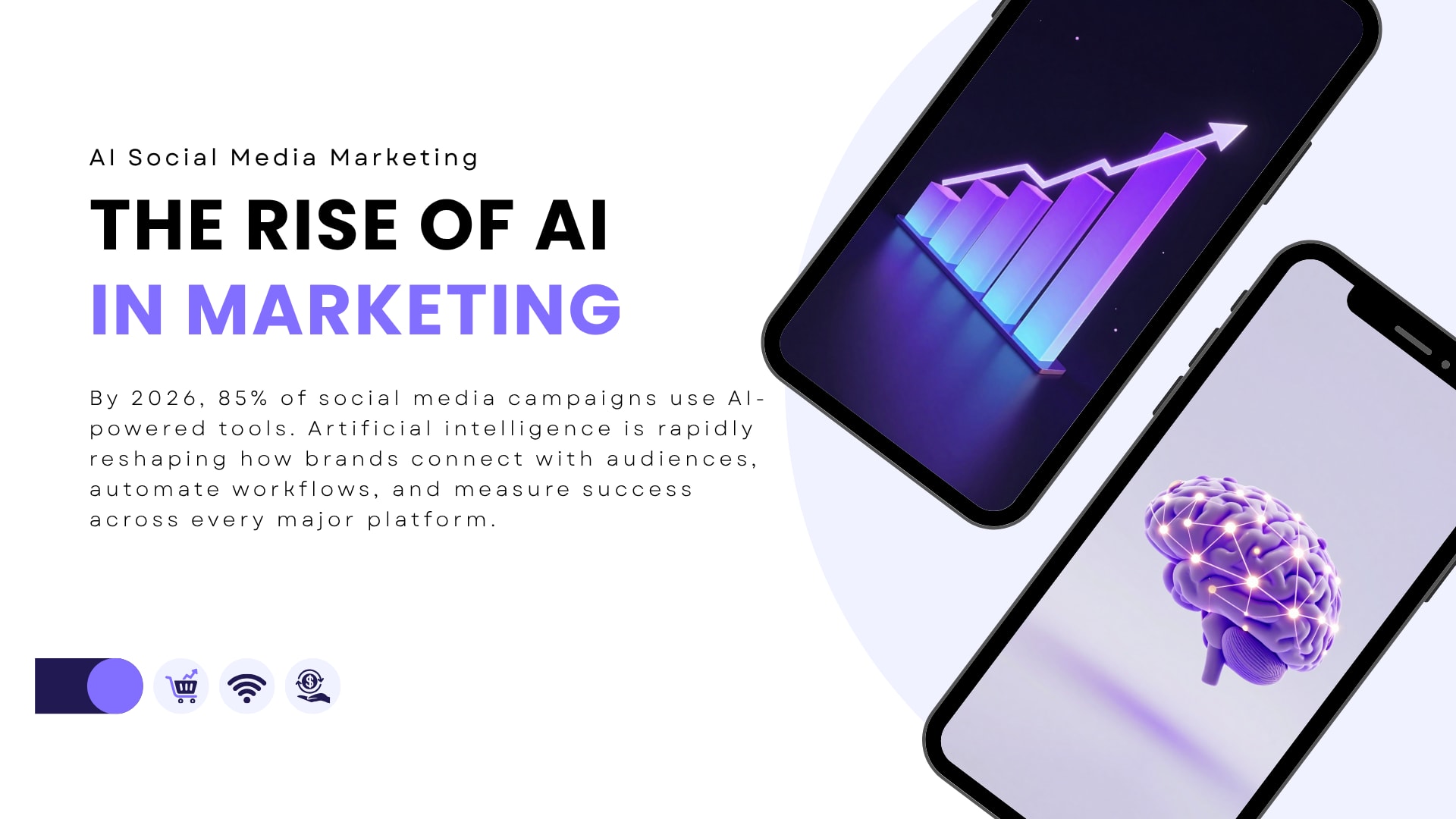
AI social media marketing is the use of artificial intelligence technologies to support and improve social media marketing activities, including content planning, content creation, audience analysis, scheduling, customer engagement, campaign optimization, and reporting.
Traditional social media management often depends heavily on manual research and repetitive execution. A marketer may spend hours researching topics, writing captions, resizing content, scheduling posts, checking comments, compiling reports, and identifying which posts performed best. AI can assist with many of these activities and make the overall workflow faster and more organized.
AI social media marketingdoes not mean that a business gives complete control of its social accounts to software. A stronger approach is to use AI for tasks where speed, pattern recognition, and repetition matter while keeping humans responsible for brand voice, positioning, ethics, creativity, and important decisions.
How Does AI Change Traditional Social Media Marketing?
AI changes social media marketing by moving many workflows from manual execution toward assisted decision-making and automation.
For example, instead of manually reviewing dozens of previous posts to identify successful themes, an AI-powered system can help analyze content patterns. Instead of starting every caption from a blank document, marketers can use AI to generate drafts that are then reviewed and refined.
The major changes include:
Faster content ideation
Assisted caption and copywriting
Automated content repurposing
Smarter scheduling
Audience segmentation
Personalized communication
Automated reporting
Faster performance analysis
Workflow automation
Improved multilingual content creation
More efficient customer engagement
The value comes from connecting these activities into one workflow rather than treating AI as a collection of isolated tools.
Why Is AI Becoming Important for Social Media Teams?
Social media requires constant activity, but marketing teams often have limited time and resources. Businesses need to maintain consistency while responding quickly to trends, audience questions, platform changes, and performance data.
AI can reduce the time required for repetitive tasks. This allows marketers to spend more time on activities that require judgment, such as defining the brand message, understanding customers, developing campaigns, and creating original concepts.
Meta has also described AI, Reels, and business messaging as technologies changing the agency ecosystem and the skills agencies need to develop.
The result is a shift from simply asking, “How many posts can a team publish?” toward a more useful question: “How efficiently can a team create, distribute, understand, and improve meaningful content?”
How Is AI Changing Social Media Marketing?
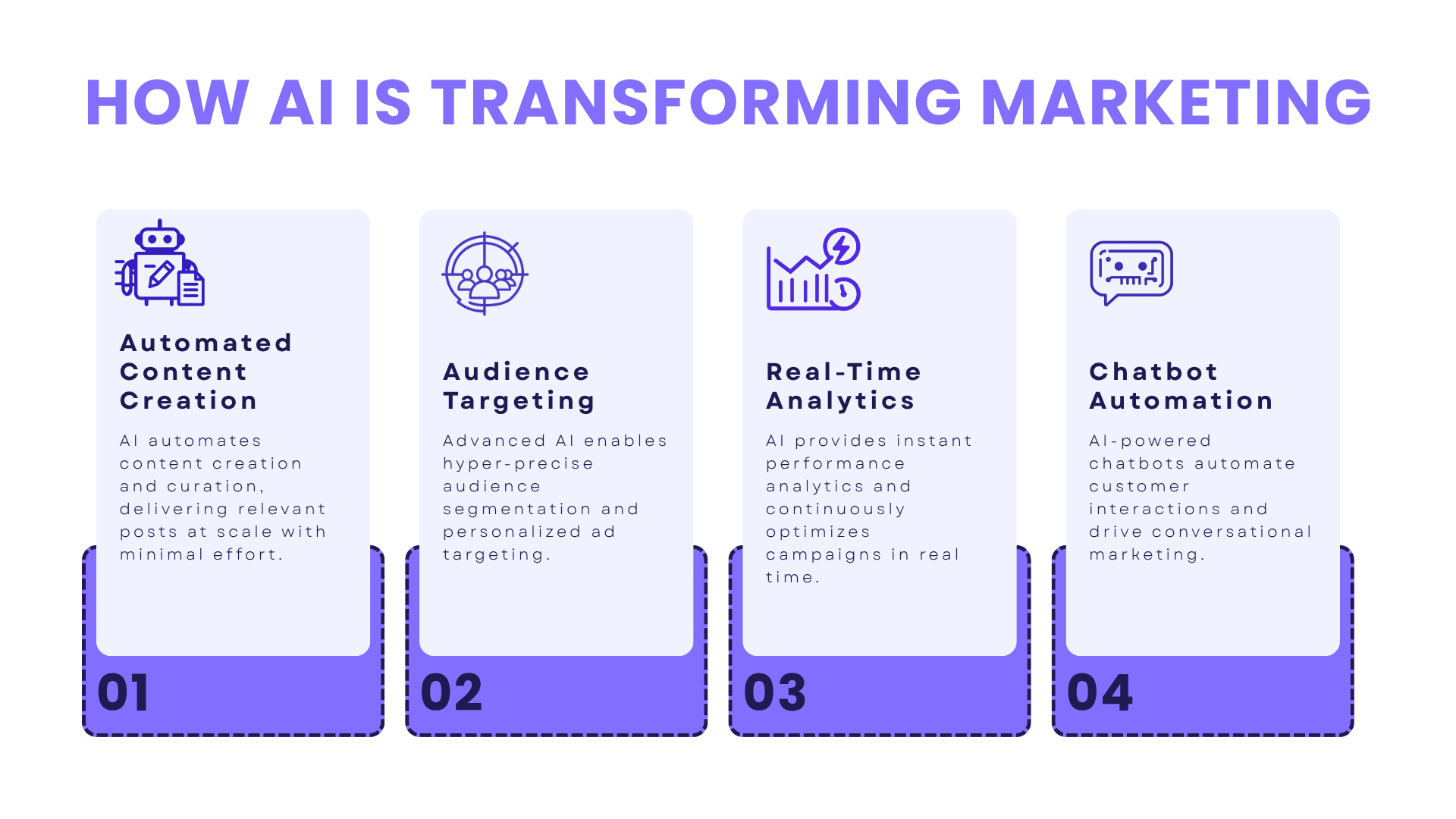
AI is changing social media marketing across almost every stage of the marketing workflow, from the first content idea to post-publication analysis. It can help marketers discover patterns, create drafts, automate repetitive activities, personalize communication, and identify opportunities for optimization.
The transformation is especially useful when a business manages several social platforms or produces content frequently.
How Does AI Help With Social Media Strategy?
AI can support strategy by processing large amounts of information and organizing it into useful patterns. It can examine historical content performance, audience interests, engagement patterns, frequently discussed topics, and campaign results.
For example, a fitness business may discover that educational posts about simple workout mistakes consistently generate more meaningful engagement than generic motivational quotes. AI can help identify this pattern more quickly, but the marketer still needs to decide how that insight should influence the broader strategy.
AI can assist with:
Topic discovery
Competitor content analysis
Audience research
Content pillar development
Campaign idea generation
Trend monitoring
Content calendar planning
Performance pattern identification
The important distinction is that AI can support strategic thinking without becoming the strategy itself.
Can AI Help Identify Content Opportunities?
Yes. AI can analyze existing content and help identify gaps or opportunities.
A business with hundreds of previous posts may have useful information hidden in its historical performance. Some topics may repeatedly generate saves, shares, comments, clicks, or leads. Other topics may receive impressions but little meaningful action.
AI can help categorize this information and suggest areas worth exploring.
For example, a software company may discover three strong content themes:
Practical tutorials generate saves.
Customer problems generate comments.
Product demonstrations generate website visits.
Instead of producing random content, the company can build a content system around these observed patterns.
The human marketer remains responsible for determining whether those patterns genuinely reflect business priorities.
How Can AI Create Social Media Content?
AI can create or assist with social media content by generating ideas, captions, headlines, scripts, visual concepts, summaries, variations, and repurposed versions of existing material.
AI content creation is one of the most visible applications of artificial intelligence in marketing because it can reduce the time required to move from an idea to a usable draft.
What Can AI Create for Social Media?
Depending on the platform and tool, AI can assist with:
Instagram captions
LinkedIn posts
Short-form video scripts
Social media headlines
Ad copy variations
Content hooks
Content calendars
Carousel copy
Video concepts
Image concepts
Hashtag suggestions
Repurposed content
Short summaries
Frequently asked question content
The strongest workflow is usually not “AI creates everything.” Instead, it is “AI creates a useful starting point that a marketer improves.”
Why Is Human Editing Still Necessary?
AI-generated content can be grammatically correct while still sounding generic. It may also misunderstand a company's positioning, use an inappropriate tone, repeat familiar phrases, or create claims that cannot be supported.
A marketer should therefore review AI-generated content for:
Accuracy
Brand voice
Originality
Context
Cultural sensitivity
Legal or compliance concerns
Factual claims
Audience relevance
Platform suitability
For example, a healthcare company should not publish an AI-generated medical claim without appropriate human review. A financial brand should also apply additional scrutiny to statements involving money, investments, or financial outcomes.
AI can accelerate production, but responsibility remains with the business.
How Can AI Repurpose Existing Content?
Content repurposing is another important use of AI.
A single long-form article can potentially become:
A LinkedIn post
Several short social posts
A carousel outline
A short video script
A series of educational questions
A newsletter section
A social media discussion prompt
AI can help transform the original material into different formats while preserving its central message.
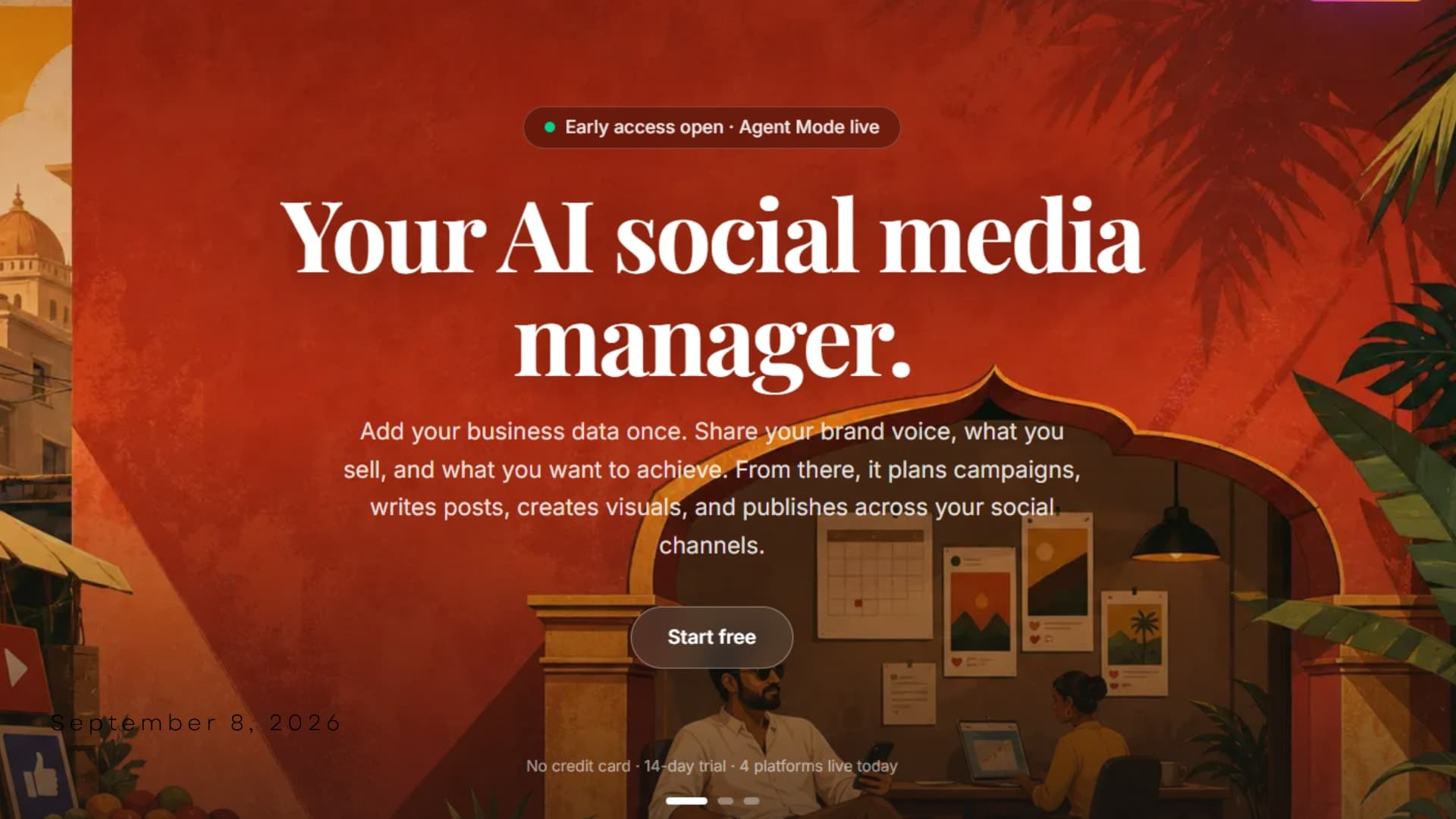
An AI-powered social media platform such as TheViralMarketing can fit into this type of workflow by helping businesses approach content planning and social media management as a connected process rather than a collection of separate manual tasks.
How Can AI Improve Social Media Campaign Planning?
AI can improve campaign planning by helping marketers organize objectives, audiences, content themes, creative variations, publishing schedules, and performance indicators.
Campaign planning becomes difficult when multiple platforms, audiences, and content formats are involved. A campaign may require different messages for Instagram, LinkedIn, Facebook, TikTok, or other channels even when the central idea remains the same.
AI can help structure the campaign around the main business objective.
What Can AI Do During Campaign Planning?
A useful AI-assisted campaign planning process can include:
Define the campaign objective.
Identify the target audience.
Establish the core message.
Develop content themes.
Generate content variations.
Assign content to platforms.
Create a publishing schedule.
Establish measurement criteria.
Review early performance.
Optimize based on evidence.
For example, an e-commerce company launching a new product could use AI to generate multiple creative angles. One angle may focus on the product problem, another on product benefits, and another on customer education.
The marketing team can then select the strongest concepts instead of blindly publishing every generated variation.
Can AI Help With Campaign Personalization?
AI can support personalization by helping businesses organize audiences into meaningful groups.
An audience may contain:
First-time visitors
Existing customers
Repeat buyers
High-engagement followers
Potential customers
Customers who stopped engaging
Users interested in specific product categories
Different groups may respond to different messages.
A new customer may need educational content, while an existing customer may respond better to product updates or loyalty-focused communication.
Personalization becomes more useful when it is based on legitimate customer signals rather than assumptions.
Meta has increasingly incorporated AI into recommendations and personalization across its ecosystem. The company has stated that AI-related interactions can contribute to how content and advertising recommendations are personalized on its platforms.
How Does AI Automate Social Media Management?
AI social media automation uses software to reduce repetitive activities involved in planning, creating, scheduling, monitoring, and analyzing social content.
Automation does not necessarily mean that every action happens without human approval. In many cases, the safest model is human-approved automation, where AI prepares or recommends an action and a marketer reviews it before publication.
Which Social Media Tasks Can Be Automated?
Common automation opportunities include:
Content scheduling
Publishing
Caption drafting
Content categorization
Repurposing
Basic reporting
Comment classification
Engagement monitoring
Performance alerts
Content calendar management
Workflow notifications
For a small business, this can make a meaningful difference.
A local business owner may not have time to manually publish content every day. A structured AI social media automation workflow can allow the owner or marketer to prepare content in advance, organize it into a calendar, and reduce repetitive publishing work.
What Is Automated Social Media Management?
Automated social media management combines scheduling, content workflows, analytics, and other repetitive marketing activities into a more systematic process.
Instead of opening several platforms individually every day, a business can create a centralized workflow.
For example:
Idea → Draft → Review → Approval → Schedule → Publish → Monitor → Analyze → Improve
AI can assist at several stages of this sequence.
TheViralMarketing can be considered within this broader category of AI-powered social media management because its positioning is centered on helping businesses streamline social media activities and automation rather than treating every marketing task as a completely manual process.
Should Businesses Automate Everything?
No.
Some activities should remain human-led.
These include:
Crisis communication
Sensitive customer complaints
Major brand announcements
Political or controversial subjects
Legal or regulatory communication
Highly personal customer conversations
Strategic positioning
Important partnerships
Reputation management
Automation is most useful when the task is repetitive, predictable, and low risk.
How Can AI Help With Social Media Scheduling and Publishing?
AI can make scheduling more efficient by helping businesses organize content around publishing frequency, platform requirements, audience behavior, campaign timelines, and content categories.
A marketer can create a content calendar manually, but AI can help identify gaps, balance content types, and suggest possible publishing sequences.
What Does AI Scheduling Look Like?
An AI-assisted scheduling workflow may look like this:
Content is added to a central library.
AI identifies content categories.
Posts are assigned to suitable platforms.
Suggested publishing times are generated.
The marketer reviews the calendar.
Approved posts are scheduled.
Performance is monitored.
Future scheduling decisions are adjusted.
This creates a feedback loop.
Instead of creating a calendar once and leaving it unchanged, marketers can use performance data to improve future scheduling.
Can AI Schedule Content Across Multiple Platforms?
Many social media management systems are designed to support multiple channels, although the exact capabilities vary by platform and software.
Cross-platform management is particularly valuable for businesses that maintain a presence on LinkedIn, Instagram, Facebook, X, TikTok, or other networks.
However, identical content should not always be copied across every platform.
A professional LinkedIn audience may respond to detailed business insights, while Instagram may require stronger visual storytelling. AI can help create variations, but platform-specific judgment is still required.
How Does AI Help With Audience Research and Personalization?
AI can help marketers understand audiences by organizing behavioral, engagement, content, and campaign information into useful patterns. It can identify recurring interests, questions, content preferences, and audience segments that may be difficult to detect manually.
Audience research is one of the areas where AI's ability to process large quantities of information becomes particularly useful.
What Can AI Learn From Social Media Data?
Depending on available data and permissions, AI-assisted analysis may identify:
Frequently discussed topics
Common customer questions
High-performing content categories
Engagement patterns
Audience interests
Content preferences
Sentiment patterns
Campaign responses
Platform differences
The quality of the insight depends heavily on the quality and relevance of the underlying data.
How Does Personalization Improve Social Media Marketing?
Personalization can make communication more relevant by aligning messages with audience interests.
For example, an online education company may have audiences interested in:
Digital marketing
Data analytics
Artificial intelligence
Business management
A single generic post may not be equally useful to all four groups.
AI can help marketers develop variations that address different interests while maintaining a consistent brand identity.
Meta has continued expanding AI-powered personalization and creative capabilities, including AI-assisted content creation and multilingual Reels features that can help creators reach broader audiences.
How Does AI Improve Social Media Analytics?
AI improves social media analytics by helping marketers move beyond collecting numbers toward identifying patterns and possible explanations.
Traditional reports often contain metrics such as reach, impressions, clicks, engagement, follower growth, and conversions. The difficult part is understanding what those numbers mean and what should happen next.
AI can help organize performance information and surface unusual changes or recurring patterns.
Which Social Media Metrics Matter?
The right metrics depend on the business objective.
For awareness campaigns, marketers may focus on:
Reach
Impressions
Video views
View duration
Brand visibility
For engagement-focused campaigns:
Comments
Shares
Saves
Replies
Engagement rate
For lead-generation campaigns:
Leads
Landing-page visits
Form completions
Cost per lead
Qualified leads
For sales campaigns:
Purchases
Revenue
Conversion rate
Return on advertising spend
Customer acquisition cost
AI should not encourage businesses to track every available metric. It should help teams focus on measurements connected to actual objectives.
Can AI Predict Social Media Performance?
AI can assist with forecasting and pattern analysis, but predictions should not be treated as guarantees.
Social media performance depends on many changing factors, including creative quality, audience behavior, competition, platform distribution, timing, seasonality, current events, and campaign execution.
A responsible marketer should treat AI predictions as decision-support information rather than certainty.
How Can AI Turn Analytics Into Action?
The real value of analytics appears when insights lead to action.
For example:
Observation: Educational videos receive stronger saves.
Possible insight: The audience values practical information.
Action: Produce more educational video content.
Measurement: Compare future saves, shares, clicks, and conversions.
This creates a continuous improvement process.
Google Analytics has also expanded its reporting capabilities around AI-driven discovery. Its 2026 updates include an AI Assistant traffic channel designed to help businesses identify traffic originating from recognized AI assistants and compare it with other acquisition sources.
This broader shift demonstrates that marketers increasingly need to understand not only traditional social traffic but also how AI influences discovery and customer journeys.
What AI Marketing Tools Can Businesses Use for Social Media Marketing?
AI marketing tools range from writing assistants and image generators to social media management platforms, analytics systems, customer engagement tools, and automation platforms.
The right tool depends on the business objective rather than the popularity of the software.
What Should Businesses Look For in an AI Social Media Platform?
A useful AI social media platform should ideally provide capabilities that match the business workflow.
Important considerations include:
Content creation support
Scheduling
Multi-platform management
Analytics
Approval workflows
Automation
Content organization
Brand customization
Integration options
User permissions
Data protection
Ease of use
A small business may value simplicity more than a large enterprise dashboard with hundreds of features.
Businesses exploring AI-powered content and social media management can also consider platforms such as TheViralMarketing when evaluating how automation could fit into their publishing workflow.
Are More AI Tools Always Better?
No.
Using too many disconnected tools can create another problem: workflow fragmentation.
A business might use one AI tool for captions, another for images, another for scheduling, another for analytics, and another for customer communication. Employees then spend time moving information between systems.
A smaller, connected technology stack can sometimes be more efficient.
The objective should be to simplify the workflow, not collect as many AI tools as possible.
What Are the Benefits of AI Social Media Automation?
The main benefits of AI social media automation include time savings, improved consistency, faster content production, better organization, scalable personalization, and more efficient analysis.
However, the value depends on how automation is implemented.
How Does AI Save Marketing Time?
AI can reduce repetitive work.
A marketer may previously have spent an hour researching content ideas, another hour drafting captions, and additional time formatting and scheduling posts.
AI can shorten parts of this process by generating initial ideas, creating drafts, organizing content, and assisting with scheduling.
The saved time can then be redirected toward:
Strategy
Creative development
Customer research
Campaign optimization
Community engagement
Business development
How Does AI Improve Consistency?
Consistency does not mean publishing identical content every day.
It means maintaining a recognizable communication style, publishing rhythm, and strategic direction.
AI can help businesses maintain content calendars and reduce the likelihood of long gaps between posts.
A small company with limited staff can particularly benefit from this type of workflow.
How Can AI Help Small Businesses?
AI social media management can be especially useful for small businesses because they often have limited marketing staff.
A business owner may understand customers extremely well but lack time for daily content production.
An AI-assisted workflow can help transform the owner's knowledge into structured content.
For example, a restaurant owner may provide answers to common customer questions. AI can turn those answers into content ideas, captions, short scripts, and educational posts. The owner can then review the content before publication.
This keeps expertise at the center while reducing production effort.
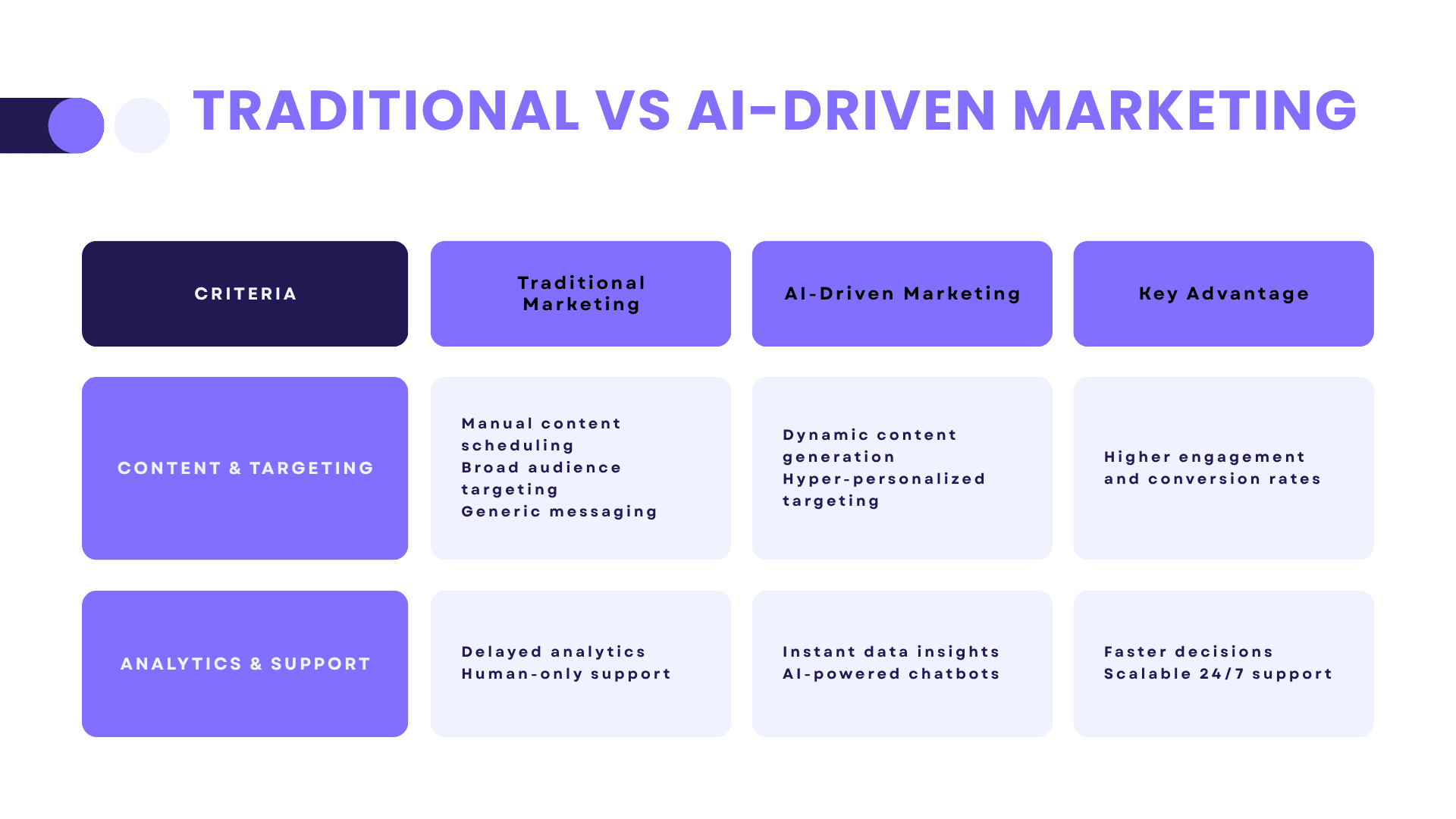
Traditional Social Media Management vs AI Social Media Marketing
Traditional Social Media Management AI social media marketing More manual researchAI-assisted research and pattern discoveryManual content draftingAI-assisted content generationManual schedulingAutomated or AI-assisted schedulingSeparate reporting tasksAutomated reporting and analysisLimited personalization at scaleAI-assisted audience segmentationMore repetitive executionGreater workflow automationHuman-led analysisHuman judgment supported by AI analysisSlower content repurposingFaster content transformation
The comparison does not mean that traditional marketing becomes irrelevant. Human strategy remains important in both approaches. AI changes how efficiently many operational tasks can be performed.
What Are the Limitations of AI in Social Media Marketing?
AI has significant limitations. It can generate incorrect information, produce repetitive content, misunderstand context, miss cultural nuances, and make recommendations based on incomplete data.
AI also cannot automatically understand every aspect of a brand's identity or customer relationships.
Can AI Replace Social Media Marketers?
AI is unlikely to eliminate the need for skilled social media marketers because successful marketing involves judgment, creativity, empathy, positioning, communication, and business understanding.
AI can replace or reduce certain repetitive tasks, but that is different from replacing the complete marketing function.
The role of the marketer is likely to evolve.
Instead of spending most of the day performing repetitive execution, marketers may increasingly spend more time:
Directing AI systems
Reviewing outputs
Developing strategy
Studying customers
Building campaigns
Managing brand reputation
Interpreting data
Creating original concepts
The marketer becomes less of a manual operator and more of a strategic editor and decision-maker.
What Problems Can Poor AI Automation Create?
Poorly designed automation can create serious problems.
For example:
Incorrect posts may be published.
Customer complaints may receive inappropriate responses.
AI-generated claims may be inaccurate.
Brand voice may become inconsistent.
Content may become repetitive.
Sensitive information may be handled improperly.
Businesses may accidentally publish content that lacks originality.
Automation should therefore include safeguards.
A useful principle is:
Automate repetition, not responsibility.
Why Does Brand Voice Matter?
A brand voice creates recognition.
If every post sounds like generic AI-generated marketing copy, audiences may struggle to distinguish the company from competitors.
AI should be trained or guided with clear brand information, including:
Target audience
Brand personality
Preferred vocabulary
Topics to avoid
Communication style
Product positioning
Customer concerns
Brand values
Even then, human review remains valuable.
How Can Businesses Adopt AI Social Media Marketing Responsibly?
Businesses can adopt AI responsibly by starting with specific workflow problems instead of adopting AI simply because it is trending.
The most practical approach is gradual.
What Is the Best Way to Start With AI?
A business can begin with one repetitive process.
For example:
Step 1: Identify the bottleneck.
Perhaps content creation takes too much time.
Step 2: Choose one AI-supported workflow.
Use AI for content ideation and first drafts.
Step 3: Establish human review.
Every generated post is reviewed before publication.
Step 4: Measure the improvement.
Track time saved and content performance.
Step 5: Expand carefully.
Once the workflow is reliable, introduce scheduling or analytics automation.
This approach reduces unnecessary complexity.
How Should Businesses Create an AI Content Workflow?
A practical workflow can be structured as:
Research → Strategy → AI Draft → Human Review → Brand Editing → Approval → Scheduling → Publishing → Analytics → Optimization
Each stage has a clear purpose.
AI can assist with research, drafting, organization, and analysis, while humans remain responsible for strategic and editorial decisions.
Platforms designed around AI social media automation can help businesses organize more of these steps within a structured system. TheViralMarketing is one example businesses can examine when considering an automated social media marketing workflow.
What Are Practical AI Social Media Marketing Use Cases?
AI becomes easier to understand when viewed through realistic business situations.
E-Commerce
An e-commerce brand can use AI to develop product-focused content, create variations for different platforms, organize promotional calendars, and analyze which products receive the strongest engagement.
AI can also help transform product information into educational posts instead of relying entirely on promotional content.
Real Estate
A real estate business can use AI to turn property information into content ideas, neighborhood education, frequently asked questions, and short-form video scripts.
Human agents still need to verify property information and avoid unsupported claims.
Healthcare
Healthcare businesses can use AI for general educational content, content organization, social media scheduling, and audience question analysis.
However, medical information requires careful human review. AI-generated health claims should never be published automatically without appropriate verification.
Education
Educational institutions can use AI to repurpose course information into social content, explain common questions, create student-focused content themes, and organize campaign calendars.
AI can help scale communication while maintaining a consistent educational message.
B2B Technology
Technology companies can use AI to turn complex subjects into simpler educational posts, create thought-leadership ideas, repurpose technical articles, and identify questions frequently raised by prospects.
This can help B2B brands maintain an active social presence without requiring every post to start from scratch.
What Is the Future of AI-Powered Social Media Marketing?
The future of AI-powered social media marketing is likely to involve deeper automation, stronger personalization, multimodal content creation, AI-assisted customer interaction, multilingual communication, and increasingly connected marketing workflows.
The direction is already visible in platform development.
Meta has introduced AI tools that support image creation, video editing, translation, personalization, and short-form AI-generated video experiences.
Will AI Make Social Media More Personalized?
Personalization is likely to become more sophisticated as platforms gain more AI capabilities.
Instead of showing the same content experience to everyone, platforms can increasingly use behavioral signals and contextual information to determine what may be more relevant to individual users.
For marketers, this means generic messaging may become less effective.
Businesses will need to understand specific audience segments and create content that genuinely addresses their interests.
Will AI-Generated Video Become More Important?
Video is already central to social media, and AI is lowering the technical barriers to video creation.
AI-assisted editing can help marketers change visual elements, create variations, translate content, and experiment with different creative concepts.
Meta's AI video editing tools demonstrate how generative AI is becoming integrated into short-form video creation workflows.
The challenge will be maintaining originality. When production becomes easier for everyone, creative differentiation becomes more important.
Will Multilingual Social Media Become Easier?
Yes, AI-powered translation is making multilingual content production more accessible.
Meta has expanded AI-powered Reels translation across multiple languages, including Hindi, Bengali, Tamil, Telugu, Marathi, Kannada, French, German, Italian, Japanese, and Korean as part of its continuing rollout.
For businesses, this can create opportunities to communicate with audiences that previously required separate production processes.
However, literal translation is not always enough. Cultural context, humor, tone, and local expressions still require human understanding.
Will AI Social Media Managers Become More Common?
AI social media managers are likely to become more capable as tools combine content creation, scheduling, analytics, audience research, and automation.
The important change may be the move from isolated AI features to connected AI agents and workflows.
Instead of asking separate tools to write captions, analyze data, and schedule posts, marketers may increasingly interact with systems that can coordinate multiple steps.
Even then, businesses should maintain approval controls for important activities.
Frequently Asked Questions About AI Social Media Marketing
What is AI social media marketing?
AI social media marketing is the use of artificial intelligence to support social media activities such as content creation, audience research, scheduling, personalization, analytics, customer engagement, and marketing automation. It helps marketers reduce repetitive work while keeping humans involved in strategy and decision-making.
Can AI create social media posts?
Yes. AI can generate social media post ideas, captions, headlines, scripts, content variations, and other drafts. However, human review is recommended because AI-generated content can contain factual errors, inappropriate wording, repetitive language, or messages that do not match a brand's voice.
How does AI automate social media management?
AI can automate or assist with tasks such as content planning, caption generation, scheduling, publishing workflows, content categorization, reporting, performance analysis, and engagement monitoring. The most effective systems combine automation with human approval rather than allowing every action to happen without supervision.
Is AI social media marketing suitable for small businesses?
Yes. Small businesses can benefit significantly because AI can reduce repetitive marketing work and help limited teams maintain consistent content. A small business can start with simple applications such as content ideation, caption drafting, scheduling, and analytics before expanding into more advanced automation.
Can AI replace social media managers?
AI can automate some tasks traditionally performed by social media managers, but it does not remove the need for strategic judgment, creativity, customer understanding, brand management, and reputation management. AI is better viewed as a productivity and decision-support tool than as a complete replacement for marketing professionals.
What should businesses look for in an AI social media platform?
Businesses should evaluate content creation capabilities, scheduling, analytics, automation, multi-platform support, approval workflows, integrations, ease of use, data protection, and brand customization. The best platform is the one that fits the business's actual workflow rather than simply offering the largest number of features.
Does AI-generated social media content always perform better?
No. AI-generated content does not automatically perform better. Performance depends on relevance, originality, creative quality, audience needs, timing, platform behavior, and the strength of the underlying marketing strategy. AI can improve production efficiency, but it cannot guarantee engagement or conversions.
What is the future of AI-powered social media marketing?
The future is likely to involve more connected automation, personalization, AI-generated and AI-assisted video, multilingual content, predictive analytics, and AI agents capable of coordinating several marketing tasks. Human oversight will remain important because effective social media marketing depends on context, creativity, trust, and responsible communication.
How Businesses Can Prepare for the Next Stage of Social Media Marketing
Businesses that want to benefit from AI should focus on building a strong marketing foundation first.
AI works best when the business already understands:
Who its customers are
What problem it solves
What makes the brand different
Which platforms matter
What content supports business objectives
Which metrics indicate success
Without this foundation, automation can simply make an inefficient process faster.
A strong AI social media strategy therefore starts with clarity.
The business should define its audience, content pillars, brand voice, objectives, and approval process before introducing extensive automation.
Once those elements are established, AI can help scale execution.
An AI-powered social media solution such as TheViralMarketing can be evaluated as part of that broader workflow, particularly when a business wants to explore content planning, automation, scheduling, and social media management within a more connected process.
The key is to judge the technology based on practical outcomes.
If AI saves time but reduces content quality, the workflow needs improvement. If it creates more posts but fewer meaningful interactions, volume is not solving the underlying problem. If automation improves consistency while allowing marketers to spend more time on strategy, it is creating genuine value.
Conclusion
AI is transforming social media marketing by changing how businesses research audiences, create content, plan campaigns, schedule posts, personalize communication, analyze performance, and automate repetitive workflows. AI social media marketing is becoming less about using one intelligent tool and more about creating connected systems that help marketing teams work more efficiently.
The biggest opportunity is not simply producing content faster. It is creating a smarter feedback loop in which audience insights influence content, content performance influences strategy, and automation reduces repetitive execution.
AI can help businesses generate ideas, repurpose information, organize campaigns, analyze data, and maintain publishing consistency. It can also help smaller teams operate with greater efficiency and give larger marketing teams more time for strategic work.
At the same time, AI has clear limitations. It can make mistakes, misunderstand context, produce generic content, and miss the human details that make communication meaningful. Businesses therefore need human oversight, especially for sensitive communication, brand positioning, factual claims, and customer relationships.
The most effective model is neither fully manual marketing nor uncontrolled automation. It is a combination of artificial intelligence and human expertise.
Businesses can use AI to handle repetitive processes while marketers focus on creativity, strategy, customer understanding, and brand trust. As AI-powered social media platforms continue to evolve, this balance will become increasingly important.
For businesses evaluating social media automation, TheViralMarketing represents one type of AI-powered approach worth exploring as part of a broader strategy for content management and marketing workflow automation.
The future of social media marketing will not simply belong to businesses that publish the most content. It will increasingly favor businesses that understand their audiences, create useful content, use data intelligently, and combine automation with genuine human judgment.
Tags
Amzsoft Innovexa
Engineering and delivery notes from the Amzsoft Innovexa team — fintech platforms, AI automation, and product engineering.