Introduction
Google Ads gives businesses the opportunity to reach potential customers when they are actively searching for products, services, and solutions. However, appearing in search results does not automatically generate qualified leads or sales. A successful campaign requires a clear strategy, relevant keywords, persuasive advertisements, useful landing pages, accurate conversion tracking, and continuous optimization.
Understanding how to create high-converting Google Ads campaigns is important for business owners, marketing professionals, startups, and growing companies that want to make better use of their advertising budgets. The objective is not simply to attract more clicks. It is to attract the right people and encourage them to take meaningful actions.
For example, a company offering website development services may receive numerous visits from people searching for free website templates. Although those visitors contribute to traffic, they may not be interested in purchasing development services. A better campaign focuses on relevant searches from people who need professional website development and are ready to discuss their projects.
This difference between traffic and intent is at the heart of effective PPC advertising.
Businesses exploring professional support can also visit the Amzsoft Innovexa PPC and Google Ads service page to learn more about the company's offering.
This guide explains how to plan, build, measure, and improve Google Ads campaigns. It covers keyword research, campaign structure, ad copy, bidding strategies, landing page optimization, conversion measurement, performance analysis, and professional PPC support. It also includes practical examples, tables, checklists, and answers to common questions.
The goal is to provide a straightforward framework that beginners can understand and experienced marketers can use to review their existing campaigns.

1. Understanding High-Converting Google Ads Campaigns
What Makes a Google Ads Campaign Effective?
A high-converting Google Ads campaign connects the right audience with the right offer at the right moment and makes the next step clear.
A conversion is a valuable action that a visitor completes after interacting with an advertisement. Depending on the business objective, this could be purchasing a product, submitting a lead form, booking an appointment, requesting a quotation, or making a qualified phone inquiry.
The definition of success depends on what the business wants to achieve. An online retailer may focus on completed purchases, while a consulting company may prioritize qualified leads and scheduled meetings.
An effective campaign typically combines these elements:
Clear objectives: Every campaign has a defined business goal.
Relevant keywords: Search terms reflect what potential customers want.
Useful advertisements: Ad copy explains the offer and sets accurate expectations.
Relevant landing pages: Visitors find information that matches their searches.
Reliable measurement: Conversion tracking records meaningful actions.
Consistent optimization: Campaign decisions are based on evidence rather than assumptions.
A campaign becomes more useful when these elements work together. Increasing bids or writing additional advertisements cannot fully compensate for an unclear offer, an irrelevant audience, or a broken conversion tracking setup.
Businesses evaluating professional PPC assistance can explore the services described at https://www.amzsoftinnovexa.com/digital-marketing/ppc-google-ads while developing their campaign objectives.
Clicks Versus Meaningful Conversions
Clicks and conversions measure different stages of the customer journey.
A click shows that someone interacted with an advertisement. A conversion shows that the person completed a defined action after interacting with the campaign. Neither metric should be interpreted without considering the business objective.
Imagine a hypothetical company that provides commercial cleaning services. Its advertisement attracts visitors searching for cleaning jobs, salary information, and free cleaning tips. The campaign may generate traffic, but many visitors will not become customers.
Another campaign attracts businesses searching for commercial office cleaning quotations. Even if the second campaign receives fewer clicks, it may generate more relevant inquiries.
The lesson is simple: traffic quality matters as much as traffic volume.
Marketers should evaluate whether visitors match their target audience, whether they understand the offer, and whether they complete meaningful actions.
For lead-generation campaigns, it is also important to distinguish between form submissions and qualified leads. A submitted form may contain incomplete contact details, an irrelevant request, or an inquiry from someone outside the service area.
Tracking qualified leads helps businesses understand whether advertising contributes to genuine opportunities rather than merely increasing the number of recorded conversions.
Identifying the Target Audience and Search Intent
Before creating advertisements, identify the people most likely to benefit from the product or service.
Consider the following questions:
What problem does the business solve?
Who experiences this problem?
What solution are potential customers looking for?
Where can the business provide its services?
What concerns might prevent someone from purchasing?
What information does a person need before making a decision?
These questions help clarify the audience and improve the relevance of advertising messages.
Search intent describes the reason behind a person's search. Understanding it allows marketers to align keywords, advertisements, and landing pages with the user's expectations.
Common search-intent categories include:
Informational intent: The person wants to learn something. Examples include "how Google Ads works" and "PPC advertising guide."
Commercial investigation: The person is researching possible solutions. Examples include "best PPC management services" and "Google Ads agency comparison."
Transactional intent: The person is closer to taking action. Examples include "hire Google Ads manager" and "request PPC campaign audit."
Navigational intent: The person wants to find a particular brand, company, or website.
These categories are useful guidelines rather than absolute rules. The same search phrase may have different meanings depending on the context.
A business selling professional advertising services may prioritize commercial and transactional searches because they are more closely connected to purchasing decisions. Informational searches may still be valuable when the company has a separate strategy for educating potential customers.
Defining Campaign Goals and KPIs
A key performance indicator, or KPI, measures progress toward a business objective.
Before launching a campaign, choose the primary action you want people to complete. Then select the metrics that help evaluate that action.
For example:
Business objective
Primary conversion
Supporting metrics
Generate service inquiries
Qualified lead submission
Cost per lead, conversion rate
Sell products online
Completed purchase
Cost per acquisition, ROAS
Increase appointment bookings
Confirmed booking
Booking cost, attendance rate
Generate phone inquiries
Qualified call
Call conversion rate, cost per call
Increase newsletter subscriptions
Valid subscription
Cost per subscriber, signup rate
Avoid selecting too many competing objectives for a single campaign. If one campaign is intended to generate purchases while another is designed to build awareness, they may require different measurement approaches.
Establish a baseline before making major changes. Record current spending, conversion volume, lead quality, and the performance of important keywords where reliable data is available.
A useful objective is specific and measurable. Instead of saying, "Improve Google Ads," define what improvement means, such as reducing the cost of qualified leads while maintaining lead quality.
Choosing the Right Campaign Type
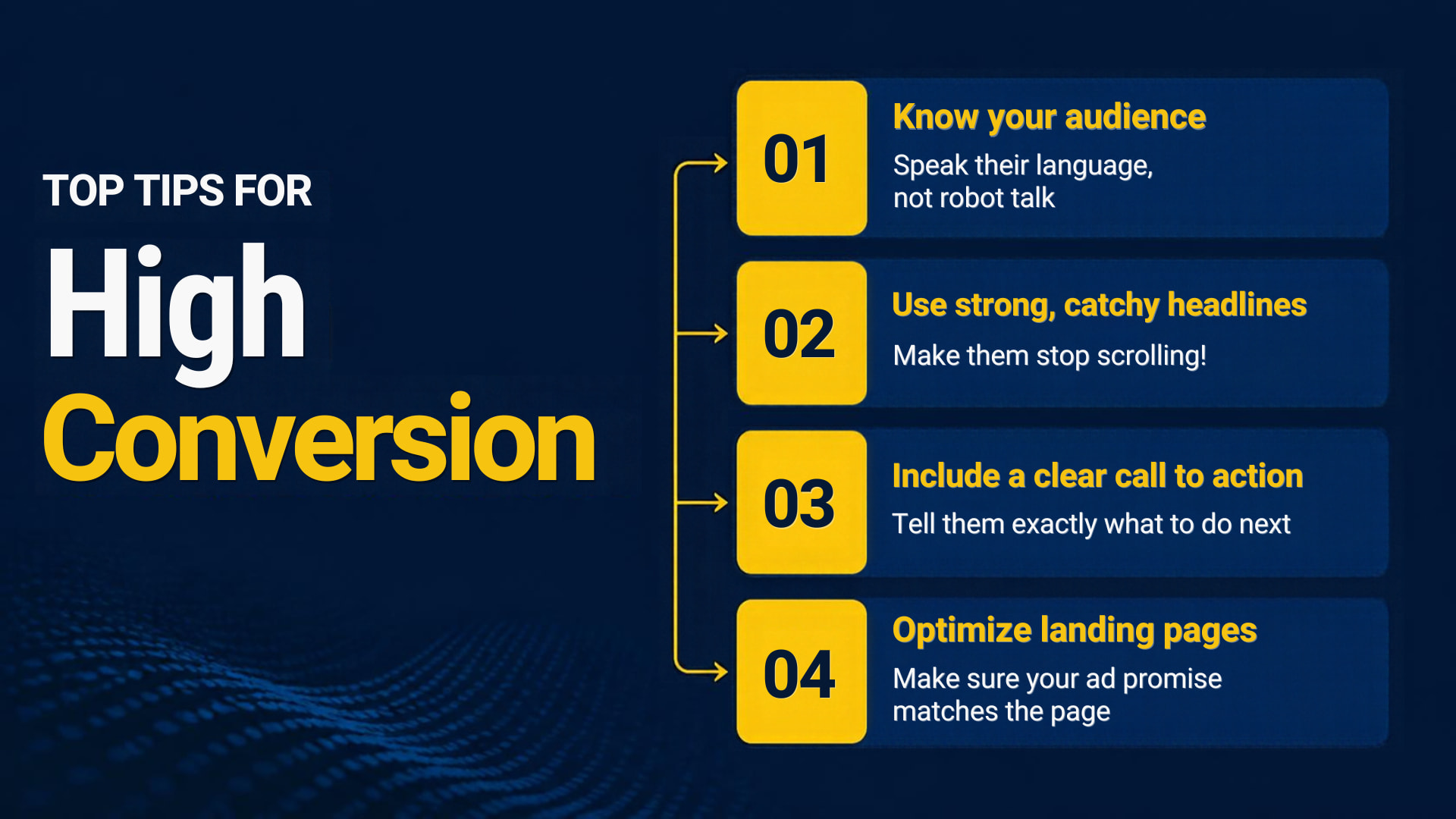
Google Ads offers different campaign types for different advertising goals. Availability, features, and settings may change, so advertisers should review the options currently available in their accounts.
Google Search Ads are particularly relevant when people actively search for products or services. They can be useful for capturing demand from users expressing a specific need.
Display campaigns can help businesses reach audiences through visual advertisements across eligible placements. Their role may include awareness, consideration, or remarketing, depending on the setup.
Shopping campaigns can help eligible retailers promote product listings with relevant product information.
Video campaigns can support awareness, consideration, and other video-focused objectives.
Performance Max campaigns can access eligible Google advertising channels through a goal-based campaign structure.
The best choice depends on the audience, offer, conversion goal, creative resources, and available measurement data.
A local service provider with a clear demand for emergency repairs may begin by evaluating Search Ads. An ecommerce retailer with a suitable product feed may evaluate Shopping or Performance Max alongside its broader strategy.
Launching several campaign types simultaneously is not always necessary. Begin with a structure that supports the most important objective, measure its performance, and expand when there is a clear reason to do so.
Understanding the Customer Journey
Customers rarely make every purchase immediately after their first interaction with a brand.
A typical customer journey may include awareness, research, comparison, evaluation, and conversion. Different search terms can represent different stages of this process.
For example, a person searching for "what is PPC advertising" may be learning about digital marketing. Someone searching for "Google Ads management for small businesses" may be comparing providers. A person searching for "hire Google Ads specialist" may be ready to contact a service provider.
The advertising message should reflect the customer's stage.
An educational search may be better served by a helpful guide, while a high-intent service search may be better served by a dedicated service page with a clear inquiry form.
This principle also explains why one generic landing page may not work equally well for every keyword group. Visitors should be directed toward the information most relevant to their immediate needs.
Setting a Realistic Advertising Budget
How much should a business spend on Google Ads? There is no universal budget that works for every industry or campaign.
Costs depend on factors such as competition, customer demand, location, keyword selection, bidding strategy, and the value of the product or service. A useful budget starts with business economics rather than an arbitrary spending target.
Consider these questions:
What is the business willing to spend to acquire a customer?
What percentage of leads typically become paying customers?
What is the approximate contribution or profit from a new customer?
How long does it take for a lead to become a customer?
How much money can the business afford to test without creating financial pressure?
For a hypothetical service business, suppose the company estimates that one out of every five qualified leads becomes a customer. If the business has established an acceptable customer acquisition cost, it can work backward to determine a reasonable target cost per qualified lead.
The estimate should be based on the company's actual sales process and margins wherever possible. It is not a guarantee of advertising performance.
A practical budget plan should include a test period, a clear spending limit, and rules for increasing or reducing investment. Advertisers should also understand that Google Ads daily budgets and actual spending over individual days may not always be identical.
The objective is to collect enough useful information to make informed decisions while keeping spending within an acceptable limit.
Common Reasons Campaigns Attract Clicks but Fail to Convert
When advertisements receive clicks but do not generate meaningful results, the problem may exist at several points in the customer journey.
Common causes include:
Keywords attract people who are researching rather than buying.
Broad targeting introduces irrelevant traffic.
Advertisements promise something the landing page does not deliver.
The offer is unclear or uncompetitive.
Landing pages load slowly or are difficult to use on mobile devices.
Forms ask for too much information.
Contact information is difficult to find.
The business targets locations it cannot serve.
Conversion tracking is missing or incorrectly configured.
The campaign optimizes toward low-value actions.
The business does not respond to leads promptly.
Avoid changing every campaign setting at once. First identify where the journey breaks down. If relevant visitors reach the website but abandon the form, landing page improvements may be more valuable than additional keywords.
If visitors are searching for unrelated services, keyword and targeting adjustments may be the better starting point.
A structured review of these issues provides a stronger foundation for Google Ads campaign optimization than simply increasing the budget.
2. How to Create and Optimize Google Ads Campaigns
Conducting Google Ads Keyword Research
Keyword research identifies the searches that can connect a business with relevant potential customers.
Begin by listing the products, services, problems, and outcomes associated with the business. Then consider the different ways customers might describe those needs.
For a hypothetical web development company, initial keyword themes might include:
Business website development
Ecommerce website development
Website redesign services
Professional web development company
Website development quotation
These are starting points for research, not recommendations to target every phrase without further evaluation.
Use available keyword research tools, Google Ads planning features, search-term reports, and customer conversations to understand how people search. Review estimated search demand, competition, and potential commercial relevance where those data points are available.
Do not choose keywords based only on search volume. A popular keyword may attract people who have little interest in purchasing the advertised service.
A narrower phrase with stronger commercial intent may be more relevant even if it attracts fewer searches.
For example, "website design ideas" and "hire ecommerce website developer" indicate different needs. The first may represent research, while the second suggests a more specific requirement for professional assistance.
Review keyword ideas against the business's actual capabilities, geographic reach, and target customers. This reduces the likelihood of paying for searches that cannot produce a useful business outcome.

Grouping Keywords by Intent and Relevance
Organize related keywords into logical groups. Each group should represent a reasonably consistent customer need so that its advertisements and landing page can address that need directly.
A poorly organized ad group might contain keywords for website design, social media management, software development, and email marketing. These services have different requirements and should not automatically share the same messaging.
A better structure separates the main service themes.
Illustrative keyword-intent table
Keyword
Likely intent
Possible landing page
What is PPC advertising
Informational
Educational guide
Google Ads management services
Commercial
PPC service page
Hire Google Ads specialist
Transactional
Consultation or inquiry page
Ecommerce PPC agency
Commercial
Ecommerce PPC service page
Google Ads campaign audit
Transactional
Campaign audit page
These classifications are illustrative. Actual search intent should be evaluated through relevant search results, search-term data, and customer behavior.
A well-organized structure makes it easier to write specific advertisements, review keyword performance, and understand which services attract qualified inquiries.
For businesses seeking professional support with campaign planning, https://www.amzsoftinnovexa.com/digital-marketing/ppc-google-ads provides a starting point for exploring Amzsoft Innovexa's PPC and Google Ads offering.
Understanding Match Types and Negative Keywords
Google Ads keyword match types help determine which searches may trigger an advertisement. The principal options are broad match, phrase match, and exact match.
According to Google Ads Help, these match types differ in how closely a search needs to relate to a keyword, and matching can consider meaning and intent rather than only identical wording.
Broad match can reach a wider range of searches related to a keyword. It can be useful for discovering relevant demand, but advertisers need to monitor search terms and ensure that their targeting and bidding strategy align with campaign goals.
Phrase match provides a more constrained approach than broad match while allowing searches that convey the keyword's meaning.
Exact match offers more control over eligible search intent, although it is not limited to searches containing precisely identical characters.
For example, a business advertising professional accounting services might test keywords related to business accounting. It should also check whether the resulting searches concern professional services or unrelated topics such as accounting courses and employment opportunities.
Negative keywords help exclude searches that are not relevant to the offer. A company that sells paid professional training might exclude terms such as "free," "jobs," or "salary" when those searches are not relevant to its goals.
Negative keywords require careful management. Excluding an overly broad term can block valuable traffic, so review the actual search context before applying exclusions.
A useful process is to review search terms regularly, identify irrelevant patterns, add appropriate negative keywords, and confirm that useful queries remain eligible.
Writing Relevant and Persuasive Ad Copy
An advertisement should communicate why the offer is relevant and what the visitor can expect after clicking.
Effective ad copy usually includes:
A clear description of the product or service
A benefit that matters to the target audience
Relevant terminology that reflects the search
A realistic point of differentiation
A direct call to action
Avoid exaggerated promises and claims that the business cannot substantiate. Statements such as "Guaranteed Results for Every Campaign" can create misleading expectations if the business cannot genuinely support that promise.
Instead, explain the service clearly. For example, a hypothetical ad for professional PPC support might emphasize campaign planning, performance measurement, and ongoing optimization if those activities are actually included in the advertised offering.
Google's responsive search ads allow advertisers to provide multiple headlines and descriptions, which can be combined into different ad variations. Advertisers should make sure the individual assets remain accurate and coherent when displayed in different combinations.
Useful headline themes might include:
The service being offered
The customer's main problem
The type of business served
A relevant benefit
A clear next step
Descriptions can add context, explain the process, and help visitors decide whether the offer suits their needs.
The objective is not to fit every possible keyword into the advertisement. It is to create a clear message that attracts relevant people and accurately represents the destination page.
Creating Clear Calls to Action
A call to action tells visitors what to do next.
Examples include "Request a Quote," "Book a Consultation," "Shop Products," and "Get Started." The appropriate wording depends on the business model and the visitor's stage in the customer journey.
A call to action should be specific, visible, and consistent with the landing page.
If an advertisement invites users to request a consultation, the destination should make the consultation request straightforward. Sending those users to a generic homepage with no obvious contact option introduces unnecessary friction.
Avoid asking visitors to complete an action that is not available on the page. If the advertised offer requires a form, make sure the form works, its fields are understandable, and the submission process provides appropriate confirmation.
Using Relevant Ad Assets
Ad assets can provide additional information and opportunities for users to interact with an advertisement. Depending on eligibility and configuration, these may include sitelinks, callouts, structured snippets, call assets, and location assets.
Choose assets that improve the user's ability to evaluate the offer.
For example, sitelinks may direct visitors toward relevant service information, pricing details where published, contact pages, or helpful resources. Call assets may be useful for businesses that handle customer inquiries by telephone.
Only use information that is accurate and current. Do not add an asset describing a service, location, discount, or feature that the business does not actually offer.
Review asset performance where reporting is available, but evaluate it in the context of the whole campaign rather than assuming every additional asset will improve conversions.
Structuring Campaigns and Ad Groups
A logical campaign structure makes performance easier to interpret and manage.
Campaigns can be separated according to objectives, major service categories, locations, or other meaningful differences in budget and targeting. Ad groups can then organize closely related keywords and advertisements.
Illustrative campaign structure
Campaign
Ad group
Keyword theme
Landing page
Search — PPC Services
Google Ads Management
Google Ads management
PPC service page
Search — PPC Services
Campaign Audits
Google Ads audit
Audit information page
Search — Web Development
Business Websites
Business website developer
Business website page
Search — Web Development
Ecommerce
Ecommerce development
Ecommerce service page
This example is hypothetical. The right structure depends on the number of services, available budget, customer demand, and how much meaningful separation the campaigns require.
Avoid unnecessary fragmentation. Creating too many small campaigns can make budget management more complicated without producing a clear benefit.
Each campaign should have a defined purpose, and its settings should reflect that purpose. Geographic targeting, language, budget, and conversion goals should be reviewed before launch.
Google recommends organizing campaigns around objectives and maintaining relevance between search terms, advertisements, and landing pages.
Google Ads Help
Choosing Suitable Google Ads Bidding Strategies
Bidding determines how Google Ads participates in advertising auctions within the constraints and objectives of a campaign.
The appropriate strategy depends on the campaign goal, conversion tracking, available data, and desired level of control.
Maximize Clicks focuses on generating website clicks within the campaign's budget constraints. It may be appropriate when traffic is the primary objective, but clicks alone do not establish business success.
Maximize Conversions aims to generate as many recorded conversions as possible within the campaign's budget constraints.
Target CPA focuses on obtaining conversions around a specified average cost-per-acquisition target. Results can vary, and the target does not guarantee that every conversion will cost the specified amount.
Maximize Conversion Value focuses on increasing the total value of recorded conversions.
Target ROAS aims to achieve a specified return on advertising spend, based on conversion values and the relevant tracking setup.
Google describes Smart Bidding as automated bidding that uses signals at auction time to optimize for conversions or conversion value. Its effectiveness depends on campaign objectives and the quality of the measurement foundation.
Do not select an automated conversion-based strategy before verifying that conversion actions are recorded correctly. Otherwise, the system may optimize toward incomplete, duplicate, or low-value actions.
New campaigns may also have limited historical data. Choose a strategy that matches the current measurement setup and review results before making major changes.
Businesses exploring PPC campaign management can review https://www.amzsoftinnovexa.com/digital-marketing/ppc-google-ads when considering whether external expertise could support their advertising objectives.
Improving Google Ads Landing Page Optimization
A landing page is where visitors arrive after clicking an advertisement. Its purpose is to help visitors understand the offer and complete the intended action.
A relevant landing page continues the message established by the advertisement. If the ad promotes a particular service, the page should explain that service rather than forcing users to search through unrelated information.
Important landing page elements include:
Message consistency: The headline, offer, and page content should match the advertisement.
Clear value proposition: Visitors should understand what the service provides and whom it helps.
Visible calls to action: Users should not have to search extensively for the next step.
Mobile usability: Text, forms, buttons, and navigation should work comfortably on smaller screens.
Reasonable loading performance: Delays can frustrate users and interrupt the conversion journey.
Trust and transparency: Business details, service explanations, and contact information should be accurate and easy to find.
Simple forms: Request only the information needed to take the next step.
Useful supporting information: Answer relevant questions about the process, suitability, deliverables, and limitations.
For example, a visitor searching for a Google Ads campaign audit may expect information about what the audit covers, what the business needs to provide, and how to request it. A generic page that merely lists every marketing service may not address those expectations.
Landing page optimization should be evaluated using actual user behavior and conversion data. Test meaningful changes rather than assuming that a particular design, color, or headline will always perform best.
Setting Up Google Ads Conversion Tracking Correctly
Conversion tracking measures actions that matter to a business after people interact with its advertisements.
Without reliable measurement, advertisers may know how many clicks they receive but struggle to identify which campaigns contribute to meaningful outcomes.
Google Ads supports conversion measurement for different types of actions, including website activity, phone interactions, and other eligible conversion sources. Setup depends on the action being measured and the relevant implementation.
Common conversion actions include:
Completed purchases
Qualified lead form submissions
Confirmed appointment bookings
Relevant phone inquiries
Newsletter subscriptions
Other meaningful business actions
Not every interaction should be treated as an equally valuable conversion. A page view, button click, completed lead form, and confirmed sale represent different levels of intent.
Separate primary conversion actions used for bidding from secondary actions intended mainly for observation when appropriate. Verify that the chosen goals align with the campaign objective.
Before launching, test the conversion path:
Complete the intended action yourself in a test environment or through an appropriate test process.
Confirm that the event is recorded correctly.
Check that duplicate events are not being counted as separate conversions.
Verify that conversion values are appropriate when value-based reporting is used.
Review attribution and reporting settings.
Confirm that relevant consent and privacy requirements are addressed.
For ecommerce, purchase values and transaction identifiers need particular attention. For lead generation, businesses should evaluate whether recorded inquiries become qualified opportunities, not simply whether the form fires successfully.
Where appropriate, offline conversion data can help connect advertising interactions with outcomes that occur later in a sales process.
Accurate measurement creates a stronger foundation for campaign decisions. It also helps marketers identify whether an apparent performance improvement represents genuine business value.
Understanding Relevant Analytics and Performance Metrics
Google Ads campaign performance should be evaluated using several metrics together.
Metric
Meaning
How to use it
Impressions
Number of times an ad is shown
Understand visibility and reach
CTR
Clicks divided by impressions
Assess how often impressions generate clicks
CPC
Cost divided by clicks
Monitor average click cost
Conversion rate
Conversions divided by the selected interaction denominator
Evaluate how often interactions produce conversions
CPA
Advertising cost divided by conversions
Assess the average cost per recorded conversion
ROAS
Attributed conversion value divided by advertising cost
Evaluate the value attributed to ad spend
Qualified lead rate
Qualified leads divided by the relevant lead total
Assess lead quality
Search impression share
Impressions received divided by estimated eligible impressions
Understand visibility among eligible auctions
Metric definitions should be checked against the reporting source, particularly when the denominator differs between platforms or conversion types.
CTR can help identify whether an ad attracts attention, but a high CTR does not prove that visitors are likely to purchase. A low CPC is not necessarily desirable if the traffic is irrelevant.
Similarly, a low CPA can be misleading if the campaign generates many unqualified leads. ROAS is more useful for businesses that can reliably measure attributed conversion value, although it does not automatically represent net profit.
For lead-generation businesses, connect advertising reports with sales outcomes whenever possible. The quality of the lead and its likelihood of becoming a customer may matter more than the initial form submission.
Testing Ad Copy, Landing Pages, and Campaign Settings
Testing helps marketers understand which changes improve performance under real campaign conditions.
Begin with a specific question. For example, does explaining the service more clearly improve qualified lead submissions? Does a shorter form reduce abandonment without lowering lead quality?
Potential testing areas include:
Advertisement headlines and descriptions
Calls to action
Landing page headlines
Form length
Service explanations
Page layout and navigation
Keyword selection
Negative keyword lists
Geographic targeting
Conversion goals and bidding settings
Where possible, use a controlled testing method and allow sufficient time for relevant data to accumulate. If several changes are introduced simultaneously, it becomes harder to identify what caused the result.
Do not declare a winner based on a handful of clicks or one isolated conversion. The amount of evidence required depends on traffic volume, conversion frequency, variability, and the practical importance of the decision.
Also account for conversion delays. A person may click an advertisement today but complete a purchase several days later. Reviewing very recent data without considering that delay can lead to incorrect conclusions.
Document each test, its purpose, the change made, and the observed result. This creates a useful record for future optimization.
Practical Step-by-Step Campaign Creation Checklist
Use this checklist before launching a new campaign.
Campaign launch checklist
0 of 11 completed
Define the objective
Choose the primary business outcome and identify the conversion that represents success.
Understand the audience
Document customer needs, location, search intent, and likely objections.
Research keywords
Build relevant keyword themes and check potential search intent.
Organize the structure
Create campaigns and ad groups that reflect meaningful objectives and services.
Write advertisements
Prepare accurate headlines, descriptions, and relevant calls to action.
Select targeting and budget
Check location, language, network settings, and affordable spending limits.
Choose a bidding strategy
Match the strategy to the objective and the quality of available conversion data.
Prepare landing pages
Align page content with the ad and make the next action clear.
Verify conversion tracking
Test conversion actions, values, duplication, and reporting settings.
Review before launch
Check links, forms, policies, exclusions, and all campaign settings.
Monitor and optimize
Review search terms, lead quality, costs, and conversion trends.
Reset checklist
This checklist can be adapted to different campaign types. Some businesses may require additional checks for ecommerce feeds, phone tracking, regulated products, or offline sales.
For additional context when planning paid search activities, visit https://www.amzsoftinnovexa.com/digital-marketing/ppc-google-ads.
Common Google Ads Mistakes and How to Avoid Them
Even a carefully designed campaign can underperform when important details are overlooked.
Mistake 1: Choosing keywords only by volume. High-volume searches may not represent purchasing intent. Evaluate relevance, intent, and business value alongside demand.
Mistake 2: Using one generic landing page. Different services and search intentions may require different destinations. Match the page to the offer.
Mistake 3: Ignoring search terms. Review the actual searches associated with campaign traffic and exclude irrelevant patterns where appropriate.
Mistake 4: Tracking every interaction as a primary conversion. This can make performance appear stronger than it is and may direct automated bidding toward low-value activity.
Mistake 5: Making frequent, unexplained changes. Excessive adjustments make it difficult to identify meaningful trends and evaluate the effects of individual decisions.
Mistake 6: Increasing budgets before fixing the conversion journey. More traffic will not necessarily solve a poor offer, broken form, or irrelevant targeting.
Mistake 7: Ignoring lead quality. Connect advertising performance with the sales process to understand which inquiries have genuine commercial value.
Mistake 8: Assuming automation eliminates the need for oversight. Automated bidding still depends on appropriate objectives, reliable measurement, relevant targeting, and sensible business decisions.
A disciplined campaign process focuses first on fixing the most significant problem, then measures the effect before making the next adjustment.
3. Improving Results and Choosing the Right PPC Support
How to Evaluate Campaign Performance
Launching a campaign is only the beginning. Long-term improvement depends on reviewing performance, identifying problems, and making informed adjustments.
Start by comparing actual results with the objectives established before launch. If the campaign is designed to generate qualified leads, prioritize qualified inquiries, cost per qualified lead, and the percentage of leads that become customers.
Review performance at several levels:
Account level: Is advertising contributing to the overall business objective?
Campaign level: Which objectives, locations, or service categories perform best?
Ad group level: Are keyword themes and advertisements sufficiently relevant?
Search-term level: Are the actual searches connected to the intended audience?
Landing page level: Are visitors completing the intended action?
Sales level: Are leads becoming valuable business opportunities?
Use comparable reporting periods and account for differences in conversion delays. A campaign that appears weaker during the current week may have conversions that have not yet been recorded.
Also consider external factors such as seasonality, changes in customer demand, competition, and availability of the advertised service. A change in performance does not always mean the campaign settings are responsible.
For an organized review process, record important observations, the proposed action, and the outcome after each change. This makes campaign optimization more systematic and reduces decisions based on isolated results.
How to Identify Wasted Advertising Spend
Wasted advertising spend occurs when money is directed toward traffic or interactions that do not support the intended business objective.
However, a click without an immediate conversion is not automatically waste. Some customers need more time to research, compare options, or consult other decision-makers before taking action.
Look for repeated patterns that indicate a genuine problem.
Irrelevant search queries: Check whether people are searching for unrelated products, jobs, free resources, or services the business does not offer. Use appropriate negative keywords to reduce unwanted traffic.
Poor geographic relevance: Confirm that advertisements reach locations the business can serve. Review location settings and the actual locations associated with campaign activity.
High-cost, low-value traffic: Investigate search terms that consume substantial spending without producing useful outcomes. Consider conversion delays, low traffic volume, and the value of each potential customer before excluding them.
Landing page abandonment: If visitors arrive but do not complete the intended action, inspect page relevance, mobile usability, loading performance, and form functionality.
Low-quality leads: Review the inquiries received by the sales team. Repeated requests outside the business's service scope may indicate a targeting or messaging problem.
Tracking errors: Confirm that recorded conversions represent genuine actions. Duplicate events or incorrectly configured conversion goals can distort performance analysis.
An effective review does not simply remove every keyword without conversions. Instead, it evaluates search relevance, spending, the length of the conversion journey, and the business value of the traffic.
For businesses considering outside assistance with these activities, https://www.amzsoftinnovexa.com/digital-marketing/ppc-google-ads is the official page for exploring Amzsoft Innovexa's PPC and Google Ads services.
How to Improve Lead Quality
Generating more leads is not always the best measure of progress. A campaign can attract many inquiries while producing few customers if the advertising message appeals to the wrong audience.
Improving lead quality starts before a visitor clicks an advertisement.
Clarify the offer. Explain what the business provides and who the service is intended for. Avoid vague claims that attract people whose needs do not match the offer.
Use relevant keywords. Focus on searches associated with the service and the customer's likely stage in the buying process.
Set accurate expectations. If a service is intended for businesses of a particular size, industry, or location, communicate that information where appropriate.
Improve lead forms. Request enough information to assess the inquiry without making the form unnecessarily difficult to complete.
Connect advertising data with sales outcomes. Where feasible, record whether inquiries are qualified, contacted, converted into opportunities, and eventually won.
Review lead handling. Delayed responses, missed calls, and inconsistent follow-up can reduce the number of leads that become customers, even when the campaign generates relevant inquiries.
For example, a hypothetical software consultancy may discover that a large share of its inquiries come from individuals looking for employment rather than companies seeking development services. It could improve the advertisement's wording, refine its keyword themes, and review the resulting search terms.
The objective is to attract prospects whose requirements align with the business's services, not merely to increase form submissions.
Interpreting CTR, CPC, Conversion Rate, CPA, and ROAS
Five frequently used metrics provide different perspectives on campaign performance.
Click-through rate (CTR) measures the percentage of impressions that result in clicks. It helps marketers evaluate how often advertisements attract attention among the impressions they receive.
Cost per click (CPC) measures average advertising cost per click. It helps explain how much traffic costs but does not measure whether that traffic is valuable.
Conversion rate measures the proportion of eligible interactions that produce a recorded conversion, according to the selected reporting definition. A higher rate can indicate that the advertisement and landing page are connecting effectively with the intended audience.
Cost per acquisition (CPA) measures advertising cost per recorded conversion. For lead-generation businesses, cost per qualified lead may be a more meaningful measure than cost per form submission.
Return on ad spend (ROAS) measures attributed conversion value relative to advertising cost. It is particularly useful when conversion values are tracked reliably.
Consider a hypothetical example. A campaign's CTR improves after its advertisements are rewritten, but the conversion rate falls. The new copy may be attracting more curiosity-driven visitors without improving the relevance of the traffic.
Alternatively, CPC may rise while the cost per qualified lead falls because the campaign attracts visitors with stronger purchasing intent.
These examples show why metrics should be interpreted together. There is no single CTR, CPC, conversion rate, CPA, or ROAS target that applies to every business and industry.
A Sample Decision-Making Scenario for Weak Campaign Performance
The following scenario is illustrative and does not represent actual customer results.
Imagine a business running a Google Search campaign for professional website development. The campaign receives clicks, but the sales team reports that few inquiries are relevant.
The marketing team reviews search terms and discovers three different patterns:
Some users are searching for free website builders.
Some are searching for website development courses.
Others are looking for professional developers for business projects.
The team identifies the first two groups as less relevant to its paid service offering.
Instead of increasing the advertising budget, the marketer takes a structured approach.
Illustrative optimization scenario
Problem identification
The campaign attracts clicks, but many search queries do not match the business's intended audience.
Search-term review
The marketer examines actual queries and separates irrelevant searches from potentially valuable commercial searches.
Targeting adjustments
Appropriate negative keywords are added, and relevant keyword groups are refined.
Landing page review
The destination page is checked to ensure it clearly describes professional development services and provides an easy way to inquire.
Measurement review
Lead form tracking is tested, and inquiry quality is reviewed alongside conversion totals.
Follow-up evaluation
The marketer compares subsequent results with the earlier period, accounting for conversion delays and changes in traffic volume.
The important lesson is that the team investigates the source of poor performance before making a major financial decision. The changes may improve relevance, but the actual outcome must be confirmed through campaign data.
Building a Continuous Optimization Process
Google Ads optimization should follow a repeatable process rather than relying on occasional, unstructured changes.
A practical cycle has five stages.
1. Measure: Review the campaign's objectives, costs, conversions, and lead quality.
2. Diagnose: Identify the most significant issue, such as irrelevant searches, weak advertisements, poor landing page engagement, or inaccurate tracking.
3. Prioritize: Choose the change most likely to address that issue without introducing unnecessary complexity.
4. Test: Implement the change and allow an appropriate period for results to become meaningful.
5. Learn: Compare results with the baseline, document the outcome, and decide whether to retain, refine, or reverse the change.
A weekly review may be appropriate for active campaigns, while smaller campaigns with limited traffic may require a longer period to gather useful evidence. Tracking problems and broken landing pages should be investigated promptly rather than waiting for a routine review.
Major changes to budgets, bidding strategies, conversion goals, and targeting should be evaluated carefully. Frequent adjustments can make it difficult to distinguish a genuine improvement from normal performance variation.
Businesses exploring professional Google Ads management services can visit https://www.amzsoftinnovexa.com/digital-marketing/ppc-google-ads to review the available service offering and consider whether professional support fits their requirements.
When Should a Business Consider Professional PPC Support?
Managing Google Ads requires time, analytical skills, and an understanding of how campaign settings influence traffic and measurement. Some businesses can manage simpler campaigns internally, while others may benefit from external support.
Professional PPC support may be worth considering when:
Campaign spending is increasing without a clear improvement in business outcomes.
The account has several campaigns, products, locations, or customer segments.
Conversion tracking is unreliable or difficult to maintain.
The business cannot consistently review search terms and campaign performance.
Landing pages need to be aligned more closely with advertising messages.
Internal staff lack the time to test and optimize campaigns.
The company needs a more structured approach to reporting and decision-making.
Before choosing a provider, clarify the scope of work. Ask how campaign objectives will be defined, what reporting will be provided, how conversion tracking will be checked, and how decisions will be documented.
It is also sensible to confirm who owns the advertising account, who pays the advertising platform directly, how access is managed, and how campaign data will be shared.
Avoid selecting a provider solely because it promises an unusually low cost per lead or guaranteed returns. Advertising performance depends on multiple factors, including competition, the offer, the website, the sales process, and the available budget.
A useful working relationship should involve clear communication, realistic expectations, transparent reporting, and a shared understanding of what constitutes a valuable conversion.
Exploring Amzsoft Innovexa's PPC and Google Ads Services
Amzsoft Innovexa provides an official service page for its PPC and Google Ads offering. Businesses can visit https://www.amzsoftinnovexa.com/digital-marketing/ppc-google-ads to explore the information presented by the company.
When reviewing a service provider, compare the advertised scope with your business requirements. Determine whether the support being considered aligns with your campaign objectives, measurement needs, and internal resources.
It is important to distinguish general PPC best practices from company-specific service commitments. A website's service description should be the basis for confirming what is actually included. Do not assume that a particular deliverable, reporting schedule, price, certification, or performance guarantee is available unless the company explicitly confirms it.
Before beginning a campaign management engagement, establish a clear working plan covering:
Campaign objectives and primary conversions
Target audience and geographic reach
Budget and spending authorization
Keyword and search-term strategy
Advertisement and landing page responsibilities
Conversion tracking and reporting
Review frequency and communication
Criteria for evaluating campaign success
This approach helps businesses assess whether professional assistance meets their needs without relying on unsupported performance promises.
Tags
Amzsoft Innovexa
Engineering and delivery notes from the Amzsoft Innovexa team — fintech platforms, AI automation, and product engineering.