
Financial operations involve many repetitive activities, from invoice processing and payment approvals to reconciliation, reporting, compliance checks, and financial data analysis. As transaction volumes increase, manual processes can become slower and harder to manage. AI-powered automation in financial operations combines artificial intelligence with automated workflows to help finance teams process information, identify patterns, manage exceptions, and make better use of their time.
Unlike basic automation that follows fixed instructions, AI-powered financial automation can work with larger and more complex data sets and support tasks that require classification, prediction, pattern recognition, or document understanding. Financial institutions, fintech companies, accounting teams, and growing businesses are therefore exploring AI in financial operations as part of broader digital transformation strategies.
The goal is not to remove people from financial decision-making. Instead, intelligent financial automation can handle suitable repetitive work while finance professionals focus on analysis, controls, exceptions, and decisions that require human judgment.
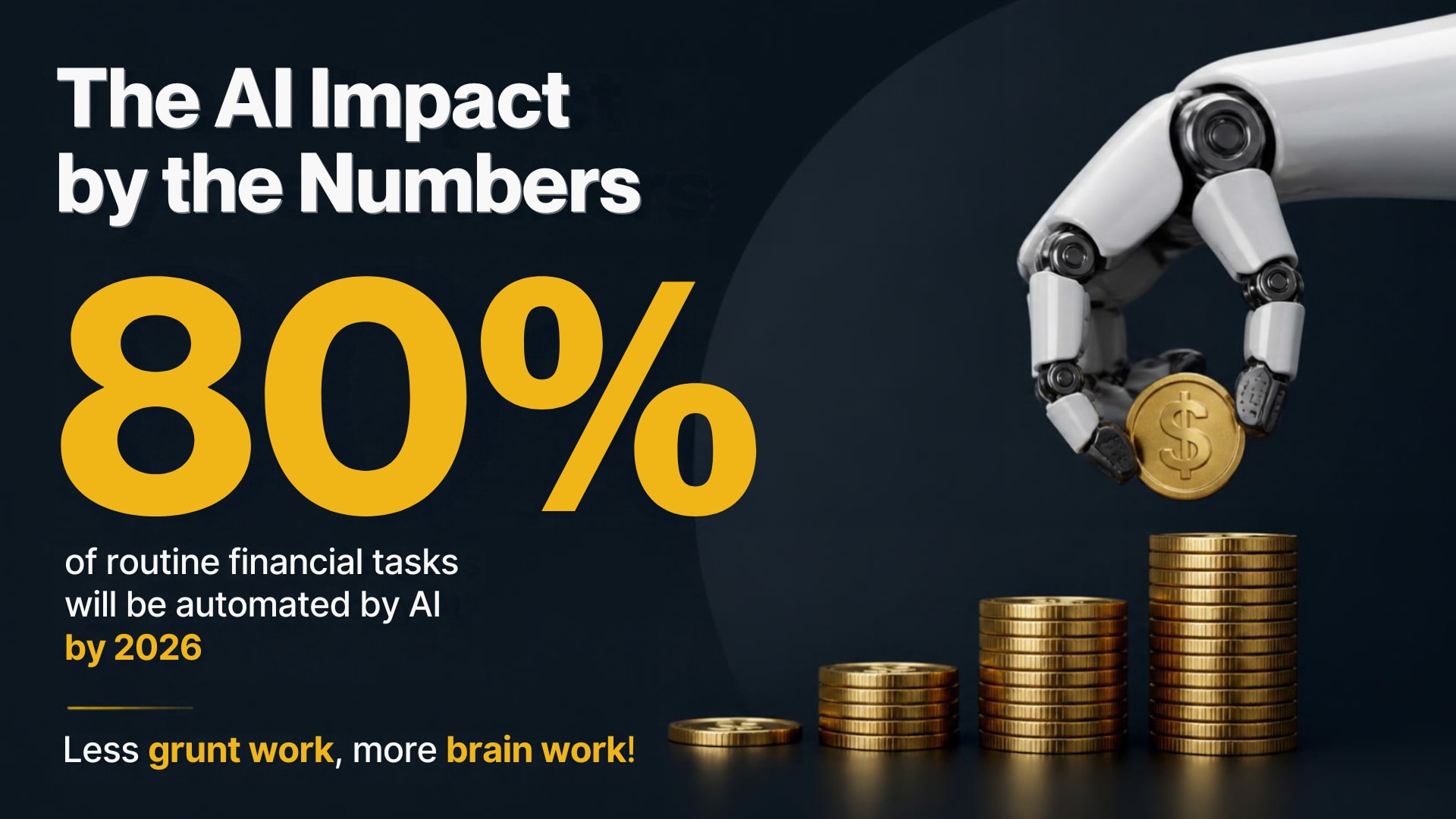
What Is AI-Powered Automation in Financial Operations?
AI-powered automation in financial operations uses artificial intelligence, data processing, and workflow automation to perform or support repetitive finance activities. It can help process documents, classify transactions, identify unusual patterns, reconcile records, prepare reports, and route exceptions for review while keeping appropriate human oversight in the process.
Traditional financial automation generally depends on predefined rules. AI adds capabilities such as document interpretation, pattern recognition, prediction, classification, and anomaly detection. This makes it possible to automate more complicated financial workflows without requiring every possible situation to be manually defined in advance.
How does AI-powered financial automation work?
A typical automated financial workflow can involve several stages:
Data collection: Information is collected from invoices, bank statements, accounting platforms, payment systems, emails, spreadsheets, or other business applications.
Data processing: AI tools can extract and organize relevant information from structured and unstructured documents.
Classification: Transactions or documents can be categorized according to predefined business requirements.
Analysis: AI models can identify patterns, unusual activity, missing information, or potential exceptions.
Workflow action: The system can trigger an approval, reconciliation, notification, report, or another predefined process.
Human review: Higher-risk or uncertain cases can be sent to finance professionals for verification.
For example, a finance team receiving hundreds of invoices each month may use automated document processing to capture supplier names, invoice numbers, dates, taxes, and amounts. The system can then match the information with purchase orders or accounting records. If something does not match, the invoice can be routed to a person instead of being automatically approved.
This approach combines automation with human oversight rather than treating AI as an independent financial decision-maker.
Which financial processes can AI automate?
Several areas of finance can benefit from financial process automation:
Invoice processing: Extracting invoice information and routing documents for approval.
Accounts payable: Supporting invoice matching, approval workflows, and payment preparation.
Accounts receivable: Tracking invoices, identifying overdue accounts, and supporting collection workflows.
Bank reconciliation: Comparing bank transactions with internal financial records and highlighting mismatches.
Expense management: Classifying expenses and identifying unusual claims.
Financial reporting: Collecting data and supporting the preparation of recurring reports.
Transaction monitoring: Reviewing large volumes of transactions for unusual activity.
Fraud detection: Identifying patterns that may require further investigation.
Cash-flow monitoring: Tracking incoming and outgoing payments to support cash-flow visibility.
Compliance workflows: Organizing documentation, checks, alerts, and audit trails.
Customer onboarding: Supporting document collection and verification processes.
Audit preparation: Organizing financial records and identifying missing documentation.
The value depends on the quality of the underlying data and the way each workflow is designed. Automation applied to a poorly structured process can simply make a poor process faster.
Why are financial teams adopting automation?
Finance departments are under pressure to process more information while maintaining accuracy, security, compliance, and timely reporting. Manual data entry also creates opportunities for duplicate records, missed information, inconsistent classification, and processing delays.
AI in finance can support teams by reducing repetitive workload and making financial information easier to process. The Financial Stability Board has identified operational efficiency, regulatory compliance, customized financial products, and advanced analytics among the potential benefits of AI adoption in finance.
The strongest use cases are usually those where:
Transaction volumes are high.
Processes are repetitive.
Data follows identifiable patterns.
Rules and approval controls are already established.
Exceptions can be reviewed by people.
Better processing speed can improve operational visibility.
For a small business, this might mean automating invoice and expense workflows. For a bank or fintech company, it may involve transaction monitoring, compliance support, customer onboarding, or financial data analysis.
How Does AI-Powered Automation Improve Financial Operations?
AI-powered automation improves financial operations by reducing repetitive manual work, speeding up data processing, supporting anomaly detection, improving workflow visibility, and helping finance teams access information more efficiently. Its effectiveness depends on reliable data, well-designed processes, appropriate controls, and human review for decisions where errors or uncertainty could create financial or compliance risks.
What are the main benefits of AI in financial operations?
The benefits vary by process, but several improvements are common.
Faster processing: Automated workflows can process large numbers of documents and transactions without requiring every item to be manually entered.
Better consistency: Standardized workflows can reduce differences in how routine finance tasks are performed.
Improved visibility: Automated reporting and dashboards can provide finance managers with more timely information about transactions, expenses, receivables, and cash flow.
Exception detection: AI can help identify transactions or documents that differ from expected patterns, allowing employees to investigate them.
More productive finance teams: When repetitive activities are automated, employees can spend more time on forecasting, analysis, controls, business planning, and financial decision-making.
Scalable operations: Automated workflows can support increasing transaction volumes without requiring every process to grow at the same manual rate.
These benefits should be measured against the actual business process rather than assumed. AI does not automatically make every financial activity faster or more accurate.
AI vs traditional financial automation: what is the difference?
Traditional automation remains valuable for predictable tasks. AI-powered automation becomes more useful when workflows involve documents, changing patterns, large data sets, or exceptions that are difficult to handle through fixed rules alone.
AreaTraditional Rule-Based AutomationAI-Powered AutomationRulesFollows predefined instructionsCan combine rules with learned patternsData processingBest with structured dataCan support structured and unstructured dataPattern recognitionLimitedCan identify patterns and anomaliesDecision supportRule-based outcomesCan provide predictions, classifications, or recommendationsAdaptabilityChanges require rule updatesCan adapt within the capabilities and controls of the modelExceptionsUsually requires predefined conditionsCan help identify and classify unusual casesHuman oversightNeeded for exceptionsStill essential for sensitive or uncertain decisions
The distinction is important because AI does not replace traditional automation. In many financial workflows, the strongest design combines both.
For instance, a payment process might use fixed rules to verify authorization limits while AI helps identify unusual transaction patterns. This creates a workflow in which deterministic controls and intelligent analysis serve different purposes.
What are practical examples of AI finance automation?
Example 1: Invoice processing
A company receives hundreds of supplier invoices. AI can extract information from documents, classify expenses, compare records, and identify missing or inconsistent information. A predefined workflow can then send approved invoices to the appropriate payment process.
Example 2: Reconciliation
A finance department may need to compare thousands of bank transactions with accounting records. Automated reconciliation can match common transactions while flagging unmatched items for employee review.
Example 3: Fraud monitoring
AI-supported transaction monitoring can examine patterns across transactions and flag unusual activity. The alert does not automatically mean fraud has occurred. A qualified employee may still need to investigate the transaction and determine the appropriate action.
Example 4: Financial forecasting
AI can analyze historical financial information and other relevant business data to support forecasting. Finance professionals can use those outputs as decision-support information rather than treating predictions as guaranteed outcomes.
For businesses evaluating these capabilities, a technology and software solutions provider such as Amzsoft Innovexa can be considered alongside other technology partners when exploring AI solutions, fintech development, business automation, software development, and broader digital transformation. The right provider should be evaluated according to the company's processes, security requirements, integration needs, and long-term goals rather than simply the presence of an AI feature.
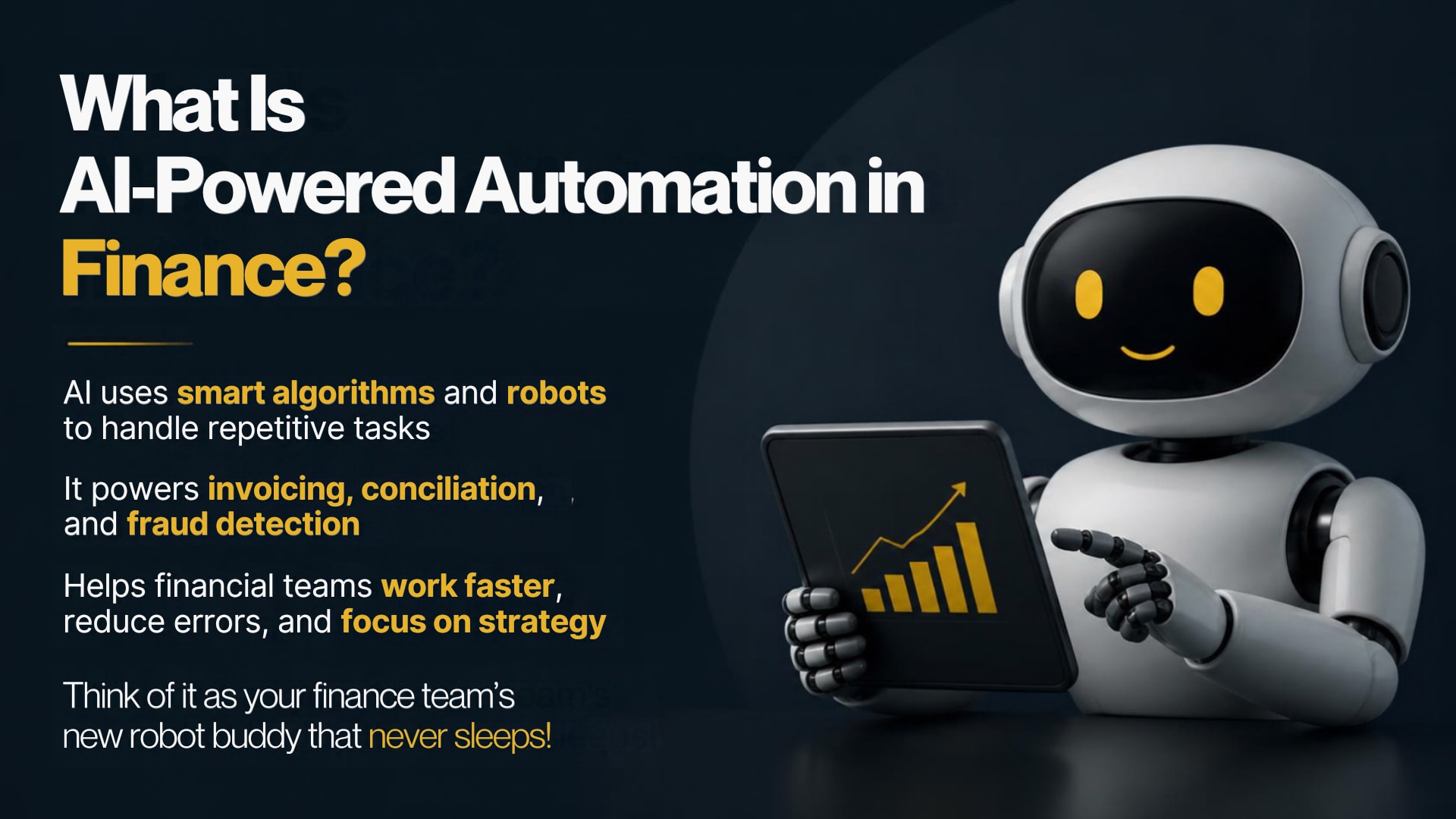
How Can Businesses Implement AI-Powered Automation Securely?
Businesses can implement AI-powered automation securely by starting with a clearly defined financial process, assessing data quality and risks, selecting suitable technology, establishing access controls and human-review procedures, testing the workflow, and monitoring performance after deployment. Financial automation should be introduced gradually, with governance and security built into the process from the beginning.
What should businesses consider before adopting financial automation?
Implementation should begin with the process rather than the technology.
A practical approach includes:
Identify a suitable process. Choose a repetitive activity with measurable problems, such as invoice processing or reconciliation.
Map the existing workflow. Understand inputs, approvals, exceptions, systems, and human responsibilities.
Assess data quality. AI systems depend heavily on accurate and relevant data. Poor data can produce unreliable outputs.
Define automation boundaries. Determine which activities can be automated and which require mandatory human approval.
Review integrations. Finance automation may need to connect with accounting software, banking platforms, ERP systems, CRM tools, or payment systems.
Test before scaling. Run the system against realistic historical or controlled data and evaluate errors and exceptions.
Monitor performance. Track accuracy, processing time, exceptions, security events, and operational outcomes.
Improve the workflow. Automation should be reviewed as business processes, regulations, and technology change.
This gradual approach helps organizations avoid automating a process before they understand its risks.
Is AI-powered financial automation secure?
Security cannot be assumed simply because an automation system uses AI. Financial data can contain sensitive customer, transaction, business, and payment information, so security controls must be part of system design.
Important considerations include:
Data privacy: Sensitive financial information should be handled according to applicable privacy and organizational requirements.
Access control: Users should receive only the permissions necessary for their roles.
Encryption: Data should be protected during transmission and storage where appropriate.
Audit trails: Important automated actions should be traceable.
Human oversight: High-impact financial decisions should have appropriate review mechanisms.
Model reliability: AI outputs should be tested and monitored rather than accepted automatically.
Vendor security: Third-party technology providers should be evaluated for security practices, dependencies, and continuity.
Business continuity: Critical financial workflows should have recovery plans if an AI or automation service becomes unavailable.
Fraud monitoring: Automated systems should themselves be monitored for misuse or suspicious activity.
NIST's AI Risk Management Framework emphasizes trustworthy characteristics including validity and reliability, security, resilience, accountability, transparency, explainability, privacy, and management of harmful bias.
Financial-sector organizations also need to consider broader technology and systemic risks. The Financial Stability Board has highlighted areas such as third-party dependencies, cyber risk, model risk, data quality, and concentration risks associated with increasing AI adoption.
What is the future of AI in financial operations?
The future is likely to involve greater integration between AI, workflow automation, financial software, analytics, and business systems. Financial teams may increasingly use AI to summarize financial information, identify exceptions, support forecasting, monitor transactions, and assist employees with routine analysis.
At the same time, increased capability creates a stronger need for governance. Recent financial-sector discussions have emphasized that AI can improve operational efficiency and risk management while also creating concerns around model risk, cyber threats, third-party dependencies, and data quality.
The most practical direction is therefore not fully autonomous finance. It is controlled intelligent automation, where AI handles suitable workloads, traditional rules enforce important controls, and financial professionals remain responsible for judgment and accountability.
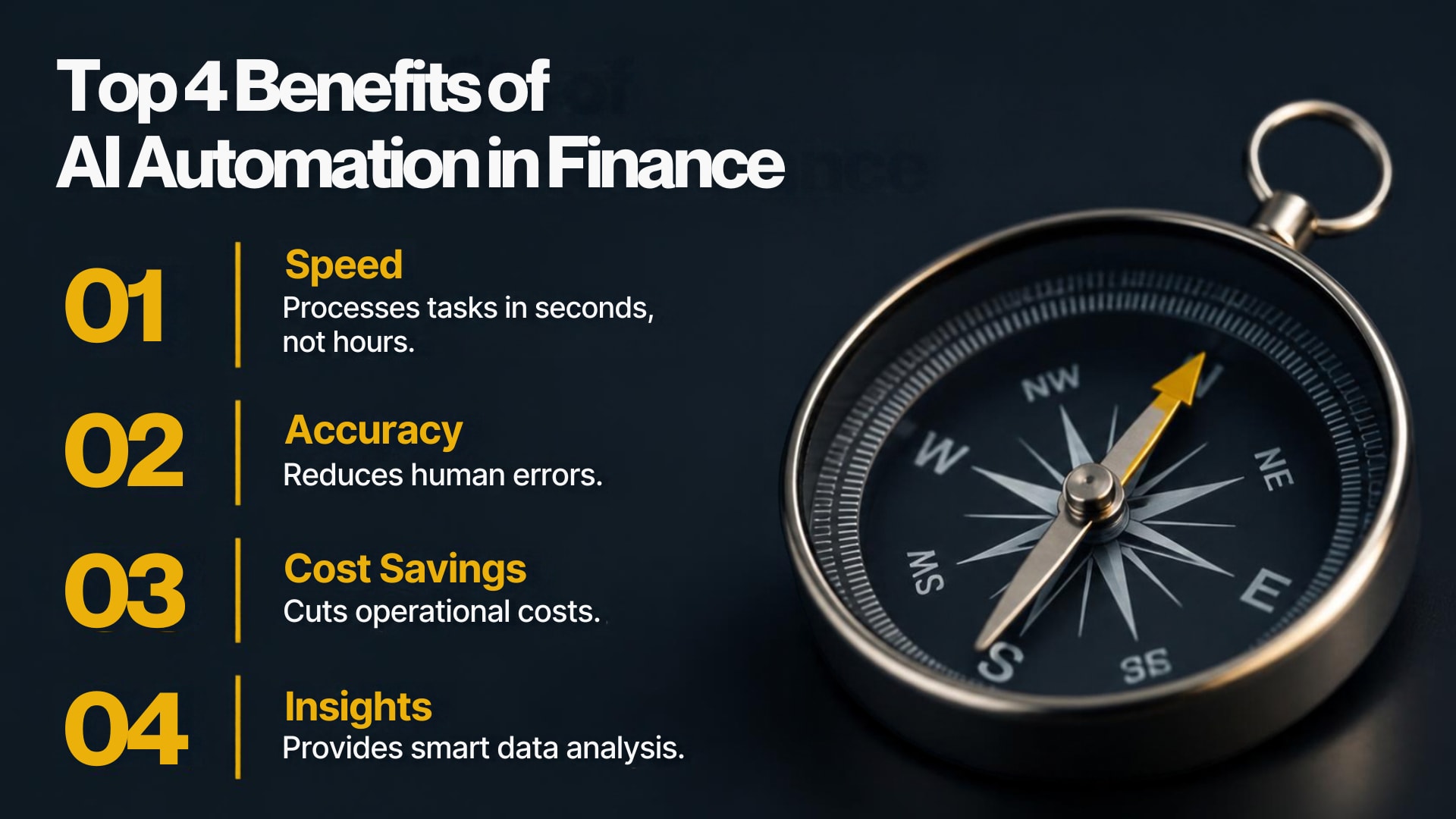
Frequently Asked Questions
1. What is AI-powered automation in financial operations?
AI-powered automation in financial operations combines artificial intelligence with automated workflows to process financial information and support repetitive activities. It can assist with invoice processing, reconciliation, reporting, transaction monitoring, document processing, forecasting, and exception detection while allowing finance professionals to review important decisions.
2. How does AI improve financial operations?
AI can improve financial operations by helping teams process large amounts of data, identify patterns, classify documents, detect unusual activity, and support automated workflows. The improvement depends on data quality, process design, technology integration, and appropriate human oversight.
3. What financial tasks can AI automate?
AI can support invoice processing, accounts payable, accounts receivable, expense management, reconciliation, financial reporting, transaction monitoring, fraud detection, cash-flow monitoring, compliance workflows, document processing, customer onboarding, and audit preparation.
4. Is AI automation useful for small businesses?
Yes. Small businesses can use financial automation for repetitive tasks such as invoice management, expense categorization, payment workflows, reconciliation, and reporting. However, the technology should match the company's transaction volume, budget, existing software, data quality, and security requirements.
5. What is the difference between AI and traditional financial automation?
Traditional automation generally follows predefined rules and works especially well for predictable processes. AI-powered automation can additionally support activities involving document interpretation, classification, pattern recognition, prediction, and anomaly detection. Many finance workflows can benefit from combining both approaches.
6. Is AI-powered financial automation secure?
It can be designed with strong security controls, but AI does not automatically make a system secure. Organizations should evaluate data privacy, encryption, access control, audit trails, vendor security, model reliability, human oversight, business continuity, and applicable regulatory requirements.
7. Can AI reduce financial errors?
AI-powered automation can reduce some manual data-entry and processing errors, particularly in repetitive workflows. It cannot guarantee error-free results. Incorrect source data, unsuitable models, integration problems, or unexpected situations can still produce incorrect outputs, which is why validation and human review remain important.
8. How does AI support fraud detection?
AI can analyze transaction data and identify patterns that differ from expected behavior. These patterns can generate alerts for investigation. AI-supported fraud detection should be treated as a risk-monitoring tool rather than proof that a transaction is fraudulent.
9. What should businesses consider before adopting financial automation?
Businesses should evaluate the process being automated, data quality, integration requirements, security, compliance, access controls, vendor reliability, costs, scalability, human-review requirements, and measurable business objectives. Starting with one well-defined workflow can make implementation easier to test and manage.
10. What is the future of AI in financial operations?
AI is expected to become increasingly connected with financial software, analytics, workflow systems, compliance tools, and business applications. The focus is likely to move toward more intelligent decision support and exception management while maintaining controls, governance, security, and human accountability.
Tags
Amzsoft Innovexa
Engineering and delivery notes from the Amzsoft Innovexa team — fintech platforms, AI automation, and product engineering.