
Microservices vs Monolithic Architecture: Which Architecture Is Better for Modern Applications?
Choosing between microservices vs monolithic architecture is not simply a technical preference. It is an architectural decision that affects development speed, scalability, deployment, infrastructure, testing, maintenance, team structure, and long-term software costs.
A monolithic architecture keeps most application functionality within a single deployable unit. Microservices architecture divides an application into smaller, independently deployable services, usually organized around business capabilities. Neither approach is automatically better. A small product with a focused team may benefit from the simplicity of a monolith, while a complex platform with several teams and demanding scaling requirements may gain more from microservices.
The right choice depends on application complexity, expected growth, team structure, operational maturity, budget, and business priorities. The most effective architecture is usually the one that solves the actual problem without introducing unnecessary complexity.
What Is the Difference Between Microservices and Monolithic Architecture?
The fundamental difference between microservices and monolithic architecture is how an application is structured and deployed. A monolithic application is generally built and deployed as one unit, while microservices architecture separates application capabilities into independently deployable services that communicate through defined interfaces. This difference affects scaling, testing, releases, infrastructure, and fault handling.
What is monolithic architecture and how does it work?
A monolithic architecture is a software architecture in which multiple application functions are packaged into a single deployable application. User authentication, product management, order processing, reporting, payment logic, and other business functions may exist inside the same application.
A monolith does not necessarily mean badly designed software. A well-structured monolith can contain clear modules, strong internal boundaries, automated tests, and clean interfaces between components.
The defining characteristic is primarily the deployment model: the application is treated as one unit for deployment.
For example, an online store could have modules for:
Customer accounts
Product catalogs
Shopping carts
Orders
Payments
Inventory
Notifications
In a monolithic system, these modules may exist in one application and share the same runtime environment and, often, the same database.
This arrangement can be highly practical during the early stages of a product because the entire system is relatively easy to run, test, and deploy.
How are application components organized in a monolith?
A monolithic application can still have internal structure. Developers may divide the code into modules, layers, controllers, services, repositories, and domain components.
The problem appears when those boundaries become weak.
Over time, one module may directly depend on another module's internal logic. Database tables may be accessed from many parts of the application. A change that appears small from a business perspective can then affect several unrelated areas.
This is where the distinction between a well-designed modular monolith and a tightly coupled monolith becomes important.
A modular monolith can preserve much of the simplicity of a single deployment while keeping the codebase organized for future growth.
How does deployment work in a monolithic application?
Deployment normally means building and releasing the application as one primary unit.
If a new payment feature changes the application, the updated application may need to be tested and deployed as a whole. Even if only one module changed, the release process can involve the entire application.
This model has a major advantage: there are fewer moving parts.
There is usually no need to coordinate dozens of independent service deployments, service discovery mechanisms, distributed tracing systems, or multiple runtime environments simply to release a small feature.
For smaller systems, that simplicity can be more valuable than independent deployment.
What is microservices architecture and how does it work?
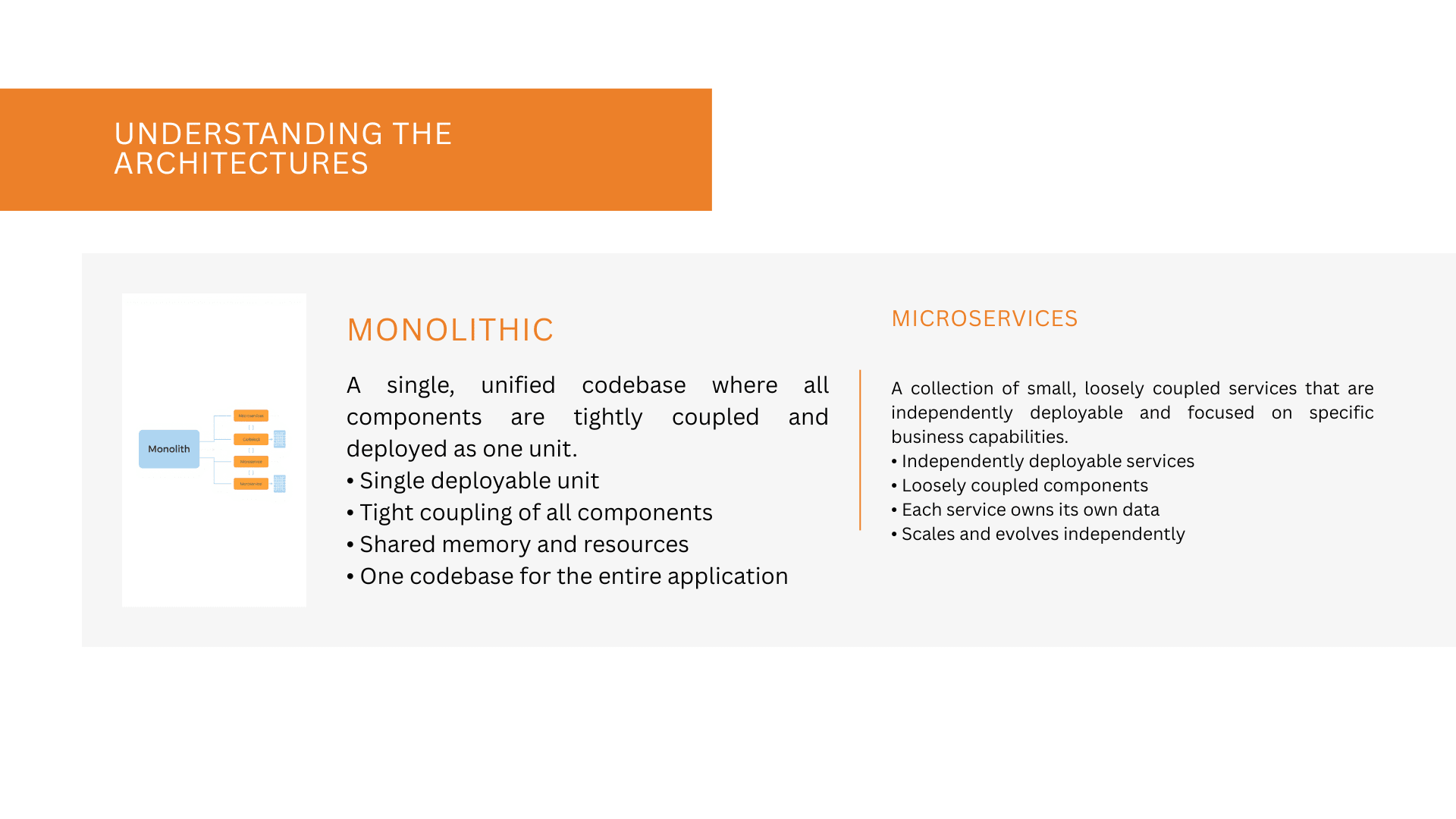
Microservices architecture structures an application as a collection of relatively small services. Each service is designed around a particular business capability and can generally be developed, deployed, and scaled independently. Services communicate through APIs or other lightweight communication mechanisms.
Consider the same e-commerce application. Instead of one application handling everything, it could contain separate services for:
Customer accounts
Product catalog
Orders
Payments
Inventory
Notifications
Search
Each service has its own responsibility and communicates with other services through defined contracts.
This does not mean that every function needs to become a separate microservice. The boundaries need to reflect meaningful business capabilities.
How are services organized around business capabilities?
One of the most important ideas in microservices architecture is business capability.
A service should exist because there is a meaningful reason to separate a particular responsibility, not simply because a developer can split a large codebase into smaller files.
For example, an order service could own order creation, order status, and order-related business rules. A payment service could handle payment processing and payment status.
Clear ownership reduces unnecessary dependencies.
The quality of service boundaries often matters more than the number of services.
A system with ten well-defined services can be easier to operate than a system with one hundred poorly designed services.
How do APIs connect microservices?
Because microservices run independently, they need ways to communicate.
Common approaches include:
REST APIs
gRPC
Message queues
Event-driven communication
Asynchronous messaging
For example, an order service might create an order and publish an event. A notification service could consume that event and send an email without requiring the order service to contain notification logic.
The network introduces new failure possibilities, however. A function call inside a monolith is generally different from a network request between two services.
A service may be unavailable, slow, unreachable, or returning an unexpected response.
That is one of the fundamental trade-offs of distributed systems.
Why are independent deployments important in microservices?
Independent deployment allows a team to release a service without necessarily rebuilding and deploying the entire application.
For example, if the notification service changes, its new version can potentially be released independently of the payment or inventory services.
This can help teams work at different release frequencies.
However, independent deployment is valuable only when the surrounding architecture supports it. Strongly coupled services, shared databases, incompatible API contracts, or manual deployment processes can reduce the practical benefits.
How do microservices and monolithic architecture compare?
The microservices vs monolithic architecture decision becomes clearer when the operational differences are considered rather than focusing only on the number of services.
CriterionMonolithic ArchitectureMicroservices ArchitectureArchitecture structureOne primary deployable applicationMultiple independently deployable servicesDevelopment complexityLower initiallyHigher initiallyScalabilityUsually scales the application as a unitIndividual services can scale independentlyDeploymentOne main deployment unitServices can be deployed separatelyMaintenanceSimple at small scale; harder as coupling growsMore manageable by service, but operationally complexTestingEasier end-to-end setupRequires unit, contract, integration, and distributed testingPerformanceFewer network calls inside the applicationNetwork communication can introduce latencyInfrastructure requirementsRelatively simpleMore infrastructure and automation often requiredTeam structureSuitable for small or centralized teamsStrong fit for multiple autonomous teamsFault isolationFailures can affect larger parts of the applicationFailures can be isolated when services are designed correctlyDevelopment speedOften fast for early developmentCan improve parallel development at larger scaleBest-fit use casesSmall to medium applications and early-stage productsComplex, large-scale, rapidly evolving distributed applications
What are the main differences between microservices and monolithic architecture?
The biggest differences are not limited to code organization. They involve the entire software delivery model.
How does scalability differ between microservices and monolithic applications?
A monolith can be horizontally scaled by running multiple instances of the entire application. This works well when most parts of the application experience similar demand.
The challenge appears when only one component needs significant additional resources.
Suppose an e-commerce application has ten major modules, but product search receives most of the traffic. A monolith may require additional instances containing all ten modules.
Microservices can allow the search service to scale independently.
That does not mean microservices automatically make an application faster. They make selective scaling easier when the architecture and infrastructure support it.
How do deployment and release processes differ?
A monolith normally has a coordinated release process.
Microservices can support independent releases, allowing teams to deploy individual services.
That flexibility can reduce coordination between teams, but it also introduces versioning and compatibility concerns.
If service A depends on service B, changes to B must preserve the expected API contract or be coordinated appropriately.
How do testing and debugging compare?
Testing a monolith can be simpler because many components run within one application environment.
Microservices require testing at several levels:
Individual service testing
API or contract testing
Integration testing
End-to-end testing
Failure testing
Performance testing
Debugging can also require distributed tracing because one user request may travel through several services.
A microservices environment therefore needs stronger engineering practices, not simply more services.
How do infrastructure requirements differ?
A monolith can often run with a comparatively straightforward infrastructure stack.
Microservices typically introduce more infrastructure components, depending on the implementation:
Container platforms
Service discovery
API gateways
Message brokers
Centralized logging
Metrics
Distributed tracing
Automated deployment pipelines
Secrets management
Load balancing
Kubernetes can help manage containerized workloads, but introducing Kubernetes does not solve architectural problems by itself. Operational complexity remains a consideration.
What are the advantages of monolithic architecture?
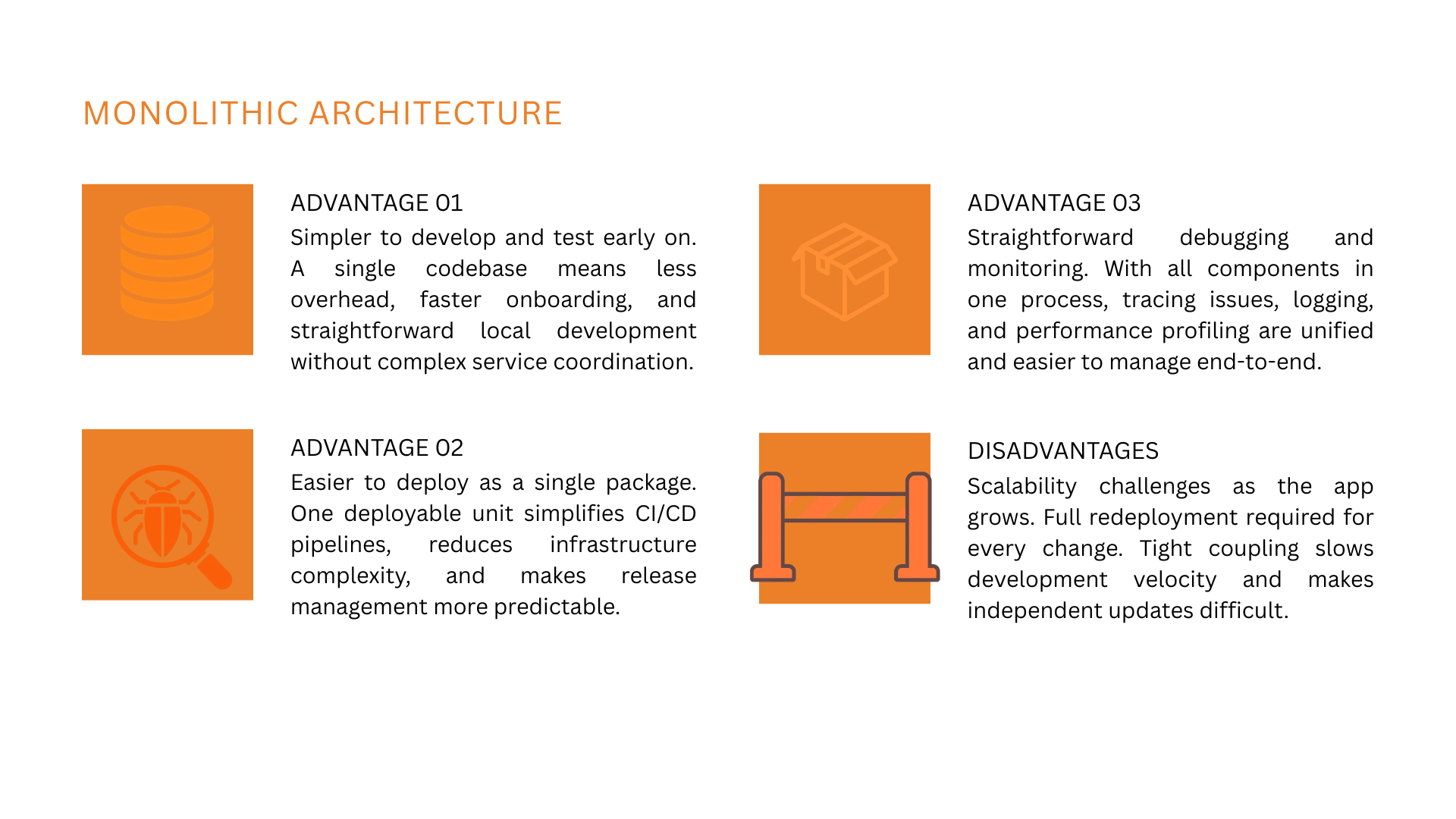
The strongest advantage of a monolithic architecture is simplicity. A single application can be easier to understand, develop, test, deploy, monitor, and operate, particularly when the product and engineering team are relatively small.
A monolith can also be an excellent starting point for a new product because business requirements are often uncertain during the early stages.
Why is a monolith often faster to build initially?
A small team can move quickly when there are fewer architectural decisions.
There may be:
One primary codebase
One deployment pipeline
One application runtime
Fewer network boundaries
Fewer infrastructure components
Simpler local development
Developers can call internal application functions directly instead of designing APIs between multiple services.
For a startup validating a product idea, this can reduce the time spent on infrastructure before the product has established product-market fit.
How can a monolithic application simplify development and testing?
When components operate in one process, developers can often reproduce application behavior locally with fewer dependencies.
A transaction involving customer data, orders, and inventory may be handled within one application and database transaction.
Testing can therefore be easier than testing the same business process across multiple distributed services.
This is especially useful when the application is relatively small and business boundaries are still evolving.
Why can a monolith reduce infrastructure complexity?
A monolithic system can operate with a relatively small infrastructure footprint.
There may be one application cluster, one primary database, one deployment pipeline, and a limited number of supporting services.
That simplicity can reduce operational overhead.
The architecture becomes problematic when growth creates coupling and the application becomes difficult to change, rather than simply because it is monolithic.
What are the disadvantages of monolithic architecture?
The disadvantages of a monolith usually become more visible as the application and organization grow. Tight coupling can make changes riskier, releases larger, and selective scaling harder.
A poorly structured monolith can eventually become difficult to understand because business logic, database access, integrations, and application workflows become deeply interconnected.
Why does a large monolith become harder to maintain?
As an application grows, its codebase can accumulate dependencies.
A change in one area may affect another area unexpectedly. Developers may need to understand large sections of the application before making apparently simple modifications.
This creates a common problem: the application becomes technically functional but increasingly expensive to change.
The issue is not the size of the codebase alone. Internal architecture, coupling, testing quality, ownership, and engineering discipline all matter.
Why can scaling a monolith become inefficient?
A monolithic application generally scales as a unit.
If one feature needs more computing resources while other features do not, the entire application may be replicated.
That can increase infrastructure consumption.
However, a monolith can still scale successfully. Horizontal scaling, caching, database optimization, load balancing, asynchronous processing, and other techniques can support substantial workloads.
Microservices simply provide a more granular scaling model.
How can tightly coupled components slow software delivery?
When multiple teams modify the same application, changes can collide.
One team may update a shared component while another team depends on its existing behavior. Release coordination becomes more important.
Large releases can also increase the size of the testing scope.
This is one reason organizations sometimes move toward microservices as their teams and product complexity grow.
When Should a Business Choose Microservices or Monolithic Architecture?
A business should choose a monolith when simplicity, rapid initial development, limited operational needs, and a small team are the dominant requirements. Microservices become more attractive when independent scaling, frequent releases, strong service boundaries, multiple autonomous teams, and complex application requirements justify distributed-system complexity. The decision should follow business needs rather than architecture trends.
What are the main benefits of microservices architecture?
The main microservices benefits are independent deployment, selective scalability, stronger service boundaries, team autonomy, and the ability to isolate certain failures. These benefits can be significant for complex applications, but they come with operational costs because the system becomes distributed.
How does microservices architecture improve application scalability?
Microservices scalability comes from the ability to scale services independently.
An online marketplace may experience heavy traffic in search while payment traffic remains moderate. A microservices design can allocate additional resources to search without necessarily duplicating every other application capability.
This can make resource allocation more precise.
The benefit becomes especially useful when application workloads have very different traffic patterns.
How do microservices support independent deployment?
Independent deployment allows a service to be updated without necessarily releasing unrelated services.
This can be valuable for large engineering organizations where different teams own different business capabilities.
For example, a product team responsible for recommendations could release changes independently from the team responsible for customer accounts.
The architecture supports organizational autonomy when service boundaries and ownership are aligned.
How can microservices improve fault isolation?
Microservices can reduce the blast radius of certain failures.
If a recommendation service fails, the rest of an application may continue operating if the system has been designed to tolerate that failure.
For example, an online store may still allow customers to search for products and place orders even if personalized recommendations are temporarily unavailable.
Fault isolation is not automatic. Poor dependencies can allow failures to spread across services.
Timeouts, retries, circuit breakers, graceful degradation, and clear dependency design are often needed.
How does microservices architecture support multiple engineering teams?
Microservices can align technical ownership with business capabilities.
One team may own orders, another payments, and another customer identity.
Each team can maintain its service and deployment process while interacting with other teams through stable interfaces.
This model becomes more useful when the organization is large enough that a single shared codebase creates significant coordination overhead.
What are the disadvantages of microservices architecture?
The major microservices disadvantages come from distribution. Network communication, independent deployments, multiple databases, monitoring requirements, service failures, data consistency, and infrastructure management all add complexity.
Microservices can solve organizational and scaling problems while creating operational problems if adopted without sufficient engineering maturity.
Why are distributed systems harder to operate?
A monolithic application may have one main runtime process. A microservices platform can have dozens or hundreds of independently running processes.
Each process can fail separately.
Communication between services can fail.
Deployments can fail.
A database can become unavailable.
A message can be delayed.
A service can return a slow response.
The engineering team must therefore understand distributed-system behavior.
How do network calls affect application performance?
An internal function call is generally faster and simpler than a network request.
Microservices communicate across networks, which introduces latency and additional failure points.
A poorly designed request chain can make performance worse.
For example:
Application → API gateway → Service A → Service B → Service C → Database
If every step waits synchronously for the next step, latency can accumulate.
Good architecture limits unnecessary communication and uses asynchronous patterns when appropriate.
Why are monitoring and observability essential for microservices?
Observability means having enough information to understand what is happening inside a running system.
Important capabilities include:
Centralized logs
Metrics
Distributed tracing
Health checks
Alerts
Error tracking
Performance monitoring
Without these tools, diagnosing a failed request across multiple services can be much harder than diagnosing a failure inside one application.
How do distributed transactions create additional complexity?
A monolithic application may perform several database operations inside one transaction.
With microservices, different services may own different data stores.
A business workflow involving payments, orders, and inventory may therefore require coordination across service boundaries.
Distributed transactions can be difficult to manage.
Many microservices systems instead use asynchronous events, compensating actions, and patterns designed around eventual consistency.
This requires careful business and technical design.
Is microservices architecture more expensive than monolithic architecture?
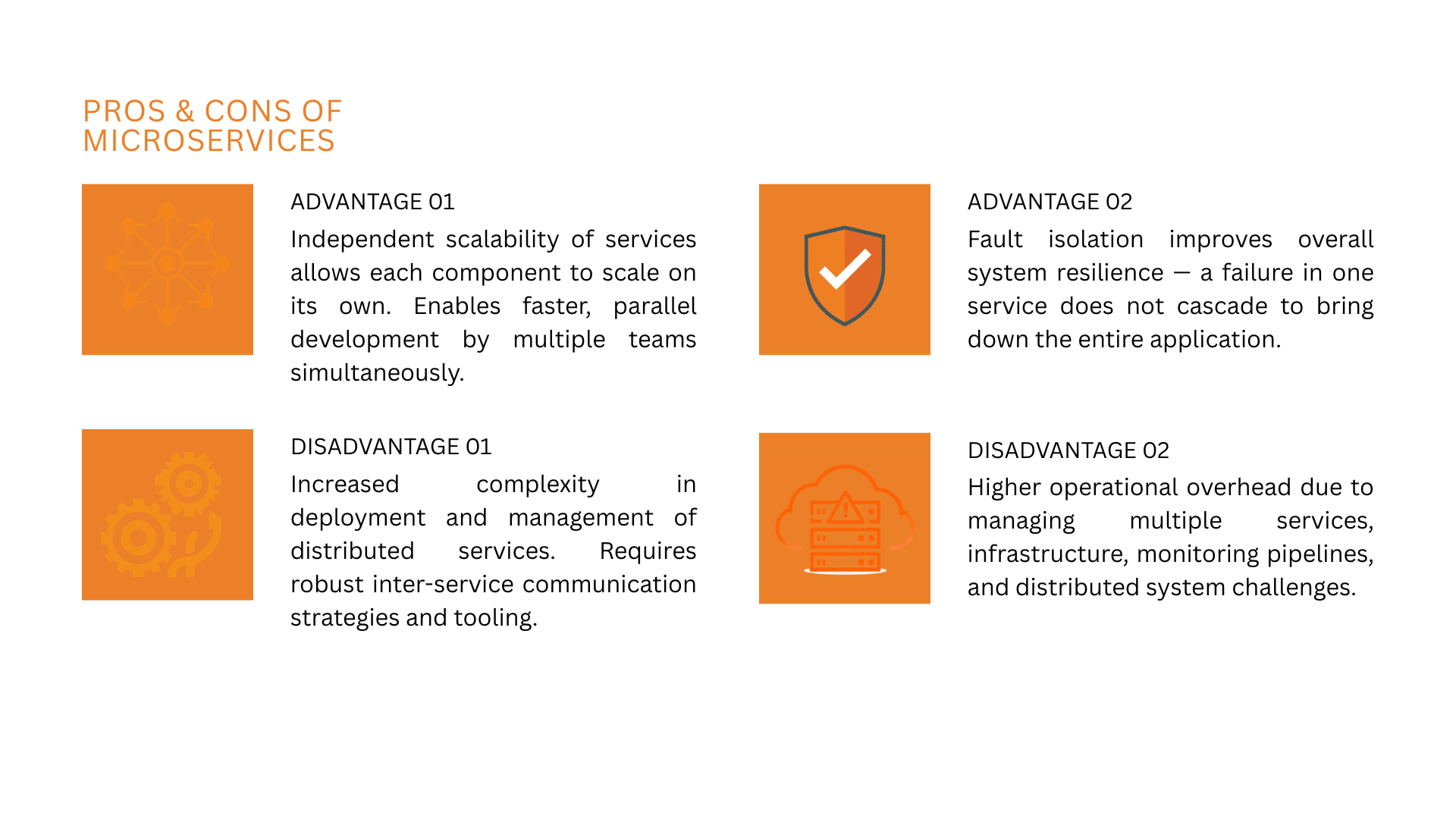
Microservices can cost more to build and operate because they require additional infrastructure, automation, monitoring, testing, deployment processes, and engineering expertise. A monolith can be cheaper for a small application. However, the long-term cost depends on scale, team structure, release requirements, and operational needs rather than architecture alone.
The financial decision should therefore include both infrastructure costs and engineering costs.
A monolith may save infrastructure expense but become expensive to modify.
Microservices may increase infrastructure expense but reduce coordination costs for a large organization.
The important question is not simply, “Which architecture is cheaper?”
It is:
Which architecture produces the lowest total cost for the application's expected requirements?
Which architecture is better for startups?
For many startups, a modular monolith is a sensible starting point.
Early-stage companies often have:
Small engineering teams
Limited infrastructure budgets
Rapidly changing requirements
Uncertain product-market fit
A need to release features quickly
At that stage, microservices can introduce complexity before the business has a clear reason to need it.
When does a startup benefit from starting with a monolith?
A startup can benefit from a monolith when the product is relatively simple and the team needs to validate the core business idea.
A single deployment can make development and troubleshooting easier.
The architecture can still be modular internally so that future separation remains possible.
The objective should not be to create a giant monolith. It should be to create a well-structured monolith that can evolve.
When should a startup consider microservices?
A startup may consider microservices when specific business needs emerge.
Examples include:
A particular service requires independent scaling.
Multiple teams need independent ownership.
Release coordination has become a major bottleneck.
Different capabilities require different technology stacks.
A business capability needs strong fault isolation.
The application has clear and stable service boundaries.
Migration should be driven by measurable problems rather than the assumption that a growing company automatically needs microservices.
Which architecture is better for large-scale applications?
Large-scale applications often benefit from microservices, but scale alone does not guarantee that microservices are the right answer.
A large application with a small engineering team and stable requirements may still operate effectively as a modular monolith.
Conversely, a rapidly changing platform with many engineering teams may face severe coordination problems with a single deployable application.
The deciding factors are usually complexity, organizational structure, scaling patterns, and operational requirements.
When should an e-commerce platform use microservices?
E-commerce platforms can be strong candidates for microservices when different business capabilities have different scaling and release requirements.
For example:
Search may require high read capacity.
Checkout may require strict reliability.
Inventory may need strong consistency.
Recommendations may use different processing methods.
Notifications may work asynchronously.
Separating these capabilities can provide useful independence.
A small online store, however, may not need this architecture. A monolith can be much easier to build and maintain when the product is still simple.
When can a banking or financial application benefit from microservices?
Financial applications often contain multiple complex business capabilities, such as identity, accounts, payments, transactions, reporting, fraud detection, and notifications.
Microservices can help separate these responsibilities and allow teams to apply different scaling, deployment, and reliability strategies.
However, financial systems also have demanding requirements around data integrity, security, auditing, and consistency.
Microservices do not remove those requirements. They can make the technical implementation more complicated because business transactions cross service boundaries.
Architecture decisions in such systems require careful domain modeling and strong operational controls.
Which architecture works well for SaaS applications?
There is no single answer for SaaS platforms.
A small SaaS product can often begin with a modular monolith.
As the platform grows, certain capabilities may become natural candidates for separation.
For example, a SaaS application could eventually separate:
Authentication
Billing
Reporting
Notifications
File processing
Search
The decision should be based on actual workload and organizational requirements.
Does every application need microservices?
No. Not every application needs microservices.
A microservices architecture is not a mandatory upgrade path for modern software.
A well-designed monolith can be easier to develop, test, deploy, and operate.
Microservices become valuable when their benefits justify their additional complexity.
A useful principle is:
Start with the simplest architecture that satisfies the known requirements, then evolve when evidence shows that the architecture has become a constraint.
That principle avoids both extremes: building an unnecessarily complex distributed system and allowing a monolith to become impossible to change.
How Can a Business Decide Between Monolithic and Microservices Architecture?
The best architecture decision comes from evaluating business requirements, application complexity, expected growth, team structure, scalability patterns, operational maturity, and budget. A practical decision process starts with the simplest viable architecture and identifies the specific conditions that would justify greater distribution. This keeps software architecture aligned with business needs instead of technology trends.
What factors should influence an architecture decision?
Architecture decisions should consider more than application size.
The following factors are especially important.
How does application complexity affect the decision?
Complexity is one of the strongest signals.
A simple application with a small number of business capabilities may not benefit from service distribution.
A platform containing many independent domains may eventually need stronger boundaries.
The key question is whether the application's internal relationships are becoming difficult to manage.
How does team size influence architecture choice?
Team structure matters because architecture affects organizational coordination.
A team of four developers may find dozens of services difficult to manage.
A company with multiple autonomous engineering teams may find a single shared application restrictive.
Microservices can support team autonomy, but only when teams can own services effectively.
How important are scalability requirements?
The application should be examined for uneven workloads.
If every component scales together, a monolith may be sufficient.
If specific capabilities experience dramatically different workloads, independent services may provide greater flexibility.
Scalability requirements should be measured rather than assumed.
How should operational maturity be evaluated?
Microservices require more operational discipline.
A team considering microservices should assess whether it can manage:
Automated CI/CD
Infrastructure as code
Monitoring
Centralized logging
Distributed tracing
Automated testing
Incident response
Security controls
Service ownership
Without these capabilities, a distributed architecture can become difficult to operate.
How do budget and infrastructure costs affect the decision?
Every additional service creates operational work.
There may be additional compute resources, deployment pipelines, monitoring requirements, databases, networking, and engineering time.
A business with limited resources should carefully consider whether those costs produce meaningful value.
Can a monolithic application be converted into microservices?
Yes. A monolithic application can be gradually converted into microservices, and a phased migration is often safer than rewriting the entire system at once. Successful modernization usually begins by understanding dependencies, identifying meaningful business boundaries, and moving selected capabilities incrementally while the existing application continues operating. AWS documents several decomposition patterns for this type of modernization.
What makes a monolith a good candidate for modernization?
A monolith may be a strong modernization candidate when it has clear problems such as:
Long release cycles
Difficult scaling
Strong coupling
Large teams blocking one another
Frequent failures caused by unrelated changes
Business capabilities that need independent deployment
Migration should not happen simply because the application is old.
A stable monolith that meets business requirements may not need to become microservices.
How should service boundaries be identified?
Service boundaries should generally follow business capabilities rather than technical layers.
For example, separating an application into:
Database service
Controller service
UI service
does not automatically produce useful microservices.
A more meaningful decomposition might be:
Order service
Customer service
Payment service
Inventory service
Each service should have a clear responsibility and ownership model.
Poor boundaries can create constant communication between services, which defeats many of the benefits of decomposition.
What is the strangler pattern for monolith migration?
The strangler pattern is a gradual modernization approach in which new services replace selected functionality while the existing application continues operating.
Instead of rewriting the entire monolith, a team identifies one capability, extracts it, redirects relevant traffic, and gradually reduces the responsibility of the old system.
This lowers migration risk compared with a complete rewrite.
AWS includes the strangler fig pattern among the approaches for decomposing monolithic applications.
How can migration happen without disrupting the existing application?
A controlled migration can follow a sequence such as:
Map the existing application and its dependencies.
Identify a business capability suitable for extraction.
Define the service's API contract.
Separate the relevant business logic.
Establish independent testing.
Deploy the new service alongside the monolith.
Redirect selected traffic.
Monitor performance and errors.
Reduce the old component's responsibility.
Repeat only where there is a clear business benefit.
This approach allows architecture to evolve incrementally.
What are the biggest mistakes when adopting microservices?
The biggest mistakes include creating too many services, choosing poor service boundaries, sharing databases carelessly, ignoring observability, underestimating operational costs, and adopting microservices before the organization can support distributed systems.
Microservices should solve a real architectural problem.
They should not be introduced merely because large technology companies use them.
Why can creating too many services become a problem?
A service should have a meaningful responsibility.
If every small feature becomes a separate service, the system can become difficult to understand and operate.
Too many services can create:
Excessive network communication
More deployments
More monitoring
More failure points
More API contracts
More operational overhead
The word “micro” should not be interpreted as “as small as technically possible.”
Why should services be aligned with business capabilities?
Business-aligned boundaries tend to provide clearer ownership.
A payment team can own payment behavior. An order team can own order behavior.
This reduces unnecessary coordination.
When services are divided only according to technical layers, multiple teams may need to modify several services to deliver one business feature.
That recreates the coordination problem that microservices were supposed to reduce.
Why is premature microservices adoption risky?
Premature microservices adoption can turn a straightforward application into a distributed system before there is a business reason to do so.
A team may spend significant time managing:
Service deployment
API versioning
Network failures
Distributed logs
Monitoring
Data synchronization
instead of improving the product.
The architecture should therefore evolve with the application's needs.
Can a modular monolith be a middle ground?
Yes. A modular monolith can provide a practical middle ground between a traditional tightly coupled monolith and a distributed microservices architecture.
The application remains a single deployable unit, but internal modules have explicit boundaries and controlled dependencies.
This approach can provide several advantages:
Simple deployment
Easier local development
Lower infrastructure complexity
Stronger internal organization
Easier testing
A clearer path toward future service extraction
For many businesses, this is a highly practical architecture.
A modular monolith does not guarantee an easy future migration, but strong internal boundaries can make later decomposition more manageable.
What role do containers, Kubernetes, CI/CD, and cloud platforms play?
Modern cloud-native architecture can support microservices through containers, automated deployment, orchestration, observability, and infrastructure automation.
Containers package an application and its dependencies into a consistent runtime unit.
Kubernetes can orchestrate containerized workloads across infrastructure.
CI/CD, meaning continuous integration and continuous delivery or deployment, automates software build, testing, and release processes.
These technologies can make microservices easier to operate, but they also require expertise.
Technology should follow architecture, not the other way around.
A business should not adopt Kubernetes simply because it plans to use microservices. The infrastructure should be appropriate for the scale and operational requirements of the application.
How do performance, reliability, and fault isolation compare?
Performance and reliability depend heavily on implementation quality.
A monolith can be extremely fast because internal components communicate without network calls.
Microservices introduce network communication, which can add latency.
At the same time, microservices can provide selective scaling and fault isolation.
The trade-off is therefore not:
monolith = slow, microservices = fast.
The more accurate comparison is:
monolith = simpler communication model; microservices = greater distribution and independence.
A well-designed monolith can outperform a poorly designed microservices system.
Likewise, a well-designed microservices architecture can provide resilience and scalability that become difficult to achieve efficiently with a tightly coupled monolith.
What practical framework can teams use to choose an architecture?
A practical architecture decision can be made through five steps.
Step 1: Define the application's business requirements
The first question should be what the application needs to accomplish.
The team should identify:
Core business capabilities
Expected users
Critical workflows
Reliability requirements
Compliance requirements
Integration needs
Release frequency
Architecture should support these requirements.
Step 2: Evaluate complexity and growth expectations
The team should distinguish between current requirements and hypothetical future requirements.
If an application has ten users today, designing infrastructure for ten million users may create unnecessary complexity.
Growth should be considered, but architecture should not be based entirely on speculation.
Step 3: Assess team and operational maturity
The organization should ask whether it can operate distributed systems effectively.
A microservices architecture without automated deployment, monitoring, testing, and clear ownership can become difficult to manage.
Operational maturity is therefore part of the architecture decision.
Step 4: Compare scalability requirements with complexity costs
The team should identify which components actually need independent scaling.
If the answer is “almost none,” a monolith may be sufficient.
If several independent capabilities have different workload patterns, microservices may provide meaningful value.
Step 5: Choose the simplest architecture that meets the requirements
The final decision should balance capability and complexity.
A useful decision pattern is:
Small application + small team + uncertain requirements: modular monolith
Growing application + increasing coupling: strengthen modular boundaries first
Multiple teams + independent business domains: consider microservices
Uneven scaling requirements: consider service-level scaling
High operational maturity + complex platform: microservices may be appropriate
Stable application + low complexity: remain with a monolith
This approach keeps architecture decisions grounded in actual constraints.
What is the final recommendation for microservices vs monolithic architecture?
There is no universally superior answer in the microservices vs monolithic architecture debate. Monolithic architecture is often the better starting point when simplicity, speed, and low operational overhead matter most. Microservices are more suitable when independent scaling, deployment, team ownership, fault isolation, and complex business boundaries justify the additional distributed-system complexity.
The most important architectural decision is not choosing the trendiest model. It is choosing a structure that the organization can build, operate, test, secure, and evolve successfully.
A small SaaS product may be better served by a modular monolith. A large marketplace with many independent engineering teams may benefit from microservices. An established enterprise may need a gradual modernization strategy rather than a complete rewrite.
Architecture can also evolve.
A business does not have to choose one model permanently. A well-designed monolith can become more modular, and selected modules can later be extracted into independent services when evidence supports that decision.
For businesses evaluating application architecture, modernization, or custom software development, AMZ Soft Innovexa can be considered as a potential technology partner for software development, application modernization, custom software solutions, cloud solutions, and architecture-related consulting. The appropriate engagement should depend on the application's requirements and technical scope.
For a deeper explanation of microservices characteristics and architectural trade-offs, Martin Fowler's Microservices guide provides a useful technical reference. For a practical comparison of monolithic and microservices approaches, AWS's monolithic vs. microservices architecture guide offers additional architectural context.
Ultimately, the best software architecture is the one that matches the application's complexity, team structure, scalability needs, operational maturity, budget, and business goals. Microservices can be powerful, but simplicity is also an engineering advantage. The strongest architecture decision is the one that provides enough flexibility for the real problem without creating complexity that the business does not yet need.
Tags
Amzsoft Innovexa
Engineering and delivery notes from the Amzsoft Innovexa team — fintech platforms, AI automation, and product engineering.