Next.js vs. React vs. Flutter: Which Tech Stack Is Best for Scalable Multi-Platform Enterprise Apps?
Selecting the best tech stack for enterprise apps requires balancing runtime performance, rendering architecture, and ecosystem maturity across web and mobile surfaces. Next.js delivers optimal web performance through hybrid rendering, React powers scalable single-page web applications, and Flutter provides compiled multi-platform mobile fidelity from a unified codebase.
Multi-platform enterprise app development in 2026 demands high throughput, rapid time-to-market, and low maintenance overhead. As organizations modernize distributed systems and support millions of concurrent users across mobile, tablet, desktop, and web clients, architectural trade-offs between full-stack web frameworks and native compiled runtimes directly dictate infrastructure spend, developer velocity, and operational scalability. In this comprehensive evaluation, we analyze Next.js vs React vs Flutter to establish an authoritative decision framework for enterprise application architecture.
+---------------------------------------------------------------------------------------------------+
|                               Enterprise Multi-Platform Selection                                 |
+------------------------------------+----------------------------------+---------------------------+
| Next.js (Full-Stack Web)           | React (Client-Centric SPA)       | Flutter (Multi-Platform)  |
| - SSR, SSG, ISR, Server Actions    | - High-interactivity SPAs        | - AOT compilation via C++ |
| - Native SEO & Web Vitals          | - Massive library ecosystem      | - Impeller GPU rendering  |
| - Edge compute integration         | - Micro-frontend decoupling       | - 95%+ cross-platform iOS |
|                                    |                                  |   & Android code sharing  |
+------------------------------------+----------------------------------+---------------------------+
1. Executive Evaluation: Architectural Paradigms and Core Trade-Offs
The choice between Next.js, React, and Flutter hinges on whether an enterprise prioritizes web-first discoverability, modular single-page application interactivity, or multi-platform native mobile parity. Next.js excels at full-stack web delivery, React maximizes client-side modularity, and Flutter offers pixel-perfect compiled execution across iOS, Android, and desktop runtimes.
+----------------------------------------------------------------------------------------------------+
|                                 Runtime Rendering Comparison                                       |
+----------------------------------------------------------------------------------------------------+
| Next.js:  [Node.js / Edge Server] ---> Pre-rendered HTML/RSC ---> [Browser DOM + Hydration]       |
| React:    [Browser Client]        ---> JavaScript Bundle     ---> [Virtual DOM -> Browser DOM]    |
| Flutter:  [Dart Native / AOT]     ---> Impeller / Skia Engine---> [Direct GPU Canvas Pipeline]    |
+----------------------------------------------------------------------------------------------------+
The Full-Stack Web Imperative: Next.js Enterprise Scalability
Next.js solves enterprise web scalability by unifying client and server execution through React Server Components, automated code-splitting, and hybrid caching pipelines. It eliminates client-side hydration bottlenecks, accelerates Time to First Byte (TTFB), and optimizes Largest Contentful Paint (LCP) for complex, high-traffic digital platforms.
When we develop enterprise web portals that process tens of thousands of requests per second, Next.js provides architectural primitives that decouple server execution from client browser constraints:
Server-Side Rendering (SSR): Generates dynamic HTML per request on Node.js or edge runtimes, ensuring personalized data loads with minimal client compute overhead.
Static Site Generation (SSG): Pre-renders static assets at build time, distributing immutable payloads across global content delivery networks (CDNs) for millisecond delivery.
Incremental Static Regeneration (ISR): Updates individual static pages in the background without rebuilding the entire application, preserving database cache health under high concurrency.
React Server Components (RSC): Ships zero JavaScript runtime overhead to the client for server-rendered components, reducing bundle sizes by up to 40% in large-scale deployments.
The Component-Driven Standard: React Ecosystem for Large-Scale Applications
React remains the enterprise benchmark for complex, authenticated SaaS dashboards, trading portals, and internal enterprise tools requiring rich client-side state manipulation. Its lightweight component model, Virtual DOM reconciliation, and massive third-party ecosystem allow development teams to build modular, decoupled user interfaces with predictable lifecycle control.
The React ecosystem for large-scale applications offers distinct architectural advantages for organizations that manage distributed development teams:
Component-Based Architecture: Encourages domain-driven design by encapsulating presentation logic, custom hooks, and UI primitives into shareable internal design systems.
Micro-Frontend Compatibility: Integrates with Webpack Module Federation to allow independent enterprise teams to develop, test, and deploy isolated business domains within a single parent container.
Unconstrained Backend Integration: Operates purely on client runtimes, allowing enterprises to pair React with arbitrary API gateways, GraphQL layers, or microservices architectures without framework lock-in.
The Native Compilation Engine: Flutter and the Impeller Runtime
Flutter bypasses traditional platform UI bridges by compiling Dart source code directly into native ARM and x86 machine instructions. Driven by the Impeller rendering engine, Flutter delivers consistent 60 to 120 FPS performance across iOS and Android by drawing directly to the GPU canvas layer.
Unlike hybrid frameworks that translate platform widgets through an asynchronous bridge, Flutter controls every pixel on screen:
Ahead-of-Time (AOT) Compilation: Compiles Dart to C++ and native machine code during release builds, ensuring instant startup times and predictable execution without runtime bytecode interpretation.
Impeller GPU Subsystem: Replaces legacy runtime shader compilation with pre-compiled shaders, eliminating shader compilation jank on modern mobile operating systems.
Unified Multi-Platform Canvas: Ensures consistent visual identity across devices, eliminating platform-specific rendering quirks across fragmented Android and iOS ecosystems.
2. Deep-Dive Framework Mechanics: Rendering, Compilation, and Execution Models
Framework runtime mechanics dictate runtime memory consumption, thread utilization, and input responsiveness under heavy enterprise workloads. Next.js prioritizes hybrid streaming on the server, React relies on asynchronous client-side concurrent scheduling, and Flutter executes compiled graphic instruction trees directly against platform hardware layers.
+---------------------------------------------------------------------------------------------------+
|                                  Execution Pipeline Matrix                                        |
+-------------------+--------------------------------+----------------------------------------------+
| Framework         | Compilation & Execution Target | Primary Rendering Subsystem                  |
+-------------------+--------------------------------+----------------------------------------------+
| Next.js           | Node.js / Edge V8 + Client JS  | Server HTML Stream -> React DOM Hydration    |
| React (SPA)       | Client V8 / JavaScript Engine  | Virtual DOM Reconciliation -> Browser DOM    |
| Flutter (Mobile)  | AOT Native Machine Code (ARM)  | Impeller Engine (Direct Metal / Vulkan GPU)  |
| Flutter (Web)     | Dart2JS / WebAssembly (Wasm)   | CanvasKit / HTML5 Canvas API                 |
+-------------------+--------------------------------+----------------------------------------------+
Rendering Strategies: Server-Side Rendering (SSR), SSG, and ISR vs. Client Rendering
Hybrid server rendering in Next.js optimizes search indexing, caching, and mobile network transport, whereas pure Single Page Application (SPA) rendering in React delegates execution to the user browser. Balancing these models determines whether your infrastructure costs reside on edge compute servers or client hardware devices.
TypeScript
// Next.js App Router: Hybrid Data Fetching with Revalidation (ISR)
export async function generateStaticParams() {
  const accounts = await fetchEnterpriseAccounts();
  return accounts.map((account) => ({ id: account.id }));
}

export default async function AccountDashboard({ params }: { params: { id: string } }) {
  // Server-side cached fetch with automated tag-based revalidation
  const res = await fetch(`https://api.enterprise.internal/v1/accounts/${params.id}`, {
    next: { revalidate: 60, tags: [`account-${params.id}`] }
  });
  const data = await res.json();

  return (
    <section className="dashboard-grid">
      <h1>Account Overview: {data.companyName}</h1>
      <MetricDisplay metrics={data.metrics} />
    </section>
  );
}
Client-side rendering in standard React requires sending a blank HTML shell, downloading heavy JavaScript bundles, and initiating client-side API waterfalls before rendering UI:
Initial Payload: Client requests HTML shell (1 to 2 KB), which references compiled bundle assets (500 KB to 5 MB).
Bundle Execution: Browser parses and executes JavaScript, mounting the root component and displaying loading indicators.
Data Fetching: Client-side hooks (
useEffector TanStack Query) trigger asynchronous REST or GraphQL calls.Final Layout Paint: Virtual DOM updates trigger browser layout calculation, and paint data to the screen, introducing latency on low-powered mobile devices.
Execution Pipelines: Ahead-of-Time (AOT) Compilation vs. Just-in-Time JavaScript
AOT compilation compiles source code into platform-native machine instructions before deployment, whereas JIT compilation and JavaScript engines parse and optimize code dynamically at runtime. Flutter uses AOT for production mobile binaries to guarantee predictable execution profiles and deterministic memory allocations.
Dart
// Flutter: Strongly-Typed Immutable Widget with State Separation
import 'package:flutter/material.dart';

class EnterpriseTelemetryCard extends StatelessWidget {
  final String metricName;
  final double throughputValue;

  const EnterpriseTelemetryCard({
    super.key,
    required this.metricName,
    required this.throughputValue,
  });

  @override
  Widget build(BuildContext context) {
    return Card(
      elevation: 2.0,
      child: Padding(
        padding: const EdgeInsets.all(16.0),
        child: Column(
          crossAxisAlignment: CrossAxisAlignment.start,
          children: [
            Text(metricName, style: Theme.of(context).textTheme.titleMedium),
            const SizedBox(height: 8.0),
            Text(
              '${throughputValue.toStringAsFixed(2)} req/sec',
              style: Theme.of(context).textTheme.headlineSmall,
            ),
          ],
        ),
      ),
    );
  }
}
JavaScript platforms (React and Next.js) rely on the V8 or JavaScriptCore runtime engines:
Parse and Bytecode Generation: The engine parses script tokens into an Abstract Syntax Tree (AST) and compiles bytecode via baseline interpreters.
Dynamic Optimization: The engine tracks hot execution paths at runtime, optimizing functions via optimizing compilers (like V8 TurboFan) while de-optimizing when variable types mutate.
Garbage Collection Pauses: Uncontrolled memory allocation in high-frequency React re-renders can trigger minor or major garbage collection sweeps, causing micro-stutters during high-concurrency client data streaming.
Canvas Graphics vs. The DOM: Impeller Engine and Flutter Web Performance Limitations
Flutter paints its UI onto an HTML5 Canvas or WebAssembly (Wasm) surface on the web, while React and Next.js manipulate semantic Document Object Model (DOM) tree nodes. This fundamental difference produces substantial performance and accessibility trade-offs across desktop and mobile browsers.
+----------------------------------------------------------------------------------------------------+
|                                    DOM vs Canvas Web Pipeline                                      |
+----------------------------------------------------------------------------------------------------+
| React / Next.js:  React Component -> Virtual DOM -> Browser DOM -> Native CSS Tree -> Screen Paint |
| Flutter Web:      Dart Widget Tree -> CanvasKit / SkWasm -> WebGL Context -> Pixel Canvas Paint    |
+----------------------------------------------------------------------------------------------------+
While Flutter Web provides visual consistency with mobile counterparts, it presents distinct enterprise trade-offs:
Initial Payload Overhead: Flutter Web applications must download the CanvasKit WebAssembly binary (typically 1.5 to 2.5 MB compressed) before executing application logic, increasing initial bounce rates for public-facing websites.
SEO Optimization Limitations: Search engine crawlers struggle to extract contextual text, metadata, and deep links from rasterized canvas elements compared to semantic HTML5 rendered by Next.js.
Browser Integration Deficits: Native browser utilities, including text selection, screen readers, autofill managers, and third-party browser extensions, encounter integration challenges with canvas-painted user interfaces.
3. Cross-Platform Delivery Models: Code Reusability, Hardware Access, and Ecosystem Maturity
A universal codebase strategy reduces initial capital expenditure, but platform abstraction leaks can increase ongoing maintenance overhead. Next.js dominates multi-surface web applications, React bridges mobile via React Native, and Flutter provides cross-platform mobile execution across iOS and Android with high code sharing.
+----------------------------------------------------------------------------------------------------+
|                                Code Reusability Across Target Platforms                            |
+------------------------------------+----------------------------------+----------------------------+
| Target Platform                    | Next.js / React Web              | Flutter Multi-Platform     |
+------------------------------------+----------------------------------+----------------------------+
| Web (Desktop & Mobile)             | 100% (Native Web Architecture)   | 80% (CanvasKit Execution)  |
| iOS & Android Mobile               | Shared logic via React Native    | 95%+ Shared UI & Logic     |
| Desktop (macOS, Windows, Linux)    | Shared logic via Electron/Tauri  | 90%+ Native Canvas App     |
+------------------------------------+----------------------------------+----------------------------+
Universal Codebase Strategy: Next.js vs React Native vs Flutter
Enterprises balancing mobile and web channels must choose between a unified JavaScript ecosystem using Next.js for web and React Native for mobile, or a unified Dart ecosystem using Flutter across both. Sharing logic across separate platforms requires deliberate architectural decoupling.
+----------------------------------------------------------------------------------------------------+
|                      Universal Codebase Architecture Models                                        |
+----------------------------------------------------------------------------------------------------+
| Model A: Shared JavaScript / TypeScript Monorepo (Turborepo / Nx)                                  |
|   ├── apps/web (Next.js SSR)                                                                       |
|   ├── apps/mobile (React Native)                                                                   |
|   └── packages/business-logic (Shared TypeScript Hooks, State, & API Clients)                      |
|                                                                                                    |
| Model B: Unified Flutter Monorepo                                                                  |
|   ├── lib/core (Shared Dart Domain, Bloc/Riverpod Architecture)                                    |
|   ├── lib/features (Shared Widget System & Responsive Layouts)                                     |
|   └── web / ios / android (Platform Shells)                                                        |
+----------------------------------------------------------------------------------------------------+
Evaluating these cross-platform architectures reveals distinct operational dynamics:
TypeScript Monorepos (Next.js + React Native): Allow teams to share 40 to 60% of code, spanning API communication clients, data validation schemas (such as Zod), authentication state machines, and utility algorithms, while retaining platform-tailored UI presentation layers.
Flutter Universal Codebases: Deliver 85 to 95% total code sharing across mobile platforms, but require architectural branching to deliver responsive desktop and web experiences that conform to standard browser navigation models.
Native Hardware API Access and Device Capabilities
Enterprise mobile applications frequently require direct integration with native platform APIs, hardware peripherals, background geolocation services, and biometrics. Flutter manages hardware communication through Platform Channels and Foreign Function Interfaces (FFI), while React Native utilizes JavaScript-to-Native JSI bridges.
+----------------------------------------------------------------------------------------------------+
|                             Flutter Platform Channel Architecture                                  |
+----------------------------------------------------------------------------------------------------+
| [Flutter Dart Logic] <---> [MethodChannel (Binary IPC)] <---> [iOS Swift / Android Kotlin Native]  |
|                              (Direct C++ FFI for Zero-Copy)                                        |
+----------------------------------------------------------------------------------------------------+
When integrating specialized hardware peripherals, enterprise development teams evaluate key platform boundaries:
Camera and Computer Vision: Flutter provides direct pixel buffer streaming via native plugins, enabling real-time barcode parsing, document scanning, and custom image processing.
Bluetooth Low Energy (BLE) and Geolocation: Both Flutter and React Native feature production-tested plugins for background telemetry, automated geofencing, and IoT device telemetry synchronization.
Biometrics and Secure Enclaves: Enterprise banking and healthcare applications access FaceID, TouchID, and Android BiometricPrompt via hardware-backed platform channels with zero client-side credential persistence.
State Management at Scale: Redux and Zustand vs Riverpod and Bloc
Managing shared state across high-concurrency enterprise applications requires deterministic mutation patterns, predictable testability, and isolated component re-rendering. React and Next.js leverage TypeScript state libraries, whereas Flutter architectures rely on Dart reactive streams.
+----------------------------------------------------------------------------------------------------+
|                                State Management Architecture Comparison                            |
+--------------------+----------------------------+--------------------------------------------------+
| Library / System   | Target Framework           | Architecture Pattern & Characteristics           |
+--------------------+----------------------------+--------------------------------------------------+
| Zustand            | React / Next.js            | Lightweight Hook-based Store, Minimal Boilerplate|
| Redux Toolkit      | React / Next.js            | Unidirectional Data Flow, Action Dispatchers     |
| Bloc / Cubit       | Flutter                    | Stream-based Reactive State, Strict Event Flow   |
| Riverpod           | Flutter                    | Compile-safe Dependency Injection & Providers    |
+--------------------+----------------------------+--------------------------------------------------+
// Flutter: Enterprise Event-Driven Bloc State Management Pattern
import 'package:flutter_bloc/flutter_bloc.dart';

abstract class AuthEvent {}
class LoginRequested extends AuthEvent {
  final String enterpriseToken;
  LoginRequested(this.enterpriseToken);
}

abstract class AuthState {}
class AuthInitial extends AuthState {}
class AuthLoading extends AuthState {}
class AuthSuccess extends AuthState { final String userId; AuthSuccess(this.userId); }

class AuthBloc extends Bloc<AuthEvent, AuthState> {
  final EnterpriseAuthRepository authRepo;

  AuthBloc(this.authRepo) : super(AuthInitial()) {
    on<LoginRequested>((event, emit) async {
      emit(AuthLoading());
      try {
        final userId = await authRepo.validateSSOToken(event.enterpriseToken);
        emit(AuthSuccess(userId));
      } catch (e) {
        emit(AuthInitial());
      }
    });
  }
}
4. Enterprise-Grade Security, Governance, and Multi-Platform Compliance
Securing enterprise applications requires hardening client-side execution contexts, securing data transmission pipelines, and enforcing strict regulatory controls. Next.js applications require robust server-side HTTP security policies, whereas Flutter native apps demand reverse-engineering defenses, binary obfuscation, and runtime protection against mobile threat vectors.
+----------------------------------------------------------------------------------------------------+
|                               Enterprise Threat Mitigation Vectors                                 |
+----------------------------------+----------------------------------+------------------------------+
| Attack Vector / Requirement      | Next.js & React Web              | Flutter Native Mobile        |
+----------------------------------+----------------------------------+------------------------------+
| Cross-Site Scripting (XSS)       | Strict CSP & Sanitized JSX       | Inherent (No HTML DOM)       |
| Cross-Site Request Forgery (CSRF)| SameSite Cookies & Origin Checks | Zero (Non-browser Native API)|
| Binary Reverse Engineering       | Minified JS (Exposed Logic)      | AOT Machine Code Obfuscation |
| Cryptographic Key Security       | Server-Side Vault / KMS Access   | Hardware Keystore / Enclave  |
+----------------------------------+----------------------------------+------------------------------+
Data Protection, Cryptography, and Zero Trust Client Architectures
Zero Trust client architecture assumes all networks and client devices are potentially compromised. Enterprises must implement automated certificate pinning, transport layer encryption, and secure local storage mechanisms across both web and native clients.
To prevent client-side data leaks across enterprise environments:
Web Storage Vulnerabilities: React and Next.js client applications must avoid storing long-lived access tokens (JWTs) in
localStorageorsessionStoragedue to Cross-Site Scripting (XSS) extraction risks. UseHttpOnly,Secure,SameSite=Strictcookies terminated at an API gateway.Hardware-Backed Mobile Keystores: Flutter applications secure cryptographic tokens and biometric keys using the iOS Keychain and Android KeyStore via hardware security modules (HSM).
Certificate and Public Key Pinning: Enforce TLS pinning within network clients (using tools like Dio in Flutter or customized fetch proxies in Node.js) to neutralize man-in-the-middle (MITM) interception across enterprise networks.
Regulatory Compliance Frameworks: SOC 2, HIPAA, and GDPR Enforcement
Compliance with international standards requires strict audit logging, access revocation mechanisms, and automated data governance across client-server interaction boundaries. Architecture decisions directly influence audit scopes and compliance validation procedures.
+----------------------------------------------------------------------------------------------------+
|                                 Compliance Architectural Requirements                              |
+---------------+------------------------------------------------------------------------------------+
| Standard      | Primary Technical Requirement & Implementation Target                              |
+---------------+------------------------------------------------------------------------------------+
| SOC 2 Type II | Immutable audit logging for every state mutation; RBAC enforced at API gateway.   |
| HIPAA         | End-to-end encryption for ePHI in transit (TLS 1.3) and at rest (AES-256-GCM).     |
| GDPR / CCPA   | Granular consent management, zero unauthorized tracking, right-to-be-forgotten API.|
+---------------+------------------------------------------------------------------------------------+
When building for regulatory compliance:
Telemetry and Sanitization: Strip Personally Identifiable Information (PII) and Protected Health Information (PHI) before forwarding application logs to aggregators such as Datadog, AWS CloudWatch, or Splunk.
Session Inactivity and Re-Authentication: Enforce automated session invalidation after defined inactivity periods across web sessions (via edge middleware in Next.js) and mobile sessions (via Flutter lifecycle observers).
Data Isolation: Implement strict tenant isolation within API gateways, preventing multi-tenant data bleed across distributed microservices.
CI/CD Pipelines, Automated Testing, and Supply Chain Governance
Scalable enterprise systems require automated build validation, dependency vulnerability scanning, and multi-platform deployment pipelines. Integrating continuous security testing into GitHub Actions, GitLab CI, or Azure DevOps prevents compromised packages from entering production systems.
YAML
# GitHub Actions: Enterprise CI Pipeline for Next.js & Flutter Validation
name: Enterprise Multi-Platform Validation
on: [push, pull_request]

jobs:
  validate-web:
    runs-on: ubuntu-latest
    steps:
      - uses: actions/checkout@v4
      - uses: actions/setup-node@v4
        with:
          node-version: 20
          cache: 'npm'
      - run: npm ci
      - run: npm audit --audit-level=high
      - run: npm run lint
      - run: npm run test:coverage
      - run: npm run build

  validate-mobile:
    runs-on: macos-latest
    steps:
      - uses: actions/checkout@v4
      - uses: subosito/flutter-action@v2
        with:
          flutter-version: '3.x'
          channel: 'stable'
      - run: flutter pub get
      - run: flutter analyze
      - run: flutter test --coverage
      - run: flutter build apk --obfuscate --split-debug-info=./symbols
5. Comparative Technical Matrix and Multi-Platform Architecture
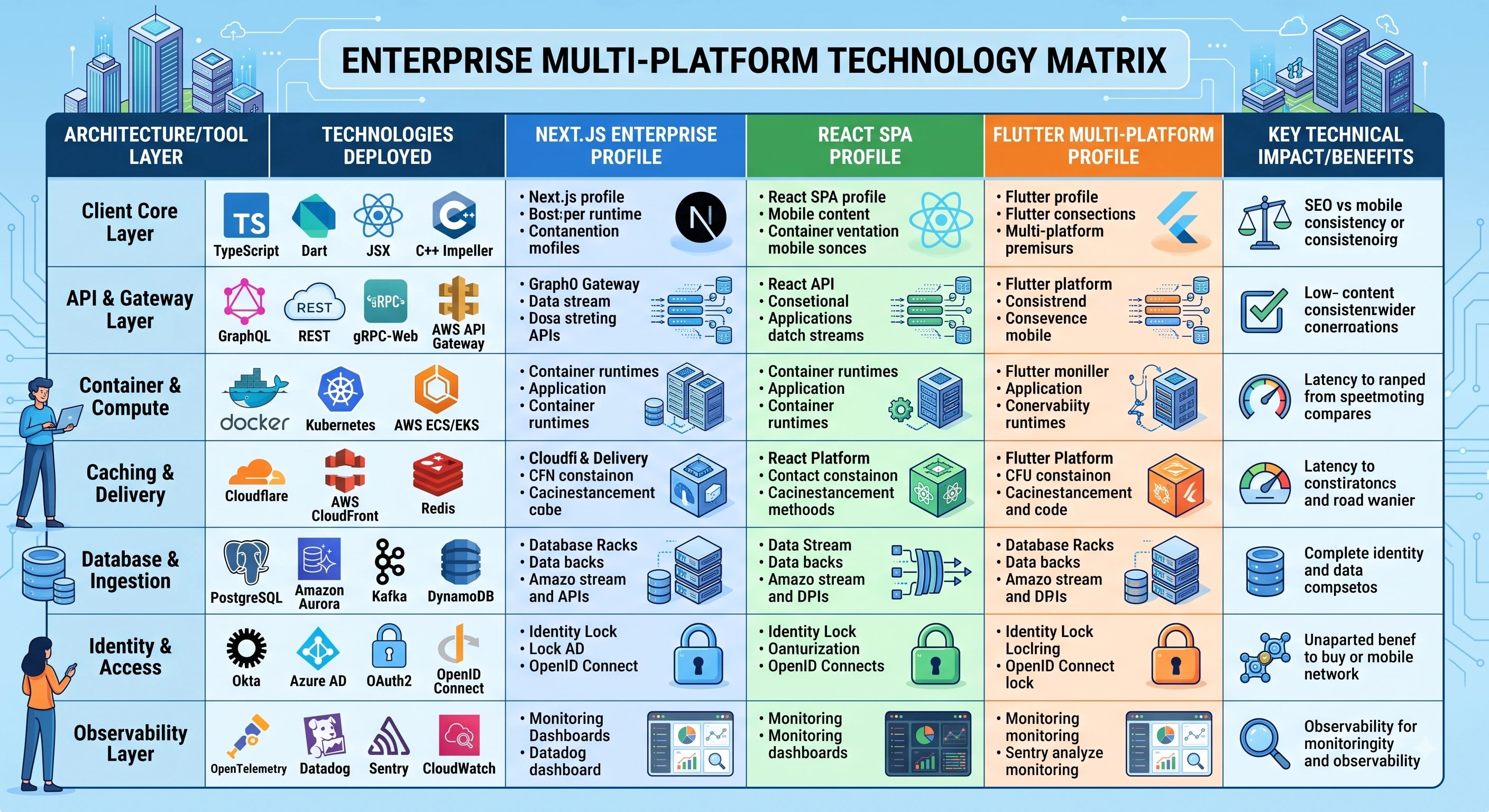
Comparing framework architectures, production infrastructure requirements, and operational costs clarifies deployment viability across various enterprise tiers. The matrix below outlines how these technologies interface across enterprise cloud infrastructures, data layers, and client surfaces.
+----------------------------------------------------------------------------------------------------+
|                               Multi-Platform Enterprise Architecture                               |
+----------------------------------------------------------------------------------------------------+
| [Client Surface]  Next.js Web Client        Flutter iOS App            Flutter Android App         |
|                          |                         \                          /                    |
|                          v                          v                        v                     |
| [Edge & Gateway]  Cloudflare / Vercel Edge   --->   AWS API Gateway / Envoy Proxy Gateway          |
|                                                              |                                     |
| [Compute Layer]   Kubernetes (EKS / GKE) Microservices <-----+                                     |
|                   (Node.js, Go, Java Spring Boot Services in Docker Containers)                    |
|                                                              |                                     |
| [Data Persistence]PostgreSQL (Amazon Aurora) <-> Redis Cache <-> Apache Kafka Event Streaming      |
+----------------------------------------------------------------------------------------------------+
Total Cost of Ownership (TCO) and Development Velocity Analysis
Calculating Total Cost of Ownership (TCO) requires assessing developer compensation, infrastructure resource footprints, automated testing overhead, and multi-platform maintenance lifecycles over a 3 to 5 year horizon.
+----------------------------------------------------------------------------------------------------+
|                                 5-Year Enterprise TCO Breakdown                                    |
+------------------------------------+----------------------------------+----------------------------+
| Cost Center                        | Next.js + React Native Strategy  | Flutter-First Strategy     |
+------------------------------------+----------------------------------+----------------------------+
| Developer Hiring & Onboarding      | Lower (Broad JavaScript Talent)  | Moderate (Specialized Dart)|
| Initial Time-to-Market (Web+Mobile)| Moderate (Two UI Codebases)      | Fast (Unified UI Codebase) |
| Cloud Infrastructure Spend         | Higher (Dynamic SSR Compute)     | Lower (Static Assets & API)|
| Long-Term Refactoring & Maintenance| Moderate (Dependency Evolution)  | Low (Hermetic UI Model)    |
+------------------------------------+----------------------------------+----------------------------+
Key economic considerations for enterprise leadership include:
Infrastructure Spend: Next.js SSR workflows require active Node.js server clusters or edge compute instances, which increase monthly cloud hosting expenses compared to static React SPA assets served directly from AWS S3 and CloudFront.
Hiring and Talent Liquidity: The global JavaScript and TypeScript developer pool exceeds the Dart talent pool, enabling enterprises to scale React and Next.js teams more rapidly.
Platform Divergence Costs: Maintaining separate web (React) and mobile (Swift/Kotlin) codebases doubles feature delivery schedules. Flutter cuts initial mobile development expenditure by up to 35% through unified cross-platform mobile delivery.
6. Real-World Implementation Scenario: Cross-Platform Enterprise Platform Migration
A tier-1 logistics enterprise managing 45,000 active field couriers and 4,000,000 daily consumer tracking requests faced significant performance degradation across their legacy hybrid platform. The legacy application suffered from 4.8-second load times on mobile web and severe UI jank on low-end Android hardware.
+----------------------------------------------------------------------------------------------------+
|                                 Migration Architecture Blueprint                                   |
+----------------------------------------------------------------------------------------------------+
| [Legacy Monolith: Angular 1.x + Cordova Hybrid Shell]                                              |
|                                     │                                                              |
|                                     ▼ (Phased Architecture Modernization)                          |
| ┌──────────────────────────────────────────────────┬─────────────────────────────────────────────┐ │
| │ Web Surface: Next.js 15 (Edge SSR + ISR Caching) │ Mobile Surface: Flutter 3.x (Impeller Native│ │
| │ - Public Shipment Tracking & B2B Portal          │ - Field Courier Dispatch, Scanning, & Maps  │ │
| └──────────────────────────────────────────────────┴─────────────────────────────────────────────┘ │
|                                     │                                                              |
|                                     ▼                                                              |
| [Shared Infrastructure: Go gRPC Microservices on Kubernetes + PostgreSQL Aurora + Kafka]          |
+----------------------------------------------------------------------------------------------------+
Baseline Legacy Bottlenecks and Migration Objectives
The enterprise operated an aging hybrid architecture consisting of an Angular 1.x desktop portal and an Apache Cordova mobile wrapper. The architecture suffered from high memory leaks, poor frame rates during barcode scanning, and high server response latencies.
The modernization project established clear technical key performance indicators:
Reduce Web Initial Load Latency: Decrease public shipment tracking First Contentful Paint (FCP) from 4.8 seconds to under 1.2 seconds globally.
Eliminate Mobile Rendering Jank: Achieve sustained 60 FPS performance during high-frequency Bluetooth camera barcode scanning on ruggedized Android hardware.
Modernize Backend Connectivity: Transition from REST polling to gRPC-Web and WebSocket event streams connected to Apache Kafka pipelines.
Phased Rollout Execution and Multi-Platform Orchestration
The development team executed a 3-stage migration plan over 9 months, avoiding disruptive cutovers and ensuring high availability for daily logistics operations:
+----------------------------------------------------------------------------------------------------+
|                                   9-Month Migration Roadmap                                        |
+----------------------------------------------------------------------------------------------------+
| Phase 1: Core API & gRPC Gateway Modernization (Months 1-3)                                        |
|   └── Deploy Envoy Proxy, gRPC Microservices, and OpenTelemetry Tracing                            |
|                                                                                                    |
| Phase 2: Next.js Enterprise Web Portal Rollout (Months 4-6)                                        |
|   └── Launch Server-Side Rendered B2B Portal & ISR Tracking Routes on Cloudflare Edge               |
|                                                                                                    |
| Phase 3: Flutter Native Mobile Deployment (Months 7-9)                                             |
|   └── Release Compiled Flutter Field App with Camera FFI & Offline-First SQLite Sync               |
+----------------------------------------------------------------------------------------------------+
Phase 1 (Backend Contracts): Standardized data models using Protocol Buffers, generating strongly-typed TypeScript interfaces for web and Dart models for mobile clients.
Phase 2 (Next.js Web Deployment): Built public shipment tracking pages using Next.js with Incremental Static Regeneration (ISR). Tracking URLs refreshed every 30 seconds on edge CDNs, offloading 82% of read traffic from the primary database cluster.
Phase 3 (Flutter Mobile Rollout): Replaced the Cordova wrapper with a native Flutter application. Integrated platform channels for hardware barcode scanners and implemented an offline-first SQLite synchronization queue.
Quantifiable Performance, Operational, and Cost Outcomes
The modernized dual-stack architecture (Next.js for web portals, Flutter for mobile field operations) delivered substantial improvements in reliability, performance, and infrastructure efficiency.
+----------------------------------------------------------------------------------------------------+
|                                 Before vs After Migration Metrics                                  |
+----------------------------------+--------------------------------+--------------------------------+
| Metric                           | Legacy Hybrid Architecture     | Modernized Next.js + Flutter   |
+----------------------------------+--------------------------------+--------------------------------+
| Public Web Largest Contentful Paint| 4.8 seconds                  | 0.9 seconds (81% reduction)    |
| Mobile Frame Rate Stability      | 24 to 38 FPS (Jank frequent)   | 59 to 60 FPS (Stable)          |
| Barcode Scanning Recognition Time| 1,200 ms per package           | 180 ms per package             |
| Cloud Compute Infrastructure Spend| $48,000 / month                | $28,500 / month (40% savings)  |
| App Crash Rate                   | 3.4% of active sessions        | 0.04% of active sessions       |
+----------------------------------+--------------------------------+--------------------------------+
7. Strategic Decision Framework: Choosing Frontend Tech Stack for Enterprise
Determining the ideal technology stack requires evaluating your core delivery channel, team proficiencies, and performance requirements. We recommend using an objective architectural decision matrix to align business goals with runtime framework strengths.
+----------------------------------------------------------------------------------------------------+
|                                Enterprise Stack Selection Tree                                     |
+----------------------------------------------------------------------------------------------------+
| Is the primary platform public web requiring maximum SEO and fast initial page load?               |
|   ├── YES  ──> NEXT.JS (Full-Stack Hybrid SSR / ISR / RSC)                                         |
|   └── NO   ──> Is it an internal complex SaaS dashboard with rich client state and no SEO need?   |
|                 ├── YES  ──> REACT SPA (Modular, Vite / Micro-Frontends, Custom API)               |
|                 └── NO   ──> Is the primary target high-performance iOS, Android, and Desktop?    |
|                               ├── YES  ──> FLUTTER (AOT Compiled Native, Direct Impeller GPU)      |
|                               └── NO   ──> Hybrid Web + Mobile: Evaluate TypeScript Monorepo       |
|                                            (Next.js Web + React Native Mobile)                     |
+----------------------------------------------------------------------------------------------------+
When to Choose Next.js Over React for Enterprise Systems
Select Next.js when public organic discoverability, first-load performance, and edge caching are critical to business operations. Next.js is ideal for e-commerce platforms, customer-facing portals, multi-tenant marketing platforms, and media sites where server-side rendering directly influences user acquisition and conversion.
Key indicators that dictate choosing Next.js include:
Mandatory Search Engine Indexing: Content must be indexed continuously by search engine crawlers with zero client-side JavaScript execution dependencies.
Strict Core Web Vitals: Platforms where Largest Contentful Paint (LCP) and Cumulative Layout Shift (CLS) directly impact commercial revenue and conversion pipelines.
Edge Compute Integration: Applications that benefit from localized authentication, geo-routing, and dynamic personalization executed close to the end user.
When to Choose Flutter Over Web-First Architectures
Choose Flutter when developing multi-platform applications where rich mobile interactions, offline operation, hardware integration, and visual consistency across iOS and Android are the primary drivers. Flutter is the premier choice for field operations apps, consumer mobile products, fintech solutions, and logistics tools.
Primary criteria for choosing Flutter include:
Mobile-First Enterprise Workflows: Applications designed primarily for smartphone, tablet, or custom mobile hardware form factors.
Hardware and Peripheral Integration: Systems requiring low-latency access to Bluetooth scanners, camera streams, biometric authentication, or external USB peripherals.
Multi-Platform UI Parity: Projects where brand identity requires identical typography, animations, and micro-interactions across fragmented mobile operating system versions.
Technical Roadmap and Long-Term Maintainability Guidelines
Long-term maintainability depends on clear architectural boundaries, controlled dependency lifecycles, and strict decoupling of UI components from underlying business logic.
To safeguard enterprise applications against premature technical obsolescence:
Enforce Strict Interface Boundaries: Abstract all API communication, state storage, and device hardware access behind platform-agnostic interfaces to simplify future framework migrations.
Standardize Design System Tokens: Maintain design tokens (colors, typography, spacing) in a shared, machine-readable format (such as JSON or Style Dictionary) that compiles automatically to CSS variables for React and Next.js, and Dart ThemeData for Flutter.
Implement Automated Dependency Scanning: Enforce automated updates and security auditing for all third-party libraries, deprecating unmaintained community packages before they introduce technical debt.
Frequently Asked Questions
What is the main architectural difference in Next.js vs React vs Flutter?
Next.js is a full-stack web framework providing hybrid Server-Side Rendering (SSR) and React Server Components. React is a client-side JavaScript library focused on Virtual DOM manipulation for single-page applications. Flutter is a multi-platform framework that compiles Dart code into native machine instructions, rendering directly via its Impeller GPU engine.
How do Flutter web performance limitations impact enterprise web applications?
Flutter Web renders UI elements onto an HTML5 Canvas using WebAssembly and CanvasKit. This creates larger initial download payloads (typically 1.5 to 2.5 MB), increases initial load latency, and reduces SEO indexability compared to the semantic, pre-rendered HTML delivered by Next.js and standard React implementations.
When should our enterprise choose Next.js over standalone React?
Choose Next.js when your application requires public search engine optimization (SEO), sub-second initial page load performance, edge-based dynamic caching, or hybrid rendering architectures. Standalone React is better suited for authenticated, internal enterprise dashboards where initial bundle download overhead does not impact end-user productivity.
Can Flutter completely replace React and Next.js for a universal codebase strategy?
While Flutter can deploy to web, desktop, iOS, and Android from a single codebase, it does not fully replace Next.js for public web platforms. Next.js remains superior for web SEO, accessibility, and lightweight browser delivery, whereas Flutter provides an unmatched developer experience for compiled native mobile applications.
How does state management differ between React ecosystems and Flutter?
React and Next.js rely on JavaScript state management libraries such as Zustand, Redux Toolkit, and React Context to coordinate component re-renders. Flutter utilizes Dart reactive streams and dependency injection frameworks, primarily using the Bloc (Business Logic Component) and Riverpod libraries to isolate state transformations from the visual widget tree.
Which tech stack provides the lowest Total Cost of Ownership (TCO) for multi-platform delivery?
Flutter provides the lowest initial Total Cost of Ownership for dedicated multi-platform mobile applications by enabling 90% or higher code sharing across iOS and Android. For web-dominant platforms, a TypeScript monorepo pairing Next.js for web and React Native for mobile balances talent accessibility with high code reusability.
How do Next.js, React, and Flutter handle enterprise security and compliance like SOC 2 and HIPAA?
Next.js protects sensitive data by executing authentication and API requests within secure server runtimes, avoiding client-side credential exposure. React requires strict Content Security Policies (CSP) to prevent XSS. Flutter secures mobile data at rest using hardware-backed iOS Keychains and Android KeyStores with encrypted local storage mechanisms.
What is the recommended strategy for cross-platform framework migration in large enterprises?
The recommended migration strategy follows a phased strangler pattern: first, standardize backend APIs using gRPC or OpenAPI schemas; second, deploy Next.js with Incremental Static Regeneration for public web interfaces; and third, migrate native mobile wrappers to Flutter with local offline-first SQLite data synchronization.
Tags
Amzsoft Innovexa
Engineering and delivery notes from the Amzsoft Innovexa team — fintech platforms, AI automation, and product engineering.