Introduction
The financial services industry is increasingly using technology to make investment management more accessible, efficient, and convenient. Investors expect digital experiences that help them understand their financial goals, assess investment risks, monitor portfolios, and make informed decisions. Traditional advisory services remain valuable, but technology-driven alternatives are creating new opportunities for financial institutions, fintech startups, and wealth management businesses.
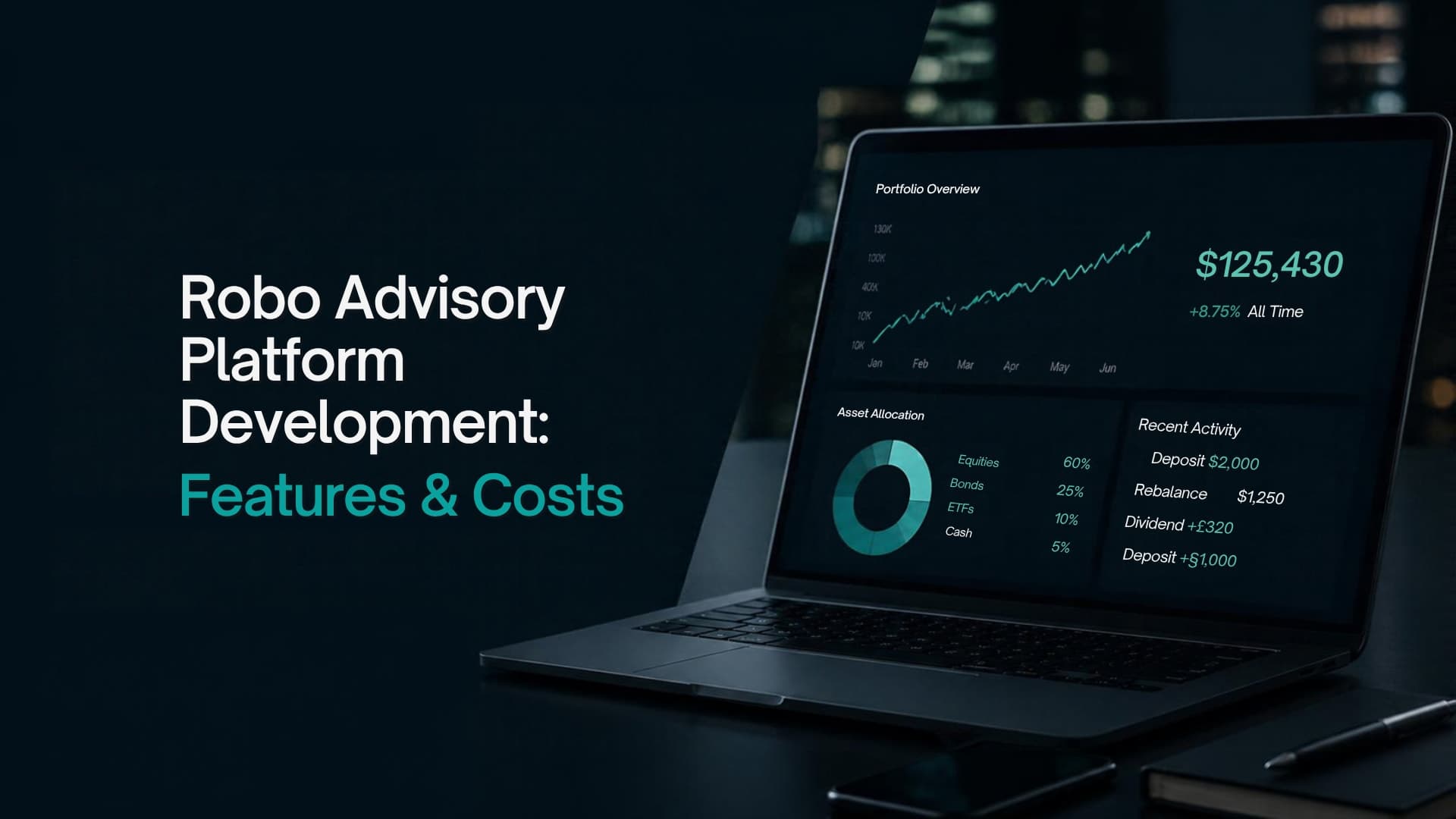
Robo Advisory Platform Development involves building digital platforms that use algorithms, investor information, and predefined investment strategies to support automated investment advice and portfolio management. Depending on the business model, these platforms can help users assess their risk tolerance, explore portfolio recommendations, track investments, and monitor progress toward financial goals.
Businesses exploring this opportunity need to consider more than the application interface. Successful development requires thoughtful financial logic, secure data management, appropriate regulatory oversight, reliable integrations, and a clear understanding of investor needs.
Companies researching development partners can explore the robo-advisory service page from Amzsoft Innovexa at https://www.amzsoftinnovexa.com/fintech/robo-advisory to learn more about its service offering. Specific project requirements, technical scope, and commercial terms should be confirmed directly with the provider.
This guide explains how robo-advisory platforms work, which features businesses may need, how the development process typically unfolds, what influences development costs, and how to approach security, compliance, and long-term maintenance.
Understanding Robo-Advisory Platforms and Their Benefits
What Is a Robo-Advisory Platform?
A robo-advisory platform is a digital investment service that uses software, algorithms, and financial models to support investment recommendations or portfolio management. Depending on its design and regulatory permissions, it may help users complete risk assessments, establish financial goals, receive asset allocation recommendations, monitor investments, and rebalance portfolios.
The term robo-advisor does not necessarily mean that a platform operates without human involvement. Some services automate most routine processes, while others combine software-based recommendations with professional financial advice.
For a fintech startup, a robo-advisory solution may provide a foundation for a new digital wealth management business. For an established financial institution, it may support an existing advisory service with additional digital capabilities.
Businesses considering this model can review https://www.amzsoftinnovexa.com/fintech/robo-advisory as an initial reference when exploring robo-advisory development services.
How Does a Robo-Advisor Work?
A robo-advisor generally follows a structured process to collect investor information, assess financial circumstances, and generate recommendations according to its configured rules.
1. Investor registration
The user creates an account and completes the required identity verification and onboarding steps.
2. Risk assessment
The platform gathers information about financial goals, investment experience, time horizon, and ability and willingness to accept risk.
3. Portfolio recommendations
Configured investment rules and algorithms generate a proposed allocation consistent with the platform's methodology and applicable suitability requirements.
4. Investment execution
Where supported and legally permitted, the platform connects with appropriate financial providers to facilitate account funding or investment transactions.
5. Monitoring and rebalancing
Portfolio values and allocations are monitored, with alerts or rebalancing actions triggered according to the configured rules and available permissions.
For example, imagine a hypothetical investor saving for a long-term financial goal. After completing a risk assessment, the investor receives a proposed portfolio allocation. The platform explains the investment categories, displays relevant risk information, and provides tools for monitoring progress. If the portfolio later moves away from its intended allocation, the system may identify the difference and suggest or initiate rebalancing when authorized.
This example illustrates a possible workflow, not a recommendation for any particular investor. Actual investment decisions depend on individual circumstances and the service's legal and operational framework.
The Role of Algorithms in Investment Management
Algorithms help robo-advisors process information consistently and apply predefined investment methodologies. Depending on the platform, these may include rules for asset allocation, portfolio construction, diversification, risk scoring, and rebalancing.
Some solutions may also use artificial intelligence to assist with specific analytical or operational tasks. However, AI-powered investment advisory should not be treated as automatically more accurate or reliable than a carefully designed rules-based system.
Financial algorithms require testing, documented assumptions, controlled updates, and ongoing monitoring. Poor-quality data, unsuitable assumptions, or coding errors can produce inappropriate recommendations. Human oversight and clear accountability remain important, particularly when the platform provides regulated investment advice or manages portfolios on behalf of clients.
Key Benefits for Businesses and Investors
Improved operational efficiency: Automated onboarding, data collection, routine notifications, and portfolio monitoring can reduce repetitive administrative work. The degree of efficiency depends on how well the platform integrates with existing systems.
Greater digital accessibility: A well-designed automated investment platform can let customers access account information and portfolio tools through supported digital channels without depending entirely on scheduled consultations.
Scalability: Standardized workflows can support a growing user base. However, scaling still requires sufficient infrastructure, customer support, security controls, and compliance resources.
Consistent processes: Software can apply approved rules consistently across eligible accounts, helping businesses standardize specific investment workflows.
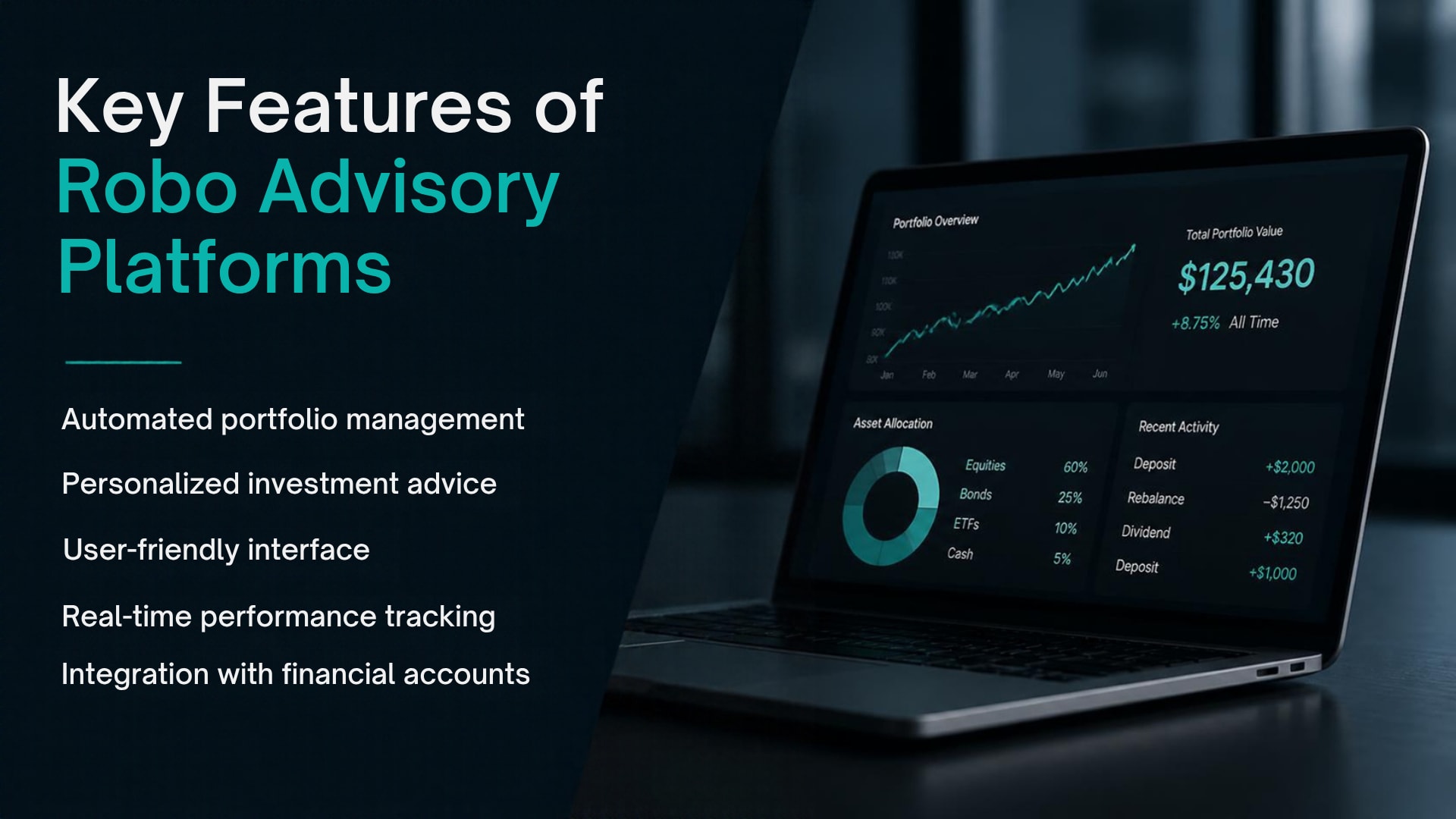
Portfolio visibility: Dashboards can bring investment allocations, account values, transaction histories, and performance reporting into a single interface.
Potential personalization: Risk assessments and goal-setting tools can help tailor permitted recommendations to user profiles. Personalization must be based on reliable information and an appropriate methodology.
Better service insights: Aggregated operational data may help businesses understand onboarding completion, support demand, and platform usage, provided data collection complies with privacy requirements.
Amzsoft Innovexa's robo-advisory service page, https://www.amzsoftinnovexa.com/fintech/robo-advisory, is a starting point for businesses investigating development support in this area.
Limitations and Investment Risks
Automation does not remove the uncertainty associated with financial markets. Investment portfolios can lose value because of market movements, interest-rate changes, economic conditions, concentration, liquidity constraints, or other risks.
A robo-advisory platform can also create risks of its own, including inaccurate investor profiles, flawed calculations, unsuitable recommendations, data breaches, system outages, and poorly managed integrations.
Financial suitability and risk disclosure should therefore be central to platform design. Users need clear explanations of the service, its limitations, relevant fees, investment risks, and the circumstances in which professional assistance may be appropriate.
Businesses should avoid presenting automated recommendations as guaranteed outcomes. A reliable platform supports informed decision-making; it cannot promise that investments will achieve a particular return.
Essential Features, Development Process, and Costs
User Registration, Identity Verification, and KYC
The onboarding experience shapes the customer's first impression of a digital wealth management platform. A lengthy or confusing registration process can discourage users, while inadequate verification can expose the business to fraud and compliance risks.
A well-planned workflow may collect basic account information, verify contact details, establish secure authentication, and guide users through the identity checks applicable to the service. Depending on the business model and jurisdiction, the process may also require additional information about the investor, beneficial ownership, source of funds, or other matters.
Know Your Customer procedures should be designed around the business's actual legal obligations. Integrating a third-party verification service does not automatically make the entire business compliant. The company remains responsible for understanding the rules that apply to its activities and for maintaining suitable operational controls.
Businesses evaluating https://www.amzsoftinnovexa.com/fintech/robo-advisory should document their onboarding requirements before requesting a project estimate. This helps distinguish essential compliance workflows from optional user-experience improvements.
Investor Risk Profiling and Suitability Assessment
Investment risk profiling is a central component of many robo-advisory systems. It helps the platform gather information relevant to determining whether a proposed investment approach is appropriate for a particular user.
A questionnaire might ask about:
Investment objectives and financial goals.
Intended investment time horizon.
Previous investment experience.
Willingness to tolerate fluctuations in portfolio value.
Financial circumstances and ability to absorb potential losses.
Liquidity needs and other relevant constraints.
Risk tolerance and risk capacity are related but different. A person may be emotionally comfortable with market fluctuations but unable to afford substantial losses because of near-term financial obligations. A suitable assessment should not rely on a single risk score without considering the broader context required by the service.
The platform should explain why it asks these questions and how the information influences its recommendations. It should also support appropriate reassessments when user circumstances or investment objectives change.
Portfolio Recommendations and Automated Rebalancing
A recommendation engine translates investor information and investment rules into a proposed portfolio. Its design depends on the available investment products, the organization's methodology, and any applicable restrictions.
For example, a system may use predefined allocation rules to distribute a hypothetical portfolio across several asset categories. It may also check whether a proposed allocation exceeds a permitted concentration limit or conflicts with a recorded investment restriction.
Automated portfolio rebalancing addresses differences between a portfolio's current allocation and its intended targets. If an allocation moves outside configured thresholds, the system may calculate a proposed adjustment or initiate an approved transaction.
However, rebalancing is not automatically beneficial in every situation. Transactions may involve fees, tax consequences, liquidity constraints, or other considerations. The platform should apply the relevant permissions, disclose material implications, and preserve records of significant decisions and actions.
When discussing portfolio logic with a development partner, businesses should establish how calculations will be validated, which decisions require approval, and how the system will respond to incomplete or outdated market data.
Investment Dashboards, Reporting, and Notifications
An investment dashboard should make complex financial information understandable without oversimplifying important risks. Customers may need to see account balances, asset allocation, transaction histories, investment goals, and relevant portfolio changes.
Performance reporting requires particular care. The platform should distinguish realized and unrealized gains, explain the measurement period, and identify whether fees or other costs are included in a displayed return. Historical performance should not be presented as a guarantee of future results.
Notifications can alert users to completed transactions, pending verification, changes in account status, or actions requiring attention. Security-sensitive notifications should avoid exposing unnecessary personal or financial information.
Accessibility also matters. Clear navigation, readable text, understandable error messages, and support for common mobile and desktop devices can make the platform easier to use for a wider range of customers.
Administrative Tools and Audit Trails
A robo-advisory platform also needs operational tools that help authorized personnel manage the service. These tools may include user account administration, verification status, support requests, reporting, system monitoring, and controlled configuration of investment rules.
Administrative access should be limited according to job responsibilities. A support employee, for example, should not automatically receive permission to change portfolio allocation rules or approve financial transactions.
Audit trails should record significant actions, including changes to investment settings, access to sensitive information where appropriate, approvals, and relevant system events. These records help investigate incidents, support internal controls, and demonstrate how a decision or change occurred.
The Robo-Advisory Platform Development Process
A structured development process reduces uncertainty and helps businesses identify important dependencies before committing to a major build. The exact sequence may vary, but the following stages provide a practical starting point.
Development-stage checklist
A typical roadmap for an automated investment platform
0 of 11 stages checked
Reset
1. Business model and market research
Define target customers, investment products, business objectives, and competitors.
2. Requirements gathering
Document user journeys, feature priorities, integrations, and acceptance criteria.
3. Regulatory assessment
Determine which registrations, disclosures, controls, and operating permissions may apply.
4. UI/UX design
Plan onboarding, risk questionnaires, dashboards, accessibility, and error handling.
5. Technology architecture
Choose appropriate frameworks, data storage, infrastructure, and integration patterns.
6. Application development
Build the frontend, backend services, account workflows, and administrative tools.
7. Investment logic implementation
Develop and validate risk scoring, allocation rules, and portfolio calculations.
8. Financial integrations
Connect approved market data, identity verification, account, or transaction providers as required.
9. Security testing and quality assurance
Test access controls, calculations, data handling, reliability, and common failure scenarios.
10. Regulatory review and controlled launch
Complete required reviews and begin with an appropriately limited release.
11. Monitoring and maintenance
Track reliability, address defects, update dependencies, and review evolving requirements.
1. Business Model and Market Research
The project begins by identifying the problem the platform will solve and the customers it will serve. A startup targeting first-time investors may need a different experience from an established wealth management business serving experienced clients.
Research should cover competitor offerings, potential customer needs, the intended revenue model, and the investment products the business expects to support. It should also identify whether the platform will provide information, personalized advice, portfolio management, transaction facilitation, or a combination of activities.
This distinction is important because different activities can trigger different regulatory requirements.
2. Requirements Gathering and Compliance Planning
Before development begins, document the platform's essential workflows, user roles, financial calculations, data sources, and reporting requirements.
The business should also identify its legal responsibilities and consult qualified compliance and legal professionals. Regulatory requirements should influence the design from the beginning rather than being treated as a final checklist after the application has been built.
For projects being considered through https://www.amzsoftinnovexa.com/fintech/robo-advisory, a clear requirements document can help establish which services are being requested and which responsibilities remain with the financial business or other specialist providers.
3. UI/UX Design and Technical Architecture
Designers and developers should map the full user journey, from registration to account management and portfolio reporting. The interface should explain financial concepts in accessible language and make important disclosures easy to find.
The architecture should support the expected number of users, data volume, integrations, and security requirements. A modular approach can make it easier to update individual components without redesigning the entire platform.
Businesses should avoid selecting a technology solely because it is popular. The right choice depends on team expertise, system requirements, available integrations, maintainability, and the long-term operating model.
4. Development, Integration, and Testing
The development team builds the user interface, backend services, data models, administrative functions, and financial logic. External integrations may be required for identity verification, market data, account information, or transaction processing.
Testing should include normal workflows as well as unusual conditions. Examples include incorrect investor inputs, unavailable data providers, duplicate transaction requests, interrupted network connections, and failed authorization checks.
Portfolio calculations should be tested against independently verified expected results. Financial transactions and sensitive account changes should have clear validation and error-handling procedures.
5. Launch, Monitoring, and Maintenance
A launch should follow appropriate security reviews, operational readiness checks, and required regulatory approvals. A controlled rollout can help the business identify usability issues and system problems before expanding access.
Ongoing maintenance includes software updates, infrastructure monitoring, incident response, dependency management, security reviews, and improvements based on legitimate user feedback. Financial rules and external provider requirements may also change, so the platform needs a process for reviewing and implementing updates safely.
How Long Does Development Take?
Development time depends on the complexity of the platform, the availability of requirements, the number of integrations, the maturity of the investment methodology, and the time needed for reviews and approvals.
A limited prototype may be possible sooner than a production-ready financial platform, but a prototype is not equivalent to a system that can safely support real investors or execute transactions.
Timelines can also be affected by third-party provider onboarding, access to test environments, data quality, legal review, and unexpected security findings. A realistic schedule should identify dependencies, testing periods, approval milestones, and responsibilities.
Businesses considering https://www.amzsoftinnovexa.com/fintech/robo-advisory should confirm any proposed delivery schedule directly with the provider after defining the project's requirements. No specific delivery time should be assumed without a scoped proposal.
Estimating the Project Budget Before Development
Before requesting a quote, businesses should prepare a clear scope document. This does not need to be a lengthy technical specification, but it should explain the intended product, target market, essential workflows, and expected integrations.
A practical budget-planning exercise should include the following:
Initial release: List the features needed to validate the business model and deliver the core service.
Future improvements: Identify features that can be added after the initial launch.
External services: Record expected providers, licensing requirements, and recurring charges.
Compliance and security: Identify the specialist reviews, testing, and operational controls the project requires.
Internal responsibilities: Clarify who manages investment methodology, legal obligations, customer support, and financial operations.
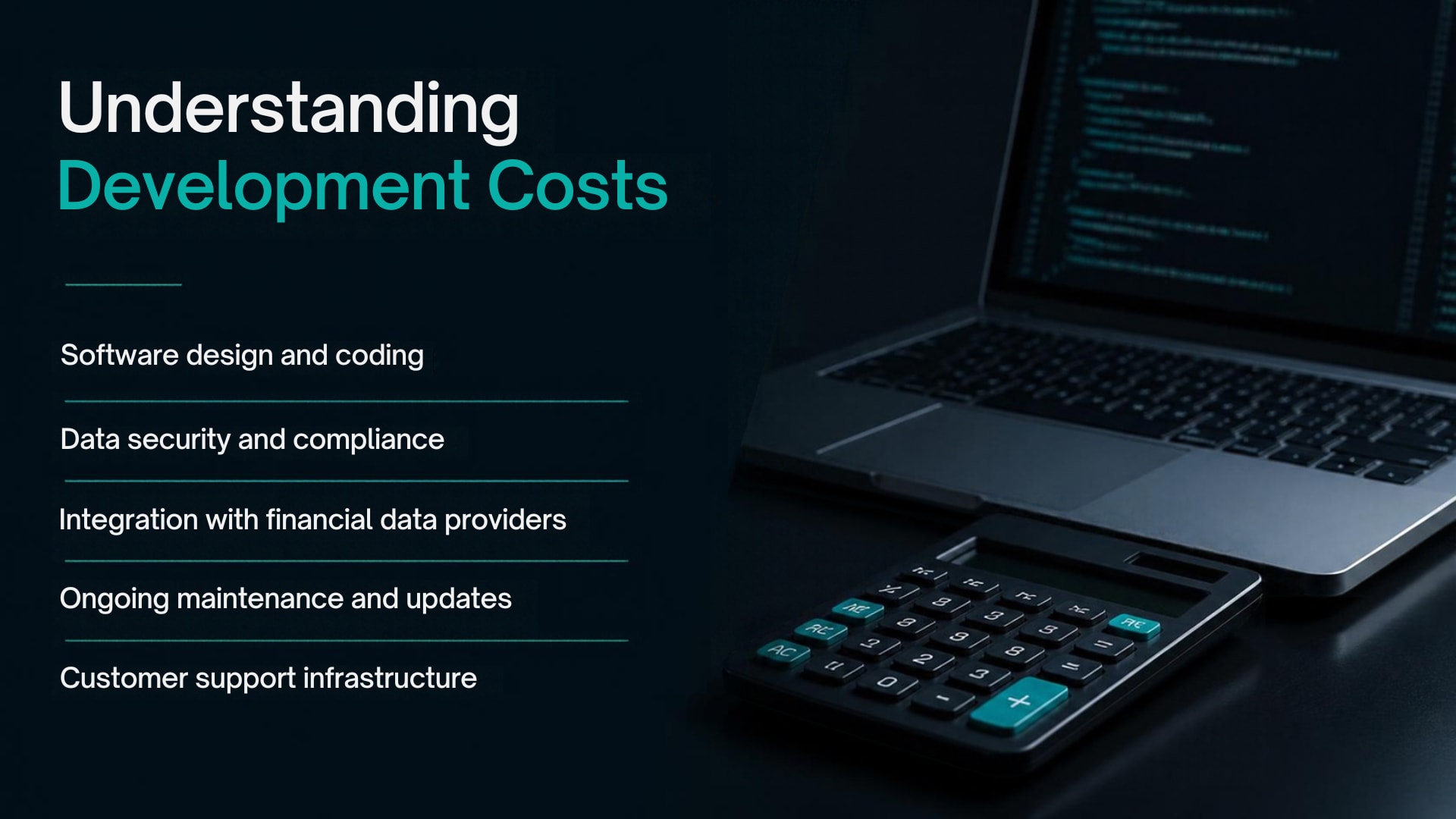
Ongoing expenses: Account for hosting, monitoring, maintenance, and support after deployment.
A hypothetical startup might begin with account registration, investor profiling, portfolio simulations, and educational reporting. If its business model later requires real-money transactions, it may need additional integrations, authorization workflows, reconciliation procedures, and operational safeguards.
This staged approach can help a business understand its priorities without assuming that every feature must be delivered at once. It must not, however, postpone legal or security requirements that are necessary for the initial product to operate lawfully and safely.
When evaluating proposals, businesses should ask whether the quoted amount includes design, development, testing, deployment, documentation, and post-launch support. They should also establish how changes in scope will be priced and approved.
Technology, Security, and Choosing a Development Partner
Designing a Scalable Architecture
A scalable architecture should allow the platform to support growth without creating unnecessary complexity from the beginning.
A small first release may use a well-structured application with clearly separated modules. As requirements grow, the system may benefit from independently deployable services for identity, portfolio calculations, notifications, reporting, and integrations.
However, microservices are not automatically superior to a modular application. They introduce additional operational overhead, monitoring needs, communication failures, and deployment complexity. Architecture should match the business's current and anticipated needs.
Important design considerations include:
Separation of user interfaces, business logic, and data access.
Clearly documented API contracts and integration boundaries.
Reliable handling of duplicate requests and failed operations.
Database backup, recovery, and data retention procedures.
Controlled release processes and rollback capabilities.
Capacity planning for expected workloads.
Monitoring of service availability and data processing failures.
Financial workflows deserve special attention. A transaction request should not be treated as successfully completed merely because the application received it. The platform may need confirmation from the relevant provider, reconciliation with account records, and a clear process for investigating incomplete or conflicting results.
Businesses can discuss these architectural requirements when exploring development services at https://www.amzsoftinnovexa.com/fintech/robo-advisory, while separately verifying the proposed technical approach and scope.
Protecting Financial and Personal Data
Robo-advisory platforms may handle identity documents, contact information, financial goals, account records, transaction histories, and other sensitive information. Security should therefore be incorporated into the architecture, development process, and operating procedures.
Authentication and authorization
Authentication verifies a user's identity, while authorization determines which actions that user is allowed to perform.
A platform may use multi-factor authentication, secure session management, and additional verification for sensitive actions. Administrative accounts should have stronger controls where appropriate, and employees should receive only the permissions required for their responsibilities.
Encryption and secrets management
Sensitive information should be protected in transit using appropriately configured secure communication protocols and encrypted at rest where required by the security design.
Passwords should be stored using appropriate password-hashing methods rather than as plain text. API keys, database credentials, and other secrets should be stored and managed separately from application source code.
Encryption alone is not enough. Access permissions, key management, secure configuration, monitoring, and incident response are also important.
Secure development and testing
Developers should review the application for common vulnerabilities, insecure access controls, input-validation problems, exposed secrets, and weaknesses in third-party integrations.
The OWASP Application Security Verification Standard provides a recognized reference for defining and assessing application security requirements. Businesses can use an appropriate security standard to structure testing and acceptance criteria.
Testing should cover both technical vulnerabilities and business-specific failure scenarios. For example, a system may be technically protected against unauthorized access but still contain an error that calculates portfolio allocations incorrectly. Both types of risk need attention.
Data privacy and retention
The platform should collect only the information needed for legitimate purposes, restrict access appropriately, and establish clear rules for retention and deletion.
Businesses must identify the privacy and data-protection laws that apply to their customers and operating locations. Where external providers process personal information, their contractual responsibilities and security practices should also be reviewed.
What Regulations Apply to Robo-Advisory Platforms?
Regulatory requirements depend on where a business operates, where its customers are located, and what services it provides. Offering general financial education is not necessarily the same as providing personalized investment advice, managing portfolios, distributing investment products, or executing transactions.
Businesses should assess the legal classification of each activity before deciding how the platform will operate.
In India, the Securities and Exchange Board of India (SEBI) publishes the Investment Advisers Regulations and related guidance. A business providing investment advisory services should examine the requirements relevant to its specific model, including applicable registration, risk-profiling, suitability, disclosure, and recordkeeping obligations. The current regulations and relevant guidance should be reviewed with qualified legal and compliance professionals.
Other markets may have their own financial services, privacy, consumer-protection, and cybersecurity rules. A business planning to serve customers in several countries should not assume that registration or approval in one jurisdiction automatically authorizes it to operate in another.
Compliance should influence the platform's design. It may affect customer onboarding, disclosures, recordkeeping, conflict-of-interest controls, data access, investment recommendations, and the handling of complaints.
The development team can implement technical controls, but software development alone does not establish regulatory compliance. The business must ensure that its operating model, personnel, permissions, and processes meet the requirements that apply to its activities.
Preparing a Practical Project Brief
Before approaching a provider, prepare a concise document covering the main decisions.
Target market and intended customer types.
Countries in which the platform will operate.
Whether the product provides education, recommendations, portfolio management, or transaction services.
Investment products and data sources to be supported.
Essential features for the initial release.
Identity verification and onboarding requirements.
Expected web and mobile access.
Security, privacy, and reporting expectations.
External integrations and provider dependencies.
Budget constraints and desired milestones.
Internal ownership of compliance and financial methodology.
Required maintenance, support, and handover arrangements.
For example, a business might specify that its first release should support registration, risk questionnaires, simulated portfolio allocation, and educational reporting, without executing real-money transactions. This scope would differ significantly from a service that manages live portfolios and processes investment orders.
A clear brief gives the development team a more reliable basis for estimating effort, identifying risks, and recommending an appropriate architecture.
Businesses can use https://www.amzsoftinnovexa.com/fintech/robo-advisory to initiate their evaluation of Amzsoft Innovexa's robo-advisory development services, then clarify project-specific details directly with the company.

Frequently Asked Questions About Robo-Advisory Platform Development
1. What is robo-advisory platform development?
Robo-advisory platform development is the process of building digital software that supports investment recommendations, portfolio monitoring, and related financial workflows through automated processes. The platform may include risk profiling, goal setting, portfolio allocation, reporting, and account integrations, depending on the business model and applicable regulations.
Businesses exploring this type of solution can review https://www.amzsoftinnovexa.com/fintech/robo-advisory as an initial reference for development services.
2. How does a robo-advisory platform work?
A robo-advisory platform typically collects investor information, assesses relevant financial circumstances, and applies configured rules or algorithms to generate portfolio recommendations. Depending on its capabilities and permissions, it may also support investment execution, performance reporting, and automated rebalancing.
The process requires reliable data, appropriate suitability controls, transparent disclosures, and ongoing monitoring. Automation does not guarantee investment returns or eliminate market risk.
3. What are the essential features of a robo-advisor?
Common features include secure registration, identity verification, investor risk profiling, financial goal setting, portfolio recommendations, asset allocation, investment dashboards, reporting, notifications, and administrative tools.
Platforms that handle real investments may also need approved financial integrations, transaction controls, reconciliation, and more extensive compliance workflows. The final feature set should match the intended service and target jurisdiction. Businesses can explore https://www.amzsoftinnovexa.com/fintech/robo-advisory when researching robo-advisory development options.
4. How much does it cost to build a robo-advisory platform?
The cost depends on the platform's scope, design, web and mobile requirements, financial logic, external integrations, security controls, testing, and regulatory obligations.
A basic prototype will generally require a different investment from a production system that handles live portfolios and financial transactions. An accurate estimate requires a project-specific scope and a clear breakdown of development and ongoing operating costs.
5. How long does robo-advisory software development take?
The timeline depends on feature complexity, team capacity, integration availability, requirements clarity, testing, and regulatory reviews. A limited prototype may be delivered more quickly than a production-ready platform with live financial workflows.
Businesses should request a milestone-based schedule that identifies dependencies and approval requirements. Any proposed timeline from Amzsoft Innovexa should be confirmed directly through https://www.amzsoftinnovexa.com/fintech/robo-advisory after the project scope has been defined.
6. Which technologies can be used to develop a robo-advisory platform?
Possible technologies include React or Angular for web interfaces, Flutter or native frameworks for mobile applications, Python or Java for backend and analytical components, and relational databases for structured application data.
The final stack should be selected according to security requirements, integration compatibility, performance expectations, team expertise, and long-term maintainability. No single technology stack is appropriate for every robo-advisory project.
7. How can robo-advisory platforms protect investor information?
Platforms can protect investor information through strong authentication, role-based access controls, encryption, secure credential management, vulnerability testing, monitoring, and documented incident response procedures.
Businesses should also minimize unnecessary data collection, establish appropriate retention policies, and assess the security of third-party providers. Security needs to be maintained throughout the platform's lifecycle rather than addressed only before launch.
8. What compliance requirements may apply to robo-advisory platforms?
Requirements depend on the services provided, the countries involved, and the organization's regulatory status. Activities such as personalized investment advice, portfolio management, product distribution, and transaction execution may have different legal requirements.
In India, businesses should review applicable SEBI regulations and guidance. In the United States, relevant federal and state requirements may need consideration. Privacy, cybersecurity, consumer protection, and recordkeeping obligations may also apply.
Qualified legal and compliance professionals should determine the requirements for the specific operating model. Businesses can review https://www.amzsoftinnovexa.com/fintech/robo-advisory as part of their development-partner research, but the service page is not a substitute for regulatory advice.
9. What challenges arise when building automated investment advisory software?
Common challenges include developing reliable financial calculations, obtaining accurate data, integrating external providers, protecting sensitive information, meeting regulatory obligations, and maintaining transparent user disclosures.
Other difficulties can involve changing requirements, unreliable APIs, inaccurate investor information, and ongoing maintenance. Businesses can manage these challenges through clear project planning, documented investment logic, independent testing, security reviews, and defined operational responsibilities.
10. How can businesses explore robo-advisory development services from Amzsoft Innovexa?
Businesses can begin by reviewing the official robo-advisory service page at https://www.amzsoftinnovexa.com/fintech/robo-advisory.
Before proceeding, they should document their business model, required features, operating jurisdictions, integration needs, security expectations, and budget considerations. They should then confirm the provider's proposed scope, technical approach, commercial terms, delivery milestones, and support arrangements directly.
Conclusion
Robo Advisory Platform Development gives fintech startups, financial institutions, and wealth management businesses an opportunity to create digital services that support investment recommendations, portfolio monitoring, and selected financial workflows.
A successful project requires more than an attractive dashboard. It depends on a well-defined business model, appropriate risk profiling, reliable investment calculations, secure architecture, carefully selected integrations, and a clear understanding of applicable regulatory requirements.
Before development begins, businesses should prioritize their essential features, establish a realistic budget, evaluate external dependencies, and define how the platform will be tested, maintained, and monitored. Security, suitability, transparent disclosures, and operational accountability should remain central throughout the project.
Choosing a development partner should involve evaluating evidence, technical planning, scope transparency, and long-term support rather than relying on unverified claims or promises of guaranteed outcomes.
Businesses interested in exploring development support can visit Amzsoft Innovexa's robo-advisory service page:
https://www.amzsoftinnovexa.com/fintech/robo-advisory
A clear project brief and a thorough evaluation process can help businesses determine whether the proposed solution aligns with their goals, resources, and regulatory responsibilities.
Tags
Amzsoft Innovexa
Engineering and delivery notes from the Amzsoft Innovexa team — fintech platforms, AI automation, and product engineering.