Fintech is moving beyond simple online banking and faster payments. In 2026, artificial intelligence, real-time payments, tokenization, open banking, embedded finance, automation, cybersecurity, and digital-first financial services are changing how money is managed and moved. The Future of Fintech Trends Shaping Digital Finance is therefore not about one breakthrough technology. It is about several technologies working together to make financial services faster, more connected, more automated, and increasingly data-driven.
For banks, fintech startups, businesses, investors, and consumers, this shift creates significant opportunities as well as new risks. AI can improve customer support and fraud detection, while tokenization can change how financial assets are issued and settled. At the same time, cybersecurity, privacy, regulation, legacy technology, and consumer trust remain critical concerns.
This article examines the major fintech trends 2026 is bringing into focus, how these technologies work, where they are being applied, and what they could mean for the future of digital finance.
What Are the Biggest Fintech Trends in 2026?
The biggest fintech trends in 2026 include AI-powered financial services, agentic automation, real-time and cross-border payments, tokenization, open banking, embedded finance, automated compliance, stronger cybersecurity, digital banking, and technology aimed at improving financial inclusion. Together, these developments are moving finance toward more connected, programmable, personalized, and automated services.
The Future of Fintech Trends Shaping Digital Finance is best understood as a transition from isolated digital tools toward connected financial ecosystems. A banking application, payment platform, fraud detection system, customer-support assistant, compliance engine, and financial dashboard are increasingly expected to communicate with each other.
This change is important because financial services are no longer experienced only inside traditional bank branches or banking websites. Financial activity can happen inside an e-commerce checkout, accounting platform, business-management application, marketplace, mobile application, or digital wallet.
Artificial Intelligence Is Becoming Core Financial Infrastructure
Artificial intelligence is one of the most important financial technology trends in 2026. Earlier fintech applications often used automation for specific repetitive tasks. Modern AI can analyze large amounts of information, identify patterns, summarize documents, assist employees, communicate with customers, and support decisions.
The difference is significant.
A traditional automated system might follow a fixed rule:
Receive a transaction.
Check a predefined condition.
Approve or reject the transaction.
Send the result.
An AI-powered system can examine multiple signals and identify patterns that may be difficult to capture through simple rules.
For example, a fraud-detection system may consider transaction behavior, device information, location signals, account activity, payment history, and other available indicators. A suspicious transaction can then be flagged for further review.
AI is also becoming useful in:
Customer support
Fraud detection
Credit risk assessment
Document processing
Financial forecasting
Compliance monitoring
Personalized recommendations
Internal knowledge management
Financial reporting
Operational decision support
The important point is that AI does not automatically make every financial process better. A model can produce incorrect results, inherit bias from its data, or behave unpredictably in unusual situations. Financial institutions therefore need governance, monitoring, human oversight, and clear accountability.
The IMF has highlighted that AI is increasingly embedded in financial decision-making and that supervisors need better visibility into AI use, dependencies, and associated risks.
Generative AI Is Changing Financial Customer Experience
Generative AI is another major part of the fintech transformation.
A customer-support assistant powered by generative AI can understand natural-language questions rather than requiring customers to select from a long list of menu options.
For example, a customer might ask:
“Why was this payment declined?”
A conventional chatbot may provide a list of generic reasons. A connected AI assistant could potentially examine permitted account and transaction information, explain the relevant reason, identify the next available step, and transfer the conversation to a human employee when necessary.
This creates a more natural financial-service experience.
Generative AI can also help financial employees summarize customer interactions, prepare reports, search internal policies, draft responses, and process large volumes of documents.
However, financial institutions cannot treat generative AI like an ordinary content-generation tool. Financial information is sensitive, and incorrect answers can have serious consequences. Strong access controls, audit trails, approved data sources, privacy controls, and human review are particularly important.
Agentic AI Could Move Finance From Assistance to Action
One of the more emerging fintech trends in 2026 is agentic AI.
Agentic AI refers to systems that can interpret an objective, plan multiple steps, and interact with digital services with limited human intervention. In financial services, that could eventually mean AI systems doing more than answering questions.
For example, an authorized financial agent could potentially:
Understand a business payment requirement.
Check available payment options.
Verify relevant conditions.
Select an approved route.
Request authorization.
Initiate the transaction.
Monitor the result.
Record the activity.
The concept is still developing, and financial infrastructure creates special requirements around authorization, accountability, settlement, and security.
The IMF's 2026 analysis of agentic AI in payments describes a tension between the probabilistic nature of AI systems and the deterministic requirements of payment infrastructure. It also identifies authorization, liquidity, settlement, compliance, cybersecurity, traceability, and legal uncertainty as important considerations.
That distinction matters. A financial system cannot simply allow an AI agent to “make decisions” without boundaries. The agent needs clearly defined permissions, spending limits, authentication, monitoring, escalation procedures, and mechanisms for reversing or stopping inappropriate actions where possible.
How Is AI Changing Fintech and Digital Financial Services?
AI is changing fintech by making financial services more predictive, personalized, automated, and responsive. Instead of using technology only to digitize existing processes, financial institutions are increasingly using AI to analyze information, detect unusual behavior, support employees, automate routine work, and deliver services through conversational interfaces.
The impact of AI can be seen across almost every stage of the financial-service lifecycle.
AI-Powered Fraud Detection
Fraud prevention is one of the most practical applications of AI in fintech.
Financial institutions process enormous numbers of transactions. Manually reviewing every transaction would be slow and expensive. AI systems can instead identify unusual patterns and assign risk signals to transactions or accounts.
A practical example could involve a customer whose account normally shows predictable spending behavior. A sudden sequence of unusual transactions from a new device, combined with other suspicious signals, could trigger additional verification.
AI does not necessarily replace human fraud analysts. In many cases, the more realistic model is:
AI detects → system prioritizes → human investigates → institution acts.
This approach can help analysts focus attention where it is most needed.
AI for Risk Assessment
Lending and financial risk assessment are also being influenced by AI.
Traditional credit assessment often relies heavily on established financial records and predefined models. AI can process larger and more diverse datasets, although the use of alternative information must be handled carefully.
The main opportunity is improved assessment of risk.
The main challenge is fairness.
If training data contains historical bias, an AI system can potentially reproduce or amplify that bias. Financial institutions therefore need explainability, validation, monitoring, and governance rather than assuming that a sophisticated model is automatically a fair model.
AI Customer Support
AI-powered customer support is becoming increasingly common across banking and fintech platforms.
The most useful systems are not simply chatbots that answer frequently asked questions. They can become connected service layers capable of:
Finding relevant information
Explaining account activity
Guiding customers through processes
Supporting application status checks
Helping with payment questions
Escalating complex cases
Summarizing conversations for human agents
The best customer experience usually combines automation with human support rather than forcing every customer into an automated channel.
AI-Powered Personalization
Personalization is another important area.
A digital financial platform can potentially provide different recommendations based on a customer's spending patterns, financial goals, account history, and permitted data.
For example, a financial application might categorize spending, identify recurring expenses, and provide budgeting suggestions.
The value comes from relevance, not from simply generating more notifications.
Excessive personalization can become intrusive. Customers need transparency about what information is being used and why.
AI and Financial Employees
The impact of AI is not limited to customers.
Employees in financial organizations can use AI to reduce time spent on repetitive work. A compliance professional might use an AI assistant to summarize regulatory documents. A support employee might receive a summary of a customer's previous interactions. An analyst might use AI to organize large amounts of financial information.
This suggests a more realistic view of AI's role.
AI is likely to automate some tasks, redesign others, and create new responsibilities rather than simply replacing every financial employee.
How Are Digital Payments Evolving in 2026?
Digital payments are evolving toward real-time, mobile, contactless, automated, and increasingly programmable transactions. Payment systems are becoming more deeply integrated into commerce, banking, business software, and digital platforms, while cross-border payment efficiency and payment security remain major priorities.
Digital payments are one of the clearest examples of fintech transformation because consumers can experience the changes directly.
A payment that once required cash, a physical card, or a lengthy bank process can now happen through a smartphone, digital wallet, QR code, online checkout, or account-to-account payment system.
Real-Time Payments
Real-time payment systems allow money to move much faster than traditional payment processes.
The importance of real-time payments goes beyond speed. Businesses can receive funds sooner, financial applications can provide more immediate account information, and payment-dependent services can become more responsive.
For businesses, faster payment settlement can potentially improve cash-flow management.
For consumers, it can reduce uncertainty about whether a payment has been completed.
For financial institutions, however, real-time infrastructure also increases the importance of fraud detection, uptime, authentication, and operational resilience.
Mobile and Contactless Payments
Smartphones have become important payment devices.
Digital wallets and contactless payment methods allow consumers to make transactions without physically handling cash or cards. This convenience is especially valuable for everyday purchases.
The next stage is likely to involve deeper integration between payment technology and digital services.
A customer may not think about “making a payment” as a separate activity. The payment can simply become one step inside a broader digital experience.
Cross-Border Payments
Cross-border payments remain an area where fintech innovation can address significant friction.
International transactions may involve multiple institutions, currencies, compliance checks, settlement processes, and fees. Technology can potentially simplify some of these steps.
The goal is not merely faster movement of money. Effective cross-border infrastructure also needs transparency, compliance, reliability, security, and predictable settlement.
Digital Wallets
Digital wallets are evolving from simple payment containers into broader financial interfaces.
Depending on the market and provider, a wallet may hold payment credentials, transaction history, loyalty information, digital assets, identification features, and other financial services.
This makes wallets an important part of the future of digital finance.
Programmable Payments
Programmable payments connect payment execution to predefined conditions.
For example, a payment could be released when a specific event occurs or when required information has been verified.
Tokenization and programmable financial infrastructure may make these arrangements easier to implement. BIS has emphasized the potential for tokenization to support programmable payments while also stressing the need for sound institutional arrangements and legal frameworks.
What Role Will Blockchain and Tokenization Play in Finance?
Blockchain and tokenization are likely to play a more targeted role in financial infrastructure rather than replacing the entire banking system. Tokenization can represent financial assets or liabilities digitally on programmable ledgers, potentially improving settlement, liquidity management, automation, and certain cross-border processes while introducing new legal, operational, and systemic risks.
Blockchain discussions often become overly broad. The more useful question is where distributed ledger technology can solve a specific financial problem.
What Is Tokenization?
Tokenization means representing an asset or financial claim in digital form on a programmable ledger.
The asset could be connected to:
Securities
Deposits
Funds
Bonds
Other financial instruments
Certain real-world assets
The technology can allow financial transactions to become more programmable.
The IMF's 2026 work on tokenized finance describes tokenization as a structural development that can affect settlement, liquidity, compliance, and financial architecture.
How Tokenization Could Improve Settlement
Traditional financial transactions often involve separate stages for execution, clearing, reconciliation, and settlement.
Tokenized infrastructure could potentially bring some of these activities closer together.
That can reduce certain forms of reconciliation and processing friction.
For example, a tokenized asset and a compatible form of digital money could potentially be exchanged through programmable rules. This can create the possibility of more synchronized settlement.
However, this does not mean tokenization automatically makes financial markets safer.
New technology creates new dependencies.
If multiple financial institutions depend on the same digital platform, software provider, ledger, or infrastructure, an operational problem could affect many participants at once.
Smart Contracts
Smart contracts are software programs that execute predefined conditions.
A simple financial example might be:
Condition verified → contract executes → payment released.
This can be useful for transactions involving multiple conditions or participants.
But smart contracts are still software. Software can contain errors, vulnerabilities, or ambiguous logic. Legal agreements also cannot always be reduced to simple technical conditions.
Smart contracts therefore work best when legal, technical, operational, and compliance requirements are considered together.
Blockchain Limitations
Blockchain should not be treated as a universal solution.
Important limitations can include:
Scalability
Interoperability
Governance
Privacy
Regulatory uncertainty
Smart-contract vulnerabilities
Energy considerations for certain architectures
Integration with existing financial systems
The future of blockchain in finance is therefore likely to be selective rather than universal.
How Will Open Banking and Embedded Finance Change Financial Services?
Open banking and embedded finance are making financial services more connected to other digital products. Open banking enables authorized data sharing and API-based connectivity, while embedded finance places financial services inside non-financial experiences such as e-commerce, SaaS platforms, marketplaces, and business applications.
These trends are important because they change where financial services are delivered.
Open Banking
Open banking allows authorized third-party services to interact with financial information through standardized or controlled interfaces, subject to applicable rules and customer consent.
An API, or application programming interface, allows different software systems to communicate.
A simple example is a budgeting application that connects to approved financial accounts and displays information in one place.
The potential benefits include:
Better financial visibility
More personalized services
Easier account aggregation
Greater competition
New financial products
More connected digital experiences
The biggest requirement is trust.
Customers need to understand what data is being shared, who receives it, why it is needed, and how access can be controlled.
Embedded Finance
Embedded finance places financial services inside a non-financial product.
Examples include:
Payments inside an e-commerce platform
Business financing inside accounting software
Insurance inside a travel platform
Banking services inside a business application
Payment tools inside marketplaces
This can reduce friction.
A small business using accounting software, for instance, may eventually access payment collection, working-capital services, payroll tools, and financial reporting from the same environment.
The financial service becomes part of the workflow rather than a separate destination.
Why Embedded Finance Matters
The significance of embedded finance is not simply convenience.
It changes competition.
A company that does not operate as a traditional bank can still provide selected financial services through partnerships and technology infrastructure.
This means financial institutions increasingly compete not only with other banks but also with technology companies, platforms, marketplaces, and specialized fintech providers.
How Is RegTech Changing Compliance in 2026?
RegTech is using technology to make regulatory and compliance processes more efficient, consistent, and scalable. In 2026, AI, automation, data analysis, identity verification, transaction monitoring, and workflow tools are increasingly being connected to compliance operations.
Financial institutions face extensive requirements around customer identity, anti-money-laundering controls, fraud prevention, reporting, and risk management.
Manual processes can become expensive and difficult to scale.
RegTech can help automate parts of this work.
Automated KYC
KYC means “Know Your Customer.”
Financial institutions need to establish and verify customer identities as part of regulated onboarding and ongoing risk management.
Automated KYC can use digital identity verification, document analysis, biometric checks where permitted, and database matching to accelerate onboarding.
A good system does not simply maximize speed.
It also needs to identify suspicious or incomplete applications and escalate them for additional review.
AML Monitoring
AML means anti-money laundering.
Technology can help monitor transactions for patterns that may require investigation.
For example, a system may identify unusual transaction activity or combinations of signals that require further review.
AI can improve pattern recognition, but automated alerts still require appropriate investigation and governance.
A system that produces too many false positives can overwhelm compliance teams.
Automated Regulatory Monitoring
Regulations change.
Financial organizations therefore need processes for identifying regulatory changes and understanding which internal policies or controls may be affected.
AI and automation can assist with document monitoring, classification, summarization, and workflow management.
The final interpretation of important legal or regulatory requirements should remain subject to qualified human review.
Why Is Cybersecurity Critical to the Future of Fintech?
Cybersecurity is one of the central requirements of the future of digital finance because financial platforms hold valuable money, identity information, transaction data, and credentials. As finance becomes more connected and automated, a security failure can affect customers, businesses, institutions, and potentially broader financial infrastructure.
The expansion of fintech increases the number of digital entry points.
These can include:
Mobile applications
APIs
Cloud platforms
Payment gateways
Digital wallets
Customer-support systems
AI models
Third-party vendors
Connected financial applications
Every connection needs appropriate security.
AI Creates Both Defense and Attack Opportunities
AI can help identify suspicious activity faster.
But attackers can also use AI to improve phishing, social engineering, vulnerability discovery, and automated attacks.
This creates an ongoing technology race.
The IMF has warned that AI can amplify cyber threats by reducing the time and cost required to identify and exploit vulnerabilities across interconnected financial infrastructure.
Identity Verification
Digital identity is becoming increasingly important.
A secure financial platform needs to determine whether the person requesting access or initiating a transaction is authorized.
Modern identity systems can combine:
Passwordless authentication
Multi-factor authentication
Device intelligence
Behavioral signals
Identity documents
Biometrics where appropriate
Transaction risk analysis
No single method is perfect.
Strong security usually comes from multiple layers working together.
Data Privacy
Fintech companies collect large amounts of information.
That information can improve personalization and fraud detection, but excessive collection creates privacy risks.
Responsible fintech therefore requires data minimization, appropriate consent, access controls, retention policies, encryption, and clear governance.
How Is Digital Banking Changing in 2026?
Digital banking is shifting from basic online access toward intelligent, personalized, automated financial platforms. Digital-first banks and traditional banks are both investing in mobile experiences, AI support, real-time services, personalized financial tools, and integrated products to meet changing customer expectations.
A modern banking application is increasingly expected to do more than show an account balance.
Customers may expect:
Instant payment notifications
Digital onboarding
Card controls
Spending analysis
Automated support
Personalized recommendations
Financial planning tools
Real-time transaction information
Integrated payment services
Traditional banks are not disappearing simply because fintech companies are growing.
Instead, the competitive environment is changing.
Banks possess important advantages such as customer relationships, regulatory experience, deposits, established infrastructure, and trust. Fintech companies often bring speed, specialized technology, and focused user experiences.
Partnerships between the two can therefore become increasingly important.
Digital-First Customer Experience
A customer may never visit a branch for many routine financial tasks.
Account opening, identity verification, payment management, card controls, customer support, and document submission can increasingly happen digitally.
The challenge is ensuring that convenience does not come at the expense of reliability or human assistance.
Some financial situations are too complicated or sensitive for a fully automated journey.
Personalized Digital Banking
Digital banking platforms can analyze permitted transaction information to provide useful financial insights.
For example:
Transactions are categorized.
Recurring expenses are identified.
Spending patterns are analyzed.
Relevant financial information is presented.
Customers can decide whether to act.
The strongest personalization gives customers more control rather than simply trying to increase engagement.
Can Fintech Improve Financial Inclusion?
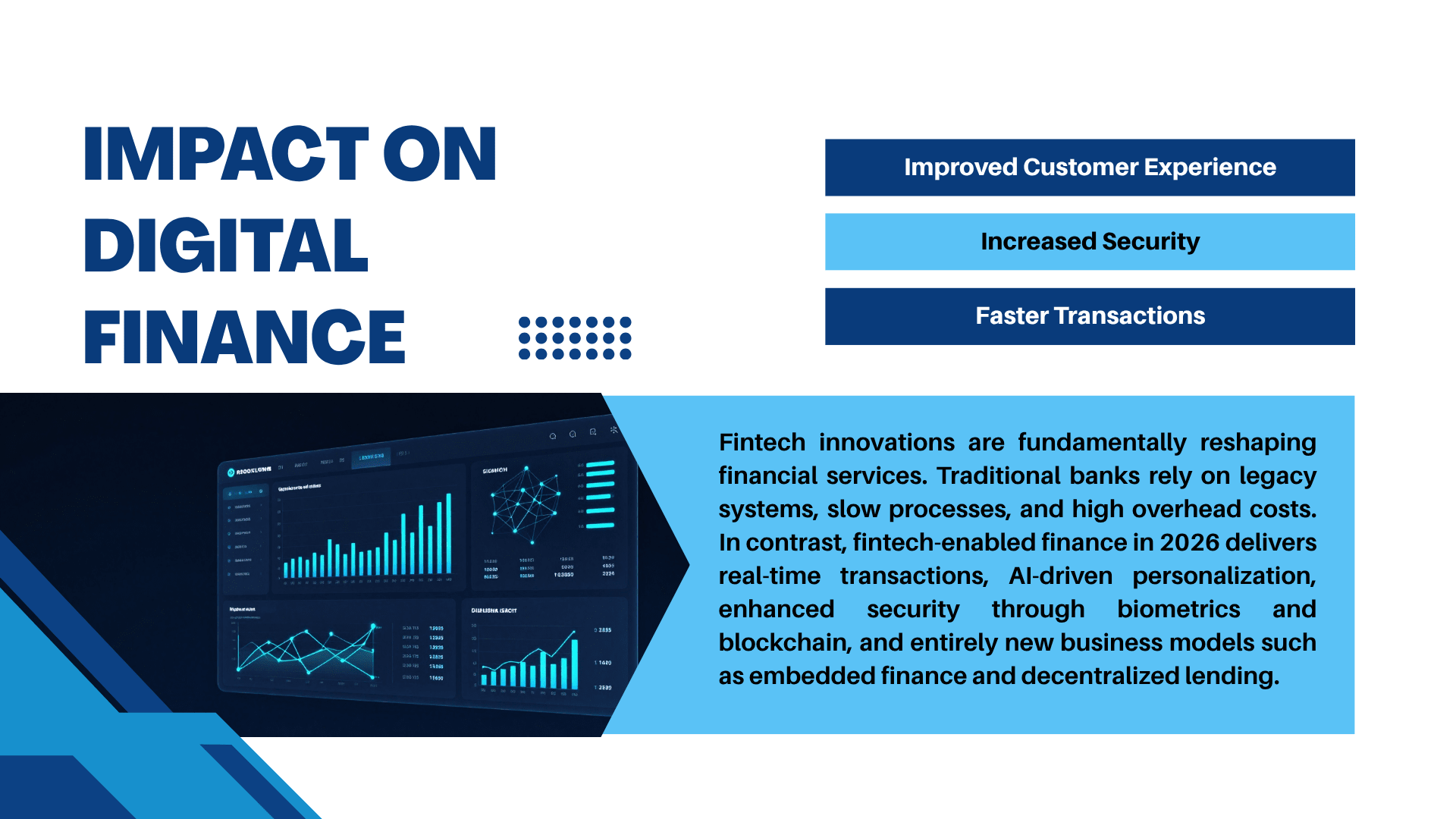
Fintech can improve financial inclusion by lowering barriers to banking, payments, credit, insurance, investment, and financial education, particularly when digital services are affordable, accessible, secure, and designed around real user needs. However, technology alone cannot solve financial exclusion where connectivity, affordability, literacy, identity, or trust remain barriers.
Financial inclusion is one of the more meaningful opportunities within the future of fintech.
Digital financial services can potentially reach people who have limited access to physical branches.
Mobile payments can make small transactions easier.
Digital onboarding can reduce the need for physical paperwork.
Technology can also support micro-businesses with digital payments and financial records.
However, inclusion requires more than an application.
A person without reliable internet access, a suitable device, digital literacy, or confidence in financial institutions may still be excluded.
Digital Credit
Fintech platforms can potentially make lending decisions faster.
However, speed should not become the only objective.
Responsible digital lending needs appropriate affordability assessment, transparency, data protection, and consumer safeguards.
Digital Insurance
Insurtech can simplify insurance distribution, claims processing, and customer communication.
Automated systems can potentially process routine claims faster while more complex cases receive human review.
Financial Education
Digital platforms can also provide financial education through interactive tools, budgeting features, calculators, and conversational assistants.
This can help people understand financial products before making decisions.
What Are the Main Benefits of Fintech Innovation?
The main benefits of fintech innovation include faster services, lower operational friction, improved customer experiences, better access to financial products, increased automation, stronger fraud detection, and more real-time financial information. The biggest gains occur when technology solves a genuine financial problem rather than being introduced simply because it is new.
Several benefits are particularly important in 2026.
1. Faster Financial Services
Real-time payments, digital onboarding, automated verification, and AI-assisted support can reduce waiting time.
2. Lower Operational Costs
Automation can reduce repetitive manual work in areas such as reporting, reconciliation, customer service, and compliance.
3. Better Customer Experience
Digital financial products can make routine services easier to access.
4. More Personalized Services
Data and AI can help financial institutions provide more relevant services, subject to consent and privacy requirements.
5. Improved Fraud Detection
Advanced analytics can identify suspicious patterns earlier.
6. Greater Accessibility
Mobile-first services can potentially extend financial services to more people.
7. Better Business Efficiency
Businesses can integrate payments, invoicing, accounting, financing, and reporting into connected workflows.
What Are the Biggest Challenges Facing Fintech in 2026?
The biggest fintech challenges in 2026 include cybersecurity, privacy, regulatory complexity, AI governance, legacy-system integration, consumer trust, fraud, technology costs, digital exclusion, and uncertainty around emerging technologies. Fintech growth therefore depends not only on innovation but also on strong governance, resilience, interoperability, and responsible implementation.
Fintech trend in 2026Main applicationPotential impact on digital financeAI and generative AISupport, fraud detection, analysis, personalizationFaster decisions and more intelligent servicesAgentic AIAutomated financial actionsMore autonomous financial workflowsReal-time paymentsInstant or near-instant transactionsFaster commerce and cash-flow managementTokenizationDigital representation of financial assetsProgrammable settlement and new financial infrastructureOpen bankingAPI-based data sharingMore connected financial productsEmbedded financeFinancial services inside digital platformsLower friction and new distribution modelsRegTechKYC, AML, compliance monitoringMore scalable compliance operationsCybersecurity technologyIdentity and fraud preventionStronger protection of digital financial systemsDigital bankingMobile and digital-first servicesMore convenient customer experiencesFinancial inclusion technologyPayments, credit, insurance, educationPotentially wider access to financial services
Legacy System Integration
One of the least visible challenges in fintech is integration.
Many financial institutions operate on technology systems that were developed years or even decades ago.
Replacing those systems can be expensive and risky.
As a result, new fintech solutions often need to work alongside existing infrastructure.
This makes APIs, middleware, cloud infrastructure, data architecture, and system modernization important parts of fintech transformation.
Regulatory Complexity
Financial technology operates within highly regulated environments.
A new product may involve banking regulations, payment rules, privacy requirements, cybersecurity obligations, consumer protection, identity verification, and cross-border considerations.
Technology can move quickly.
Regulation often moves more deliberately.
The gap can create uncertainty for fintech companies and financial institutions.
Consumer Trust
Trust remains one of the most important assets in financial services.
Customers may accept a poor recommendation from an entertainment application and simply ignore it.
A wrong financial recommendation can have much greater consequences.
Fintech companies therefore need transparent communication, reliable systems, strong security, and responsible handling of customer data.
AI Bias and Explainability
AI models can produce unfair outcomes if training data or model design contains bias.
This is particularly important in lending, insurance, fraud detection, hiring, and other decisions affecting people.
Financial institutions need processes to test, monitor, document, and govern AI systems.
Technology Costs
Advanced AI, cloud infrastructure, cybersecurity, compliance systems, and modern data platforms require investment.
Smaller fintech companies may struggle to fund every capability internally.
This can increase the importance of technology partnerships and specialized infrastructure providers.
Digital Exclusion
A highly digital financial system can unintentionally leave some people behind.
Older consumers, people with limited digital literacy, people without reliable connectivity, and customers who prefer human assistance may need alternative channels.
A strong digital finance strategy should not assume that every customer has the same technical ability or access.
What Will Fintech Look Like in the Next Five Years?
Over the next five years, fintech is likely to become more embedded, automated, intelligent, and interoperable rather than simply creating more standalone financial applications. AI agents, programmable financial infrastructure, real-time payments, open APIs, tokenized assets, embedded finance, and automated compliance could increasingly operate together as connected financial systems.
Several developments deserve close attention.
1. Finance Will Become More Invisible
Financial services may increasingly disappear into everyday workflows.
A business may not open a separate banking application to perform every financial task. Payment collection, financing, insurance, payroll, and reporting can become integrated into business software.
2. AI Agents Will Handle More Routine Tasks
AI agents could increasingly manage repetitive financial workflows under defined permissions.
The key phrase is under defined permissions.
Financial institutions cannot simply give unrestricted authority to autonomous systems.
Authorization, monitoring, traceability, and human escalation will remain essential.
3. Tokenized Finance Could Expand
Tokenization may increasingly influence securities, deposits, collateral, settlement, and programmable financial arrangements.
The IMF has described tokenization as a potential structural change to financial architecture, while BIS has emphasized the importance of integrating technological innovation with sound institutional and monetary arrangements.
4. Payments Will Become More Contextual
A payment may increasingly happen automatically as part of another activity.
For example:
Order placed → identity verified → payment authorized → transaction completed → receipt generated.
The customer may experience this as one seamless process rather than several separate financial steps.
5. Compliance Will Become More Automated
RegTech systems will likely become better at identifying regulatory changes, monitoring transactions, checking documentation, and prioritizing cases for human review.
6. Cybersecurity Will Become More Intelligent
Security systems will need to respond to increasingly sophisticated threats.
This means financial organizations will use AI not only to improve products but also to protect infrastructure.
7. Interoperability Will Matter More
The next phase of fintech cannot depend entirely on isolated platforms.
Financial institutions, fintech providers, payment networks, regulators, technology companies, and businesses need systems that can communicate securely.
Interoperability may become one of the defining requirements of digital finance.
What Does the Future of Digital Finance Mean for Businesses?
The future of digital finance means businesses will increasingly manage payments, financial data, financing, compliance, and customer interactions through connected technology platforms. Companies that modernize carefully can improve efficiency and customer experience, but technology investment should be based on measurable business needs rather than trend adoption alone.
A practical fintech strategy can begin with a simple process.
Step 1: Identify Financial Friction
Businesses should identify processes that are slow, repetitive, expensive, or difficult for customers.
Examples include:
Manual invoice processing
Slow payment reconciliation
Repetitive customer support
Manual KYC checks
Delayed reporting
Fragmented financial data
Step 2: Determine Whether Technology Solves the Problem
Not every problem requires AI or blockchain.
A simple API integration may solve a problem more effectively than a complex AI system.
Step 3: Evaluate Security and Compliance
Any financial technology should be evaluated for:
Data protection
Access control
Vendor security
Regulatory requirements
Auditability
Reliability
Business continuity
Step 4: Start With a Controlled Use Case
A pilot can reduce risk.
A business might begin by automating customer-support classification rather than allowing an AI system to make unrestricted financial decisions.
Step 5: Measure Results
Useful metrics can include:
Processing time
Cost per transaction
Customer response time
Error rate
Fraud losses
Conversion rate
Support resolution time
Compliance workload
The technology should prove its value through measurable outcomes.
What Does the Future of Fintech Mean for Banks and Fintech Startups?
For banks, the future of fintech means modernizing infrastructure while protecting trust, security, and regulatory compliance. For fintech startups, the opportunity lies in solving specific financial problems better than existing systems while building strong compliance and security foundations from the beginning.
Banks and fintech startups have different strengths.
Banks typically have:
Established customer relationships
Regulatory experience
Capital
Deposits and financial infrastructure
Large transaction histories
Fintech startups may have:
Faster product development
Specialized technology
Focused user experiences
Modern software architecture
Ability to target specific financial problems
The future may therefore contain more partnerships rather than a simple battle between banks and fintech companies.
A fintech provider may offer specialized fraud technology to a bank.
A bank may provide regulated financial infrastructure to a technology platform.
A SaaS company may integrate payments or financing through a financial partner.
This creates a broader ecosystem in which different companies contribute different capabilities.
Which Fintech Trends Matter Most for Consumers?
For consumers, the most meaningful fintech trends are likely to be real-time payments, digital banking, AI-powered support, personalized financial services, stronger fraud protection, digital identity, and more convenient access to financial products. The value of these trends depends on whether they improve convenience without weakening privacy, security, transparency, or consumer control.
Consumers may notice the transformation through everyday experiences rather than through technical terminology.
A payment may arrive instantly.
A banking application may explain unusual spending.
A support assistant may resolve a routine problem within seconds.
A fraud system may stop a suspicious transaction before money leaves an account.
A financial platform may bring several accounts into one dashboard.
These improvements can make digital finance feel simpler even though the technology behind them becomes more sophisticated.
The challenge is ensuring that simplicity does not hide important information.
Customers should still understand fees, permissions, risks, data use, and financial consequences.
What Should Businesses Watch in 2026?
Businesses monitoring fintech industry trends in 2026 should focus on technologies that improve financial workflows while also strengthening security, compliance, and customer trust. AI, payments, tokenization, embedded finance, open banking, RegTech, and cybersecurity deserve attention, but each should be evaluated according to the business problem it solves.
The most important signals include:
AI moving from experimentation into production
Agentic AI entering controlled financial workflows
Real-time payment adoption
Tokenization moving into regulated financial infrastructure
Growth of embedded financial services
Expansion of API-based financial connectivity
Automation of compliance operations
Increasing cybersecurity requirements
Greater focus on AI governance
Demand for seamless digital banking experiences
These trends are connected.
AI requires data.
Data requires secure infrastructure.
Payments require identity and fraud controls.
Open banking requires consent and secure APIs.
Tokenization requires reliable digital infrastructure and appropriate regulation.
Embedded finance requires partnerships between technology and financial-service providers.
That interconnectedness is one of the most important characteristics of the future of fintech.
How Can Fintech Innovation Remain Responsible?
Responsible fintech innovation requires a balance between speed and control. Financial technology providers need to consider security, privacy, regulatory obligations, explainability, consumer protection, operational resilience, and human oversight alongside product performance and growth.
A responsible approach includes several principles.
Security by Design
Security should be considered during product development rather than added after launch.
Privacy by Design
Companies should collect and process only the information required for legitimate purposes.
Human Oversight
High-impact financial decisions should have appropriate human review and escalation mechanisms.
Transparent AI
Where AI influences important decisions, institutions should understand how the system works, how it is monitored, and how errors are handled.
Strong Governance
Every automated system should have clear ownership.
Someone should be responsible for monitoring its performance, risks, and changes.
Resilience
Financial services need to keep functioning during technical failures, cyber incidents, or unexpected market conditions.
Technology should therefore include backup processes and recovery plans.
Why Trust Will Define the Future of Fintech
Technology can make financial services faster, but trust determines whether people are willing to use them.
This is particularly important as finance becomes more automated.
A customer may be comfortable allowing an application to recommend a product. That does not automatically mean the customer is comfortable allowing an AI agent to execute a financial transaction.
Trust depends on several factors:
Clear authorization
Reliable security
Transparent communication
Data privacy
Human support
Regulatory protection
Predictable system behavior
Ability to challenge or correct decisions
The more autonomy technology receives, the more important these safeguards become.
This is especially relevant to agentic AI. The IMF's 2026 research emphasizes that payment systems need to reconcile autonomous, probabilistic AI behavior with the deterministic requirements of financial infrastructure.
That is a useful principle for the wider fintech industry: innovation can move quickly, but financial trust cannot be treated as an afterthought.
Where Can Reliable Information on Digital Finance Be Found?
For organizations tracking financial technology in 2026, authoritative research from international financial institutions can provide useful context alongside national regulators, central banks, and established financial authorities.
The International Monetary Fund's fintech and AI research provides analysis covering AI, digital finance, tokenization, payments, and related financial-system developments.
The Bank for International Settlements' fintech and digital-finance research provides research and policy analysis on financial innovation, payment systems, AI, tokenization, and financial stability.
These sources are particularly useful because fintech developments can move quickly, while regulatory and financial-stability implications require careful analysis.
What Is the Overall Future of Fintech?
The overall future of fintech is a connected financial ecosystem in which AI, automation, real-time payments, open banking, embedded finance, tokenization, digital banking, RegTech, and cybersecurity work together. The strongest fintech businesses will not necessarily be those using the most advanced technology, but those that solve real financial problems safely, efficiently, and transparently.
The Future of Fintech Trends Shaping Digital Finance is therefore less about predicting one dominant technology and more about understanding how several technologies will interact.
AI can improve decision support and customer service.
Automation can reduce repetitive operational work.
Real-time payments can make money movement faster.
Open banking can connect financial information across services.
Embedded finance can place financial products directly inside business workflows.
Tokenization can create new forms of programmable financial infrastructure.
RegTech can make compliance more scalable.
Cybersecurity can help protect increasingly connected financial systems.
Digital banking can bring these capabilities together through customer-facing platforms.
The biggest opportunities will come from combining these capabilities carefully rather than adopting them independently.
At the same time, the biggest risks will also come from that interconnectedness. A highly automated financial ecosystem can spread errors faster. A shared digital dependency can create concentration risk. An AI model can make decisions at a scale that humans cannot manually review. A cyberattack can potentially affect multiple connected services.
That is why governance matters as much as innovation.
Conclusion: The Future of Fintech Trends Shaping Digital Finance
The Future of Fintech Trends Shaping Digital Finance in 2026 is being defined by a shift from simple digitization toward intelligent, connected, automated, and increasingly programmable financial services.
AI is becoming a major technology for customer support, fraud detection, risk assessment, personalization, and financial operations. Agentic AI is opening another stage in which software may eventually perform more financial tasks under delegated authority. Digital payments are becoming faster and more integrated into everyday commerce. Open banking and embedded finance are connecting financial services to broader digital ecosystems.
Tokenization is also gaining attention because it can change how financial assets, money, settlement, and liquidity are represented and managed. At the same time, RegTech and cybersecurity are becoming essential foundations rather than optional additions.
The important lesson from these fintech industry trends is that technology alone does not create better finance.
A successful digital financial system needs innovation, security, regulation, interoperability, privacy, resilience, and trust working together.
Banks, fintech startups, technology providers, businesses, regulators, and consumers all have a role in shaping that environment.
The future of digital finance will therefore not simply be about making financial services digital. Much of finance is already digital. The next stage is about making digital financial services more intelligent, connected, responsive, programmable, and useful while maintaining the safeguards that make people willing to trust them.
That balance between fintech innovation and responsible financial infrastructure will be one of the defining themes of financial technology in 2026 and the years that follow.
Tags
Amzsoft Innovexa
Engineering and delivery notes from the Amzsoft Innovexa team — fintech platforms, AI automation, and product engineering.