Why API Integration in Modern Apps Is the Backbone of Digital Growth
A few years ago, businesses could survive with disconnected software.
Your website worked separately. Your payment system worked separately. Customer support sat inside another dashboard. Marketing tools lived somewhere else. Teams manually copied data from one platform to another and somehow managed to keep operations moving.
That approach doesn’t work anymore.
Today, customers expect everything to feel instant.
They expect payments to process immediately. Orders to update in real time. Notifications to arrive within seconds. Apps to sync across devices without errors. Support teams to already know their purchase history before the conversation even starts.
Behind almost every smooth digital experience, there’s one thing quietly making it happen: API Integration in Modern Apps.
Most users never notice APIs. They simply expect technology to work. But businesses know the truth — modern applications are no longer standalone products. They’re connected ecosystems.
And honestly, companies that still ignore APIs usually end up facing the same problems:
Slow workflows
Disconnected systems
Data silos
Poor customer experiences
Delayed product launches
Scaling issues
High operational costs
That’s exactly why businesses investing in modern app development now treat APIs as infrastructure, not optional add-ons.
What Is API Integration in Modern Apps?
At its simplest level, API integration allows different software systems to communicate with each other automatically.
An API (Application Programming Interface) acts like a bridge between applications.
Instead of manually transferring information between systems, APIs allow software to exchange data instantly.
Think about how normal this has become in daily life:
Logging into apps with Google
Paying online using Stripe or PayPal
Tracking deliveries in real time
Connecting smartwatches to fitness apps
Booking flights inside travel apps
Using AI chatbots on websites
None of this works smoothly without APIs.
So when we talk about API Integration in Modern Apps , we’re really talking about building connected digital experiences where systems share information seamlessly.
And this connectivity is now shaping nearly every industry.
Why Businesses Depend on API Integration Benefits
Businesses don’t adopt APIs just because they’re trendy.
They adopt them because APIs solve expensive operational problems.
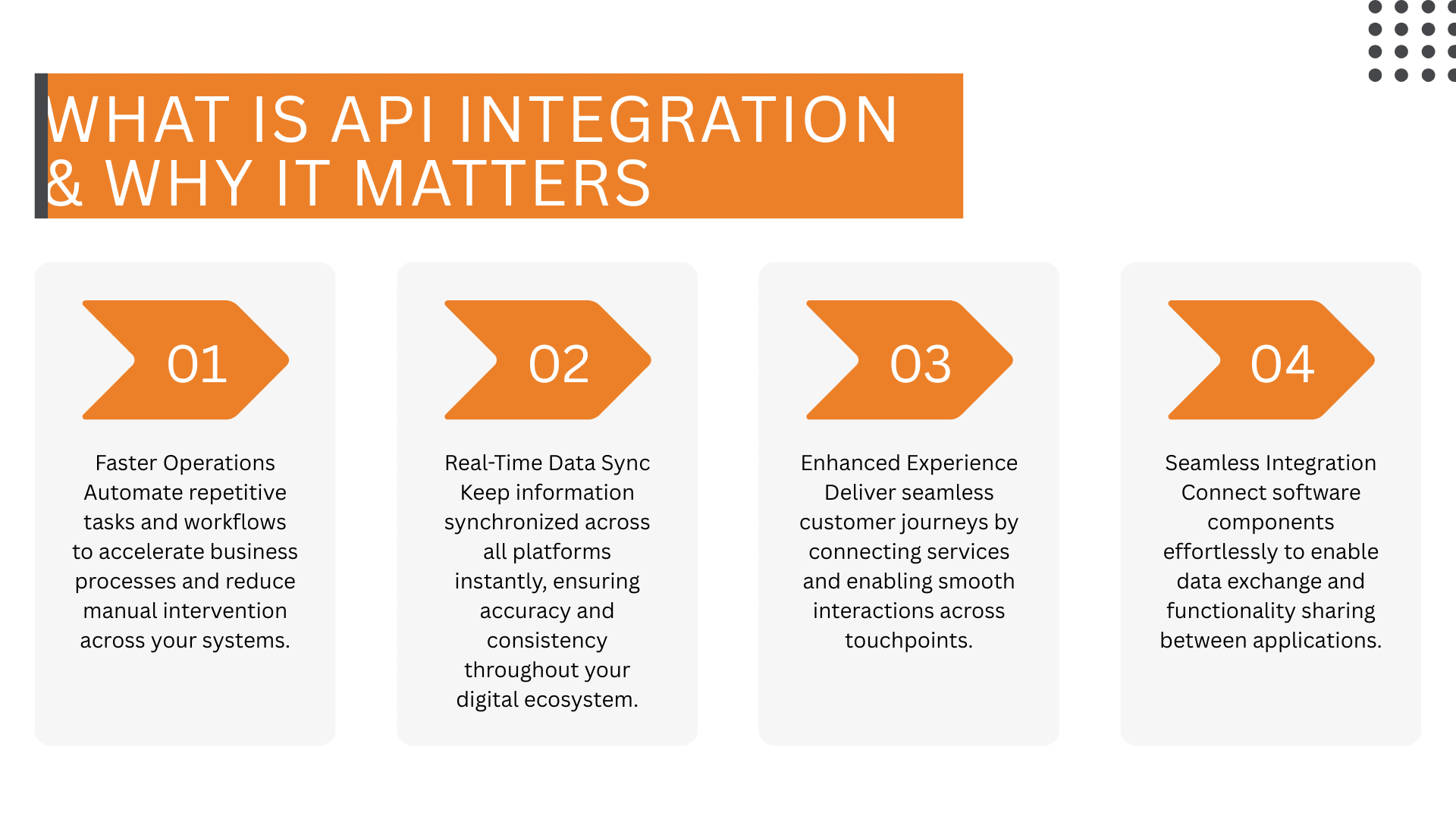
The biggest API integration benefits usually include:
Faster Operations
Manual workflows slow businesses down.
When APIs automate communication between systems, teams stop wasting time moving data manually.
For example:
A single eCommerce order can automatically:
Process payment
Update inventory
Notify the warehouse
Generate invoices
Send shipping alerts
Update CRM records
All within seconds.
Without APIs? Employees often handle parts of that workflow manually.
That becomes a nightmare at scale.
Real-Time Data Synchronization
Modern businesses rely heavily on live data.
Examples include:
Banking transactions
Inventory updates
Delivery tracking
Healthcare monitoring
Ride-sharing systems
Financial dashboards
Without real-time data synchronization, users lose trust quickly.
Imagine checking a banking app and seeing outdated balances. Or ordering a product that’s actually out of stock.
That’s exactly why APIs have become essential infrastructure.
Better Customer Experience
Customer expectations changed dramatically after companies like Amazon, Uber, Netflix, and Spotify normalized seamless digital experiences.
People now expect:
Instant responses
Personalized experiences
One-click logins
Fast payments
Cross-device syncing
Real-time notifications
APIs make those experiences possible.
And honestly, users rarely tolerate friction anymore.
If an app feels slow, disconnected, or outdated, people leave fast.
How REST APIs Became the Standard for Modern Applications
Among all API technologies, REST APIs dominate modern development.
And there’s a reason for that.
REST APIs are:
Lightweight
Fast
Flexible
Easier to scale
Developer-friendly
Most web and mobile apps today rely heavily on REST architecture because it simplifies communication between frontend apps and backend systems.
For example:
Mobile banking apps
SaaS platforms
Social media applications
eCommerce websites
Streaming services
All commonly use REST APIs.
Developers also prefer them because they reduce complexity compared to older protocols like SOAP.
REST APIs vs SOAP APIs vs GraphQL APIs
Different API architectures serve different business needs.
API TypeBest ForMain AdvantageREST APIsWeb & mobile appsSpeed and simplicitySOAP APIsBanking & enterprise systemsHigh securityGraphQL APIsComplex data-heavy applicationsFlexible querying
Why Developers Prefer GraphQL for Complex Apps
GraphQL allows applications to request only the exact data they need.
That reduces unnecessary data transfer and improves performance.
For example:
Instead of downloading entire datasets, an app can ask for only:
Username
Profile picture
Recent notifications
Nothing extra.
That becomes extremely useful for large-scale applications with millions of users.
Why Third-Party API Integration Saves Businesses Massive Time
Imagine building every feature internally.
Payments. Maps. Notifications. Authentication. Messaging. AI tools.
It would take years.
That’s why third-party API integration became one of the smartest strategies in software development.
Businesses now integrate ready-made services instead of reinventing everything.
Popular examples include:
Stripe for payments
Twilio for SMS
Google Maps for geolocation
OpenAI APIs for AI features
Firebase for backend services
PayPal for transactions
This approach dramatically reduces development time and costs.
More importantly, businesses can launch products faster.
And in digital markets, speed matters more than most companies realize.
How Cloud API Integration Changed Modern Software
Cloud computing completely changed how applications are built.
Before cloud infrastructure became mainstream, scaling applications was expensive and complicated.
Now businesses use cloud API integration to connect:
Cloud storage
AI services
Analytics tools
Security systems
Automation platforms
Databases
This flexibility allows companies to scale infrastructure dynamically.
For example:
A streaming platform experiencing traffic spikes can automatically scale cloud resources through APIs without downtime.
That’s a huge reason why cloud-native businesses scale faster than traditional companies.
The Role of APIs in Microservices Architecture
Older applications were often built as massive monolithic systems.
One bug could affect the entire application.
One update could require redeploying everything.
That created maintenance headaches.
Modern companies increasingly prefer microservices architecture, where applications are divided into smaller independent services connected through APIs.
Each service handles one specific task.
For example:
Payment service
Notification service
Authentication service
Inventory service
Analytics service
APIs coordinate communication between these services.
This structure improves:
Scalability
Stability
Development speed
Fault isolation
Deployment flexibility
It’s one of the biggest reasons APIs became central to scalable app development.
Why APIs Are Essential for Scalable App Development
A small app with 500 users is easy to manage.
An app with 5 million users? Completely different story.
As applications grow, businesses face challenges like:
Server overload
Slow response times
Complex infrastructure
Higher maintenance costs
Increased downtime risks
APIs help solve these issues by distributing workloads efficiently.
Instead of one system doing everything, APIs allow services to operate independently.
That flexibility is critical for scalable app development.
And honestly, scalability is something many startups underestimate early on.
Some apps collapse under growth simply because their architecture wasn’t built for expansion.
How APIs Power Real-Life Digital Experiences
Most people interact with APIs dozens of times every day without realizing it.
Here are some real-world examples.
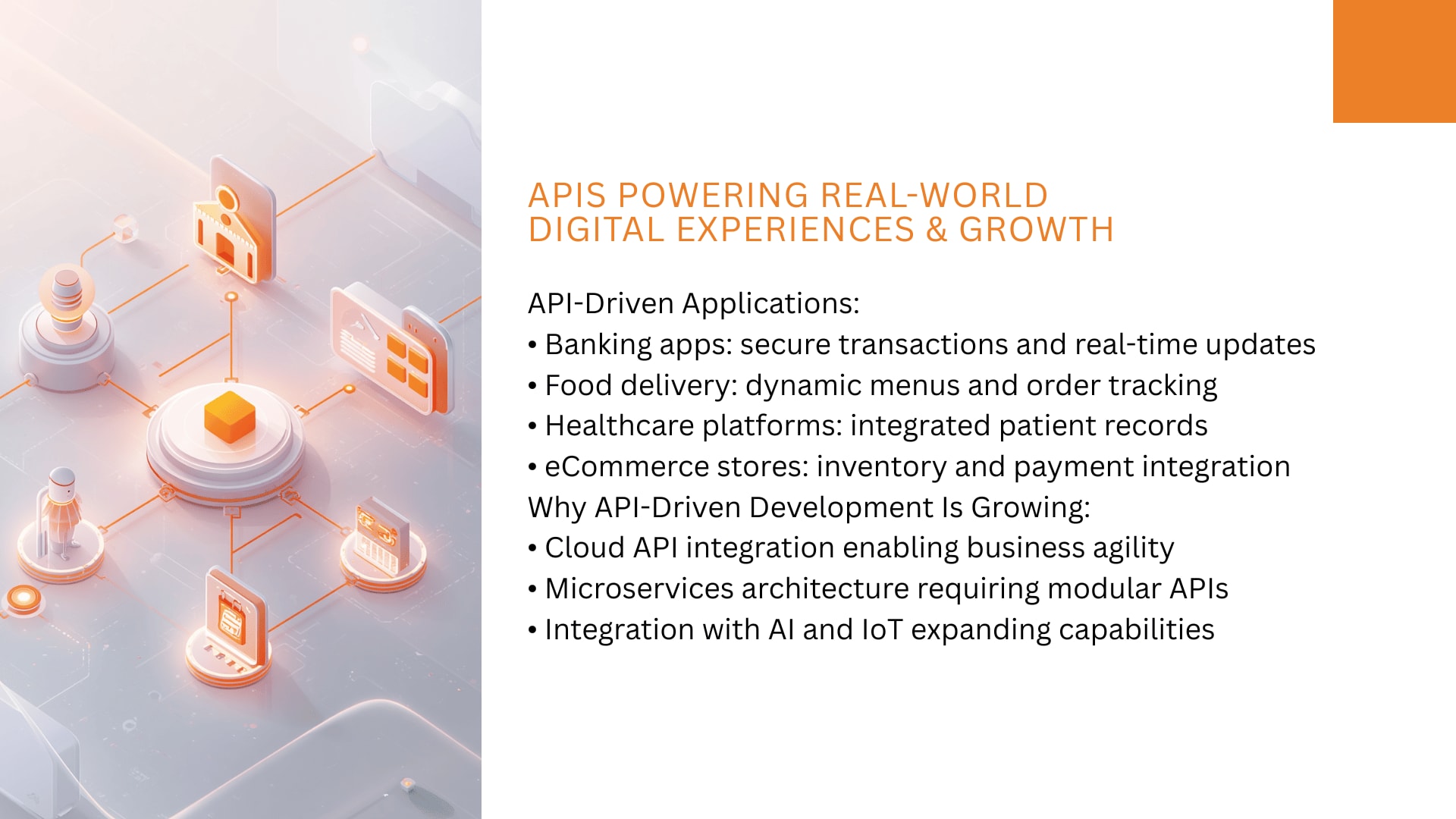
Banking Apps
When users transfer money instantly between banks, APIs handle:
Authentication
Fraud detection
Balance verification
Transaction processing
Without APIs, modern fintech wouldn’t exist.
Food Delivery Apps
Delivery platforms integrate APIs for:
Payments
GPS tracking
Restaurant management
Notifications
Customer communication
That’s why users can watch drivers moving live on maps.
Healthcare Platforms
Healthcare systems use APIs to connect:
Patient records
Telemedicine platforms
Diagnostic labs
Insurance systems
Wearable devices
This improves patient care while reducing administrative workload.
eCommerce Stores
Online stores rely heavily on APIs for:
Payment gateways
Inventory synchronization
Shipping providers
CRM systems
Product recommendations
Without APIs, most large eCommerce businesses couldn’t operate efficiently.
Why API-Driven Development Is Growing So Fast
Modern software teams increasingly adopt API-driven development strategies.
Instead of building the frontend first, developers now design APIs early in the development process.
Why?
Because APIs define how systems communicate.
This approach improves:
Team collaboration
Scalability
Faster frontend/backend development
Easier testing
Better long-term flexibility
Frontend teams and backend teams can work independently while APIs act as the shared contract.
That speeds up development dramatically.
The Connection Between APIs and AI Applications
AI growth massively increased API demand.
Most AI tools businesses use today are accessed through APIs.
Examples include:
AI chatbots
Recommendation engines
Voice assistants
Image recognition
Predictive analytics
Natural language processing
Instead of building AI models internally, businesses connect external AI APIs into their applications.
This lowers costs while accelerating innovation.
And honestly, this trend is only getting bigger.
AI without APIs would remain inaccessible for most businesses.
How APIs Support IoT and Smart Devices
The Internet of Things depends almost entirely on APIs.
Smart devices constantly exchange data using APIs.
Examples include:
Smart home systems
Fitness trackers
Industrial monitoring systems
Connected healthcare devices
Fleet tracking systems
Without APIs, these devices wouldn’t communicate effectively.
As IoT adoption grows, API ecosystems become even more important.
Why API Security Matters More Than Ever
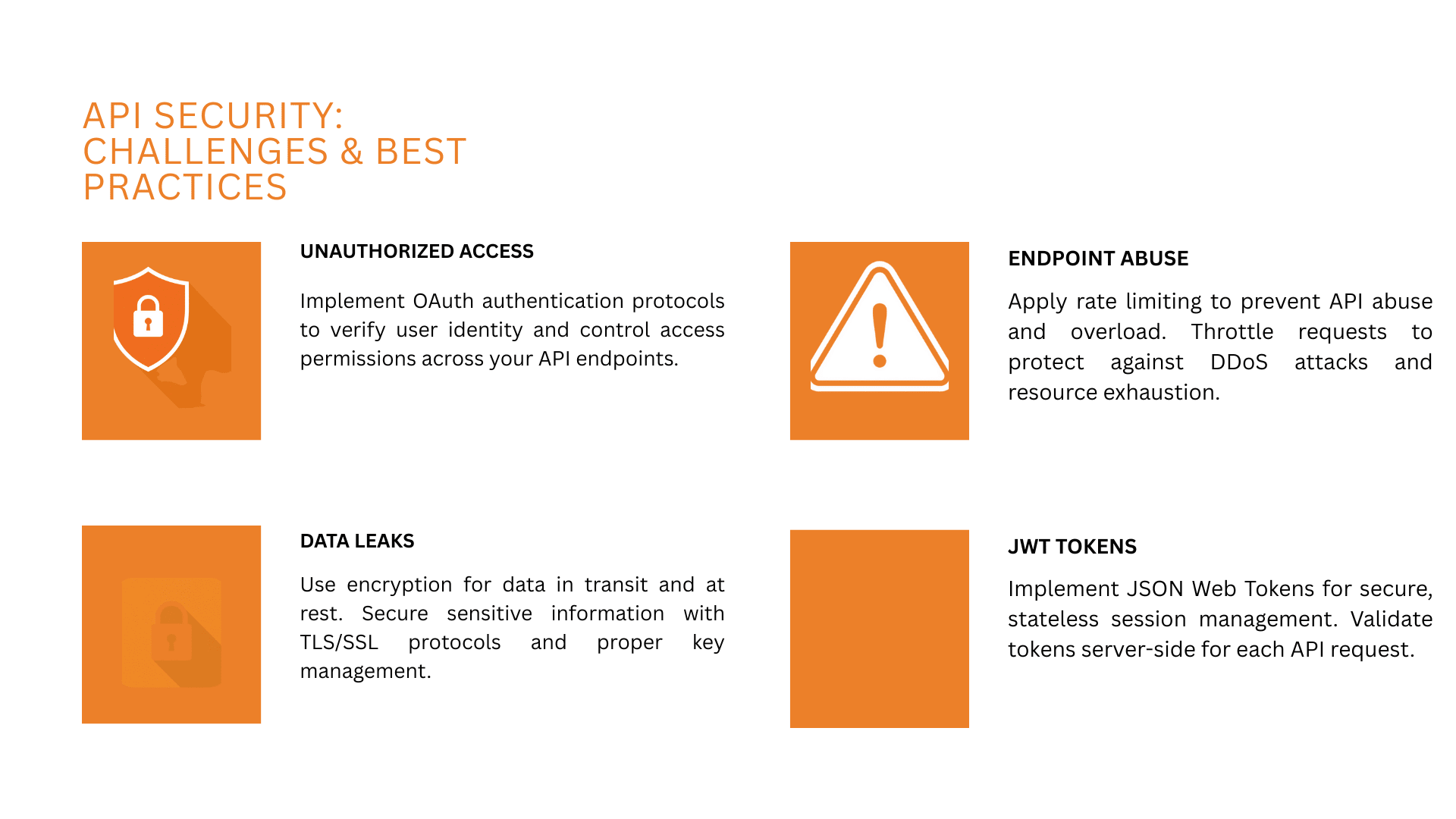
Here’s the uncomfortable reality:
APIs are incredibly powerful.
But they can also become major security vulnerabilities if managed poorly.
Since APIs expose system functionality and business data, attackers often target them directly.
That’s why API security is now a major priority for businesses.
Common API Security Risks
Some of the biggest API vulnerabilities include:
Weak authentication
Broken authorization
Data exposure
Injection attacks
DDoS attacks
API abuse
Poor encryption
And unfortunately, many companies still underestimate API security until something goes wrong.
How Businesses Improve API Security
Strong API protection usually involves several layers.
OAuth Authentication
OAuth allows secure access without exposing passwords.
It’s widely used for:
Google logins
Facebook authentication
SaaS integrations
JWT Tokens
JWT tokens securely verify user identity between systems.
They help applications maintain secure sessions efficiently.
Encryption
Businesses encrypt API traffic to protect sensitive data during transmission.
This is especially important for:
Banking apps
Healthcare systems
Financial platforms
Rate Limiting
Rate limiting prevents abuse by restricting excessive API requests.
This improves:
Stability
Security
Performance reliability
Continuous Monitoring
Businesses monitor APIs constantly to detect:
Unusual traffic
Suspicious behavior
Failed requests
Potential attacks
Security isn’t a one-time setup anymore. It’s an ongoing process.
Biggest Challenges of API Integration in Modern Apps
Despite the advantages, API integration isn’t always simple.
Businesses commonly face issues like:
Legacy System Compatibility
Older systems often weren’t designed for modern APIs.
This creates integration complexity.
Many enterprises still rely on outdated infrastructure that’s difficult to modernize.
Poor Documentation
Bad API documentation slows developers down badly.
Clear documentation should explain:
Endpoints
Authentication
Error handling
Usage examples
Request limits
Without proper documentation, integration projects become frustrating quickly.
Scalability Problems
Some APIs work well initially but fail under high traffic.
That’s why businesses must evaluate scalability before adopting third-party APIs.
Vendor Dependency
Relying heavily on external APIs can create risks if providers:
Change pricing
Limit functionality
Experience outages
Shut services down
Smart businesses usually avoid depending entirely on one provider.
Best Practices for Successful API Integration
Businesses that succeed with APIs usually follow a few consistent principles.
Choose Scalable APIs
Always think long term.
An API that works for 1,000 users may struggle with 1 million.
Prioritize Security Early
Security should never be added later as an afterthought.
Secure authentication, encryption, and monitoring should exist from day one.
Test APIs Continuously
Applications evolve constantly.
Regular testing helps prevent:
Downtime
Compatibility issues
Security vulnerabilities
Monitor Performance
Businesses should track metrics like:
Response times
Error rates
Uptime
Request failures
Monitoring helps teams identify problems before users notice them.
Use API Gateways
API gateways simplify large-scale API management.
They help with:
Authentication
Traffic control
Analytics
Security policies
Monitoring
Large enterprises rely heavily on gateways to manage complex ecosystems.
Why Startups Prefer API-First Strategies
Startups move fast.
They don’t have years to build every feature internally.
That’s why API-first development became extremely popular among startups.
It allows companies to:
Launch MVPs faster
Reduce infrastructure costs
Scale quickly
Test ideas rapidly
Integrate external tools easily
In competitive industries, fast iteration often matters more than perfection.
And APIs enable that speed.
The Future of API Integration in Modern Apps
APIs are becoming even more important as technology evolves.
Several trends are shaping the future right now.
AI-Powered APIs
AI systems increasingly automate:
Testing
Error detection
Workflow orchestration
Data analysis
This reduces manual engineering effort significantly.
Low-Code and No-Code Integrations
Businesses increasingly use platforms that allow API integrations without heavy coding.
This makes automation accessible to non-technical teams.
Event-Driven Architectures
Instead of constant polling, systems now react instantly to events.
This improves efficiency and responsiveness.
Serverless APIs
Serverless infrastructure reduces operational overhead while improving scalability.
Many modern startups now build entirely serverless architectures.
Hyperautomation
Businesses increasingly connect multiple workflows through APIs and automation platforms.
This reduces repetitive manual tasks dramatically.
Why APIs Are the Foundation of Digital Transformation
Digital transformation sounds like a buzzword until companies realize what it actually means:
Connected systems.
That’s it.
Businesses modernize by connecting technologies together efficiently.
And APIs make that possible.
Without APIs, organizations struggle with:
Disconnected departments
Slow operations
Data silos
Poor visibility
Inefficient workflows
APIs improve collaboration across teams while making businesses more agile.
That’s why APIs are no longer just a developer topic. They’re now a business growth strategy.
Real Business Lessons From Companies That Scaled With APIs
Some of the world’s biggest tech companies grew because of strong API ecosystems.
Stripe
Stripe simplified online payments using developer-friendly APIs.
Its success came largely from making integrations easy.
Salesforce
Salesforce expanded rapidly by allowing businesses to connect third-party tools into its CRM ecosystem.
That flexibility increased platform value dramatically.
Twilio
Twilio built a billion-dollar communication platform around messaging APIs.
Instead of building communication systems from scratch, businesses integrate Twilio APIs directly.
Why Businesses Can’t Ignore API Integration in Modern Apps Anymore
The digital economy runs on connected systems.
Customers now expect apps that feel:
Fast
Intelligent
Personalized
Seamless
Real-time
Without APIs, delivering those experiences becomes nearly impossible.
Businesses that invest in strong API ecosystems gain major advantages:
Faster innovation
Better scalability
Lower operational costs
Improved automation
Stronger customer experiences
Meanwhile, companies with disconnected systems often struggle to keep up.
And honestly, this gap is only widening.
FAQs About API Integration in Modern Apps
What is API Integration in Modern Apps?
API Integration in Modern Apps refers to connecting different software systems using APIs so they can exchange data and functionality automatically in real time.
Why are APIs important for businesses?
APIs help businesses automate workflows, improve customer experiences, enable scalability, and connect multiple digital systems efficiently.
What are the most common types of APIs?
The most common API types include REST APIs, SOAP APIs, GraphQL APIs, cloud APIs, and webhook integrations.
How does API integration improve scalability?
APIs distribute workloads across systems and enable modular architectures, helping applications scale efficiently as user demand grows.
What industries benefit the most from API integration?
Industries like healthcare, fintech, eCommerce, SaaS, logistics, and mobile app development rely heavily on API ecosystems.
Final Thoughts
The future of software is connected.
Applications no longer succeed because they simply “work.” They succeed because they communicate efficiently with other systems, adapt quickly, and deliver smooth user experiences at scale.
That’s exactly why API Integration in Modern Apps has become one of the most important parts of modern software development.
Businesses that embrace APIs gain flexibility, automation, scalability, and faster innovation. Businesses that ignore them usually end up trapped in outdated workflows and disconnected infrastructure.
As AI, cloud computing, IoT, and automation continue evolving, APIs will quietly remain the technology powering almost everything behind the scenes.
And honestly, most users will never notice them.
They’ll just expect everything to work instantly.
Tags
Amzsoft Innovexa
Engineering and delivery notes from the Amzsoft Innovexa team — fintech platforms, AI automation, and product engineering.