Decentralized applications are changing how businesses build digital products, manage transactions, protect information, and interact with users. From decentralized finance and digital asset management to blockchain-based marketplaces and Web3 gaming, DApps are creating new opportunities for startups, developers, and established organizations.
Unlike traditional applications that depend entirely on centralized servers and databases, decentralized applications use blockchain networks and smart contracts to perform specific operations. This architecture can improve transparency, reduce dependence on intermediaries, and provide users with greater control over digital interactions. However, decentralization does not automatically make an application secure.
A poorly designed smart contract, vulnerable wallet integration, exposed private key, or insecure frontend can create serious problems. A single coding mistake may expose financial assets, allow unauthorized transactions, or affect the reliability of an entire application.
This is why secure decentralized application development requires careful planning, appropriate blockchain selection, reliable architecture, secure smart contract development, comprehensive testing, and continuous monitoring.
If you are wondering how to build a secure decentralized application, the process begins with understanding your application's purpose and security requirements. You must then select a suitable blockchain, design its architecture, develop and test smart contracts, integrate wallets securely, conduct security audits, and deploy the application responsibly.
For businesses exploring blockchain technology,
provides a technology-focused environment for exploring blockchain solutions, smart contracts, and decentralized application development.
This guide explains the complete DApp development process in beginner-friendly language, including common security vulnerabilities, development tools, practical examples, security best practices, costs, challenges, and future opportunities.
Understanding Decentralized Applications and DApp Security
What Is a Decentralized Application?
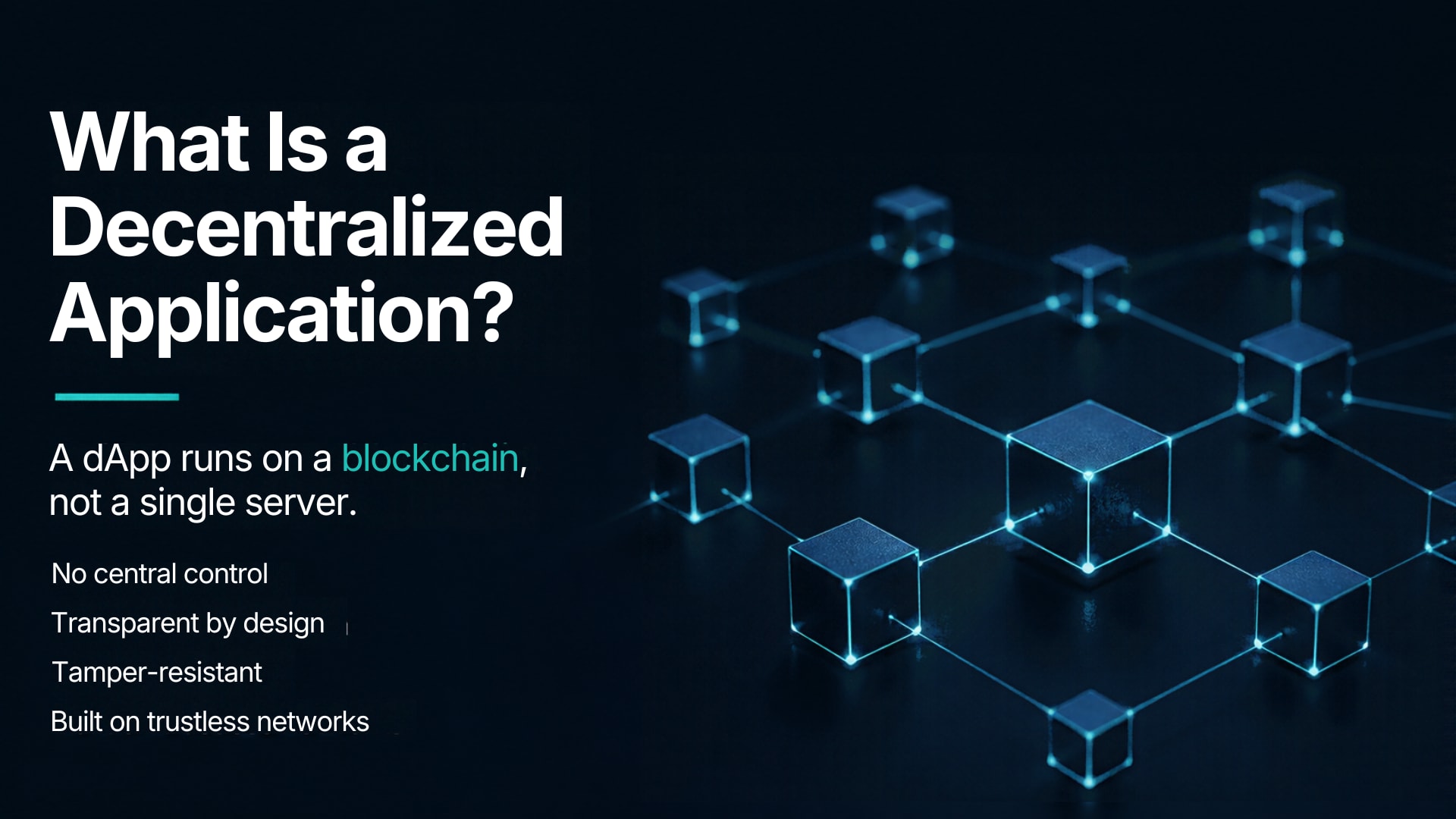
A decentralized application, commonly known as a DApp, is a software application that uses blockchain technology and smart contracts to perform certain operations without depending entirely on a central authority.
Traditional applications generally rely on centralized infrastructure. For example, when someone uses an online shopping application, the application communicates with company-managed servers and databases. The organization controls the infrastructure, user accounts, and application logic.
A decentralized application works differently. Its core business logic may operate through smart contracts deployed on a blockchain network. Users interact with these contracts through a frontend interface and a compatible cryptocurrency wallet.
The blockchain records transactions through a distributed network of computers, helping participants verify activities without relying exclusively on one organization's database.
Consider a decentralized marketplace.
In a traditional marketplace, a company manages product listings, payments, transactions, and user accounts. In a blockchain-based marketplace, smart contracts can manage selected transaction conditions and release payments when predefined requirements are satisfied.
This does not mean every part of the marketplace must be decentralized. User interfaces, search systems, customer support, and other services may still depend on traditional infrastructure.
The primary purpose of a DApp is to use decentralization where it provides meaningful benefits.
How Do Decentralized Applications Work?
A decentralized application generally combines a frontend interface, blockchain network, smart contracts, and wallet integration.
The process can be understood through the following steps:
A user opens the DApp through a website or mobile application.
The user connects a compatible blockchain wallet.
The frontend communicates with the selected blockchain network.
The user reviews an operation, such as transferring tokens or purchasing a digital asset.
The wallet displays the transaction details and requests authorization.
The user signs the transaction using their private key.
The blockchain network processes and validates the transaction.
The smart contract executes the relevant instructions when its conditions are satisfied.
The frontend displays the transaction status and updated information.
For example, imagine a user purchasing a digital collectible through a decentralized marketplace. The smart contract can verify the payment and update ownership records according to its programmed rules.
The transaction becomes part of the blockchain's recorded history.
Centralized Applications vs. Decentralized Applications
Understanding the difference between traditional applications and DApps helps businesses determine which architecture is appropriate for their requirements.
Comparison Factor
Centralized Application
Decentralized Application
Architecture
Uses centralized infrastructure
Uses blockchain-based infrastructure for core operations
Data management
Usually managed through company databases
Selected records are maintained on distributed ledgers
Control
Managed by an organization
Core operations may be governed by smart contracts
Transactions
Processed through centralized systems
May be validated through blockchain networks
User accounts
Often use platform-managed accounts
May use blockchain wallets
Transparency
Depends on organizational policies
Blockchain transactions may be publicly verifiable
Security responsibilities
Servers, databases, APIs, and accounts
Smart contracts, wallets, frontend, infrastructure, and blockchain
Updates
Generally controlled by the application owner
Depend on contract design, permissions, and upgrade mechanisms
Neither architecture is universally superior.
Centralized systems may be more appropriate for applications requiring high-speed internal processing, private databases, and straightforward administration.
Decentralized systems may be useful when transparent transaction records, shared ownership, or programmable blockchain operations are important.
Businesses should evaluate the actual problem before selecting a blockchain-based solution.
Key Components of a DApp
A secure DApp consists of several interconnected components. Each component has its own functionality and security responsibilities.
1. Frontend Interface
The frontend is the part of the application users interact with.
It may include:
Registration or wallet connection screens.
User dashboards.
Transaction forms.
Token balances.
Product listings.
Transaction histories.
Notifications.
Settings and account preferences.
Frontend development commonly involves technologies such as React, Next.js, JavaScript, and TypeScript.
A user-friendly interface should clearly communicate transaction details, network information, fees, and permission requests.
Developers should also protect the frontend against malicious scripts, unsafe dependencies, and misleading transaction information.
2. Blockchain Network
The blockchain network provides the decentralized infrastructure on which smart contracts operate.
Examples include Ethereum and other smart-contract-enabled networks.
A blockchain network maintains transaction records and uses its consensus mechanism to determine which transactions become part of the accepted ledger.
The selected network affects transaction fees, processing capacity, security assumptions, developer tools, and user accessibility.
3. Smart Contracts
Smart contracts are programs deployed on blockchain networks.
They automatically execute predefined instructions when specified conditions are satisfied.
For example, a payment smart contract might release funds to a seller after verifying a required transaction condition.
Smart contracts can support:
Token transfers.
Digital asset ownership.
Decentralized exchanges.
Lending and borrowing.
Voting systems.
Automated payments.
Marketplace transactions.
Because smart contracts may control valuable digital assets, their logic must be carefully developed and tested.
4. Wallet Integration
A blockchain wallet allows users to manage digital assets and authorize transactions.
Wallets also provide the cryptographic signing functionality required to interact with smart contracts.
A DApp may support compatible wallets through established wallet connection standards and libraries.
Developers must ensure that users understand what they are signing and which permissions they are granting.
5. Web3 Libraries and APIs
Web3 libraries connect application interfaces with blockchain networks.
Popular technologies include Ethers.js and Web3.js.
These libraries help developers:
Read blockchain information.
Connect to smart contracts.
Prepare transactions.
Retrieve account information.
Listen for blockchain events.
Interact with wallet providers.
The correct library depends on the application's architecture and technology requirements.
6. Decentralized Storage
Some applications need to store documents, images, metadata, or other files.
Blockchain storage can be expensive and inefficient for large files. Therefore, developers may use decentralized storage solutions where appropriate.
IPFS is one example of a distributed file storage and addressing system.
Sensitive personal information should not automatically be placed on a public blockchain or public decentralized storage network.
7. Off-Chain Services
Not every DApp operation needs to happen on-chain.
Off-chain services may handle:
Notifications.
Search functionality.
Analytics.
External API connections.
Data indexing.
User interface preferences.
Certain authentication processes.
These components can improve performance, but they also introduce additional security responsibilities.
A well-designed DApp separates blockchain operations from supporting services without creating unnecessary trust assumptions.
Why DApp Security Matters
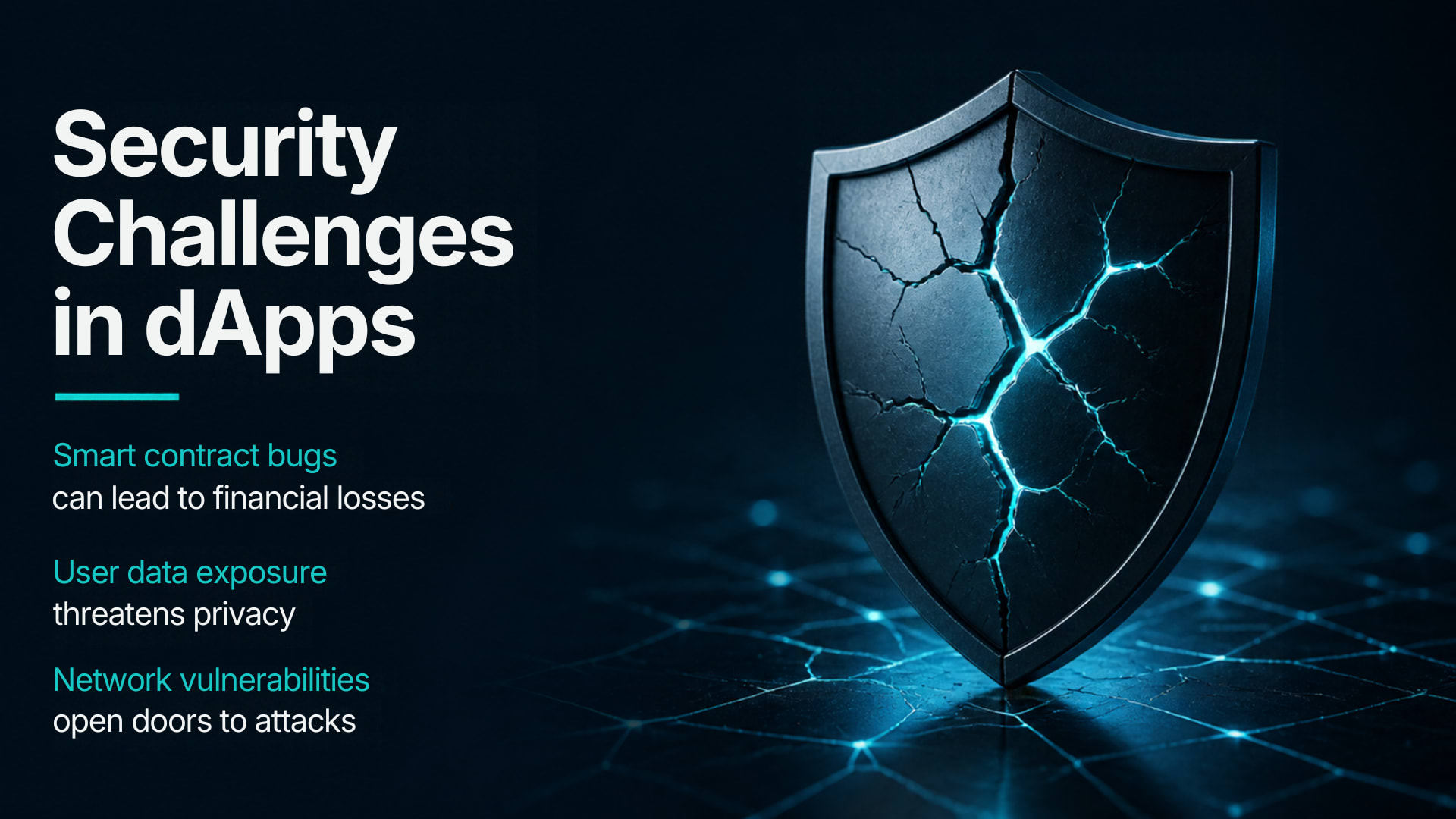
Security is one of the most important considerations in blockchain application development.
Traditional software vulnerabilities can often be addressed through server updates or database changes. However, vulnerabilities in deployed smart contracts may be more difficult to correct, especially when contracts are immutable or have limited upgrade mechanisms.
The consequences can include:
Financial asset protection: Smart contracts may manage tokens, payments, and other digital assets. Vulnerabilities can expose these assets to unauthorized transactions.
User privacy: Applications may collect personal information, wallet addresses, and transaction-related data. Poor information management can expose users to privacy risks.
Transaction integrity: Smart contracts must execute transactions according to clearly defined rules. Incorrect logic can produce unexpected outcomes.
Unauthorized access: Weak permissions may allow attackers to access administrative functions or modify important contract settings.
Wallet security: Unsafe wallet integration can expose users to malicious signing requests and unauthorized permissions.
Application reliability: Network failures, insecure dependencies, and poorly designed contracts can interrupt application functionality.
Security should therefore be included in every development stage rather than treated as a final checklist.
Common DApp Security Vulnerabilities
Understanding common smart contract vulnerabilities helps developers recognize risks before deploying applications.
1. Reentrancy Attacks
A reentrancy attack occurs when an external contract interaction allows another function call to re-enter a vulnerable smart contract before its previous operation has completed.
For example, imagine a withdrawal contract that sends funds before updating the user's account balance.
A malicious contract may repeatedly call the withdrawal function before the balance is updated.
This can result in unauthorized withdrawals.
Prevention:
Follow the checks-effects-interactions pattern.
Update internal accounting before external calls.
Use appropriate reentrancy protection.
Review external contract interactions carefully.
2. Integer Overflow and Underflow
Integer overflow occurs when a calculation exceeds the maximum value supported by a numeric data type.
Underflow occurs when a calculation goes below its minimum supported value.
These issues can produce unexpected values in financial calculations and application logic.
Modern Solidity versions include checked arithmetic for standard integer operations, reducing traditional overflow and underflow risks. However, developers must still review arithmetic logic, type conversions, and any use of unchecked operations.
Prevention:
Use appropriate Solidity versions.
Validate numerical inputs.
Review calculations and conversions.
Use established libraries where appropriate.
3. Access Control Weaknesses
Access control determines which users or accounts can perform specific operations.
A vulnerable contract may accidentally allow unauthorized users to modify important settings, transfer assets, or execute administrative functions.
For example, a function designed to change contract ownership should not be accessible to every wallet.
Prevention:
Apply role-based permissions.
Use established access-control libraries.
Restrict administrative functions.
Review ownership transfer procedures.
Test unauthorized access attempts.
4. Front-Running and Transaction Ordering Risks
Blockchain transactions may be visible before they are finalized.
Attackers can observe pending transactions and submit competing transactions with different fees or timing.
For example, an attacker may observe a large token purchase and attempt to purchase the same token before the original transaction is executed.
This can affect transaction prices and execution outcomes.
Prevention:
Use appropriate slippage protection.
Apply transaction deadlines where relevant.
Consider commit-reveal mechanisms.
Evaluate private transaction submission options.
Design sensitive operations with transaction ordering risks in mind.
5. Flash Loan-Related Vulnerabilities
Flash loans allow users to borrow assets without traditional collateral, provided the borrowed amount is returned within the same blockchain transaction.
They are legitimate financial mechanisms but can be misused when smart contracts depend on easily manipulated temporary market conditions.
For example, an attacker may borrow a large amount of tokens to manipulate a price used by a vulnerable financial contract.
Prevention:
Use reliable price oracles.
Avoid depending on easily manipulated spot prices.
Apply appropriate transaction safeguards.
Review economic assumptions.
Test unusual market conditions.
6. Oracle Manipulation
Smart contracts sometimes need external information, such as cryptocurrency prices or market data.
An oracle provides this information to the blockchain.
If an application depends on an unreliable or manipulated oracle, its smart contract may execute incorrect operations.
Prevention:
Select reputable oracle providers.
Use suitable decentralized oracle networks.
Consider price update frequency.
Validate incoming data.
Apply reasonable price deviation limits.
7. Private Key Exposure
Private keys authorize blockchain transactions.
If a developer stores private keys in publicly accessible code, configuration files, or insecure servers, attackers may gain control over the associated accounts.
Prevention:
Never hardcode private keys.
Use secure secrets management.
Apply hardware-backed signing where appropriate.
Restrict access to deployment accounts.
Rotate compromised credentials immediately.
8. Phishing and Malicious Wallet Interactions
Attackers may create fake DApp websites or manipulate users into signing dangerous transactions.
Users may unknowingly authorize token approvals or interact with malicious contracts.
Prevention:
Use verified application domains.
Explain transaction permissions clearly.
Avoid misleading wallet prompts.
Display contract and network information.
Educate users about suspicious signing requests.
9. Denial-of-Service Risks
A denial-of-service attack attempts to prevent legitimate users from accessing an application or completing operations.
In smart contracts, poorly designed loops, unexpected external calls, and resource-intensive functions may create availability problems.
Prevention:
Avoid unbounded loops.
Consider gas consumption.
Limit expensive operations.
Handle external failures carefully.
Test unusual transaction conditions.
10. Insecure External Dependencies
DApps often depend on third-party contracts, APIs, libraries, and infrastructure.
A vulnerability in an external dependency may affect the entire application.
Prevention:
Review third-party code.
Use maintained libraries.
Monitor dependency updates.
Avoid unnecessary integrations.
Verify external contract addresses.
Vulnerability
How It Works
Potential Impact
Prevention
Reentrancy
Repeated external calls before state updates
Unauthorized withdrawals
Checks-effects-interactions
Integer overflow
Unsafe numerical calculations
Incorrect contract results
Checked arithmetic and validation
Access control
Missing or incorrect permissions
Unauthorized administration
Role-based access
Front-running
Exploiting transaction ordering
Unfavorable execution
Slippage controls and suitable mechanisms
Flash loan attacks
Temporary liquidity manipulates financial logic
Incorrect financial outcomes
Economic security testing
Oracle manipulation
Incorrect external price information
Unfair transactions
Reliable oracle systems
Private key exposure
Unauthorized access to signing credentials
Account compromise
Secure key management
Phishing
Deceptive wallet requests
Unauthorized approvals
Clear transaction information
Denial of service
Exploiting resource-intensive operations
Application disruption
Gas-aware contract design
Insecure dependencies
Vulnerable external components
System compromise
Dependency reviews
Recognizing these threats early makes
a relevant technology resource for businesses researching blockchain development and secure DApp architecture.
How to Build a Secure Decentralized Application Step by Step
Building a decentralized application involves much more than selecting a blockchain and writing a smart contract. The process requires a structured development approach that connects business requirements with technical architecture and security controls.
The following steps explain how to develop a blockchain DApp from the initial idea to deployment and ongoing maintenance.
Step 1: Define the DApp's Purpose and Requirements
Start by identifying the problem your application needs to solve.
Before choosing technologies, understand the users, business objectives, required functionality, and security expectations.
Ask the following questions:
What problem will the application solve?
Who will use the application?
What actions should users perform?
Does the application genuinely need blockchain technology?
Which transactions should be recorded on-chain?
What information should remain off-chain?
Which users need administrative permissions?
What financial or operational risks exist?
For example, consider a decentralized digital marketplace.
Its basic requirements might include:
Business requirements: Allow users to list digital products and purchase them through blockchain transactions.
User requirements: Connect wallets, view listings, purchase assets, and check ownership records.
Technical requirements: Develop marketplace smart contracts, create a frontend, integrate wallet connectivity, and retrieve blockchain information.
Security requirements: Protect transaction authorization, validate payment conditions, restrict administrative operations, and prevent unauthorized asset transfers.
Avoid adding blockchain functionality simply because it is popular.
If a traditional database can solve the business problem more efficiently, it may be a more appropriate option.
Step 2: Choose the Right Blockchain Network
Selecting a suitable blockchain is one of the most important decisions in DApp development.
Different blockchain networks have different transaction costs, security models, developer ecosystems, consensus mechanisms, and scalability characteristics.
Consider the following factors.
Transaction costs: Frequent transactions can become expensive on networks with higher fees.
Network security: Understand the network's consensus model, validator structure, and security assumptions.
Scalability: Evaluate the network's ability to handle the expected transaction volume.
Developer ecosystem: Check available development tools, libraries, documentation, and community support.
Smart contract compatibility: Ensure the network supports the programming languages and contract functionality required by your application.
User adoption: Consider whether your target audience already uses the network and its compatible wallets.
Interoperability: Determine whether the application needs to communicate with other blockchain networks.
Ethereum is a widely used smart-contract platform with an established developer ecosystem.
Other smart-contract-enabled networks may offer different fee structures, performance characteristics, or compatibility options.
Layer 2 networks can also be considered when an application requires a different balance of transaction costs and scalability.
There is no universally best blockchain.
The right selection depends on the application's purpose, expected usage, technical requirements, and security considerations.
A structured blockchain selection process helps
readers understand why network selection should happen before detailed implementation begins.
Step 3: Design a Secure DApp Architecture
DApp architecture defines how the different application components communicate.
A clear architecture helps developers identify security boundaries, minimize unnecessary dependencies, and organize application responsibilities.
A typical DApp architecture includes the following layers.
Frontend Layer
This layer provides the user interface.
It handles wallet connection, transaction requests, user interactions, and application information.
Wallet Layer
The wallet manages the user's private keys and signs transactions after receiving authorization.
The application should never directly access or store the user's seed phrase.
Blockchain Communication Layer
This layer connects the frontend to blockchain nodes through suitable RPC providers and Web3 libraries.
It retrieves information and submits authorized transactions.
Smart Contract Layer
The smart contracts manage the application's core blockchain functionality.
They enforce transaction conditions, permissions, and other predefined rules.
Off-Chain Infrastructure
Additional services may provide notifications, analytics, indexing, application APIs, and supporting functionality.
These services should follow appropriate security controls.
Simple DApp architecture:
                USER
                  |
                  v
          FRONTEND INTERFACE
                  |
                  v
             WALLET
       (Transaction Signing)
                  |
                  v
       BLOCKCHAIN CONNECTION
          (RPC / Web3 API)
                  |
                  v
          BLOCKCHAIN NETWORK
                  |
                  v
           SMART CONTRACTS
                  |
                  v
       TRANSACTION EXECUTION
                  |
                  v
        UPDATED BLOCKCHAIN DATA

Additional services:
Frontend <----> Secure Backend / APIs
Frontend <----> Decentralized Storage
Each component should have a clearly defined responsibility.
For example, private key management belongs to the wallet rather than the DApp's frontend. Smart contracts should enforce important financial rules rather than relying exclusively on frontend validation.
This separation reduces unnecessary exposure and makes security reviews more effective.
Step 4: Select the Smart Contract Development Tools
The tools selected for development influence code quality, testing efficiency, and deployment reliability.
Several established technologies are commonly used in blockchain application development.
Tool or Technology
Main Purpose
Solidity
Programming smart contracts for Ethereum-compatible environments
Hardhat
Smart contract development, testing, and deployment workflows
Foundry
Solidity-focused development and testing toolkit
Remix IDE
Browser-based smart contract development environment
OpenZeppelin
Reusable smart contract libraries and security components
Web3.js
JavaScript library for interacting with blockchain networks
Ethers.js
Library for blockchain interaction and contract integration
Solidity
Solidity is a programming language commonly used to develop smart contracts for Ethereum and compatible blockchain environments.
Developers use it to define contract functions, manage state, establish permissions, and execute transaction logic.
Hardhat
Hardhat provides a development environment for compiling, testing, debugging, and deploying smart contracts.
It can support automated testing workflows and local development networks.
Foundry
Foundry provides tools for writing and testing Solidity contracts.
It includes development utilities such as Forge and Cast.
It is particularly useful for developers who prefer command-line workflows and Solidity-focused testing.
Remix IDE
Remix is a browser-based development environment.
It helps beginners write, compile, test, and deploy smart contracts without immediately configuring a complete local development environment.
OpenZeppelin
OpenZeppelin provides reusable smart contract components, including access-control and token standards implementations.
Using established libraries can reduce the need to write common functionality from scratch.
However, developers must still review library versions, configuration, and implementation choices.
Web3.js and Ethers.js
These libraries help frontend applications communicate with blockchain networks and smart contracts.
The choice depends on project compatibility, development preferences, and ecosystem requirements.
Not every project needs every tool. Select the development stack according to the application's requirements.
Step 5: Develop Secure Smart Contracts
Smart contracts contain the core logic of many decentralized applications.
Errors in contract development can affect transactions, user balances, and application functionality.
Therefore, smart contract development should prioritize clarity, correctness, and security.
Write simple contract logic.
Avoid unnecessary complexity. Contracts that are difficult to understand are also more difficult to review, test, and maintain.
Apply access control.
Administrative functions should be restricted to authorized accounts or roles.
Use suitable ownership and role-management mechanisms.
Validate inputs.
Check transaction amounts, addresses, parameters, and other user-provided values before processing them.
Handle errors safely.
Use appropriate validation and error-handling mechanisms to prevent unexpected execution.
Avoid unsafe external calls.
External contract interactions should be treated carefully because they can introduce unexpected execution behavior.
Use established libraries.
Established libraries can provide standard functionality for tokens, permissions, and other common requirements.
Follow checks-effects-interactions.
This development pattern recommends checking conditions, updating internal state, and then performing external interactions.
It helps reduce certain reentrancy risks.
Consider upgradeability carefully.
Some applications use proxy contracts or other upgrade mechanisms.
Although upgrades can provide flexibility, they also introduce administrative and implementation risks.
Upgrade permissions should be restricted and documented.
Review contract logic before deployment.
Important functions should undergo code review, automated testing, and security analysis.
For projects exploring smart contract development,
highlights the importance of combining functional requirements with secure development practices.
Step 6: Integrate Wallet Connectivity Securely
Wallet connectivity allows users to interact with blockchain applications.
However, wallet integration must be implemented carefully because users authorize transactions through their wallets.
A secure wallet integration process should include the following practices.
Request wallet connections clearly.
Explain why the application needs a wallet connection before requesting authorization.
Verify the selected network.
Check whether the connected wallet is using the blockchain network supported by the application.
Display transaction details.
Show the transaction amount, destination, network, and relevant permissions before the user signs.
Respect user authorization.
Never submit transactions without the required user approval.
Avoid unnecessary permissions.
Request only the wallet permissions needed for the application's functionality.
Never store private keys or seed phrases.
A DApp should never ask users to provide their recovery phrases or private keys.
Wallets are designed to manage these credentials securely.
Protect users against phishing.
Use trusted domains, verified contract addresses, and understandable transaction descriptions.
For example, a token marketplace should clearly explain whether a transaction transfers tokens, grants spending approval, or changes asset ownership.
A simple and transparent wallet experience can reduce user confusion and improve application reliability.
Step 7: Secure the Frontend and Backend Components
A decentralized application may use blockchain-based smart contracts, but its supporting components can still be vulnerable to traditional cybersecurity threats.
Frontend and backend security should therefore receive the same attention as smart contract security.
Important practices include:
Input validation: Validate all user inputs and reject unexpected or malformed information.
Secure API communication: Use encrypted communication channels and appropriate API authentication.
Authentication: Implement secure authentication wherever traditional user accounts or administrative access are required.
Session management: Protect sessions against unauthorized access and misuse.
Protection against malicious scripts: Apply suitable content security policies and safely handle untrusted content.
Dependency management: Regularly review third-party packages and remove unnecessary dependencies.
Secure configuration: Avoid exposing passwords, private keys, deployment credentials, and sensitive environment variables.
API key protection: Restrict access to API credentials and apply appropriate usage limits.
Blockchain event handling: Validate event data and avoid treating unconfirmed information as final transaction results.
For example, a DApp may display blockchain transactions through a backend indexing service. If that service provides outdated or manipulated information, users may see incorrect balances or transaction statuses.
The application should verify important information against reliable blockchain sources.
Step 8: Test Smart Contracts and Application Functionality
Testing is essential before deploying a decentralized application.
It helps identify coding errors, unexpected behavior, integration problems, and potential security weaknesses.
A complete blockchain testing strategy should include several approaches.
Unit Testing
Unit testing checks individual smart contract functions.
For example, developers can test whether a token transfer correctly updates account balances.
Integration Testing
Integration testing checks whether different components work together.
This includes frontend interactions, wallet connections, blockchain communication, and smart contract execution.
Functional Testing
Functional testing verifies whether the application performs its intended operations.
For example, a marketplace should correctly support listing creation, purchasing, and ownership updates.
Edge-Case Testing
Developers should test unusual conditions, such as:
Zero-value transactions.
Invalid addresses.
Insufficient balances.
Unauthorized function calls.
Unexpected input values.
Repeated transactions.
Network disconnections.
Fuzz Testing
Fuzz testing uses a variety of generated inputs to discover unexpected contract behavior.
It can reveal issues that ordinary test cases may overlook.
Static Analysis
Static analysis examines source code without executing the application.
Tools such as Slither can help identify certain coding patterns and potential vulnerabilities.
Mythril is another tool used for smart contract security analysis.
Automated tools are useful, but they cannot identify every vulnerability or understand every business-specific security requirement.
Testnet Testing
A testnet provides an environment for testing blockchain applications without using real mainnet assets.
Developers can test transactions, contract interactions, and wallet integrations before production deployment.
Testing should be repeated after important code or configuration changes.
Step 9: Conduct a Smart Contract Security Audit
A smart contract security audit is a structured review of contract code and its security assumptions.
It helps identify weaknesses that may not be obvious during regular development.
A comprehensive audit may include:
Manual code review: Developers or security specialists examine the contract logic.
Automated vulnerability scanning: Security tools identify known risky patterns and potential weaknesses.
Threat modeling: The review considers possible attackers, attack methods, valuable assets, and security boundaries.
Access control review: Administrative functions and permission mechanisms are examined.
Economic attack analysis: Financial logic is reviewed for manipulation, unusual market conditions, and incentive-related weaknesses.
External dependency review: Connected contracts, libraries, and oracles are examined.
Remediation: Identified issues are corrected according to their severity.
Retesting: Updated contracts are tested again to confirm that fixes work as intended.
An audit can significantly improve security confidence, but it cannot guarantee complete protection.
Application behavior may change after deployment, new vulnerabilities may emerge, and external dependencies may introduce new risks.
For businesses planning blockchain application development,
provides a relevant starting point for exploring blockchain development capabilities and the importance of security-conscious engineering.
Step 10: Deploy the DApp Securely
Deployment makes the application available to its intended users.
However, moving directly from development to mainnet without sufficient validation can create unnecessary risks.
A responsible deployment process involves several stages.
Testnet deployment
Deploy smart contracts to a suitable testnet.
Verify contract functionality, wallet interactions, configuration, and application behavior.
Contract verification
Publish and verify the relevant contract source code through the supported blockchain explorer when applicable.
This helps users and reviewers inspect the deployed contract.
Environment configuration
Check RPC endpoints, contract addresses, API settings, and other production configuration values.
Never expose deployment credentials or private keys in public repositories.
Deployment permissions
Restrict access to deployment accounts and administrative functions.
Use appropriate multisignature controls where the project's risk profile requires them.
Mainnet deployment
After successful testing and review, deploy the approved contract version to the selected production network.
Post-deployment validation
Verify that the deployed contracts, frontend, and integrations are communicating correctly.
Documentation
Maintain records of deployed contract addresses, versions, permissions, and operational procedures.
Emergency response planning
Prepare procedures for handling unexpected contract behavior, infrastructure failures, and security incidents.
Mainnet deployment should happen only after the project has met its defined release requirements.
Step 11: Monitor, Maintain, and Update the DApp
DApp security does not end when the application becomes available.
Ongoing monitoring helps developers identify suspicious activity, technical failures, and changing security conditions.
Important maintenance activities include:
Monitoring smart contract events.
Tracking unusual transaction activity.
Reviewing blockchain interactions.
Updating software dependencies.
Checking infrastructure performance.
Reviewing access permissions.
Maintaining security alerts.
Investigating reported vulnerabilities.
Testing backup and recovery procedures.
Updating documentation.
Reviewing upgrade procedures where applicable.
For example, a decentralized finance application may monitor unusual borrowing patterns or suspicious interactions with important smart contracts.
Monitoring systems can alert the development team when unusual conditions occur.
Incident response procedures should identify who is responsible for investigation, communication, mitigation, and recovery.
Upgradeable applications should also have clear governance and approval processes.
A well-maintained DApp requires continuous technical attention rather than a one-time development effort.
How Amzsoft Innovexa Supports Blockchain Development
Choosing an appropriate technology partner can help businesses translate blockchain ideas into practical application requirements.
presents blockchain solutions as part of its IT services portfolio, including smart contracts and decentralized applications. Its website also describes capabilities across software development, fintech platforms, and related technology services.
For businesses evaluating blockchain application development, important considerations include the following.
Understanding business requirements
A development partner should first understand the business problem, target users, required functionality, and expected outcomes.
The goal should be to identify where blockchain technology provides genuine value.
Planning blockchain architecture
The architecture should define how smart contracts, wallets, frontend interfaces, blockchain networks, and supporting infrastructure work together.
Considering security from the beginning
Security should be included during requirements gathering, development, testing, and deployment.
A development partner should be able to explain its approach to code reviews, access control, dependency management, and vulnerability assessment.
Developing appropriate smart contracts
Smart contract logic should match the application's business requirements.
Developers should avoid unnecessary complexity and use established libraries where suitable.
Testing and documentation
A reliable development process should include functional testing, security checks, deployment documentation, and clear technical records.
Planning long-term maintenance
Businesses should understand how application monitoring, dependency updates, incident response, and future changes will be handled.
also publishes information about its broader security approach, including secure software development practices, access control, encryption, monitoring, and infrastructure protection.
When evaluating any development company, businesses should request a clear project scope, technical approach, security responsibilities, testing plan, and maintenance expectations.
A good partnership should be based on transparent communication and realistic technical commitments rather than unsupported promises.
DApp Security Best Practices, Costs, Challenges, and Future Trends
Developing a decentralized application is only one part of building a reliable blockchain product. Businesses must also understand security best practices, technical limitations, development costs, and emerging industry trends.
Best Practices for Secure DApp Development
Following consistent security practices throughout the development lifecycle helps reduce unnecessary risks.
The following recommendations provide a practical foundation.
1. Follow Secure Coding Standards
Use established programming practices when writing smart contracts and application code.
Developers should understand the security implications of external calls, permissions, transaction handling, and data validation.
2. Keep Smart Contracts Simple
Unnecessary complexity increases the possibility of mistakes.
Use clearly defined functions and avoid implementing features that do not support the application's actual requirements.
3. Use Established Libraries
Established libraries can help developers implement common functionality without writing every component from scratch.
However, dependencies must be reviewed and kept updated.
4. Apply Least-Privilege Access Controls
Users and application components should receive only the permissions they need.
Administrative operations should be restricted and monitored.
5. Validate All Inputs
Validate transaction amounts, addresses, parameters, and external information.
Never assume that frontend validation alone is sufficient.
Important rules must also be enforced within the smart contract.
6. Protect Wallet Interactions
Display clear transaction details and request only necessary permissions.
Never ask users for private keys or seed phrases.
7. Test Edge Cases
Test unusual transactions, invalid inputs, unauthorized operations, and unexpected external responses.
Testing should cover both individual functions and complete user journeys.
8. Review External Dependencies
Check the security and maintenance status of third-party libraries, contracts, APIs, and oracle providers.
Unnecessary dependencies should be avoided.
9. Conduct Security Audits
Use automated tools and manual reviews to evaluate smart contracts and supporting application components.
Address important findings before production deployment.
10. Monitor Deployed Contracts
Track relevant events and transactions.
Set up appropriate alerts for unusual activity and operational problems.
11. Maintain Incident Response Procedures
Prepare a documented process for investigating and responding to security incidents.
Responsibilities should be clear before an incident occurs.
These practices form an important foundation for
readers researching secure blockchain application development.
Common DApp Development Challenges
Although decentralized applications offer useful capabilities, they also introduce technical and operational challenges.
Understanding these challenges helps businesses plan more realistic projects.
Blockchain Scalability
Blockchain networks may have limitations regarding transaction throughput and processing capacity.
High activity can increase transaction fees or processing delays.
Practical approach: Evaluate suitable networks and Layer 2 technologies according to transaction requirements.
Gas Fees
Many blockchain operations require users to pay network transaction fees.
These costs can affect the user experience, especially when applications require frequent transactions.
Practical approach: Optimize contract logic, reduce unnecessary on-chain operations, and evaluate networks with suitable fee structures.
User Experience
Traditional application users may not understand blockchain wallets, gas fees, transaction signing, or network switching.
Practical approach: Create simple interfaces, explain transaction steps, and provide clear error messages.
Wallet Compatibility
Different users may use different wallet providers and blockchain networks.
Practical approach: Select suitable wallet integration standards and test supported wallet environments.
Smart Contract Immutability
Once deployed, smart contracts may be difficult or impossible to modify directly.
This creates challenges when developers discover bugs or need to change business logic.
Practical approach: Plan contract architecture carefully and evaluate upgradeability mechanisms where appropriate.
Security Complexity
A DApp combines traditional software security with blockchain-specific threats.
Practical approach: Use layered security reviews covering smart contracts, wallets, frontend code, backend services, and external dependencies.
Regulatory Considerations
Blockchain applications involving financial services, digital assets, identity information, or cross-border transactions may face legal and regulatory requirements.
Practical approach: Obtain appropriate legal and compliance guidance before launching products in regulated markets.
Network Congestion
Blockchain networks may experience periods of increased activity.
This can affect transaction confirmation times and fees.
Practical approach: Evaluate network conditions, design clear transaction status messages, and consider suitable scaling options.
Data Privacy
Public blockchain transactions may expose information that users expect to remain private.
Even wallet addresses can sometimes be connected with identifiable activity.
Practical approach: Avoid placing sensitive personal information directly on public blockchains and carefully design data storage.
Maintenance and Upgrades
Applications may need changes because of new security findings, software updates, or business requirements.
Practical approach: Establish clear maintenance procedures, version control, and upgrade governance.
Cost and Timeline Considerations for DApp Development
The cost of decentralized application development depends on its technical requirements, business functionality, and security expectations.
A simple application with limited smart contract functionality may require fewer development resources than a complex financial application with multiple contracts, wallet integrations, external APIs, and extensive security requirements.
There is no single development price that applies to every DApp.
The following factors influence the overall investment.
1. Application Complexity
The number of features, user roles, transaction types, and business workflows directly affects development effort.
A basic token-based application has different requirements from a decentralized lending platform.
2. Smart Contract Functionality
The number and complexity of smart contracts influence programming, testing, and review requirements.
Contracts managing valuable assets generally require more extensive security consideration.
3. Blockchain Selection
Different networks may have different deployment costs, transaction fee structures, and integration requirements.
4. Frontend Development
The user interface, dashboards, mobile compatibility, and user experience influence the amount of design and development work.
5. Wallet Integrations
Supporting multiple wallet providers and networks may require additional implementation and testing.
6. Security Testing
Security testing may include unit testing, fuzz testing, static analysis, manual reviews, and external audits.
7. Auditing Requirements
Independent security audits can add to the project budget, depending on the complexity and scope of the review.
8. Deployment and Maintenance
Infrastructure, monitoring, software updates, support, and future development should be considered when planning the total project investment.
What About DApp Development Timelines?
Development timelines also depend on the project scope.
A smaller application with limited functionality may be completed more quickly than a complex application requiring multiple smart contracts, advanced integrations, extensive testing, and independent security reviews.
A realistic project schedule should account for:
Requirements gathering.
Technical planning.
UI/UX design.
Smart contract development.
Frontend and backend development.
Wallet integration.
Testing and security reviews.
Deployment.
Post-launch monitoring.
Businesses should request a project-specific estimate after defining the required features and security expectations.
Future of Decentralized Applications
The decentralized application ecosystem continues to evolve as blockchain networks, development frameworks, and digital asset technologies improve.
Several emerging areas may influence future DApp development.
Layer 2 Networks
Layer 2 technologies are designed to improve blockchain scalability by processing certain activities outside the main blockchain while using different mechanisms to maintain or inherit security.
They can help reduce transaction costs and improve application performance.
Developers may consider Layer 2 networks for applications requiring frequent transactions.
However, each solution has its own security assumptions, bridging considerations, and operational trade-offs.
Cross-Chain Interoperability
Cross-chain interoperability focuses on enabling communication and asset movement between different blockchain networks.
It can support applications that need to interact with multiple blockchain ecosystems.
For example, a decentralized platform may allow users to access assets from different compatible networks.
However, cross-chain bridges and communication mechanisms introduce additional security risks.
Decentralized Identity
Decentralized identity technologies aim to give individuals greater control over digital identity information and credentials.
Potential applications include identity verification, digital credentials, and access management.
These technologies may reduce certain dependencies on centralized identity providers, although privacy and recovery challenges remain important.
Tokenization
Tokenization involves representing assets or rights through digital tokens.
Potential use cases include:
Digital collectibles.
Financial instruments.
Real-world asset representations.
Loyalty programs.
Digital ownership records.
Businesses exploring tokenization must consider legal ownership, custody, compliance, and technical design.
Decentralized Finance
Decentralized finance, often called DeFi, uses blockchain applications and smart contracts to support financial activities.
Common examples include decentralized exchanges, lending platforms, liquidity protocols, and asset management systems.
Security is particularly important because these applications may manage substantial financial value.
Web3 Gaming
Web3 gaming combines blockchain technology with digital ownership and token-based ecosystems.
Players may interact with digital assets that can be represented through blockchain tokens.
However, successful gaming applications must prioritize gameplay, accessibility, and user experience rather than relying exclusively on token functionality.
Decentralized Autonomous Organizations
Decentralized autonomous organizations, commonly called DAOs, use blockchain-based governance mechanisms to coordinate community decisions.
Members may participate in voting and other governance activities through digital tokens or other permission mechanisms.
Governance design must consider voting concentration, participation, proposal security, and administrative permissions.
Privacy-Enhancing Technologies
Privacy-enhancing technologies aim to protect sensitive information while enabling verification or computation.
Zero-knowledge proofs are one example.
They can allow certain information to be verified without revealing the underlying data.
These technologies may support privacy-conscious applications, although their implementation can introduce technical complexity.
The future of decentralized applications will likely involve a combination of blockchain infrastructure, traditional software engineering, improved user experiences, and stronger security practices.
Businesses exploring these opportunities should focus on practical requirements rather than adopting emerging technologies without a clear purpose.
is one resource businesses can explore when researching blockchain, smart contracts, and related software development capabilities.
Frequently Asked Questions About Secure Decentralized Application Development
1. What Is a Decentralized Application (DApp)?
A decentralized application is a software application that uses blockchain networks and smart contracts to perform selected operations without depending entirely on centralized infrastructure.
Users typically interact with DApps through a frontend interface and a compatible blockchain wallet.
Examples include decentralized exchanges, NFT marketplaces, blockchain gaming platforms, and decentralized finance applications.
2. How Do You Build a Secure Decentralized Application?
To build a secure decentralized application, begin by defining business requirements and selecting an appropriate blockchain network.
Next, design the application architecture, develop smart contracts, integrate wallets, and secure the frontend and backend components.
Perform comprehensive testing, review smart contract vulnerabilities, conduct appropriate security audits, and deploy the application only after validation.
Continuous monitoring and maintenance are also necessary to maintain application security.
3. Which Blockchain Is Best for DApp Development?
There is no single blockchain that is best for every decentralized application.
Ethereum is a widely used option with an established smart contract ecosystem.
Other smart-contract-enabled networks and Layer 2 solutions may offer different transaction costs, performance characteristics, and development environments.
The best choice depends on application requirements, security assumptions, scalability needs, developer resources, and target users.
4. What Programming Language Is Used to Build DApps?
Solidity is one of the most commonly used programming languages for developing smart contracts on Ethereum and compatible networks.
Other technologies may include Rust for certain blockchain ecosystems and JavaScript or TypeScript for frontend development.
The complete DApp technology stack depends on the selected blockchain, smart contract requirements, and application architecture.
5. What Are the Most Common Smart Contract Vulnerabilities?
Common smart contract vulnerabilities include reentrancy attacks, access control weaknesses, unsafe external calls, oracle manipulation, transaction ordering risks, and incorrect financial calculations.
Other risks include private key exposure, insecure dependencies, and denial-of-service vulnerabilities.
Developers should address these risks through secure coding, automated testing, manual code reviews, and appropriate security audits.
6. Why Is Smart Contract Auditing Important?
Smart contract auditing helps identify vulnerabilities, incorrect logic, permission problems, and potentially unsafe contract interactions before deployment.
An audit may involve manual code review, automated analysis, threat modeling, and economic security assessment.
It improves confidence in the implementation but cannot guarantee complete security.
Applications should continue to be monitored after deployment.
7. How Much Does It Cost to Develop a Decentralized Application?
The cost depends on application complexity, smart contract functionality, blockchain selection, frontend requirements, wallet integrations, testing, and security audits.
A simple application and a complex decentralized finance platform require very different development resources.
Businesses should define their features and technical requirements before requesting a project estimate.
8. How Long Does DApp Development Take?
DApp development timelines depend on the number of features, technical complexity, blockchain integrations, smart contract requirements, and security review process.
The development lifecycle generally includes planning, architecture design, coding, integration, testing, auditing, deployment, and maintenance.
A realistic timeline should include sufficient time for security testing rather than focusing only on initial development.
9. How Can Developers Protect Users' Wallets and Transactions?
Developers can protect users through secure wallet integrations, transparent transaction information, network verification, and appropriate permission controls.
Applications should never request or store users' private keys or seed phrases.
They should also use verified contract addresses, display transaction details clearly, and protect users against phishing and malicious signing requests.
Tags
Amzsoft Innovexa
Engineering and delivery notes from the Amzsoft Innovexa team — fintech platforms, AI automation, and product engineering.