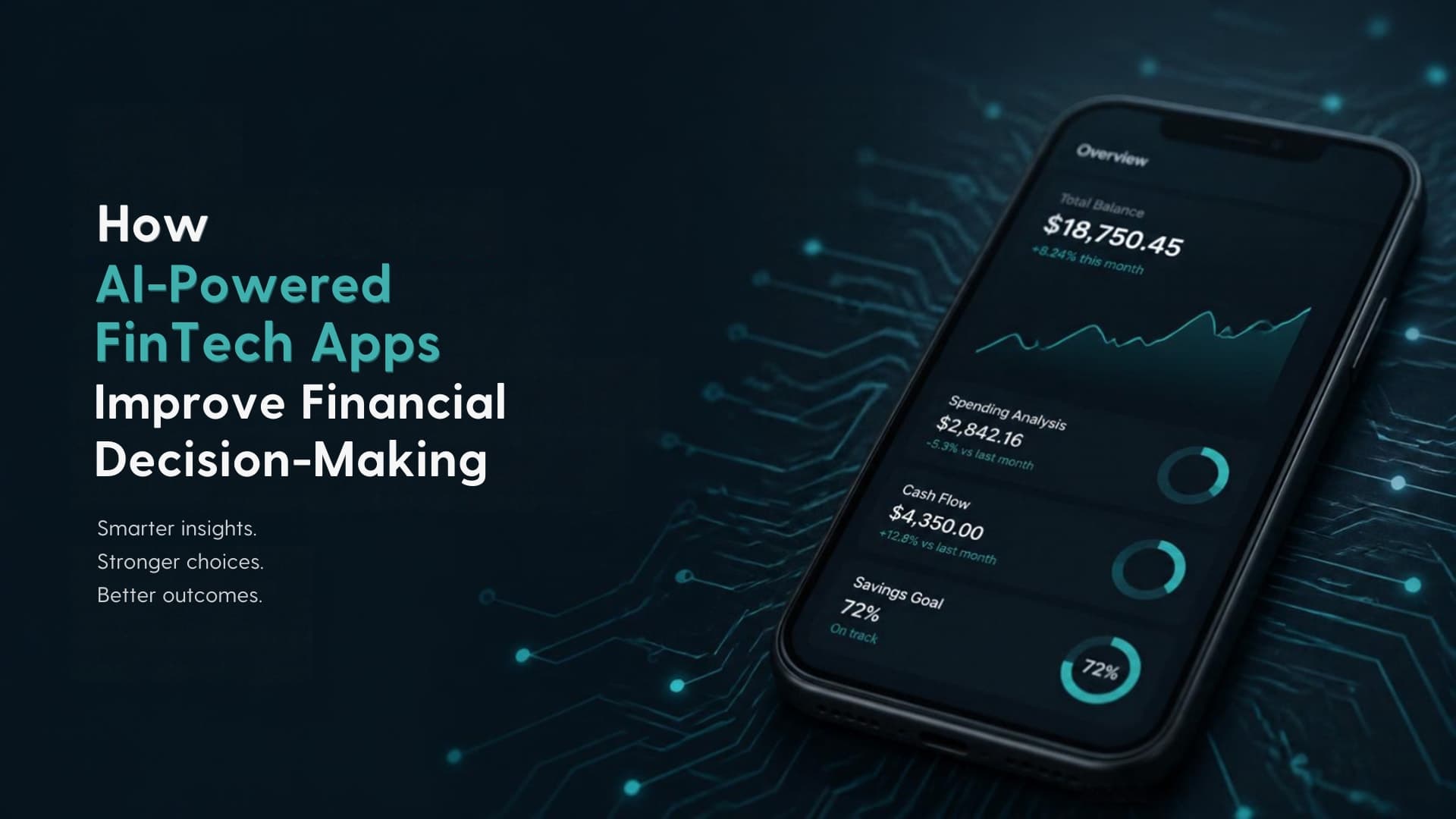
Financial decisions often depend on how quickly and accurately information can be understood. AI-Powered FinTech Apps Improve Financial Decision-Making by bringing artificial intelligence, machine learning, predictive analytics, and automated insights into financial workflows. Instead of relying only on spreadsheets, manual reviews, or historical reports, businesses and financial institutions can use intelligent applications to analyze large volumes of financial data and identify meaningful patterns.
AI-powered FinTech apps can support activities such as financial forecasting, fraud detection, credit assessment, customer behavior analysis, risk monitoring, and personalized financial recommendations. The technology does not eliminate the need for human judgment. Instead, it can help decision-makers access relevant information faster and evaluate complex situations with greater consistency.
This is particularly important for FinTech companies, banks, financial service providers, startups, investment platforms, lending businesses, and organizations managing large amounts of transactional data. In India, for example, financial applications may need to operate across high transaction volumes, digital payment ecosystems, identity verification processes, and evolving regulatory expectations.
This article explains how AI works inside FinTech applications, how it can improve financial decision-making, where businesses can apply it, what risks need to be considered, and how organizations can approach AI-powered FinTech app development responsibly.

How AI-Powered FinTech Apps Improve Financial Decision-Making
AI-Powered FinTech Apps Improve Financial Decision-Making by processing large amounts of structured and unstructured financial data, identifying patterns, generating predictions, detecting unusual behavior, and delivering automated insights. These capabilities help businesses and financial institutions make faster, more informed decisions while keeping human oversight involved in important financial and regulatory matters.
What Are AI-Powered FinTech Apps?
AI-powered FinTech apps are financial applications that use artificial intelligence to analyze information, recognize patterns, automate selected processes, and support financial decisions.
Traditional financial software generally follows predefined rules. For example, a system may approve a transaction when a particular condition is met or generate a report after collecting information from a database.
AI-enabled applications can go further.
They can evaluate relationships within large datasets, learn from historical examples, identify unusual patterns, classify information, estimate future outcomes, and provide recommendations based on available data.
Depending on the application, AI can be used for:
Fraud detection
Credit scoring
Financial forecasting
Risk assessment
Customer segmentation
Transaction monitoring
Investment analysis
Personalized recommendations
Document processing
Financial data analysis
Customer support
Compliance assistance
Automated financial insights
Cash-flow prediction
Anomaly detection
The exact implementation depends on the business model, available data, regulatory environment, and decision being supported.
AI is therefore not a single feature added to a FinTech application. It can become part of a broader technology architecture that connects data, analytics, workflows, and user experiences.
How Does AI Work Inside a FinTech Application?
AI in FinTech generally works through a combination of data collection, data preparation, algorithms, models, application logic, and monitoring.
A simplified process looks like this:
Financial data → Data processing → AI/ML model → Pattern recognition → Prediction or insight → Business action → Human review or automated workflow
A FinTech application may collect information from transactions, customer profiles, payment activity, account records, market information, financial documents, or connected systems.
The data then needs to be cleaned and organized before an AI model can use it effectively.
Machine learning models can identify relationships within historical data. Depending on the use case, the model may classify transactions, estimate risk, predict cash flow, identify suspicious activity, or recommend an appropriate action.
The result can then appear inside a dashboard, alert system, customer application, risk engine, or automated workflow.
The important point is that AI should support a defined business decision rather than simply being added because it is technically available.
AI Financial Data Analysis
Financial organizations generate significant amounts of data.
A business may have:
Transaction records
Customer information
Payment histories
Revenue data
Expense records
Loan information
Investment activity
Market data
Account behavior
Customer interactions
Financial documents
Reviewing all this information manually can become difficult as transaction volumes grow.
AI-powered financial data analysis can help organize information and identify relationships that may be difficult to detect through manual review.
For example, a financial application could compare transaction patterns over time and identify that certain types of expenses are increasing faster than revenue. A business dashboard could then highlight the change and provide an early warning to finance teams.
The value is not simply in producing more data.
The value comes from turning raw information into useful insights.
The Role of Machine Learning in FinTech
Machine learning is one of the most important technologies behind intelligent financial applications.
Instead of requiring every possible rule to be manually programmed, machine learning models can learn patterns from historical data.
For example, a lending application may use historical information to identify characteristics associated with different levels of repayment risk.
A fraud detection system can learn from previous transaction patterns and identify behavior that appears unusual.
A forecasting system can evaluate historical revenue, seasonal patterns, customer activity, and other relevant variables to estimate future outcomes.
Machine learning in FinTech can therefore support decisions that involve classification, prediction, ranking, or anomaly detection.
However, a machine learning model does not automatically become accurate simply because it has access to a large dataset. Data quality, model design, training methodology, monitoring, and appropriate validation remain important.
Predictive Analytics in Finance
Predictive analytics uses historical and current information to estimate what may happen in the future.
This can be useful because many financial decisions are forward-looking.
A business may want to understand:
Whether cash flow could tighten in the coming months
Which customers may become inactive
Which transactions may require additional review
Which applicants may represent higher risk
How demand may change
Whether certain expenses are likely to increase
Which products customers may be interested in
AI-powered predictive analytics can combine multiple variables to generate forecasts or risk scores.
For example, a cash-flow model could consider previous income, expenses, payment cycles, outstanding invoices, and seasonal behavior. Instead of waiting for a cash-flow problem to become visible in a monthly report, finance teams may receive an earlier indication that attention is needed.
Forecasts are not guarantees. They are estimates based on available information and assumptions.
That distinction is especially important in financial applications.
Automated Financial Insights
AI can also transform financial dashboards from passive reporting tools into decision-support systems.
A traditional dashboard may show:
Revenue
Expenses
Profit
Transactions
Customer counts
Outstanding payments
An intelligent dashboard can potentially explain changes in those numbers.
For example:
Revenue decreased during the period, while customer acquisition remained stable. The largest change came from lower average transaction value in a specific customer segment.
This type of automated financial insight can reduce the time required to manually search through multiple reports.
The application can prioritize information that deserves attention rather than presenting every metric with equal importance.
Real-Time Decision Support
Financial decisions are often time-sensitive.
A payment platform may need to evaluate a transaction before completing it. A fraud monitoring system may need to identify suspicious behavior quickly. A trading platform may need to process changing market information. A lender may need to assess an application while a customer is still engaged.
AI can support these scenarios by processing information as it becomes available.
Real-time decision support can involve:
Receiving new information.
Comparing it with historical patterns.
Running a model or rules engine.
Generating a score, prediction, or alert.
Triggering an appropriate workflow.
Escalating complex cases to a human reviewer.
The exact response depends on the financial application and its regulatory requirements.
For high-impact decisions, human review may remain necessary.
AI-Powered Credit Scoring and Risk Assessment
Credit decisions are another important area for AI in FinTech.
Traditional credit assessment may rely heavily on predefined criteria and historical credit information. AI-enabled systems can potentially analyze a broader set of permitted data points and identify relationships between variables.
A financial application may evaluate factors such as:
Repayment history
Existing obligations
Transaction behavior
Income patterns
Account activity
Application information
Relevant financial indicators
The purpose is not to remove judgment from lending decisions. Instead, AI can help lenders organize information and identify risk patterns more efficiently.
Financial risk assessment also extends beyond lending.
Insurance companies, investment platforms, payment providers, and financial institutions may use AI to monitor operational, transactional, market, or customer-related risks.
The design of these systems needs careful attention to fairness, explainability, privacy, and applicable financial regulations.
AI Fraud Detection
Fraud detection is one of the most practical applications of AI in financial technology.
Fraudsters may change behavior quickly. Fixed rules can remain useful, but they may not capture every emerging pattern.
AI can analyze transaction characteristics and identify behavior that differs from expected activity.
Potential signals may include:
Unusual transaction amounts
Unexpected transaction locations
Abnormal transaction frequency
Rapid changes in account behavior
Multiple accounts displaying related patterns
Unusual login activity
Suspicious payment sequences
A model can generate a risk score or alert for further investigation.
The Reserve Bank of India has highlighted the potential of AI and machine learning for financial-sector applications, including fraud prevention. Its work has included an AI/ML-based MuleHunter.AI initiative focused on detecting mule bank accounts.
This illustrates an important principle: AI can become particularly valuable when financial systems need to identify patterns across large numbers of transactions.
Customer Behavior Analysis
Financial decisions are not only about transactions. They are also about understanding customers.
AI-powered FinTech applications can analyze how customers interact with financial products.
For example, an application may identify:
Frequently used services
Changes in transaction behavior
Customer engagement levels
Product preferences
Payment patterns
Account activity
Potential churn signals
These insights can help financial organizations improve customer experiences.
A customer who regularly uses one service may be presented with relevant information about another suitable product. A customer whose engagement is declining may receive timely support.
Personalization should remain responsible. Financial applications should not use sensitive information in inappropriate ways or make unfair assumptions about individuals.
Personalized Financial Services
Personalization is another area where AI can improve digital financial experiences.
A generic financial application may present the same information to every customer.
An intelligent financial application can potentially adapt information according to customer behavior and relevant financial context.
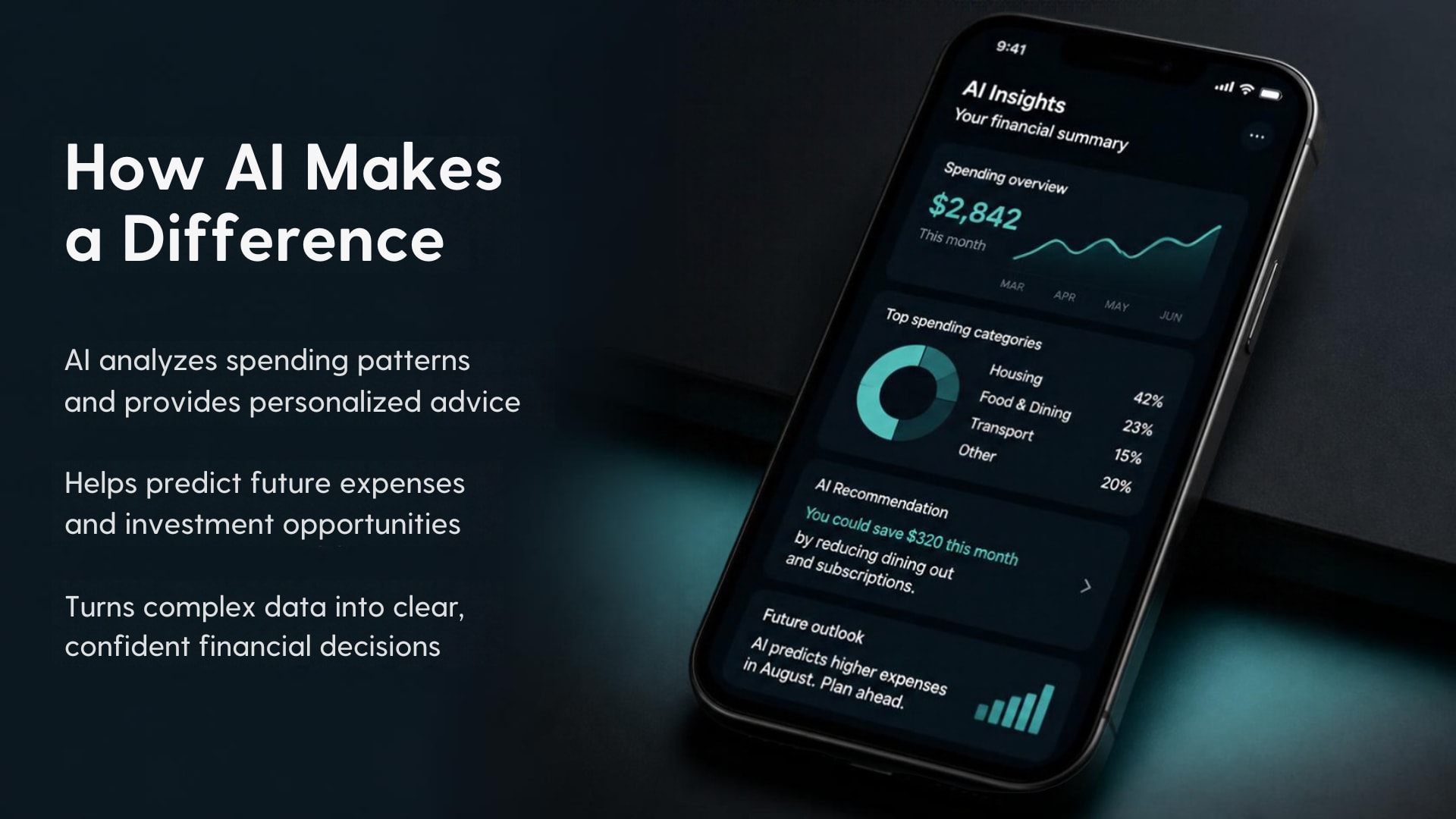
For example, a personal finance app may categorize spending and provide budgeting suggestions based on the user's historical activity.
An investment platform may organize educational information around the user's interests.
A banking application may identify recurring payments and help customers understand their monthly financial commitments.
The goal should be useful personalization rather than excessive automation.
Customers should understand why recommendations appear and should have appropriate control over their financial choices.
Automated Financial Operations
Financial decision-making also depends on the quality of financial operations.
If data is entered incorrectly, documents are processed slowly, or reconciliation is delayed, decision-makers may receive incomplete information.
AI-powered automation can assist with tasks such as:
Document classification
Invoice processing
Data extraction
Reconciliation support
Transaction categorization
Report preparation
Exception identification
Workflow routing
This can help finance teams spend less time on repetitive administrative tasks and more time reviewing exceptions and making strategic decisions.
Automation does not mean that every financial task should be fully autonomous.
A better approach is often to automate predictable activities while routing unusual or high-risk cases to people.
Benefits for Businesses
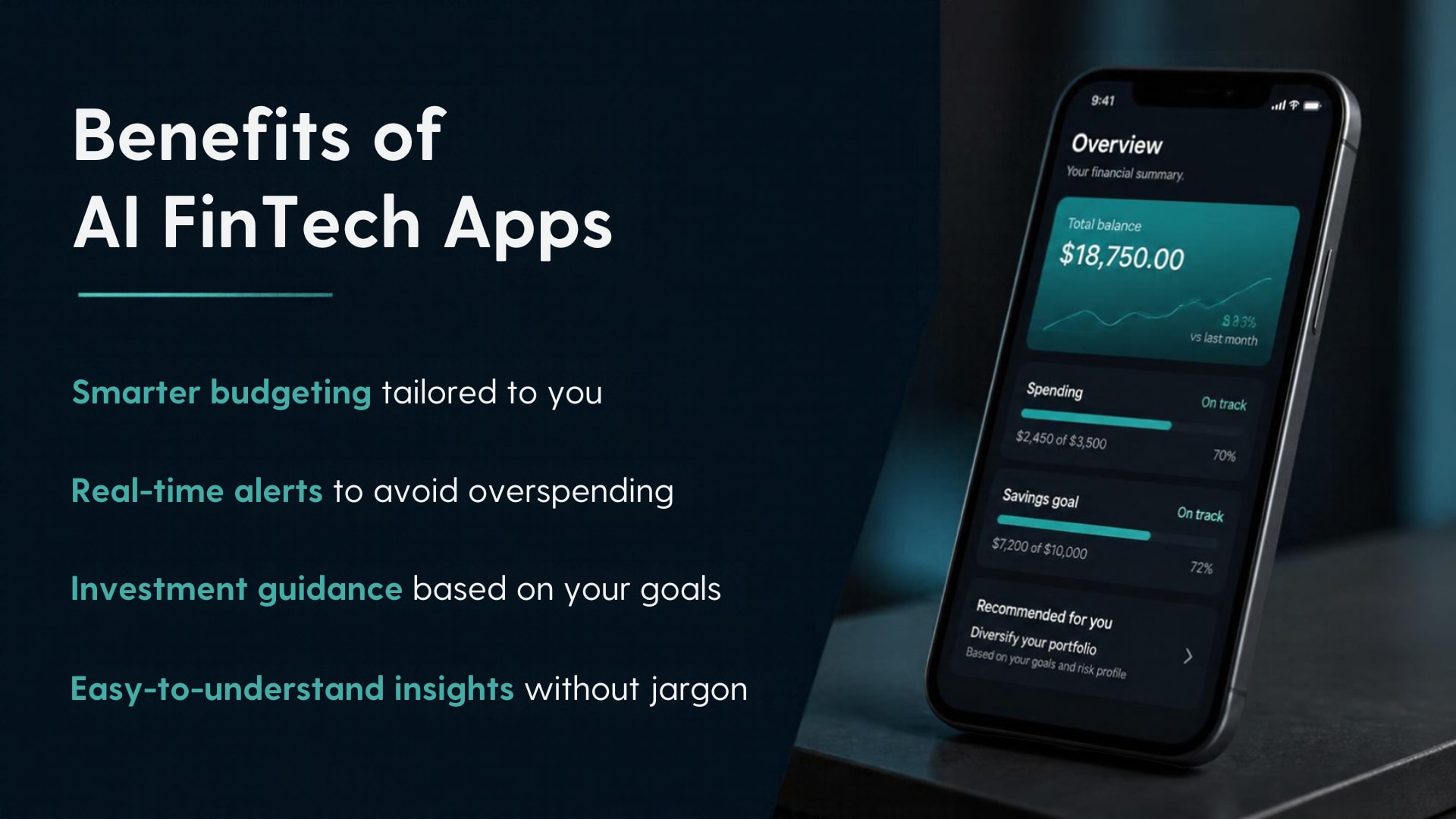
Businesses can benefit from AI-powered financial applications in several ways.
Faster access to insights: Financial information can be processed and summarized more quickly.
Better visibility: AI can identify relationships across multiple datasets.
Improved forecasting: Predictive models can help finance teams prepare for possible future scenarios.
Reduced manual workload: Repetitive data-processing tasks can be automated.
Earlier risk detection: Unusual patterns can trigger alerts before they become larger problems.
More personalized customer experiences: Customer behavior can inform relevant recommendations.
Scalable operations: Automated systems can process growing transaction volumes without requiring every task to be performed manually.
These benefits are especially relevant to businesses that have large datasets but limited financial-analysis resources.
Benefits for Financial Institutions
Banks, lenders, insurers, investment platforms, and other financial organizations can use AI to support several operational areas.
AI can help financial institutions:
Monitor transactions
Identify potential fraud
Analyze customer behavior
Support credit assessment
Improve service personalization
Automate document workflows
Detect anomalies
Generate financial insights
Support risk teams
Improve internal decision workflows
The benefits need to be balanced with governance requirements.
Financial institutions operate in environments where incorrect decisions can have significant consequences. AI systems therefore require stronger controls than many ordinary consumer applications.
Benefits for Customers
Customers can also experience direct improvements.
AI-powered financial services can make financial information easier to understand and more accessible.
Examples include:
Automated spending categorization
Personalized budgeting support
Faster transaction monitoring
Intelligent alerts
Easier financial planning
Faster customer support
More relevant product information
Suspicious transaction notifications
The best applications do not simply add more technology. They reduce complexity for customers.
Practical Applications, Challenges, and Implementation of AI in FinTech
AI in FinTech becomes most valuable when it is connected to a specific financial problem, reliable data, measurable business goals, and appropriate governance. Businesses should identify the decision they want to improve, determine what data is available, select suitable AI capabilities, integrate them securely, and continuously monitor performance.
Practical FinTech Use Cases
AI can support a wide range of financial technology products.
FinTech AreaPotential AI ApplicationDecision SupportedLendingRisk scoring and document analysisCredit decisionsPaymentsTransaction monitoringFraud and payment riskBankingCustomer behavior analysisService personalizationInvestmentPattern analysis and forecastingPortfolio decisionsInsuranceRisk and claims analysisUnderwriting and claims reviewPersonal financeSpending analysisBudgeting and financial planningWealth managementCustomer profilingAdvisory supportFinance operationsData extraction and reconciliationOperational decisions
The right use case depends on the organization's data, customers, regulatory obligations, and business model.
AI in Digital Lending
Digital lending platforms can use AI to assist with parts of the lending lifecycle.
A typical workflow may include:
Customer application
Data collection
Document processing
Identity verification
Risk analysis
Credit assessment
Decision support
Loan servicing
Repayment monitoring
AI can potentially assist at several stages.
For example, document-processing models can extract information from financial documents. Risk models can analyze permitted variables. Monitoring systems can identify unusual repayment behavior.
However, lending decisions have direct financial consequences for customers. Models should therefore be tested for accuracy, fairness, explainability, and unintended bias.
AI in Payments
Payment applications operate in environments where speed and security matter.
AI can help analyze transactions and identify suspicious behavior.
A payment platform may assign different risk levels to transactions based on contextual information.
A low-risk transaction may continue normally, while an unusual transaction may trigger additional verification.
This approach can help reduce unnecessary friction while directing attention toward transactions that deserve closer review.
The system must be carefully designed because an overly aggressive fraud model can also create problems by incorrectly blocking legitimate customers.
AI in Investment and Wealth Platforms
Investment applications can use AI for data analysis, portfolio monitoring, market research assistance, customer segmentation, and scenario analysis.
AI can process large amounts of information and highlight patterns that may deserve human attention.
For example, a wealth platform may provide portfolio summaries and risk indicators rather than requiring customers to manually review multiple data sources.
However, AI-generated recommendations should not automatically be treated as financial truth.
Markets are influenced by economic events, geopolitical developments, investor behavior, policy changes, and unexpected events. Predictive models can fail when conditions change.
The IMF has noted that AI may improve risk management and market efficiency while also introducing concerns around opacity, cyber risks, market manipulation, and greater speed during periods of stress.
AI-Powered Financial Forecasting
Financial forecasting is particularly suitable for AI because businesses continuously generate historical data.
Forecasting systems can potentially analyze:
Revenue history
Expenses
Customer demand
Seasonal patterns
Payment behavior
Inventory activity
Outstanding invoices
Business growth trends
The output may help organizations prepare different scenarios.
For example:
Scenario A: Revenue remains stable.
Scenario B: Customer demand increases.
Scenario C: Payment collections slow down.
Instead of producing one supposedly certain prediction, a well-designed system can help decision-makers understand possible outcomes.
This makes AI financial forecasting more useful as a planning tool.
Automated Financial Decision-Making
Automated financial decision-making should be approached carefully.
Some decisions are repetitive and low risk.
Others are complex, sensitive, or legally significant.
A practical architecture can divide decisions into three categories:
Low-risk decisions: Suitable for automation when clearly defined.
Medium-risk decisions: AI recommends an action while a person reviews it.
High-risk decisions: AI provides analysis, but an authorized human makes the final decision.
This human-in-the-loop approach can improve accountability.
The IMF has also observed that human involvement is expected to remain important for significant financial decisions even as AI adoption expands.
Challenges of AI-Powered FinTech Applications
AI can create significant value, but it also introduces challenges.
Data Quality
Poor-quality data can produce unreliable outputs.
Missing information, inconsistent records, outdated datasets, duplicate transactions, and incorrect labels can reduce model performance.
Data preparation should therefore be treated as a core part of AI FinTech app development.
Model Bias
AI models can reproduce or amplify patterns present in historical data.
If historical data contains unfair patterns, the model may produce unfair outcomes.
This is particularly important in areas such as lending, insurance, hiring within financial institutions, and customer eligibility.
Explainability
Some AI systems can be difficult to explain.
In financial decision-making, stakeholders may need to understand why a system generated a particular score, alert, or recommendation.
Explainability can support customer communication, internal review, audit processes, and regulatory compliance.
Security Risks
Financial applications process highly valuable information.
AI systems can create additional security considerations involving model access, data pipelines, APIs, third-party services, and automated workflows.
Cybersecurity should therefore be considered from the architecture stage rather than added after development.
Model Drift
Customer behavior and financial conditions change.
A model that performs well today may become less accurate as patterns change.
Regular monitoring and model evaluation are necessary.
Data Privacy and Security Considerations
Data privacy is one of the most important issues in AI-powered financial technology.
Financial applications may process sensitive information such as:
Identity information
Account information
Transaction histories
Financial records
Contact information
Behavioral data
Credit-related information
Businesses should establish clear rules around what information is collected, why it is collected, where it is stored, who can access it, and how long it is retained.
Security controls may include:
Encryption
Access controls
Authentication
Audit logs
Secure APIs
Data minimization
Monitoring
Backup systems
Incident response processes
Vendor security assessments
NIST's AI Risk Management Framework emphasizes trustworthy AI characteristics including validity, reliability, safety, security, resilience, accountability, transparency, explainability, privacy, and fairness.
These principles are especially relevant to financial applications because the consequences of incorrect or insecure AI systems can be significant.
Regulatory and Governance Considerations
Financial technology operates within different legal and regulatory environments depending on the country, financial product, customer type, and data involved.
Businesses operating in India need to consider applicable requirements from relevant authorities and regulations governing financial services, payments, lending, data protection, cybersecurity, and customer protection.
The Reserve Bank of India has recognized both the opportunities and risks associated with AI and machine learning in financial services. Its FREE-AI initiative focuses on responsible and ethical enablement of AI in the financial sector, including concerns such as algorithmic bias, explainability, and data privacy.
Global businesses may also need to account for requirements in multiple jurisdictions.
Therefore, AI FinTech development should involve legal, compliance, security, and risk stakeholders from the beginning.
Common Mistakes Businesses Should Avoid
Businesses considering AI-powered financial applications can avoid several common mistakes.
Adding AI without a clear business problem
AI should solve a defined problem rather than exist as a marketing feature.
Using poor-quality data
Model performance depends heavily on the quality and relevance of input data.
Automating high-impact decisions too quickly
Not every financial decision should be fully automated.
Ignoring explainability
Users and internal teams may need to understand why an AI system reached a conclusion.
Treating security as a later-stage feature
Security should be incorporated into architecture and development from the beginning.
Failing to monitor model performance
AI systems require ongoing evaluation.
Ignoring regulatory requirements
Financial technology cannot be developed in isolation from applicable laws and industry obligations.
Building a complex system before validating the use case
A smaller pilot can help organizations test whether AI provides meaningful value before expanding the system.
How Businesses Can Implement AI in FinTech
A practical implementation process can follow several stages.
Step 1: Define the Financial Decision
Start with the decision that needs improvement.
Examples include:
Which transactions need review?
Which customers require support?
How much cash may be available next quarter?
Which applications require additional risk assessment?
Which financial processes consume excessive manual effort?
A clear question creates a better foundation for an AI solution.
Step 2: Audit Available Data
Identify available data sources and assess:
Quality
Completeness
Accuracy
Relevance
Accessibility
Ownership
Privacy requirements
This stage can reveal whether an AI project is technically feasible.
Step 3: Select the Right AI Capability
Different problems require different technologies.
Machine learning may be appropriate for prediction or classification.
Natural language processing may be useful for financial documents and customer communication.
Generative AI may assist with summarization and knowledge workflows.
Anomaly detection may be appropriate for suspicious transaction monitoring.
The technology should follow the business problem.
Step 4: Build a Secure Architecture
A financial application may include:
Mobile or web interface
Backend services
Databases
AI/ML models
APIs
Payment integrations
Authentication
Monitoring
Reporting
Security controls
The architecture should allow AI components to operate without compromising sensitive financial information.
Step 5: Test Before Scaling
A pilot can help evaluate:
Accuracy
False positives
False negatives
User experience
Processing time
Operational impact
Security
Compliance requirements
Testing should include realistic edge cases rather than only ideal scenarios.
Step 6: Monitor Continuously
After deployment, organizations should monitor model behavior.
Useful indicators may include:
Prediction accuracy
Error rates
Drift
Fraud detection performance
Customer complaints
Processing time
Human override frequency
Security events
AI should be treated as a continuously managed system rather than a one-time software feature.
How to Evaluate an AI FinTech Technology Partner
Choosing a technology partner requires more than checking whether a company offers AI development.
Businesses should evaluate whether the partner understands both technology and the financial use case.
Important questions include:
Does the provider understand FinTech architecture?
Can the team work with mobile and web applications?
How is sensitive financial data protected?
How are AI models tested?
What monitoring capabilities are included?
Can the system integrate with existing APIs and financial infrastructure?
How are human review processes handled?
How will the application scale?
How are changes and maintenance managed?
Can the provider support development after launch?
The right partner should also be willing to challenge unnecessary complexity.
Amzsoft Innovexa as a FinTech Technology Partner
Businesses evaluating AI-powered financial applications can consider a technology partner such as Amzsoft Innovexa when they need support across product engineering, FinTech platforms, AI automation, and digital financial experiences.
According to its current website, Amzsoft Innovexa works across fintech platforms including wallets, KYC, trading, payments, mutual fund applications, and advisory-related experiences. Its stated delivery approach covers discovery, design, development, launch, and ongoing optimization.
For an organization exploring an AI-enabled financial product, the appropriate starting point would be a clear discussion around the business objective, users, data sources, regulatory requirements, integrations, and desired decision-support capabilities.
The purpose of such a technology partnership should be to translate a financial problem into a practical digital product rather than adding AI features without a measurable purpose.
Future Trends in AI-Powered FinTech
The next stage of AI in financial services is likely to involve deeper integration between AI, financial infrastructure, automation, and human decision-making.
Several developments deserve attention.
More Intelligent Financial Assistants
Financial applications may increasingly provide conversational interfaces that allow users to ask questions about financial information in natural language.
Instead of navigating several reports, a finance professional could ask for a summary of cash-flow changes, unusual transactions, or major expense movements.
Agentic Financial Workflows
AI systems may increasingly move from simply generating recommendations toward completing defined workflow steps.
For example, an AI system might identify an exception, collect relevant information, prepare a summary, and send the case to an authorized employee for review.
Financial organizations will still need strong controls around permissions and automated actions.
Explainable AI
As AI becomes more involved in financial decisions, explainability will become increasingly important.
Decision-makers may need to understand not only the output but also the major factors influencing it.
Stronger AI Governance
AI governance is likely to become a more formal part of FinTech technology management.
The BIS has identified governance, model risk management, data governance, expertise, and third-party AI providers among important areas for financial-sector AI oversight.
Greater Integration With Financial Infrastructure
AI will increasingly operate as part of broader financial platforms rather than as a separate analytics tool.
A modern FinTech product may connect payments, customer data, risk engines, CRM systems, financial analytics, and AI workflows within one architecture.
Human-AI Collaboration
The most practical future may not be completely autonomous financial decision-making.
Instead, AI can handle data-heavy analysis while people remain responsible for decisions that require judgment, accountability, context, and regulatory oversight.
Frequently Asked Questions
What are AI-powered FinTech apps?
AI-powered FinTech apps are financial applications that use artificial intelligence and machine learning to analyze data, identify patterns, generate predictions, automate selected workflows, and support financial decisions. They can be used for fraud detection, credit assessment, financial forecasting, personalization, transaction monitoring, customer service, and financial data analysis.
How does AI improve financial decision-making?
AI improves financial decision-making by processing large datasets quickly and identifying patterns that may be difficult to find manually. It can generate risk scores, forecasts, alerts, recommendations, and summaries. These outputs can help financial professionals make decisions faster while still allowing human reviewers to evaluate important or sensitive cases.
What is the role of machine learning in FinTech?
Machine learning allows financial applications to learn patterns from historical data and apply those patterns to new information. Common applications include fraud detection, credit scoring, customer segmentation, transaction classification, anomaly detection, and forecasting. Model performance depends on data quality, appropriate training, testing, and continuous monitoring.
Can AI be used for financial risk assessment?
Yes. AI can support financial risk assessment by analyzing relevant historical and real-time information and identifying patterns associated with risk. It can be used in lending, payments, insurance, investment platforms, and financial operations. AI-generated risk assessments should be appropriately validated and governed, particularly when decisions can significantly affect customers.
How does AI help with fraud detection?
AI fraud detection systems analyze transaction and behavioral patterns to identify activity that appears unusual. Models can consider factors such as transaction frequency, amount, timing, account behavior, and other permitted signals. When activity appears suspicious, the system can generate an alert, assign a risk score, or send the case for additional review.
Can AI-powered FinTech apps predict financial outcomes?
AI-powered FinTech applications can generate forecasts based on historical and current information. Financial forecasting may involve revenue, expenses, cash flow, customer behavior, demand, or other relevant variables. Forecasts should be treated as estimates rather than guarantees because economic conditions, customer behavior, market events, and other variables can change.
What are the main limitations of AI in financial services?
Important limitations include poor data quality, model bias, limited explainability, model drift, cybersecurity risks, privacy concerns, incorrect predictions, and dependence on third-party technology. AI can also create false positives or false negatives. Effective governance, testing, monitoring, and human oversight are therefore important when deploying AI in financial applications.
What should businesses consider before developing an AI FinTech app?
Businesses should define the financial problem, identify available data, evaluate regulatory requirements, select suitable AI capabilities, design secure architecture, plan integrations, establish human-review processes, and define performance metrics. A pilot can help validate the business case before the organization invests in a larger production system.
How much does AI FinTech app development cost?
There is no universal development cost because an AI FinTech application can range from a focused MVP to a complex financial platform involving multiple integrations, security controls, AI models, mobile applications, and regulatory requirements. Scope, technology, data complexity, integrations, development resources, and ongoing maintenance all influence the final cost.
What is the future of AI in financial services?
The future of AI in financial services is likely to include more predictive analytics, conversational financial assistants, automated workflows, intelligent fraud monitoring, personalized services, and deeper integration with financial platforms. At the same time, governance, transparency, security, privacy, and human oversight are expected to remain important as AI adoption expands.
Tags
Amzsoft Innovexa
Engineering and delivery notes from the Amzsoft Innovexa team — fintech platforms, AI automation, and product engineering.