Artificial intelligence is no longer limited to large technology companies. Businesses of every size are using AI to improve customer experiences, automate repetitive work, analyse data faster, and make smarter decisions. From retail and healthcare to finance and manufacturing, AI has become a practical business tool rather than a future concept.
Understanding Artificial Intelligence Trends Every Business Should Know helps business owners prepare for changing customer expectations, rising competition, and rapid technological innovation. Companies that embrace the right AI technologies often improve efficiency, reduce costs, and discover new opportunities for growth. Those that ignore these changes risk falling behind competitors that use AI to work faster and smarter.
This guide explores the most important AI business trends shaping 2026, practical examples from different industries, common implementation challenges, and strategies businesses can use to adopt artificial intelligence successfully.
Which Artificial Intelligence Trends Every Business Should Know Are Shaping 2026?
Artificial Intelligence Trends Every Business Should Know include generative AI, AI automation, enterprise AI platforms, predictive analytics, responsible AI, and industry-specific AI solutions. These innovations are changing how businesses serve customers, manage operations, and make strategic decisions while creating new opportunities for growth.
Artificial intelligence is evolving much faster than many businesses expected. A few years ago, AI was mainly used for automation and data analysis. Today, it can write reports, generate images, analyse contracts, predict equipment failures, personalise shopping experiences, and even assist software developers.
Several major trends are influencing organisations worldwide.
How Is Generative AI Changing Business Operations?
Generative AI has become one of the biggest business technology trends.
Instead of only analysing information, generative AI creates new content based on existing knowledge.
Businesses now use it to:
Draft marketing content
Generate product descriptions
Write customer support responses
Create software code
Summarise business reports
Translate documents
Produce training materials
For example, an online retail company may use generative AI to create hundreds of unique product descriptions instead of writing each manually. Marketing teams can generate campaign ideas within minutes, allowing employees to focus on strategy rather than repetitive writing.
Business Benefits of Generative AI
Faster content creation
Improved employee productivity
Lower operational costs
Better customer communication
Quicker product launches
Despite these advantages, businesses still need human review to maintain quality, brand consistency, and factual accuracy.
Why Is AI Automation Becoming Essential?
AI automation goes beyond traditional automation.
Older automation systems followed fixed rules.
Modern AI automation can:
Learn from previous data
Adapt to changing situations
Handle complex workflows
Recommend improvements
Predict future outcomes
Consider a logistics company.
Instead of assigning delivery routes manually, AI analyses traffic, weather, fuel costs, delivery deadlines, and vehicle availability to recommend the most efficient routes automatically.
Businesses adopting intelligent automation often save significant time while reducing operational errors.
How Is Machine Learning Improving Business Decisions?
Machine learning allows computers to recognise patterns from historical data.
Rather than making decisions based on assumptions, companies can rely on predictive insights.
Machine learning helps businesses:
Forecast demand
Detect fraud
Predict equipment failures
Estimate customer lifetime value
Reduce inventory waste
Improve pricing strategies
Retailers, for instance, analyse purchasing history to recommend products customers are most likely to buy.
Banks monitor millions of financial transactions every day to detect suspicious behaviour almost instantly.
Healthcare providers identify patients who may require additional care before complications become serious.
These practical applications demonstrate why machine learning has become one of the most valuable AI business strategies.
Why Are Businesses Investing in Enterprise AI?
Enterprise AI focuses on integrating artificial intelligence across an organisation instead of using isolated tools.
Rather than solving one problem, Enterprise AI connects departments including:
Sales
Finance
Marketing
Customer service
Human resources
Operations
When these departments share AI-powered insights, decision-making becomes much more accurate.
For example, customer service data may reveal common complaints.
Marketing teams use those insights to improve messaging.
Product teams identify design improvements.
Sales teams personalise customer conversations.
Finance predicts future revenue more accurately.
Enterprise AI creates a connected business ecosystem.
How Are Different Industries Using Artificial Intelligence Successfully?
Artificial Intelligence Trends Every Business Should Know vary across industries, but the goal remains the same: improving efficiency, customer experience, and decision-making. Businesses are adopting AI differently depending on their challenges, regulations, and customer expectations.
Every industry has unique opportunities for AI adoption.
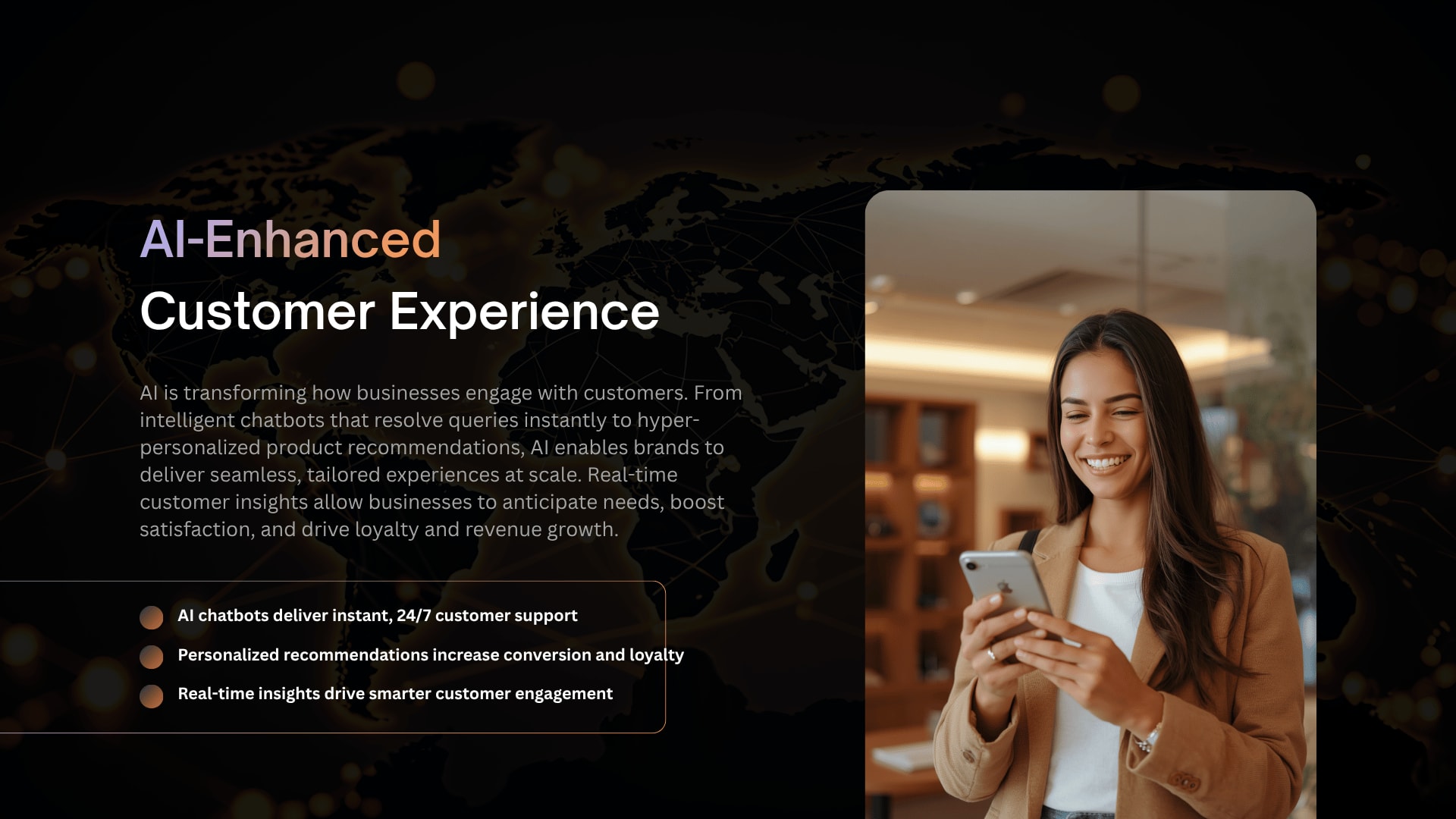
Retail and E-commerce
Retail businesses use AI for:
Personalised recommendations
Dynamic pricing
Inventory forecasting
Customer support chatbots
Demand prediction
Fraud prevention
Imagine an online clothing retailer.
AI analyses customer behaviour, browsing history, weather conditions, and seasonal demand.
Instead of displaying identical products to every visitor, each shopper receives personalised recommendations.
This creates a better shopping experience while increasing sales.
Healthcare
Healthcare organisations increasingly depend on AI for:
Medical image analysis
Appointment scheduling
Patient risk prediction
Clinical documentation
Virtual health assistants
Drug discovery
AI does not replace doctors.
Instead, it provides faster information, helping medical professionals make better decisions.
Hospitals also reduce administrative workload through intelligent automation.
Banking and Financial Services
Financial institutions rely heavily on AI.
Common applications include:
Fraud detection
Credit risk assessment
Investment analysis
Customer support
Identity verification
Regulatory compliance
Machine learning models detect unusual spending behaviour within seconds, reducing financial fraud.
Banks also personalise financial products according to customer behaviour.
Manufacturing
Manufacturers increasingly adopt AI-powered systems to improve production.
Applications include:
Predictive maintenance
Quality inspection
Production scheduling
Supply chain optimisation
Energy management
Instead of waiting for machines to fail, AI predicts maintenance requirements before breakdowns occur.
This reduces downtime and lowers repair costs.
Education
Educational institutions use AI to personalise learning experiences.
Examples include:
Adaptive learning platforms
AI tutoring
Automated assessments
Student performance prediction
Learning recommendations
Students receive customised study plans based on strengths and weaknesses.
Teachers spend more time supporting students instead of completing repetitive administrative tasks.
Real Estate
Real estate companies use AI to:
Predict property prices
Analyse investment opportunities
Match buyers with properties
Automate customer enquiries
Estimate property values
AI helps agents spend less time on repetitive paperwork while providing better client experiences.
Which AI Technologies Should Businesses Invest in First?
Artificial Intelligence Trends Every Business Should Know do not require businesses to adopt every new technology immediately. Organisations achieve better results by investing in AI solutions that solve specific business problems and provide measurable value.
Choosing the right technology depends on business goals.
The following comparison highlights common AI solutions.
AI TechnologyBest ForBusiness BenefitGenerative AIContent creationFaster marketing and documentationMachine LearningPredictionsBetter business decisionsComputer VisionImage analysisImproved quality controlNatural Language ProcessingCustomer communicationSmarter chatbots and supportPredictive AnalyticsForecastingReduced business riskRobotic Process Automation with AIRepetitive tasksHigher operational efficiency
Businesses should avoid purchasing AI tools simply because competitors are using them.
Instead, they should identify problems first.
For example:
High customer support costs
Slow report generation
Poor demand forecasting
Low employee productivity
High manual processing time
Once challenges are identified, AI investments become much easier to justify.
What Challenges Do Businesses Face During AI Adoption?
Although AI offers significant advantages, implementation is not always straightforward.
Common challenges include:
Poor data quality
Employee resistance
High implementation costs
Privacy concerns
Cybersecurity risks
Skills shortages
Integration with existing software
Many companies underestimate the importance of clean data.
Even advanced AI systems produce weak results when trained on inaccurate or incomplete information.
Employee training is equally important.
Workers often worry that AI will replace jobs.
Successful organisations explain that AI supports employees by removing repetitive work rather than replacing human expertise.
How Can Businesses Successfully Implement AI Without Major Risks?
Artificial Intelligence Trends Every Business Should Know show that successful AI adoption depends on clear business goals, quality data, employee training, and responsible implementation. Companies that take a structured approach achieve better results while avoiding common risks such as wasted investment, poor accuracy, and low employee adoption.
Many businesses assume AI implementation begins with purchasing software. In reality, successful AI projects start by identifying a specific business problem.
Instead of asking, "Which AI tool should be used?" organisations should ask, "Which business process needs improvement?"
A clear objective helps businesses choose the right technology, measure results, and achieve a stronger return on investment.
Identify High-Impact Business Problems First
Businesses should prioritise areas where AI can produce measurable improvements.
Examples include:
Reducing customer support response times
Improving sales forecasting
Automating invoice processing
Predicting equipment maintenance
Enhancing marketing personalisation
Detecting financial fraud
Improving inventory management
Starting with one well-defined project allows businesses to learn from the implementation before expanding AI across other departments.
Signs That a Business Is Ready for AI
Businesses are often ready to adopt AI if they experience:
Large amounts of business data
Repetitive manual tasks
Slow decision-making
Growing customer service demands
Increasing operational costs
Difficulty analysing business performance
When these challenges appear, AI can provide practical solutions that improve efficiency and productivity.
Why Is High-Quality Data Essential for AI Success?
Artificial intelligence depends on data to make predictions and recommendations.
If business data is incomplete, outdated, or inconsistent, AI systems cannot produce reliable results.
For example, a sales forecasting model trained on inaccurate customer information may generate incorrect inventory predictions. This can lead to overstocking, stock shortages, or unnecessary operational costs.
Businesses should regularly review:
Customer databases
Product information
Financial records
Operational reports
Sales history
Inventory data
Clean, organised, and accurate data significantly improves AI performance.
How Should Businesses Prepare Employees for AI?
Technology alone cannot transform a business.
Employees play an equally important role in successful AI adoption.
Many organisations face resistance because employees fear automation will replace their jobs.
Business leaders can reduce these concerns by explaining that AI supports employees rather than replacing them.
Training programmes should focus on:
Understanding AI capabilities
Learning new digital skills
Using AI responsibly
Verifying AI-generated outputs
Protecting sensitive information
Employees who understand AI are more likely to use it confidently and effectively.
Why Should Businesses Start Small?
Large-scale AI projects often involve significant costs and complexity.
A phased approach reduces risk.
A simple roadmap may include:
Identify one business challenge.
Select an appropriate AI solution.
Launch a pilot project.
Measure business outcomes.
Improve the process.
Expand AI implementation gradually.
This strategy allows organisations to gain experience before investing in larger enterprise-wide AI initiatives.
What Are the Biggest Challenges Businesses Face with Artificial Intelligence?
Artificial Intelligence Trends Every Business Should Know also highlight several challenges, including data privacy, cybersecurity, implementation costs, ethical concerns, integration issues, and regulatory compliance. Businesses that prepare for these challenges are more likely to achieve long-term success with AI.
Although AI creates exciting opportunities, organisations should recognise potential risks before implementation.
Data Privacy and Security
Businesses collect vast amounts of customer information.
AI systems often require access to this data to generate insights.
Protecting sensitive information is essential.
Organisations should:
Encrypt confidential data
Limit user access
Monitor AI systems regularly
Follow local privacy regulations
Update cybersecurity policies
Strong security measures help maintain customer trust while reducing the risk of data breaches.
Integration with Existing Systems
Many companies rely on older software platforms that were never designed for artificial intelligence.
Connecting AI with these systems may require additional development work.
Businesses should evaluate:
Software compatibility
API availability
Data migration requirements
Infrastructure readiness
Long-term maintenance costs
Planning integration before implementation prevents unexpected delays and expenses.
Managing AI Costs
AI implementation involves more than purchasing software.
Businesses should also consider:
Infrastructure upgrades
Employee training
Data preparation
Ongoing maintenance
Software subscriptions
Technical support
Rather than focusing only on initial costs, organisations should evaluate long-term business value.
Many AI projects recover their investment through increased productivity, reduced operational expenses, and improved customer satisfaction.
Ethical and Responsible AI
Responsible AI has become one of the fastest-growing business priorities.
Organisations must ensure AI systems remain:
Fair
Transparent
Explainable
Secure
Free from unnecessary bias
Accountable
Customers increasingly expect businesses to use AI responsibly.
Transparent policies improve trust while reducing legal and reputational risks.
Which Emerging AI Innovations Will Shape the Future of Business?
Artificial Intelligence Trends Every Business Should Know continue to evolve as new AI innovations enter the market. Businesses that monitor emerging technologies can prepare for future opportunities while maintaining a competitive advantage.
Artificial intelligence is advancing beyond automation.
Several innovations are expected to reshape business operations during the coming years.
AI Agents
AI agents can perform complex business tasks with minimal human supervision.
Unlike traditional chatbots, AI agents can:
Plan tasks
Make decisions
Interact with multiple business systems
Complete multi-step workflows
Learn from previous outcomes
Businesses are beginning to use AI agents for customer service, scheduling, research, and operational support.
Multimodal AI
Traditional AI systems typically process one type of information.
Multimodal AI can understand:
Text
Images
Video
Audio
Documents
This capability allows businesses to analyse richer information and improve customer experiences.
For example, an insurance company may process accident photos, written reports, and customer conversations simultaneously.
Hyper-Personalisation
Customers increasingly expect personalised experiences.
AI helps businesses deliver:
Personalised product recommendations
Custom pricing
Individual marketing campaigns
Tailored customer support
Personalised learning experiences
Businesses that understand customer preferences can improve engagement and build stronger long-term relationships.
Predictive Business Intelligence
Traditional reporting explains what happened.
Predictive AI estimates what is likely to happen next.
Business leaders can forecast:
Customer demand
Revenue trends
Market changes
Employee turnover
Supply chain disruptions
Predictive insights allow organisations to act before problems occur rather than reacting afterwards.
Sustainable AI
Many businesses are combining AI with sustainability initiatives.
Examples include:
Reducing energy consumption
Optimising delivery routes
Minimising production waste
Monitoring carbon emissions
Improving resource allocation
Sustainable AI helps businesses reduce environmental impact while lowering operational costs.
Tags
Amzsoft Innovexa
Engineering and delivery notes from the Amzsoft Innovexa team — fintech platforms, AI automation, and product engineering.