What are the Future of Software Development Trends 2026 that every business and developer should watch?
The Future of Software Development Trends 2026 is being shaped by artificial intelligence, cloud-native architectures, cybersecurity-first practices, platform engineering, and data-driven innovation. Businesses are no longer focused only on building applications faster; they are also prioritizing scalability, security, sustainability, and intelligent automation.
Software development has entered a period of rapid transformation. Organizations across industries are redesigning products, modernizing infrastructure, and investing heavily in technologies that can adapt to changing customer demands. Developers, meanwhile, are expected to work with AI tools, cloud platforms, automated testing systems, and increasingly complex architectures.
Several major shifts are already redefining the industry:
AI-powered software engineering and coding assistants.
Low-code and no-code development platforms.
Cloud-native and serverless applications.
Platform engineering and internal developer portals.
DevSecOps and built-in cybersecurity practices.
Edge computing and real-time data processing.
Sustainable software engineering initiatives.
API-first ecosystems and composable applications.
For startups, enterprises, and technology teams, understanding these changes is no longer optional. The organizations that prepare early will be better positioned to innovate, reduce costs, and deliver better digital experiences.
What are the Future of Software Development Trends 2026 that businesses should watch?
The Future of Software Development Trends 2026 revolves around intelligent automation, modern software architecture, cloud ecosystems, and secure development practices. Companies that embrace these trends early can improve operational efficiency, accelerate product delivery, and remain competitive in an increasingly digital economy.
The software industry has evolved beyond traditional coding practices. Development teams are expected to ship features faster, maintain high security standards, and support millions of users across devices and regions.
Businesses are increasingly looking for technology partners that understand both innovation and long-term scalability. Companies such as <a href="https://www.amzsoftinnovexa.com/">AMZ Soft Innovexa</a> are helping organizations adopt modern engineering practices, build scalable applications, and navigate the transition toward future-ready software ecosystems.
The sections below explore the technologies and strategies that will define software development in 2026.
Why are the Future of Software Development Trends 2026 changing faster than ever?
The Future of Software Development Trends 2026 is evolving rapidly because customer expectations, digital transformation initiatives, and global technology investments continue to accelerate innovation. Businesses need faster deployment cycles, smarter applications, and software systems that can adapt to constant change.
Unlike previous decades, software is no longer limited to technology companies. Healthcare providers, manufacturers, banks, retailers, educational institutions, and government agencies all depend on software to run critical operations.
Several forces are pushing the industry forward simultaneously:
Rising demand for personalized digital experiences.
Rapid advancements in artificial intelligence.
Expansion of cloud infrastructure.
Growing cybersecurity threats.
Increased global investment in technology.
Pressure to reduce operational costs.
Competition among digital-first businesses.
These factors are creating an environment where software engineering trends evolve faster than ever before.
What factors are driving the future of software development in 2026?
The future of software development is being driven by customer demands, AI innovation, enterprise modernization, and global technology investments. Organizations must respond quickly to changing market conditions while maintaining software quality and security.
Technology leaders increasingly recognize that software has become a core business asset rather than a support function. This shift influences everything from hiring strategies to infrastructure decisions.
How are evolving customer expectations influencing software development?
Customers now expect software to be:
Fast and responsive.
Available around the clock.
Personalized to their needs.
Secure and privacy-focused.
Accessible across multiple devices.
A banking application, for example, is expected to provide instant transactions, personalized financial insights, and seamless experiences on smartphones, tablets, and desktops.
These expectations force engineering teams to adopt modern development practices and invest in continuous improvement.
Why is digital transformation accelerating software innovation?
Digital transformation projects continue to expand across industries. Companies are replacing legacy systems with cloud-native platforms, automating workflows, and integrating AI capabilities into their products.
Manufacturers use predictive maintenance systems. Retailers deploy recommendation engines. Hospitals rely on connected healthcare platforms. Educational institutions build digital learning ecosystems.
As a result, software teams must deliver more sophisticated solutions in shorter timeframes.
How are global technology investments shaping software trends?
Governments, venture capital firms, and enterprises are investing billions of dollars in artificial intelligence, cloud infrastructure, cybersecurity, and developer tools.
Major technology companies continue to expand their ecosystems:
Microsoft is integrating AI capabilities into development workflows.
Google Cloud is investing heavily in machine learning infrastructure.
AWS continues to expand cloud services for enterprises.
Open-source communities are accelerating innovation.
According to the latest industry insights from the <a href="https://www.gartner.com/en/information-technology">Gartner technology research center</a>, organizations are increasing spending on AI-enabled systems and modern software infrastructure.
These investments create new opportunities while also increasing competitive pressure.
How is artificial intelligence transforming software development in 2026?
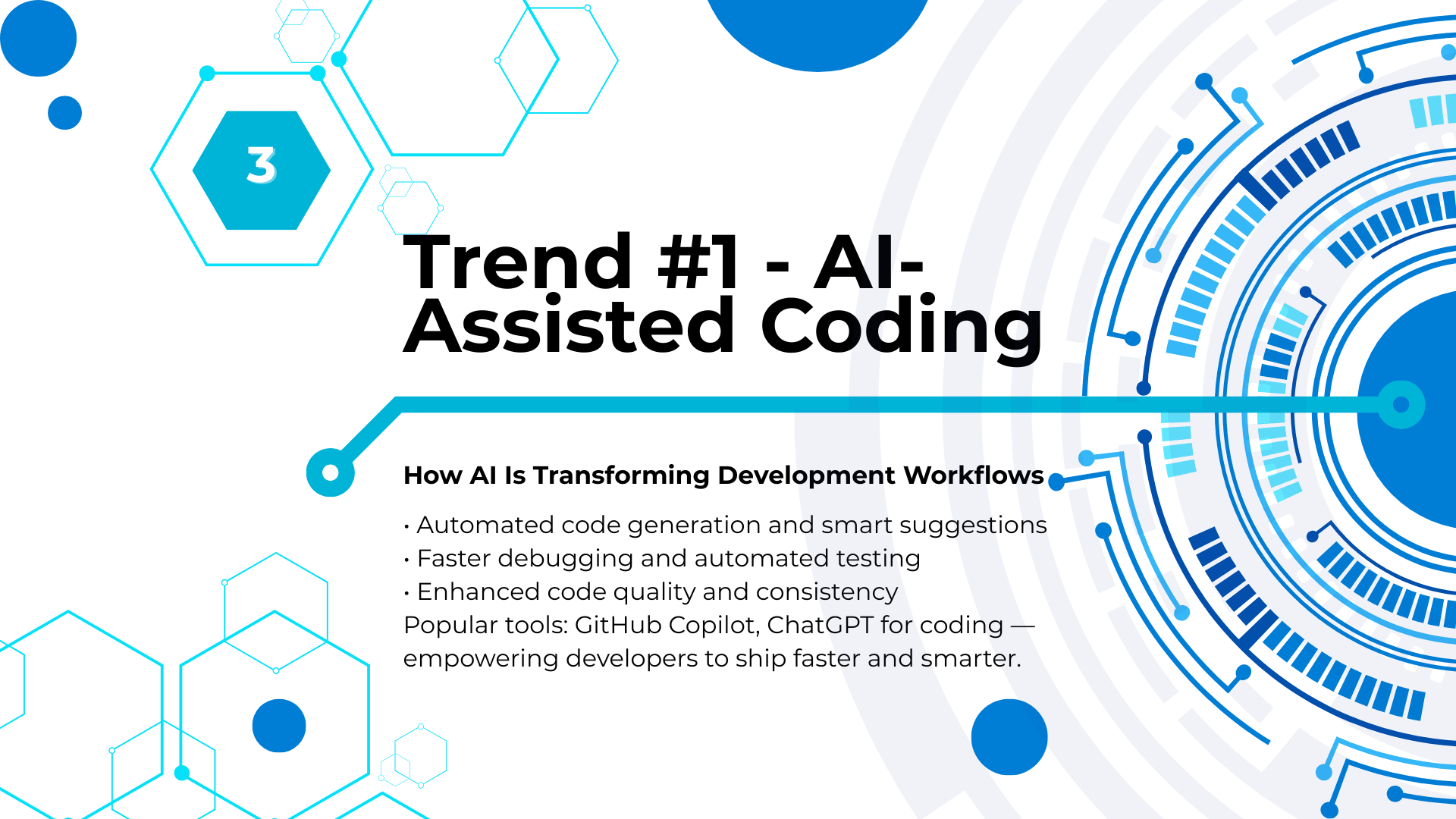
Artificial intelligence is one of the most influential parts of the Future of Software Development Trends 2026. AI is changing how developers write code, test applications, monitor systems, and manage software projects, leading to faster delivery cycles and improved productivity.
AI has moved beyond experimentation. It is becoming embedded in daily software engineering workflows.
Teams are using AI to:
Generate code suggestions.
Detect vulnerabilities.
Automate testing.
Improve documentation.
Optimize infrastructure.
Predict system failures.
Analyze user behavior.
The role of developers is evolving from writing every line of code manually to supervising, validating, and refining AI-generated outputs.
Will AI coding assistants become standard for developers?
AI coding assistants are likely to become standard tools across software teams by 2026.
Modern coding assistants can:
Generate boilerplate code.
Suggest functions and algorithms.
Detect syntax errors.
Recommend optimizations.
Create documentation.
Developers still need deep technical knowledge, but AI reduces repetitive tasks and allows teams to focus on architecture, business logic, and innovation.
GitHub, Microsoft, and several startups are actively expanding AI-powered development tools, signaling a long-term shift in software engineering practices.
How are AI-powered software engineering tools improving productivity?
AI-powered engineering tools increase productivity in several ways:
Faster code generation.
Automated bug detection.
Intelligent testing recommendations.
Improved project management.
Better documentation workflows.
Predictive maintenance.
A development team that previously spent days writing unit tests can now generate test cases automatically and focus on quality assurance.
Internal engineering data from many organizations shows measurable productivity improvements when AI tools are integrated responsibly.
Can generative AI replace traditional software development?
Generative AI cannot fully replace traditional software development.
Although AI can produce code quickly, software engineering involves many responsibilities that require human expertise:
Understanding business requirements.
Designing architecture.
Managing security risks.
Reviewing performance.
Ensuring compliance.
Coordinating teams.
AI excels at assisting developers, but complex decision-making still depends on human judgment.
Experienced engineers continue to play a central role in building scalable, secure, and reliable systems.
What are the limitations and risks of AI-generated code?
AI-generated code introduces several risks:
Security vulnerabilities.
Inaccurate outputs.
Licensing concerns.
Hidden bugs.
Poor maintainability.
Data privacy issues.
Development teams must establish review processes and governance policies before relying heavily on AI-generated code.
The industry is increasingly adopting human-in-the-loop workflows, where AI accelerates development while engineers maintain oversight.
Why is developer productivity becoming a top business priority?
Developer productivity has become a strategic priority because organizations need to build software faster without sacrificing quality. The Future of Software Development Trends 2026 emphasizes automation, intelligent tooling, and streamlined workflows that allow teams to deliver more value.
Executives no longer measure software teams only by lines of code written. Instead, they evaluate:
Deployment frequency.
Feature delivery speed.
Reliability.
User satisfaction.
Security performance.
Team efficiency.
Organizations that improve developer experience often achieve faster innovation cycles.
How are low-code and no-code platforms changing development workflows?
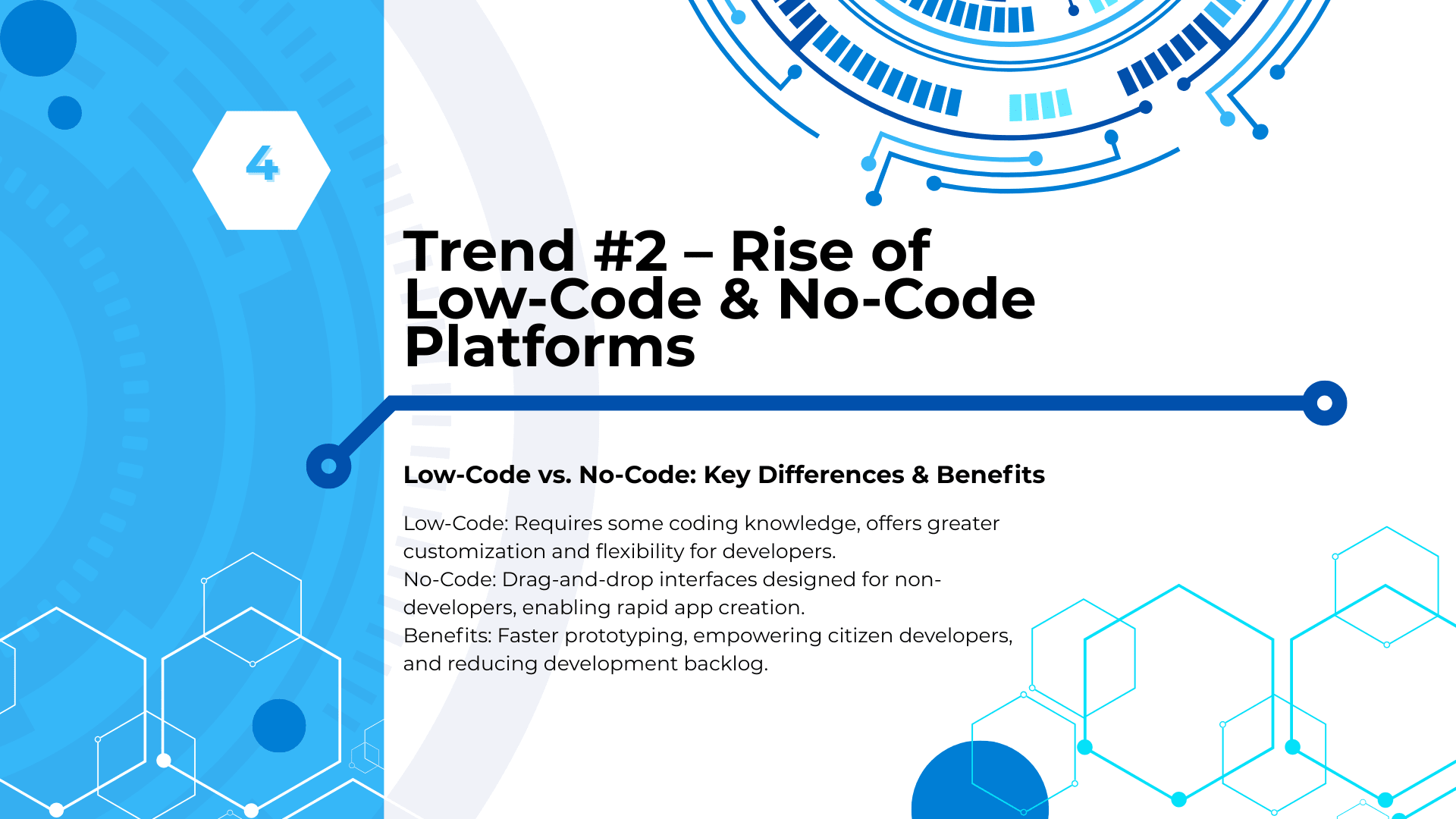
Low-code and no-code platforms are transforming development by enabling non-technical teams to create applications with minimal programming.
Popular use cases include:
Workflow automation.
Customer portals.
Internal dashboards.
Reporting systems.
Business applications.
Traditional developers still remain essential. Their responsibilities increasingly include:
Building core systems.
Managing integrations.
Ensuring security.
Supporting scalability.
Low-code development accelerates innovation but does not eliminate the need for professional engineering expertise.
What role do automation and intelligent testing play in modern development?
Testing automation is becoming essential because modern applications are too complex for manual quality assurance alone.
Automation helps teams:
Detect bugs earlier.
Improve release quality.
Reduce testing costs.
Increase deployment speed.
Ensure consistent performance.
AI-enhanced testing tools can now identify patterns and predict failures before they affect users.
How are AI-driven DevOps practices reducing deployment time?
AI-driven DevOps combines machine learning with deployment pipelines to reduce delays and improve reliability.
Benefits include:
Automated infrastructure management.
Intelligent resource allocation.
Predictive monitoring.
Faster incident response.
Improved release planning.
Organizations adopting DevOps maturity programs are seeing shorter release cycles and stronger collaboration between development and operations teams.
For teams embracing modern engineering practices, resources from the <a href="https://cloud.google.com/architecture">Google Cloud architecture center</a> provide valuable guidance on scalable software systems and cloud-native design.
Comparison Table: Major Software Development Approaches in 2026
ApproachPrimary GoalBest Use CasesKey ChallengeAI-Assisted DevelopmentIncrease developer productivityCode generation, testing, documentationQuality controlLow-Code DevelopmentAccelerate application deliveryInternal tools, workflowsLimited customizationCloud-Native DevelopmentImprove scalabilitySaaS platforms, enterprise systemsInfrastructure complexityDevSecOpsIntegrate security into developmentEnterprise softwareCultural adoptionPlatform EngineeringSimplify developer workflowsLarge engineering teamsInitial investment
How will cloud-native development evolve in 2026?
Cloud-native development will remain one of the most important components of the Future of Software Development Trends 2026 because businesses need scalable, resilient, and cost-efficient software systems. Organizations are increasingly moving away from monolithic architectures toward flexible cloud-based environments.
Modern applications must support millions of users, frequent updates, and global availability. Cloud-native technologies make these goals achievable.
Cloud-native systems typically rely on:
Containers.
Microservices.
Kubernetes.
Serverless functions.
Automated deployment pipelines.
Distributed databases.
As enterprises modernize legacy systems, cloud-native architecture will continue to dominate software engineering strategies.
Why are containerized applications becoming the industry standard?
Containerization enables developers to package applications and dependencies into portable environments.
Key advantages include:
Consistent deployments.
Improved scalability.
Faster testing.
Better resource utilization.
Easier collaboration.
Kubernetes and container orchestration platforms are now standard tools in enterprise engineering teams.
How is serverless computing reshaping software architecture?
Serverless computing reduces infrastructure management by allowing developers to focus on application logic.
Businesses benefit from:
Lower operational costs.
Automatic scaling.
Faster deployment.
Reduced maintenance.
This approach is especially valuable for startups and organizations with fluctuating workloads.
What is the future of multi-cloud and hybrid cloud strategies?
Enterprises increasingly adopt multi-cloud and hybrid cloud strategies to:
Avoid vendor lock-in.
Improve reliability.
Meet compliance requirements.
Optimize costs.
Support global operations.
Large organizations rarely rely on a single provider. Instead, they combine public cloud services with private infrastructure to create flexible technology ecosystems.
How is cybersecurity becoming part of the software development lifecycle?
Cybersecurity has become a core element of the Future of Software Development Trends 2026 because modern applications face increasingly sophisticated threats. Security is no longer treated as a final testing phase. Instead, organizations are embedding security controls throughout the software development lifecycle to reduce risks and improve resilience.
A decade ago, many teams focused primarily on functionality and speed. Today, security failures can result in financial losses, regulatory penalties, and reputational damage. As applications become more interconnected through APIs, cloud platforms, and edge devices, the attack surface continues to expand.
Businesses are responding by integrating security into every development stage:
Threat modeling during planning.
Automated code scanning.
Secure coding practices.
Continuous vulnerability monitoring.
Compliance checks.
Runtime protection.
Security teams and developers are increasingly working together instead of operating in separate departments.
Why is secure-by-design software becoming essential?
Secure-by-design development ensures that security considerations are included from the earliest stages of software planning rather than added later.
Organizations adopting this approach prioritize:
Strong authentication systems.
Data encryption.
Access control mechanisms.
Secure APIs.
Privacy protection.
Continuous security testing.
A healthcare platform, for example, cannot simply add encryption after deployment. Security requirements must shape the entire architecture from day one.
As regulations around privacy and data protection continue to evolve, secure-by-design practices are becoming a business necessity.
How are DevSecOps practices evolving in 2026?
DevSecOps is evolving from a niche practice into a standard software engineering model.
Modern DevSecOps workflows include:
Automated security testing.
Real-time vulnerability scanning.
Compliance automation.
Secure CI/CD pipelines.
AI-powered threat detection.
Infrastructure security monitoring.
Engineering teams now expect security tools to integrate directly into development environments. This shift reduces friction and helps developers identify problems earlier.
What role does AI play in software security and threat detection?
Artificial intelligence is helping organizations detect and respond to security threats faster than traditional methods.
AI-driven security tools can:
Identify suspicious behavior patterns.
Detect malware.
Analyze large volumes of logs.
Predict vulnerabilities.
Prioritize security risks.
Human expertise remains essential, however. AI can accelerate detection, but security professionals still make critical decisions about mitigation and compliance.
Why is platform engineering replacing traditional infrastructure management?
Platform engineering is becoming a defining aspect of the Future of Software Development Trends 2026 because development teams need simpler and more efficient ways to manage infrastructure. Organizations are building internal platforms that allow developers to focus on creating software rather than maintaining complex systems.
As software ecosystems grow, developers often spend too much time configuring environments, managing deployments, and troubleshooting infrastructure.
Platform engineering addresses these challenges by standardizing tools and workflows.
Common goals include:
Reducing operational overhead.
Improving developer experience.
Accelerating releases.
Increasing consistency.
Supporting scalability.
Many technology leaders now consider platform engineering a strategic investment rather than an operational expense.
What is platform engineering, and why does it matter?
Platform engineering involves creating internal systems that streamline software development and infrastructure management.
A typical internal platform may include:
Deployment pipelines.
Monitoring dashboards.
Security controls.
Development environments.
Infrastructure templates.
Documentation portals.
Instead of configuring servers manually, developers can use self-service tools that simplify common tasks.
How do internal developer platforms improve engineering efficiency?
Internal developer platforms help teams eliminate repetitive work and reduce complexity.
Their benefits include:
Faster onboarding.
Consistent development environments.
Automated deployments.
Improved collaboration.
Lower infrastructure costs.
A large enterprise with hundreds of developers may lose significant time due to inconsistent workflows. Internal platforms solve this problem by creating standardized processes.
How does platform engineering support scalable software delivery?
Scalable software delivery depends on repeatable systems and automation.
Platform engineering enables organizations to:
Deploy applications across multiple environments.
Handle increasing workloads.
Maintain reliability.
Reduce operational bottlenecks.
Improve release frequency.
Companies investing in platform engineering today are laying the foundation for long-term growth.
How are APIs shaping the future of software development?
APIs are central to the Future of Software Development Trends 2026 because modern applications depend on seamless communication between services, devices, and platforms. Businesses increasingly adopt API-first strategies to create flexible, scalable, and interoperable software ecosystems.
Very few applications operate in isolation anymore. Payment gateways, analytics tools, customer relationship systems, and AI services all rely on APIs.
The API economy continues to expand because organizations need:
Faster integrations.
Better scalability.
Reusable components.
Third-party connectivity.
Cross-platform experiences.
API strategies are influencing everything from startup architecture to enterprise modernization.
Why are API-first development strategies becoming the default?
API-first development prioritizes interface design before application implementation.
This approach offers several advantages:
Better collaboration between teams.
Faster integrations.
Improved scalability.
Consistent user experiences.
Easier maintenance.
Many organizations now define APIs at the beginning of projects instead of treating them as secondary features.
How are composable applications changing enterprise software?
Composable applications allow businesses to assemble software from modular components rather than building everything from scratch.
Examples include:
E-commerce systems.
Customer service platforms.
Financial applications.
Supply chain solutions.
This approach enables organizations to replace or upgrade individual services without redesigning entire systems.
What role do microservices play in modern software development?
Microservices remain a cornerstone of modern software architecture.
They help organizations:
Scale individual services independently.
Deploy updates faster.
Improve fault tolerance.
Support distributed teams.
Reduce system complexity.
Many enterprises are moving away from monolithic systems because microservices provide greater flexibility and resilience.
How is edge computing influencing software development trends in 2026?
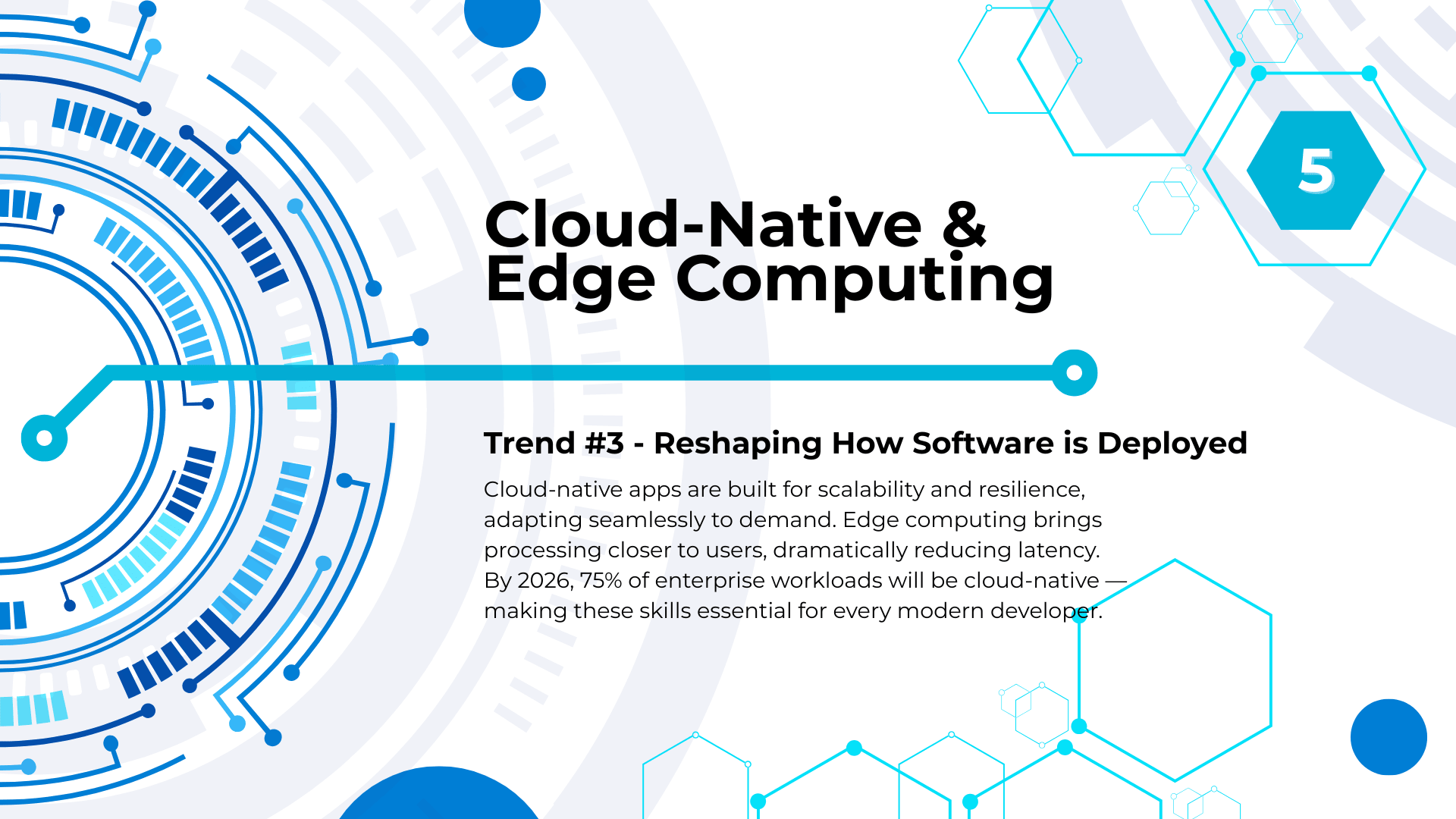
Edge computing is reshaping the Future of Software Development Trends 2026 by moving data processing closer to users and connected devices. This approach reduces latency, improves performance, and supports real-time applications that traditional cloud models struggle to handle efficiently.
As smart devices and connected systems multiply, centralized processing becomes less practical.
Edge-native applications are becoming critical for:
Internet of Things (IoT) solutions.
Autonomous systems.
Industrial automation.
Healthcare devices.
Smart cities.
Retail analytics.
Software architects are increasingly designing systems that combine cloud infrastructure with edge processing capabilities.
Which industries benefit the most from edge computing?
Several sectors are rapidly adopting edge computing:
Manufacturing.
Healthcare.
Logistics.
Automotive.
Telecommunications.
Retail.
A factory equipped with thousands of sensors cannot afford delays caused by sending every data point to a distant data center. Edge computing enables instant decision-making.
How does edge AI improve application performance?
Edge AI combines artificial intelligence with local data processing.
Benefits include:
Faster response times.
Lower bandwidth usage.
Better privacy.
Improved reliability.
Reduced cloud dependency.
Applications such as facial recognition systems and predictive maintenance platforms rely heavily on edge AI capabilities.
What challenges come with edge-native software development?
Despite its advantages, edge-native development introduces several challenges:
Device management complexity.
Security concerns.
Limited computing resources.
Data synchronization issues.
Difficult debugging processes.
Engineering teams must carefully balance performance gains against operational complexity.
Will blockchain continue to influence software development beyond cryptocurrency?
Blockchain remains part of the Future of Software Development Trends 2026, although its influence extends far beyond digital currencies. Businesses are increasingly exploring decentralized technologies for transparency, automation, and secure data sharing.
Early blockchain discussions focused almost entirely on cryptocurrency. Today, enterprises are evaluating practical applications across multiple industries.
Potential use cases include:
Supply chain management.
Identity verification.
Smart contracts.
Healthcare records.
Financial transactions.
Asset tracking.
The technology is evolving from experimentation toward targeted business applications.
How are decentralized applications evolving?
Decentralized applications, often called dApps, are becoming more sophisticated and user-friendly.
Recent improvements include:
Better scalability.
Improved interfaces.
Enhanced interoperability.
Lower transaction costs.
Stronger security frameworks.
Developers are increasingly integrating blockchain capabilities into traditional software systems rather than building fully decentralized ecosystems.
What industries are adopting blockchain-based software solutions?
Blockchain adoption continues to expand across:
Finance.
Healthcare.
Logistics.
Insurance.
Government services.
Retail.
A logistics company, for example, can use blockchain to create transparent shipment records that reduce fraud and improve accountability.
What are the limitations of blockchain in software engineering?
Blockchain still faces significant barriers:
Scalability constraints.
Regulatory uncertainty.
High implementation costs.
Energy consumption concerns.
Complex user experiences.
For many businesses, traditional databases remain more practical than decentralized alternatives.
How are immersive technologies changing software experiences?
Immersive technologies are becoming an important component of the Future of Software Development Trends 2026, particularly in industries that rely on visualization, training, and collaboration. Augmented reality, virtual reality, and spatial computing are changing how users interact with software.
These technologies are moving beyond entertainment and gaming.
Businesses are exploring immersive software for:
Employee training.
Product design.
Remote collaboration.
Education.
Healthcare.
Industrial operations.
The next generation of applications will increasingly blend digital experiences with physical environments.
What role do AR and VR play in enterprise software?
AR and VR technologies provide businesses with new ways to visualize information and improve productivity.
Examples include:
Medical simulations.
Equipment maintenance training.
Virtual meetings.
Architecture visualization.
Product demonstrations.
Companies investing in enterprise software are beginning to view immersive experiences as practical business tools rather than experimental technologies.
How is spatial computing influencing application development?
Spatial computing allows software to understand and interact with physical environments.
Developers are building applications that can:
Interpret real-world spaces.
Track movement.
Overlay digital information.
Enable natural interactions.
This shift creates new opportunities but also demands new design and engineering skills.
Will the metaverse still impact software innovation in 2026?
Although excitement around the metaverse has cooled, many underlying technologies continue to influence software innovation.
Key areas of ongoing investment include:
Digital collaboration tools.
Virtual training systems.
Immersive commerce.
Spatial interfaces.
The broader concept may evolve, but its technologies are expected to remain relevant.
How is sustainability influencing software development trends?
Sustainability is increasingly shaping the Future of Software Development Trends 2026 as organizations seek to reduce energy consumption and environmental impact. Software teams are beginning to consider efficiency and resource usage alongside performance and scalability.
Businesses face growing pressure from regulators, investors, and customers to adopt environmentally responsible practices.
Sustainable software strategies include:
Efficient code design.
Optimized cloud usage.
Reduced computing waste.
Energy-aware architecture.
Smarter infrastructure management.
Green software engineering is emerging as an important discipline within the broader technology ecosystem.
What is green software engineering?
Green software engineering focuses on minimizing the environmental footprint of software systems.
It encourages developers to:
Write efficient code.
Reduce unnecessary processing.
Optimize storage.
Improve hardware utilization.
Monitor energy consumption.
The goal is not only sustainability but also cost savings and operational efficiency.
How can developers reduce software energy consumption?
Developers can improve software efficiency by:
Optimizing algorithms.
Reducing network requests.
Improving database performance.
Scaling infrastructure intelligently.
Eliminating redundant processes.
Small improvements at scale can significantly reduce energy usage.
Why are sustainable software practices becoming a competitive advantage?
Organizations that prioritize sustainability often benefit from:
Lower operational costs.
Improved brand reputation.
Regulatory readiness.
Greater investor confidence.
As environmental goals become more important, sustainable engineering practices are likely to become standard business expectations.
How is data engineering evolving alongside software development?
Data engineering is evolving rapidly because modern applications depend on real-time insights, artificial intelligence, and reliable analytics. The Future of Software Development Trends 2026 increasingly connects software engineering with advanced data infrastructure and governance.
Applications today generate enormous volumes of information. Without strong data systems, even the most advanced software products struggle to deliver value.
Modern data strategies focus on:
Real-time processing.
Data quality.
Governance frameworks.
Scalable pipelines.
AI readiness.
Businesses that invest in robust data foundations are better positioned to compete in an AI-driven world.
Why are real-time data pipelines becoming essential?
Real-time pipelines allow organizations to process and analyze information immediately.
They support:
Fraud detection.
Personalized recommendations.
Predictive maintenance.
Operational monitoring.
Customer analytics.
Users increasingly expect instant responses, making real-time data infrastructure a necessity.
How does data quality impact AI-powered applications?
Poor data quality leads to inaccurate predictions, unreliable automation, and poor customer experiences.
Organizations must focus on:
Data validation.
Consistency.
Accuracy.
Monitoring.
Governance.
AI systems are only as effective as the information they receive.
What role does data governance play in modern software?
Data governance ensures that information is managed responsibly and securely.
Strong governance frameworks help organizations:
Meet compliance requirements.
Protect sensitive data.
Improve trust.
Support analytics initiatives.
Reduce operational risks.
Businesses building AI-powered systems in 2026 will need governance strategies that evolve alongside technology.
Tags
Amzsoft Innovexa
Engineering and delivery notes from the Amzsoft Innovexa team — fintech platforms, AI automation, and product engineering.