Introduction
The business website has long been the foundation of digital presence. For decades, companies relied on static pages, contact forms, product catalogs, and basic navigation structures to connect with customers online. While these traditional websites served their purpose, customer expectations have changed dramatically.
Today’s users expect instant answers, personalized experiences, intelligent recommendations, and seamless interactions. They no longer want to search through dozens of pages to find information. Instead, they expect websites to understand their intent and respond immediately.
This shift has led to the rapid rise of AI Websites—a new generation of intelligent digital platforms designed to engage visitors, automate interactions, personalize content, and continuously improve performance through artificial intelligence.
Unlike traditional websites that primarily display information, AI-powered websites actively participate in customer conversations, generate insights, automate workflows, and adapt to user behavior in real time. As businesses embrace digital transformation, AI Websites are increasingly replacing conventional business websites across industries.
From small businesses and startups to enterprise organizations, companies are adopting intelligent websites to improve customer engagement, increase conversions, reduce operational costs, and create superior digital experiences.
This article explores how AI Websites are transforming the online business landscape, why traditional websites are becoming outdated, and what the future of websites looks like in an AI-driven world.
What Are AI Websites?
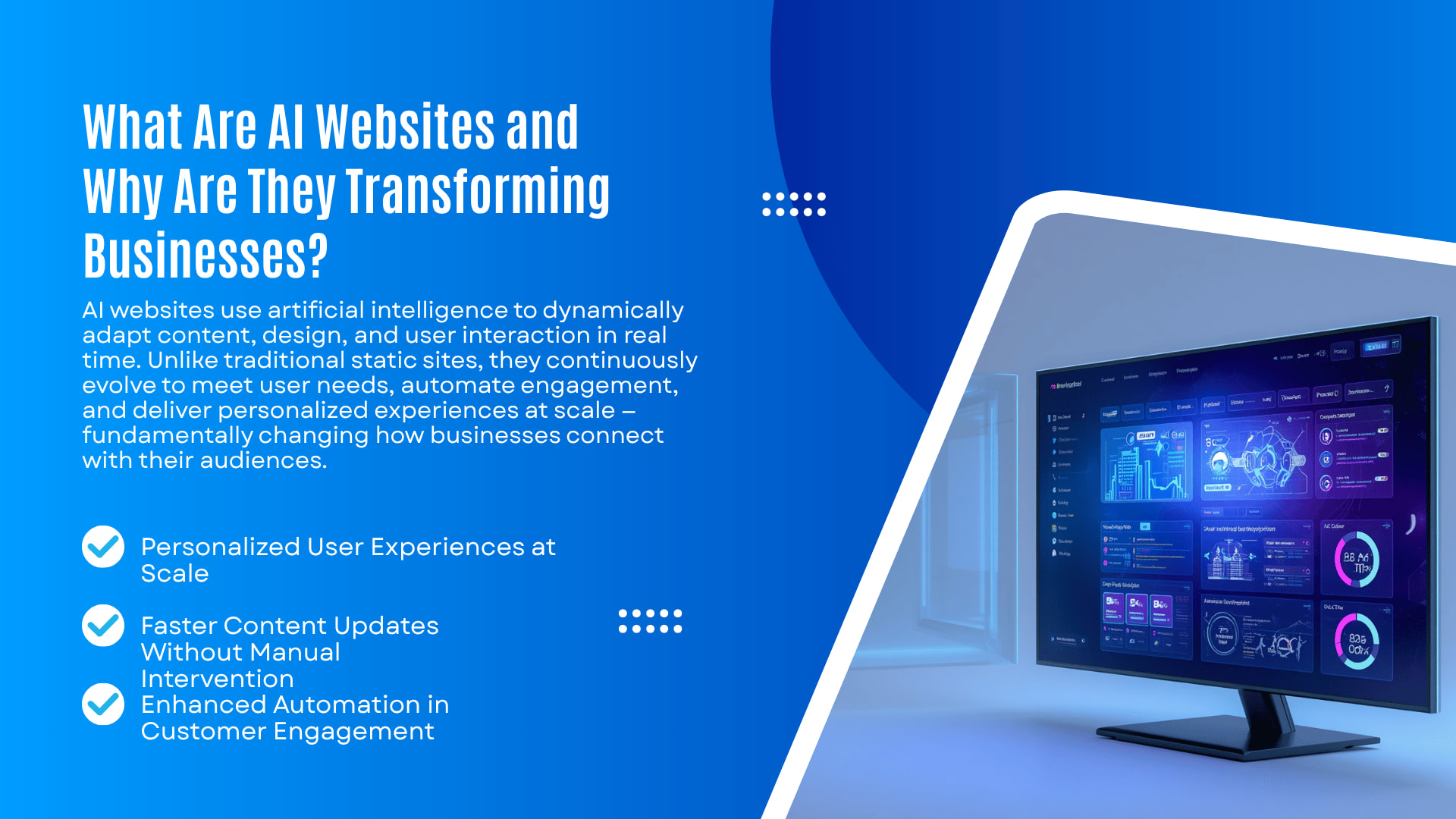
AI Websites are intelligent digital platforms that use artificial intelligence to personalize user experiences, automate customer interactions, analyze visitor behavior, and continuously optimize website performance. Unlike traditional websites, they actively engage visitors instead of simply displaying information.
The evolution of web technology has moved beyond static pages and basic navigation systems. Modern businesses require websites that can think, learn, and respond dynamically to customer needs.
AI-powered websites leverage technologies such as:
Machine Learning
Natural Language Processing (NLP)
Predictive Analytics
Conversational AI
Recommendation Engines
Behavioral Intelligence
Automation Systems
These technologies enable websites to provide personalized experiences at scale.
For example:
A visitor lands on an AI website looking for software solutions.
Instead of browsing through multiple pages, the website:
Identifies visitor intent.
Initiates a conversation.
Recommends relevant solutions.
Answers questions instantly.
Schedules a consultation.
Captures lead information automatically.
The entire interaction happens without human intervention.
This level of intelligence is redefining customer expectations and changing how businesses operate online.
Why Are Traditional Business Websites Becoming Obsolete?
Traditional websites are becoming less effective because modern customers expect personalization, instant responses, and intelligent interactions. AI Websites fulfill these expectations by providing dynamic and automated experiences that static websites cannot match.
For years, businesses focused on creating visually appealing websites. However, design alone is no longer enough.
Several challenges make traditional websites increasingly outdated:
Limited Customer Interaction
Most traditional websites rely on:
Contact forms
Email inquiries
Static FAQs
Visitors often leave before receiving answers.
Lack of Personalization
Traditional websites show identical content to every visitor regardless of:
Industry
Interests
Location
Purchase intent
Modern consumers expect customized experiences.
Slow Lead Conversion
Without intelligent automation:
Leads wait for responses.
Sales opportunities are lost.
Customer engagement decreases.
Inefficient Data Utilization
Many businesses collect visitor data but fail to use it effectively.
AI-powered websites transform data into actionable insights that improve conversions and customer experiences.
As digital competition increases, businesses that continue relying solely on traditional websites risk falling behind.
How Do AI Websites Deliver Better User Experiences?
AI Websites deliver better user experiences by understanding visitor behavior, personalizing content, providing instant assistance, and continuously optimizing interactions based on real-time data and user intent.
Customer experience has become one of the most important competitive advantages in the digital world.
AI-driven user experience focuses on creating interactions that feel relevant, efficient, and personalized.
Personalized Content Recommendations
AI Websites analyze visitor behavior and automatically present the most relevant content, products, or services based on individual preferences and actions.
Traditional websites typically display the same homepage to every visitor.
AI-powered websites can:
Recommend products
Suggest services
Customize landing pages
Adapt messaging
For example:
An eCommerce visitor interested in fitness products may instantly see:
Workout equipment
Personalized recommendations
Relevant promotions
Meanwhile, another visitor may see completely different content.
This level of personalization significantly increases engagement and conversions.
Intelligent Navigation
AI Websites simplify navigation by predicting user intent and guiding visitors toward the information they need without requiring extensive searching.
Users often leave websites when they cannot quickly find answers.
AI improves navigation through:
Smart search functionality
Context-aware recommendations
Conversational interfaces
Dynamic content delivery
Instead of navigating five pages, users can receive answers within seconds.
Real-Time Customer Assistance
Conversational websites provide immediate support through AI chatbots and virtual assistants, reducing response times and improving customer satisfaction.
Customers increasingly expect immediate answers.
AI-powered assistants can:
Answer questions 24/7
Recommend solutions
Qualify leads
Schedule appointments
Resolve common issues
This creates a seamless and responsive customer experience.
Continuous Learning and Optimization
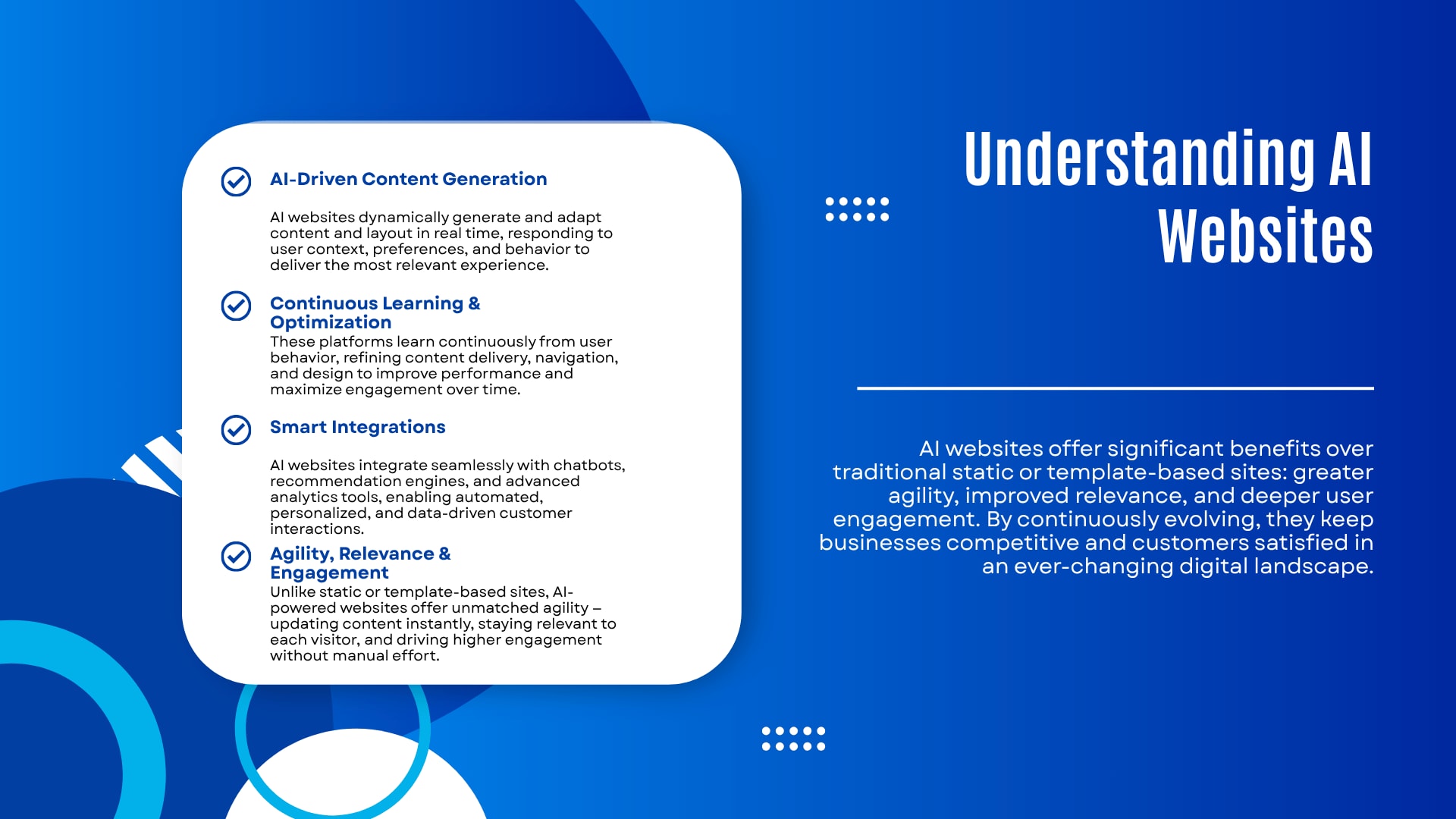
AI Websites improve over time by analyzing user behavior and adjusting content, layouts, and interactions based on performance data.
Unlike traditional websites that require manual updates, intelligent websites learn from:
Visitor interactions
Conversion patterns
Search queries
Engagement metrics
The result is a constantly improving user experience.
How Are AI Websites Replacing Traditional Business Functions?
AI Websites are replacing many traditional business functions by automating customer service, lead generation, sales support, content delivery, and operational workflows directly through the website experience.
The website is no longer just a marketing tool.
It is becoming an intelligent business platform.
Automated Customer Support
Businesses previously needed large support teams to handle inquiries.
AI-powered websites now automate:
FAQ responses
Order tracking
Appointment scheduling
Technical support
This reduces costs while improving service availability.
Intelligent Lead Generation
AI websites identify and qualify leads automatically.
They can:
Analyze visitor behavior.
Detect purchase intent.
Ask qualifying questions.
Collect contact information.
Route leads to sales teams.
This creates a more efficient sales process.
Automated Sales Assistance
Many companies use conversational websites as digital sales representatives.
These systems can:
Recommend products
Compare options
Provide pricing information
Handle objections
Guide purchasing decisions
The sales process becomes faster and more scalable.
Content Personalization
Instead of manually creating multiple landing pages, AI websites dynamically generate relevant experiences for different audiences.
This improves:
Engagement
Conversion rates
Customer retention
AI Websites vs Traditional Business Websites
AI Websites outperform traditional business websites by providing automation, personalization, and intelligent engagement that modern customers increasingly expect.
The differences between these two approaches are becoming increasingly significant.
FeatureAI WebsitesTraditional Business WebsitesCustomer InteractionConversational and interactiveMostly staticPersonalizationReal-time customizationLimited personalizationLead GenerationAutomated and intelligentManual processesCustomer Support24/7 AI assistanceBusiness-hour supportContent DeliveryDynamic and adaptiveFixed contentData AnalysisContinuous learningBasic analyticsUser ExperienceAI-driven user experienceStandard navigationScalabilityHighly scalableResource-dependentAutomationExtensive website automationMinimal automationConversion OptimizationContinuous improvementManual optimization
As businesses seek greater efficiency and customer satisfaction, AI-powered websites are becoming the preferred solution.
What Technologies Power AI Websites?
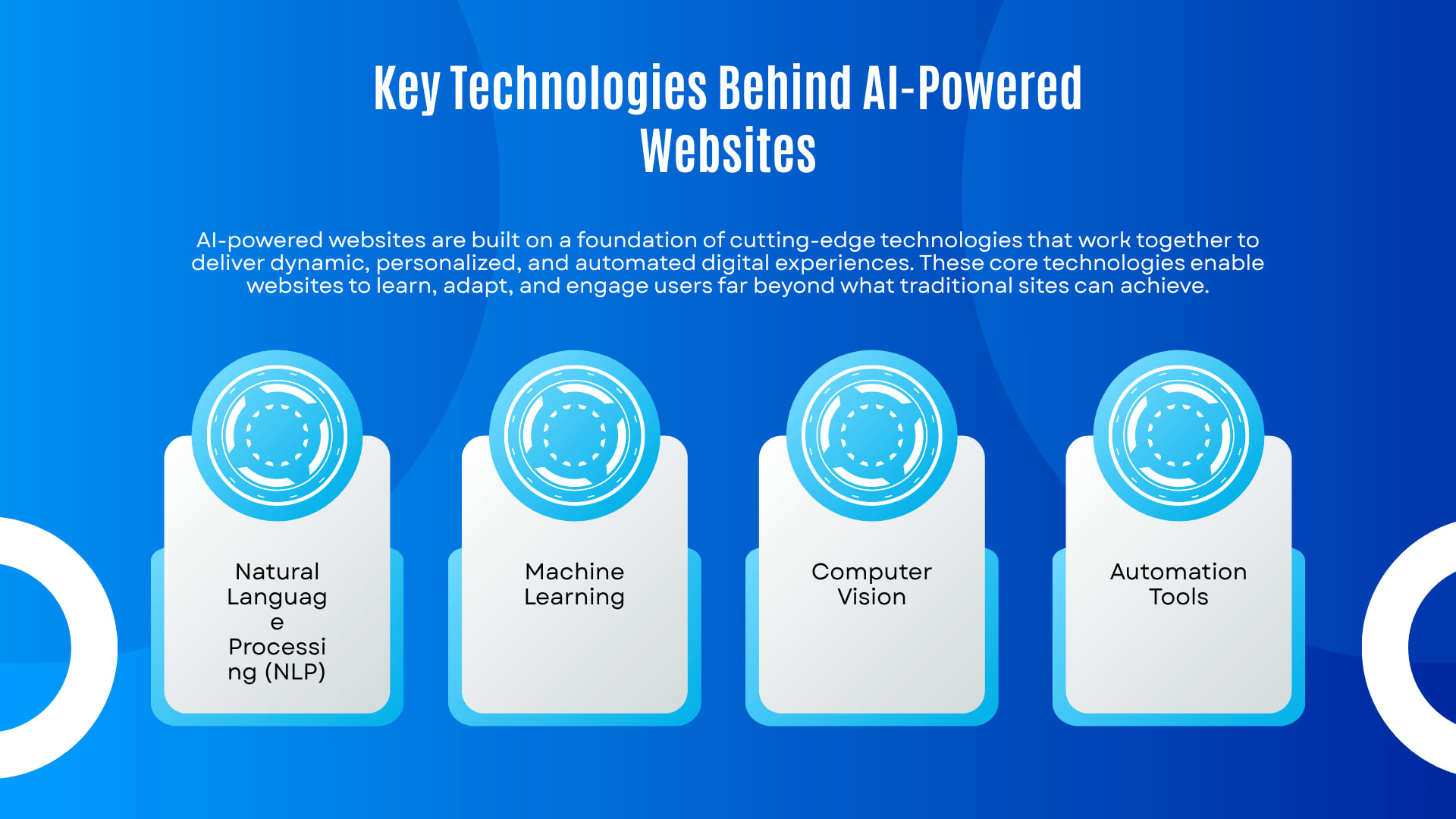
AI Websites rely on advanced technologies such as machine learning, natural language processing, predictive analytics, automation systems, and intelligent recommendation engines to create adaptive and personalized digital experiences.
The intelligence behind these platforms comes from several powerful technologies.
Machine Learning
Machine learning enables websites to:
Learn from user behavior
Improve recommendations
Predict customer actions
Optimize performance
The system becomes smarter over time.
Natural Language Processing (NLP)
NLP allows conversational websites to understand human language.
Benefits include:
Human-like interactions
Better chatbot performance
Improved search functionality
Accurate customer responses
Predictive Analytics
Predictive analytics helps businesses anticipate customer needs.
Examples include:
Product recommendations
Lead scoring
Churn prediction
Purchase forecasting
Intelligent Automation
Automation systems reduce repetitive tasks.
Capabilities include:
Lead management
Customer onboarding
Email workflows
Support ticket handling
These technologies collectively drive digital transformation across industries.
Why Are Businesses Investing in AI Websites?
Businesses are investing in AI Websites because they improve efficiency, increase revenue, enhance customer experiences, reduce operational costs, and support long-term digital transformation initiatives.
The business case for AI-powered websites is becoming stronger every year.
Several key factors are driving adoption.
Higher Conversion Rates
Personalized experiences often lead to:
Increased engagement
Better lead quality
Improved sales performance
Customers are more likely to convert when content matches their needs.
Reduced Operating Costs
Automation reduces dependence on manual processes.
Businesses can:
Lower support costs
Reduce administrative work
Improve operational efficiency
Improved Customer Satisfaction
Fast responses and personalized experiences create stronger customer relationships.
Customers value convenience and responsiveness.
Competitive Advantage
Companies that adopt intelligent websites gain an edge over competitors still using traditional websites.
They can:
Respond faster
Scale more effectively
Deliver better experiences
This advantage becomes increasingly important in crowded markets.
How Are Different Industries Using AI Websites?
AI Websites are transforming industries by automating customer interactions, personalizing services, improving operational efficiency, and delivering smarter digital experiences tailored to specific business needs.
AI adoption extends far beyond technology companies.
Healthcare
Healthcare organizations use AI-powered websites for:
Appointment scheduling
Patient inquiries
Symptom assessments
Information delivery
Patients receive faster assistance and better access to care.
E-Commerce
Online retailers leverage intelligent websites for:
Product recommendations
Personalized shopping
Cart recovery
Customer support
These features increase sales and customer loyalty.
Real Estate
Real estate firms use conversational websites to:
Qualify buyers
Schedule viewings
Recommend properties
Answer questions
This improves lead management significantly.
Professional Services
Law firms, consultants, and agencies use AI business solutions to:
Capture leads
Automate consultations
Provide instant information
Improve client onboarding
The result is greater efficiency and improved client experiences.
What Role Does Website Automation Play in Business Growth?
Website automation enables AI Websites to streamline operations, reduce manual tasks, improve customer engagement, and accelerate business growth through intelligent and scalable digital processes.
Automation is one of the most valuable aspects of AI-powered websites.
Businesses can automate numerous functions.
Lead Management Automation
Automated systems can:
Capture leads.
Qualify prospects.
Assign sales priorities.
Schedule follow-ups.
Track conversions.
This improves efficiency and sales performance.
Customer Communication Automation
Businesses automate:
Emails
Notifications
Follow-ups
Appointment reminders
Customers receive timely communication without manual effort.
Marketing Automation
AI websites support:
Personalized campaigns
Behavioral targeting
Audience segmentation
Dynamic content delivery
These capabilities enhance marketing effectiveness.
Operational Efficiency
Automation reduces repetitive work and allows teams to focus on strategic activities.
This creates a more productive organization.
How Are AI Websites Supporting Digital Transformation?
AI Websites serve as a critical component of digital transformation by connecting data, automation, customer experiences, and business intelligence into a unified digital ecosystem.
Digital transformation is more than adopting new technology.
It involves fundamentally changing how businesses operate and deliver value.
AI-powered websites contribute in several ways.
Enhanced Data Utilization
Businesses collect vast amounts of data.
AI systems convert this information into actionable insights.
Improved Decision-Making
Intelligent websites provide:
Customer analytics
Behavioral trends
Performance metrics
Predictive forecasts
Leaders can make more informed decisions.
Scalable Growth
AI systems support growth without requiring proportional increases in staffing.
This creates sustainable scalability.
Integrated Customer Experiences
Modern AI business solutions connect websites with:
CRM platforms
Marketing tools
Customer support systems
Analytics platforms
The result is a seamless digital ecosystem.
Organizations seeking advanced AI website development and digital transformation strategies often partner with specialized providers such as Amz Soft Innovexa to implement intelligent web solutions tailored to business objectives.
What Does the Future of Websites Look Like?
The future of websites will be increasingly intelligent, conversational, predictive, and autonomous, with AI Websites becoming the standard digital platform for customer engagement and business operations.
The evolution of websites is accelerating.
Several trends are shaping the next generation of digital experiences.
Hyper-Personalization
Future intelligent websites will personalize experiences at unprecedented levels.
Every visitor may receive:
Unique content
Customized offers
Personalized navigation
Tailored recommendations
Voice-Driven Experiences
Voice interactions are becoming more common.
Future websites will support:
Voice search
Conversational navigation
AI voice assistants
This aligns with growing voice-search adoption.
Autonomous Optimization
AI systems will continuously improve:
Design
Content
Conversion paths
User journeys
Minimal human intervention will be required.
Fully Conversational Interfaces
The future of websites may resemble intelligent conversations more than traditional browsing experiences.
Users will increasingly interact through natural language rather than menus and navigation structures.
Are AI Websites Suitable for Small Businesses?
AI Websites are highly suitable for small businesses because they provide enterprise-level automation, customer engagement, and personalization capabilities without requiring large teams or extensive resources.
Small businesses often face resource limitations.
AI helps overcome these challenges.
Benefits include:
Automated customer support
Better lead generation
Improved customer experiences
Increased operational efficiency
Scalable growth opportunities
A small business can compete more effectively against larger organizations by leveraging intelligent automation.
Rather than hiring additional staff, many routine tasks can be managed through AI-powered websites.
This creates a cost-effective path toward growth and digital transformation.
Frequently Asked Questions
What are AI Websites?
AI Websites are intelligent digital platforms that use artificial intelligence to automate interactions, personalize user experiences, analyze behavior, and optimize performance in real time.
How are AI Websites different from traditional websites?
Traditional websites primarily display information, while AI-powered websites actively engage visitors, provide personalized experiences, automate support, and continuously improve through data analysis.
Do AI Websites improve SEO performance?
Yes. AI Websites can improve engagement metrics, user experience, content relevance, and personalization, all of which contribute to stronger SEO performance.
Can small businesses benefit from AI-powered websites?
Absolutely. Small businesses can use intelligent websites to automate customer service, generate leads, improve efficiency, and compete more effectively with larger organizations.
Are conversational websites replacing traditional navigation?
In many cases, yes. Conversational websites allow users to find information quickly through natural interactions rather than navigating multiple pages.
What industries benefit most from AI Websites?
Healthcare, eCommerce, real estate, professional services, education, finance, and technology companies are among the industries seeing significant benefits from AI-driven user experiences.
How does website automation help businesses?
Website automation reduces manual tasks, improves customer communication, streamlines operations, and increases overall efficiency while lowering costs.
What is the future of AI Websites?
The future of websites includes hyper-personalization, voice interactions, predictive experiences, autonomous optimization, and increasingly intelligent customer engagement systems.
Conclusion
The shift from traditional websites to AI Websites represents one of the most significant developments in modern digital business.
Businesses are no longer competing solely on products, services, or pricing. They are competing on experience. Customers expect instant answers, personalized recommendations, seamless interactions, and continuous support. Traditional websites struggle to meet these expectations, while AI-powered websites are specifically designed to deliver them.
Through intelligent automation, conversational interfaces, predictive analytics, and personalized experiences, AI Websites are transforming how organizations engage customers, generate leads, provide support, and drive growth.
As digital transformation continues across industries, intelligent websites will become the standard rather than the exception. Companies that embrace AI web development today position themselves for greater efficiency, stronger customer relationships, and sustainable competitive advantage tomorrow.
The future of websites is intelligent, adaptive, and customer-centric. For businesses seeking long-term success in an increasingly digital world, AI Websites are not simply an innovation—they are rapidly becoming a necessity.
Tags
Amzsoft Innovexa
Engineering and delivery notes from the Amzsoft Innovexa team — fintech platforms, AI automation, and product engineering.