
Choosing the right backend technology has a direct impact on application performance, scalability, development speed, and long-term maintenance. Laravel vs Node.js, is one of the most common comparisons among developers, startups, and businesses because both technologies power modern web applications but solve backend challenges in different ways.
Laravel is a PHP framework designed to simplify web application development with elegant syntax, built-in authentication, database management, and robust security features. Node.js, on the other hand, is a JavaScript runtime that enables developers to build fast, scalable, event-driven applications capable of handling thousands of concurrent connections.
The decision between Laravel and Node.js depends on several factors, including project complexity, expected traffic, developer expertise, performance requirements, budget, and future scalability. While Laravel excels in structured application development with a rich ecosystem, Node.js stands out for real-time applications, microservices, and high-concurrency environments.
This detailed comparison explores every major aspect of Laravel vs Node.js, , helping businesses, developers, and decision-makers understand where each technology performs best and when one becomes a better choice than the other.
What Is Laravel?
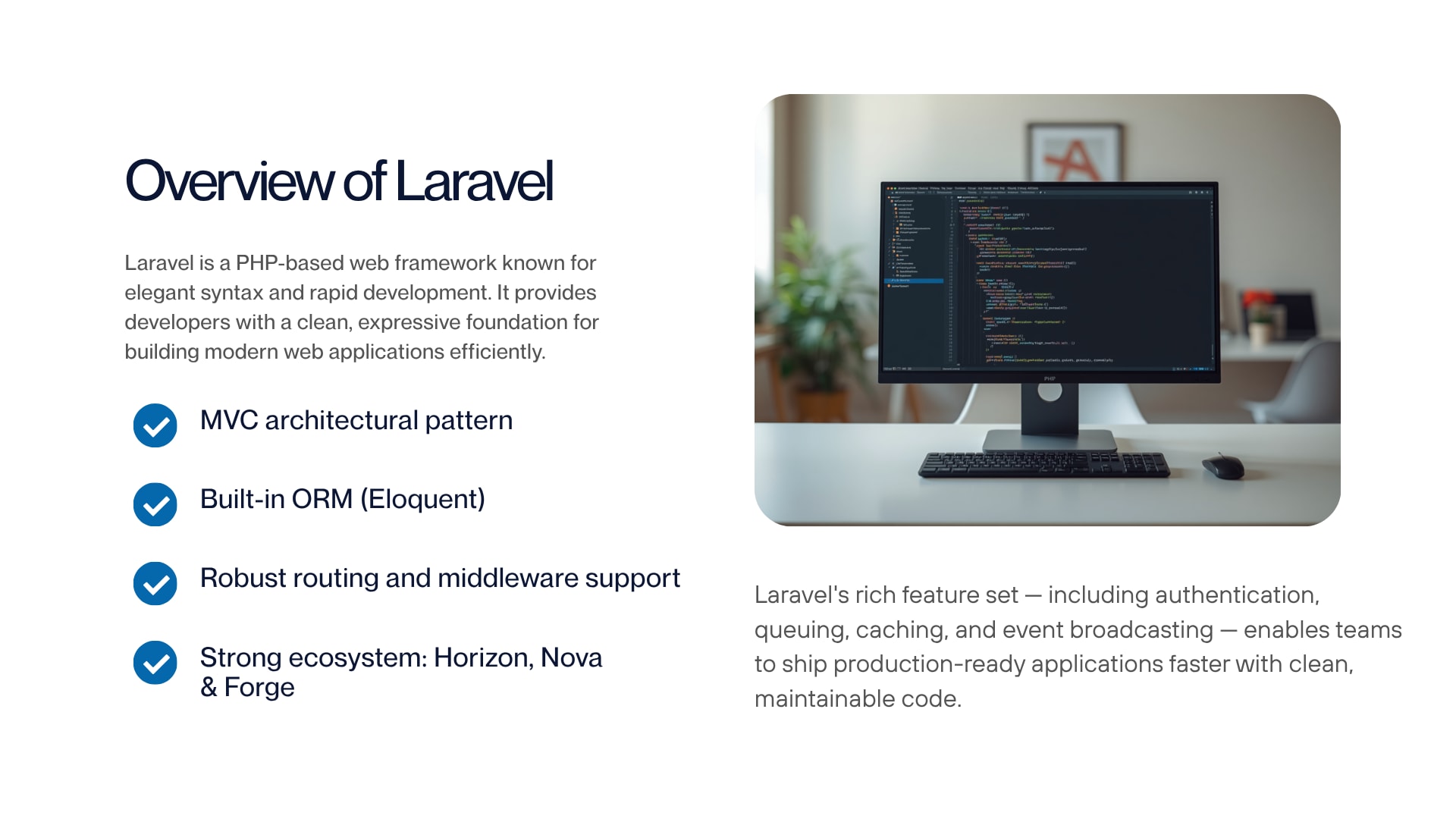
Laravel vs Node.js comparisons often begin by understanding Laravel itself. Laravel is a modern PHP framework that emphasizes developer productivity, clean architecture, strong security, and rapid application development. It is particularly suitable for business applications, content management systems, eCommerce platforms, SaaS products, and enterprise solutions where maintainability is just as important as performance.
Laravel was introduced to overcome many limitations found in traditional PHP development. Instead of writing repetitive code for routing, authentication, sessions, validation, or database interactions, developers can rely on Laravel's built-in features and expressive syntax.
Unlike basic PHP projects where developers often build everything manually, Laravel follows the MVC (Model-View-Controller) architecture. This separation makes applications easier to organize, debug, test, and scale over time.
Why Laravel Became So Popular
Laravel has earned widespread adoption because it balances simplicity with powerful capabilities. Developers can build production-ready applications much faster compared to traditional PHP development.
Some major reasons behind Laravel's popularity include:
Elegant and readable syntax
Built-in authentication and authorization
Powerful ORM called Eloquent
Blade templating engine
Queue management
Job scheduling
RESTful API support
Strong security features
Large package ecosystem
Excellent documentation
These features reduce repetitive development tasks and allow teams to focus more on solving business problems.
Core Features of Laravel
Laravel includes numerous built-in tools that simplify backend development.
Some of its most valuable features include:
MVC architecture
Eloquent ORM
Authentication system
Authorization policies
Route management
Middleware
Blade Template Engine
Database migration
Queue system
Event broadcasting
Task scheduling
Email services
File storage integration
Caching support
Testing tools
Instead of relying heavily on third-party libraries, Laravel provides many production-ready solutions directly within the framework.
Laravel Architecture Explained
Laravel follows the Model-View-Controller (MVC) architecture.
Each component has a specific responsibility:
Model
The Model manages application data and communicates with the database.
Examples include:
Users
Products
Orders
Payments
View
The View handles everything users see inside the browser.
Laravel uses the Blade templating engine to create reusable layouts while keeping presentation logic separate.
Controller
Controllers receive user requests, process business logic, communicate with models, and return appropriate responses.
This architecture creates a clean separation of concerns, making applications easier to maintain as projects grow.
Advantages of Laravel
Laravel provides several advantages for businesses building modern web applications.
Key benefits include:
Faster development cycles
Clean project structure
Excellent security defaults
Easy database management
Rich ecosystem
Large developer community
Better maintainability
Built-in testing support
Strong API capabilities
Long-term scalability
These benefits explain why Laravel remains one of the most popular PHP frameworks worldwide.
Limitations of Laravel
Although Laravel is highly capable, it is not the perfect solution for every project.
Some limitations include:
Slower than lightweight frameworks for extremely simple projects
Higher memory usage compared to plain PHP
Real-time communication often requires additional technologies
CPU-intensive workloads may perform better using other platforms
Developers need solid PHP knowledge
For most business applications, these limitations are minor compared to Laravel's productivity benefits.
Common Laravel Use Cases
Laravel powers thousands of business-critical applications.
Typical examples include:
CRM software
ERP systems
Hospital management systems
School management portals
Inventory systems
Accounting software
HR platforms
SaaS applications
Online marketplaces
eCommerce websites
Booking platforms
Membership portals
Customer dashboards
Business automation software
Many organizations choose Laravel because it accelerates development while maintaining code quality over the long term.
What Is Node.js?
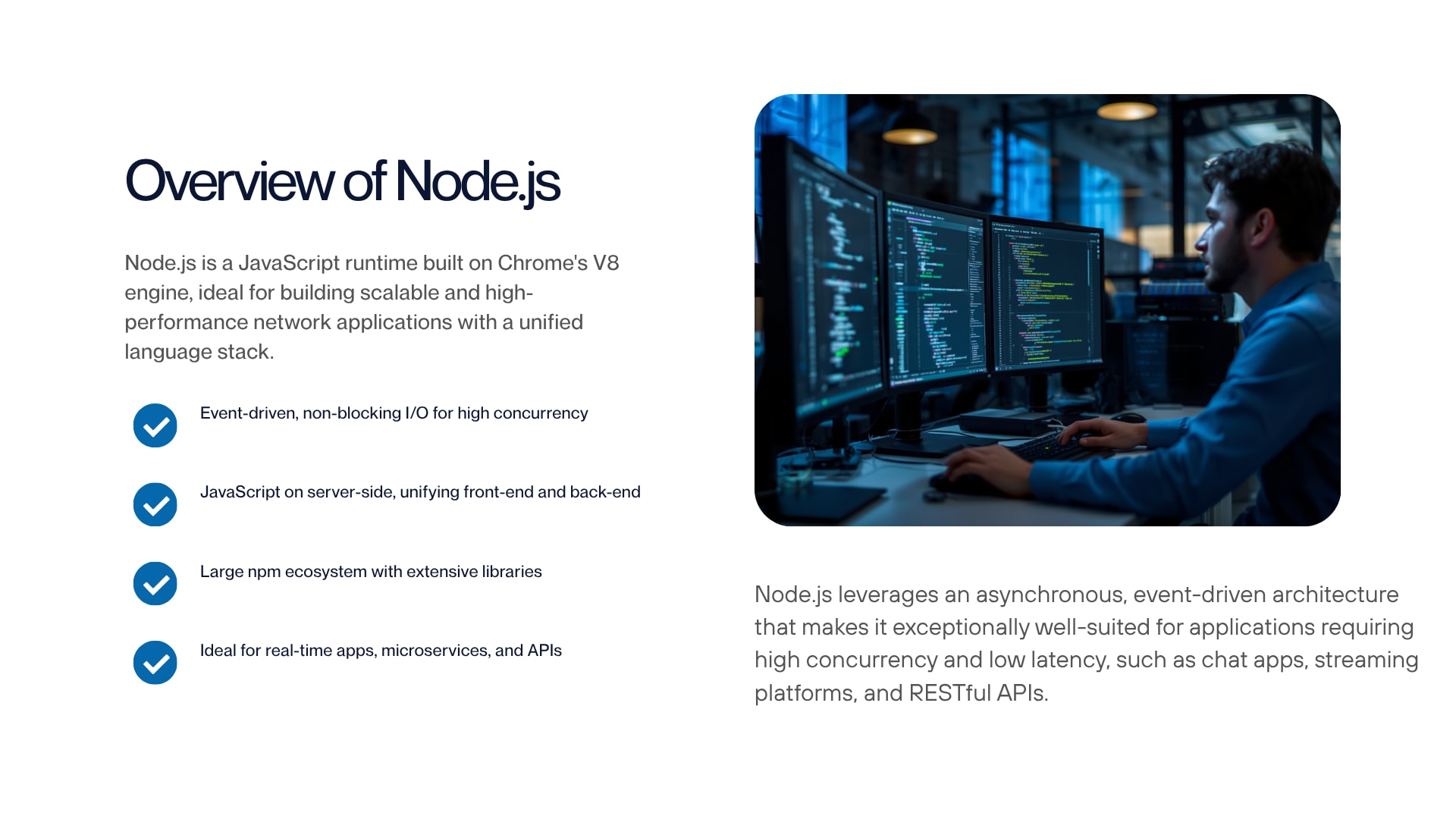
When evaluating Laravel vs Node.js, understanding Node.js is equally important. Node.js is an open-source JavaScript runtime built on Google's V8 engine that allows JavaScript to run outside the browser. It is designed for speed, asynchronous processing, and handling thousands of simultaneous requests, making it an excellent choice for real-time and data-intensive applications.
Unlike traditional backend environments that process requests sequentially, Node.js uses an event-driven, non-blocking architecture. This enables applications to serve many users at the same time without creating a separate thread for every request.
This design has made Node.js one of the most popular backend technologies for modern web applications.
Why Developers Choose Node.js
Node.js offers several advantages that simplify modern application development.
Popular reasons include:
JavaScript for both frontend and backend
Extremely fast execution
Non-blocking I/O
Event-driven architecture
Massive npm ecosystem
Excellent scalability
Strong community support
Cross-platform compatibility
Ideal for REST APIs
Excellent microservices support
Using a single programming language across the entire application also improves collaboration between frontend and backend teams.
Core Features of Node.js
Node.js includes several capabilities that make it suitable for modern web development.
Important features include:
Event loop architecture
Asynchronous programming
Non-blocking I/O
npm package manager
V8 JavaScript engine
Streams
WebSockets
Cluster module
File system APIs
HTTP module
Cross-platform support
Together, these features enable developers to create high-performance applications capable of handling significant workloads.
Understanding the Event Loop
The event loop is the heart of Node.js.
Instead of creating a new thread for every incoming request, Node.js continuously listens for events.
The process typically works like this:
A request arrives.
Node.js accepts the request.
Long-running operations are delegated.
The server continues accepting new requests.
Completed operations return their results.
Responses are sent back without blocking other users.
This efficient workflow explains why Node.js performs exceptionally well under heavy concurrent traffic.
Advantages of Node.js
Node.js provides several practical benefits for development teams.
Its strengths include:
High performance
Excellent scalability
Fast API development
Large package ecosystem
Real-time communication
Reduced development time
Shared JavaScript codebase
Active open-source community
Strong cloud compatibility
Efficient resource usage
These advantages make Node.js especially attractive for startups and rapidly growing digital products.
Limitations of Node.js
Despite its strengths, Node.js also presents some challenges.
Common limitations include:
Callback complexity in poorly structured code
CPU-intensive tasks can block the event loop
Rapid ecosystem changes
Package quality varies
Requires experienced developers for large-scale architecture
Many of these issues can be addressed by following modern development practices and selecting well-maintained libraries.
Common Node.js Use Cases
Node.js is widely used for applications requiring speed and real-time communication.
Popular examples include:
Chat applications
Messaging platforms
Video streaming services
Collaboration software
Online gaming servers
Live dashboards
Financial trading systems
IoT platforms
Real-time analytics
API gateways
Microservices
Social networking platforms
Large technology companies continue to rely on Node.js because of its scalability and ability to manage high volumes of concurrent users.
Laravel vs Node.js: Comparison Table
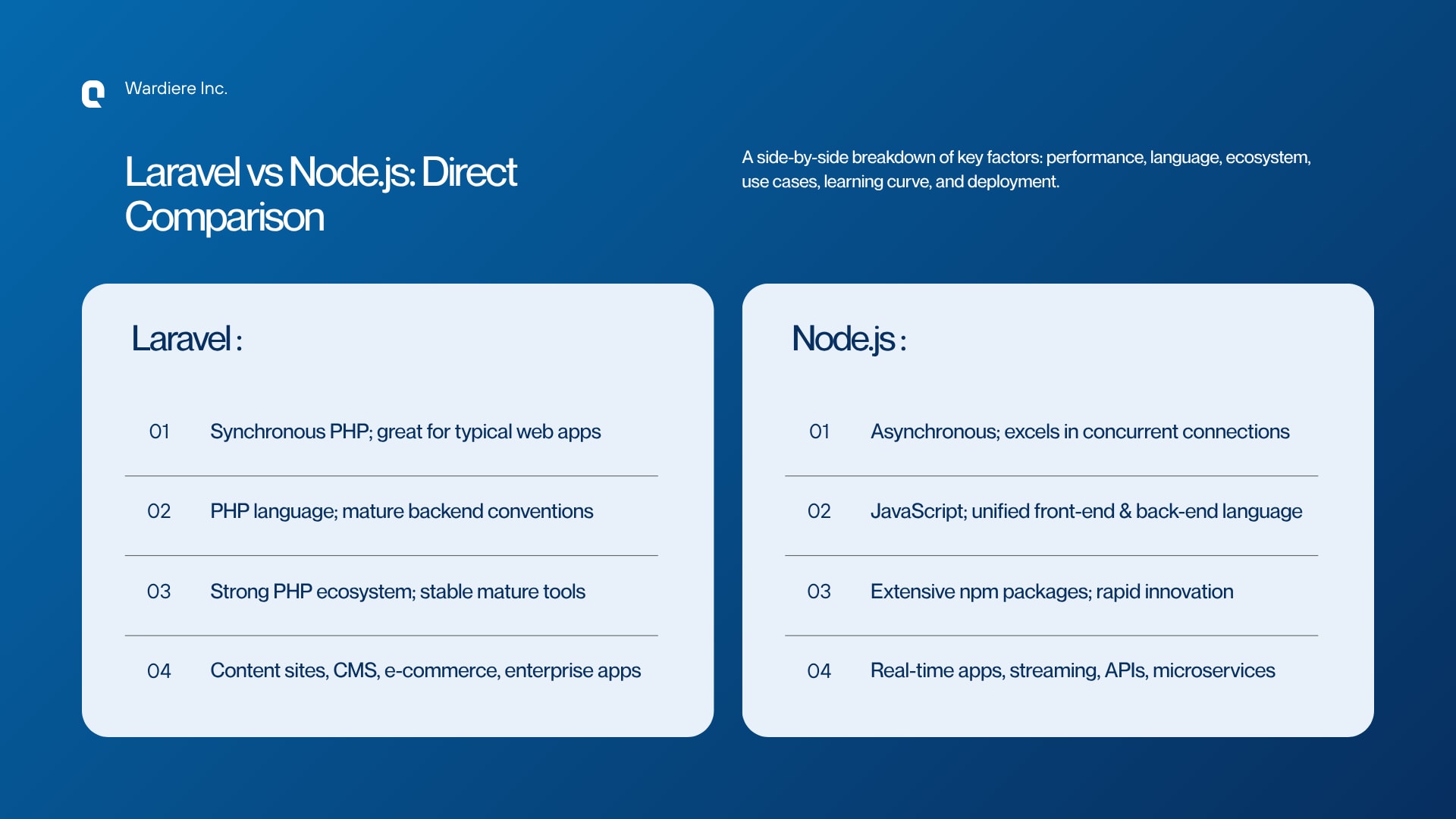
Laravel vs Node.js becomes easier to evaluate when both technologies are compared across the features that matter most to businesses and developers. Laravel offers a complete PHP framework with many built-in capabilities, while Node.js provides a lightweight runtime focused on speed, asynchronous processing, and scalable application architecture.
FeatureLaravelNode.jsLanguagePHPJavaScriptPerformanceExcellent for most web applicationsOutstanding for real-time and high-concurrency applicationsScalabilityHighly scalable with proper architectureNaturally scalable due to event-driven architectureLearning CurveModerate for PHP developersModerate for JavaScript developers; asynchronous concepts require practiceSecurityStrong built-in security features including CSRF, authentication, encryption, and validationSecurity depends more on implementation and selected packagesDatabase SupportExcellent with Eloquent ORM and migrationsSupports SQL and NoSQL databases through various libraries and ORMsAPI DevelopmentFast with built-in routing, authentication, and resourcesExtremely fast, especially for REST APIs and microservicesCommunity SupportLarge global PHP and Laravel communityMassive JavaScript and Node.js community with extensive npm packagesBest Use CasesBusiness applications, CMS, ERP, CRM, SaaS, eCommerceReal-time apps, chat platforms, streaming services, APIs, microservicesCostOpen source with affordable hosting optionsOpen source with flexible cloud deployment optionsDeploymentSupported by most PHP hosting providersCommonly deployed on cloud platforms, containers, and VPS environments
Laravel vs Node.js Performance
Laravel vs Node.js performance depends largely on the application's workload rather than a simple benchmark score. Laravel delivers reliable performance for most business applications, while Node.js generally handles real-time communication and concurrent requests more efficiently because of its non-blocking architecture.
Performance comparisons often create the impression that one technology is universally faster than the other. In practice, application design, database optimization, caching strategy, server configuration, and code quality have a much greater influence on performance than the framework or runtime alone.
How Laravel Handles Performance
Laravel is designed to simplify backend development while maintaining excellent performance for typical business workloads.
Several built-in features contribute to this:
Route caching
Configuration caching
View caching
Queue processing
Database indexing
Lazy loading optimization
Redis integration
Efficient ORM queries
When these features are properly implemented, Laravel applications can comfortably support thousands of users without performance issues.
A well-optimized Laravel application often performs better than a poorly designed Node.js application despite theoretical benchmark differences.
How Node.js Achieves High Performance
Node.js is optimized for handling many simultaneous connections with minimal resource consumption.
Its performance comes from:
Event-driven architecture
Non-blocking I/O
Lightweight runtime
Fast V8 engine
Efficient memory usage
Asynchronous request handling
This makes Node.js particularly effective for applications where users continuously exchange small amounts of data, such as chat systems, live notifications, and collaborative platforms.
Real-World Performance Considerations
Raw speed rarely determines project success. Experienced backend teams usually evaluate several practical factors before choosing between Laravel and Node.js.
Important considerations include:
Expected daily traffic
Database complexity
Number of concurrent users
Real-time communication needs
Third-party integrations
Server resources
Maintenance requirements
Future scalability plans
For example, an eCommerce platform with complex business logic may perform exceptionally well on Laravel. In contrast, a live collaboration tool or messaging platform benefits significantly from Node.js.
The most successful projects focus on selecting the technology that aligns with business requirements instead of chasing benchmark numbers alone.
Laravel vs Node.js Architecture
Laravel vs Node.js architecture differs fundamentally in how each technology processes requests and organizes applications. Laravel follows the Model-View-Controller (MVC) pattern, making code highly structured and maintainable, while Node.js relies on an event-driven, non-blocking architecture that excels at handling concurrent operations and building scalable network applications.
Architecture influences everything from code organization and testing to long-term maintenance and team collaboration. Choosing the right architectural approach often depends more on business requirements than on technical preferences.
Laravel Architecture
Laravel follows the MVC (Model-View-Controller) pattern, which separates application logic into three distinct layers.
The workflow typically looks like this:
A user sends a request.
The request reaches the routing system.
Middleware validates or filters the request.
The controller processes business logic.
Models interact with the database.
The controller prepares a response.
Blade templates or API resources return the final output.
This structured workflow makes Laravel applications easier to maintain, especially as projects grow over several years.
Benefits of Laravel's MVC Architecture
Laravel vs Node.js architectural comparisons often favor Laravel for large business systems because MVC promotes clean code organization and long-term maintainability.
Key benefits include:
Clear separation of responsibilities
Easier debugging
Better code reusability
Improved team collaboration
Simplified testing
Organized project structure
Easier feature expansion
Better documentation support
For enterprise applications with multiple developers, this consistency reduces confusion and technical debt.
Node.js Architecture
Node.js uses an event-driven architecture built around a single-threaded event loop.
Instead of waiting for one request to finish before processing another, Node.js delegates time-consuming operations such as file access or database queries while continuing to handle incoming requests.
This approach enables efficient resource utilization, particularly for applications with many simultaneous users.
Benefits of Node.js Event-Driven Architecture
The architecture behind Node.js provides several practical advantages.
These include:
Handles thousands of concurrent requests
Lower memory consumption
Fast response times
Efficient asynchronous processing
Excellent for streaming data
Supports microservices naturally
Simplifies real-time communication
This architecture explains why many messaging platforms, streaming services, and collaborative applications rely on Node.js.
Which Architecture Is Better?
There is no universal winner.
Laravel architecture works exceptionally well when applications involve:
Complex business rules
Administrative dashboards
Multi-role authentication
Extensive database relationships
Long-term enterprise maintenance
Node.js architecture is usually preferred when applications require:
Live updates
Continuous data streams
High concurrency
Real-time notifications
Lightweight microservices
The better architecture depends on how the application is expected to behave rather than which technology appears more modern.
Laravel vs Node.js Scalability
Laravel vs Node.js both support scalable applications, but they achieve scalability in different ways. Laravel scales effectively through caching, queues, load balancing, and optimized infrastructure, while Node.js naturally handles high concurrency with its event-driven architecture, making it especially suitable for rapidly growing real-time platforms.
Scalability is more than supporting millions of users. It also includes maintaining performance, reliability, and development efficiency as applications evolve.
How Laravel Scales
Laravel includes several built-in tools that support application growth without requiring major architectural changes.
Important scalability features include:
Redis caching
Queue workers
Database optimization
Horizontal scaling
Task scheduling
Session management
Load balancing
Cloud deployment support
A properly designed Laravel application can comfortably support growing businesses for many years.
Large SaaS platforms frequently use multiple Laravel servers behind a load balancer while background jobs process emails, reports, payments, and notifications separately.
How Node.js Scales
Node.js is designed to handle large numbers of simultaneous users efficiently.
Its scalability comes from:
Event-driven execution
Non-blocking I/O
Cluster module
Microservices architecture
Container support
Lightweight runtime
Efficient memory utilization
Many companies running live communication platforms choose Node.js because adding more application instances is relatively straightforward.
Common Scalability Challenges
Regardless of the chosen technology, scalability usually depends on application design rather than framework selection.
Common challenges include:
Slow database queries
Poor caching strategy
Inefficient APIs
Large file uploads
Excessive server requests
Unoptimized background jobs
Memory leaks
Inadequate monitoring
Addressing these issues early often produces better results than migrating to a different technology later.
Best Practices for Building Scalable Applications
Experienced backend teams generally follow these practices:
Optimize database queries.
Use caching wherever appropriate.
Separate background jobs from user requests.
Monitor server performance continuously.
Scale horizontally before vertically.
Minimize unnecessary API calls.
Use CDN services for static assets.
Perform regular performance testing.
These practices improve scalability regardless of whether Laravel or Node.js powers the application.
Laravel vs Node.js Security
Laravel vs Node.js both enable secure web applications, but Laravel includes many security protections by default, whereas Node.js relies more heavily on developer implementation and carefully selected libraries. In either case, following secure coding practices is far more important than the technology itself.
Security should never be treated as an afterthought. Most vulnerabilities originate from implementation mistakes rather than limitations in the framework.
Laravel Security Features
Laravel includes numerous built-in protections that reduce common security risks.
These features include:
CSRF protection
SQL injection prevention
Password hashing
Authentication
Authorization policies
Input validation
Encryption services
Secure session handling
Signed URLs
Rate limiting
Because these features are integrated into the framework, developers spend less time building security mechanisms from scratch.
Common Laravel Security Best Practices
Experienced Laravel developers usually recommend:
Validate every user input.
Keep dependencies updated.
Use HTTPS.
Protect environment variables.
Enable rate limiting.
Implement role-based access control.
Perform regular security audits.
These habits significantly reduce the likelihood of common attacks.
Node.js Security Features
Node.js itself is a runtime rather than a full framework, so many security measures depend on the libraries and architecture chosen.
Developers commonly implement:
JWT authentication
OAuth
Helmet middleware
Rate limiting
Input validation
Secure cookies
Environment variables
HTTPS encryption
Frameworks such as Express.js often provide the foundation for implementing these protections.
Common Security Mistakes
Many security problems are caused by avoidable developer errors.
Examples include:
Weak passwords
Hardcoded credentials
Outdated packages
Missing validation
Insecure API endpoints
Excessive user permissions
Poor error handling
Unencrypted sensitive data
Regular code reviews and dependency updates help prevent many of these issues.
Which Platform Is More Secure?
Laravel generally provides stronger security out of the box because many protections are built directly into the framework.
Node.js can achieve an equally secure environment, but success depends more on implementation quality and responsible package management.
For organizations without dedicated security engineers, Laravel's built-in protections often reduce development complexity and security risks.
Laravel vs Node.js Database Support
Laravel vs Node.js both offer excellent database support, but Laravel provides a more integrated experience through Eloquent ORM and database migrations, while Node.js offers greater flexibility by allowing developers to choose from multiple ORMs, query builders, and database drivers based on project requirements.
Database management plays a significant role in application performance and maintainability.
Laravel Database Capabilities
Laravel includes Eloquent ORM, one of its most appreciated features.
Developers can:
Define relationships easily
Create migrations
Seed databases
Roll back schema changes
Perform complex queries
Build reusable models
Simplify CRUD operations
This reduces repetitive SQL code while improving readability.
Laravel supports databases such as:
MySQL
PostgreSQL
SQLite
SQL Server
Integration with Redis is also available for caching and session storage.
Node.js Database Options
Node.js supports a wide variety of relational and NoSQL databases.
Popular choices include:
MySQL
PostgreSQL
MongoDB
MariaDB
Redis
Cassandra
Oracle
Firebase
Developers can choose from tools such as:
Prisma
Sequelize
TypeORM
Mongoose
Knex.js
This flexibility allows teams to select the database technology that best matches project requirements.
Choosing the Right Database Approach
When comparing Laravel vs Node.js, database selection should align with business goals.
Laravel often suits:
ERP systems
CRM software
Accounting applications
eCommerce stores
Inventory platforms
Node.js frequently powers:
Social platforms
Analytics systems
Chat applications
Streaming platforms
IoT solutions
The underlying database architecture often matters more than the backend technology itself.
Laravel vs Node.js API Development
Laravel vs Node.js are both excellent choices for API development, but Laravel emphasizes structured, secure REST APIs with built-in authentication and validation, while Node.js prioritizes speed, lightweight services, and high-throughput APIs capable of serving large numbers of concurrent requests.
Modern applications increasingly rely on APIs to connect mobile apps, websites, third-party services, and cloud platforms.
Building APIs with Laravel
Laravel simplifies API development through numerous built-in features.
These include:
Resource controllers
API routing
Validation
Authentication
Authorization
Rate limiting
JSON responses
API Resources
Middleware
Sanctum
Passport
These tools help developers build secure and maintainable APIs quickly.
When Laravel APIs Work Best
Laravel is commonly selected for APIs supporting:
Business software
Customer portals
Administrative dashboards
Healthcare platforms
Educational systems
Financial applications
Its structured architecture makes long-term API maintenance much easier.
Building APIs with Node.js
Node.js has become a preferred platform for API-heavy applications because of its speed and asynchronous request handling.
Developers frequently use:
Express.js
Fastify
NestJS
Koa
Hapi
These frameworks simplify routing, middleware, authentication, and request processing.
Best Use Cases for Node.js APIs
Node.js APIs perform particularly well for:
Mobile backends
Streaming services
Gaming platforms
Live dashboards
Chat applications
SaaS platforms
Microservices
Its lightweight nature helps reduce response times under heavy traffic.
REST API or Microservices?
Choosing between monolithic APIs and microservices depends on project complexity.
REST APIs are often ideal for:
Small businesses
Medium-sized applications
Administrative systems
Internal tools
Microservices become valuable when applications require:
Independent deployments
Multiple development teams
High scalability
Service isolation
Frequent feature releases
Laravel and Node.js both support these architectures, although Node.js is often favored for microservices because of its lightweight runtime.
Laravel vs Node.js Learning Curve
Laravel vs Node.js offer approachable learning paths for developers familiar with their respective languages. Laravel feels intuitive for PHP developers thanks to its structured framework and extensive documentation, while Node.js is easier for JavaScript developers but requires a solid understanding of asynchronous programming and event-driven concepts.
Learning speed depends largely on previous programming experience.
Learning Laravel
Laravel provides an organized development experience.
New developers typically learn:
Routing
Controllers
Models
Blade templates
Database migrations
Authentication
Middleware
API development
Because many common features are built into the framework, beginners can build complete applications relatively quickly.
Learning Node.js
Node.js introduces several concepts beyond standard JavaScript.
Developers usually study:
Event loop
Asynchronous programming
Promises
Async/await
Streams
Express.js
npm
WebSockets
Understanding these topics is essential for writing efficient Node.js applications.
Common Learning Mistakes
Many beginners encounter similar challenges regardless of the chosen technology.
Frequent mistakes include:
Ignoring architecture principles
Skipping documentation
Writing unstructured code
Neglecting testing
Avoiding version control
Copying code without understanding it
Ignoring security practices
Overusing third-party packages
Developing strong fundamentals early makes long-term growth much easier.
Which Is Easier to Learn?
Developers with PHP experience generally become productive in Laravel more quickly.
Those already comfortable with modern JavaScript often adapt to Node.js faster.
For complete beginners, both technologies require consistent practice, but Laravel's structured conventions can make large projects feel easier to organize, while Node.js offers greater flexibility once asynchronous programming becomes familiar.

Laravel vs Node.js Community Support
Laravel vs Node.js both have thriving global communities, extensive documentation, and mature ecosystems. Laravel benefits from a highly organized PHP community with excellent learning resources, while Node.js has one of the largest JavaScript ecosystems in the world, supported by millions of developers and the vast npm package registry.
A strong community plays an important role in the long-term success of any technology. Active contributors, frequent updates, third-party packages, and reliable documentation help developers solve problems faster and keep applications secure and up to date.
Laravel Community
Laravel has built one of the most welcoming communities in the PHP ecosystem. Since its release, it has gained widespread adoption among freelancers, startups, agencies, and enterprise development teams.
Developers benefit from:
Comprehensive official documentation
Thousands of open-source packages
Active GitHub contributors
Regular framework updates
Long-Term Support (LTS) releases when available
Community forums
Video tutorials
Technical blogs
Conferences and meetups
One of Laravel's greatest strengths is its consistency. Most packages follow similar coding standards, making integrations smoother and reducing compatibility issues.
Node.js Community
Node.js has one of the largest developer communities globally because JavaScript is already the dominant language for frontend development.
Its ecosystem includes:
Millions of npm packages
Large GitHub community
Frequent runtime improvements
Active open-source maintainers
Countless online tutorials
Technical conferences
Enterprise adoption
Cloud-native development support
Because Node.js powers applications across industries, developers can usually find libraries for almost any functionality without building everything from scratch.
Community Comparison
When comparing Laravel vs Node.js, both communities offer excellent support, but their strengths differ.
Laravel is often preferred for:
Structured documentation
Business application development
Stable package ecosystem
Clear coding conventions
Enterprise PHP projects
Node.js is commonly chosen for:
Modern JavaScript development
Large open-source ecosystem
Microservices
Cloud-native applications
Rapid innovation
Businesses should consider the availability of experienced developers within their own teams rather than choosing a technology solely because of community size.
Laravel vs Node.js Best Use Cases
Laravel vs Node.js each excel in different scenarios. Laravel is generally the better option for structured business applications that require authentication, complex database relationships, and long-term maintainability, while Node.js performs exceptionally well for real-time applications, streaming platforms, APIs, and systems handling thousands of simultaneous connections.
Many businesses assume there is a single "best" backend technology. In reality, successful projects are built by selecting the framework or runtime that best aligns with functional requirements and future growth plans.
When Laravel Is the Better Choice
Laravel is particularly well suited for applications where business logic is more important than real-time communication.
Typical Laravel projects include:
Enterprise Resource Planning (ERP) systems
Customer Relationship Management (CRM) software
Inventory management platforms
Human Resource Management Systems (HRMS)
Accounting software
Healthcare portals
School and university management systems
Learning Management Systems (LMS)
Booking platforms
Hotel management software
Membership websites
Subscription-based SaaS platforms
eCommerce stores
Business dashboards
Customer support portals
These applications usually involve multiple user roles, secure authentication, detailed reporting, and extensive database operations.
Laravel simplifies these requirements by offering many production-ready features directly within the framework.
Real-World Laravel Example
Consider a growing manufacturing company that wants to digitize its operations.
The application may include:
Employee login
Department management
Inventory tracking
Purchase orders
Invoice generation
Customer management
Reporting dashboards
Payment integration
Email notifications
Role-based permissions
Laravel's structured architecture makes it easier to manage these interconnected features while keeping the codebase organized for future development.
When Node.js Is the Better Choice
Node.js shines when applications must process many concurrent requests with minimal delay.
Common Node.js applications include:
Live chat platforms
Messaging applications
Video conferencing software
Online gaming servers
Live collaboration tools
Streaming platforms
Real-time analytics dashboards
Stock trading applications
IoT platforms
Food delivery tracking
Ride-sharing systems
Live sports score applications
Social media feeds
Notification services
API gateways
These systems continuously exchange data between users, making Node.js an excellent fit because of its event-driven architecture.
Real-World Node.js Example
Imagine a customer support platform where thousands of users communicate with agents simultaneously.
The application may require:
Instant messaging
Typing indicators
Live notifications
Real-time file sharing
Presence status
WebSocket connections
Push notifications
Node.js handles these continuous interactions efficiently without creating excessive server overhead.
When Laravel and Node.js Can Work Together
Many modern businesses no longer choose one technology exclusively.
Instead, they combine Laravel and Node.js to take advantage of each platform's strengths.
A hybrid architecture may look like this:
Laravel manages authentication
Laravel handles user management
Laravel processes payments
Laravel stores business data
Node.js powers live chat
Node.js delivers notifications
Node.js handles WebSocket communication
Node.js processes streaming events
This approach allows organizations to build highly scalable applications while maintaining a clean and maintainable backend architecture.
Industry-Wise Recommendations
Different industries often have different backend requirements.
Laravel is commonly preferred for:
Healthcare
Education
Finance
Government services
Manufacturing
Retail management
Corporate portals
Node.js is frequently selected for:
Media platforms
Entertainment
Online gaming
Social networking
Logistics tracking
Streaming services
Real-time collaboration software
Understanding industry requirements helps businesses avoid unnecessary technology changes later in the project lifecycle.
Laravel vs Node.js Cost
Laravel vs Node.js are both open-source technologies with no licensing fees, making them cost-effective choices for businesses of all sizes. The overall project cost depends less on the framework itself and more on development complexity, infrastructure, maintenance, hosting, and the experience of the development team.
Choosing the least expensive technology at the beginning does not always result in the lowest long-term cost. Maintenance, scalability, developer availability, and infrastructure requirements all influence the total investment.
Development Costs
Several factors determine backend development costs.
These include:
Project scope
Feature complexity
UI integration
API requirements
Third-party services
Testing
Security implementation
Deployment process
Both Laravel and Node.js support rapid development when experienced developers follow established best practices.
Hosting Costs
Laravel can run efficiently on most traditional PHP hosting environments.
Common hosting options include:
Shared hosting
VPS
Dedicated servers
Managed cloud hosting
Container platforms
Node.js applications are commonly deployed on:
Cloud servers
VPS
Docker containers
Kubernetes clusters
Serverless platforms
Infrastructure pricing varies depending on traffic, storage, and resource consumption rather than the chosen backend technology.
Maintenance Costs
Maintenance should always be included in long-term planning.
Regular maintenance involves:
Security updates
Dependency upgrades
Bug fixes
Performance optimization
Database maintenance
Monitoring
Backup management
Feature enhancements
Applications built with clean architecture generally cost less to maintain over several years than projects developed without coding standards.
Factors That Influence Total Cost
Businesses should evaluate the complete lifecycle of an application instead of focusing only on initial development expenses.
Important considerations include:
Developer availability
Infrastructure requirements
Future scalability
Feature expansion
Security compliance
Technical support
Third-party integrations
Long-term maintenance
Making technology decisions based solely on short-term cost often results in expensive migrations later.
Laravel vs Node.js Deployment
Laravel vs Node.js both support modern deployment strategies, cloud platforms, and containerized environments. Laravel is straightforward to deploy on traditional PHP hosting as well as cloud infrastructure, while Node.js integrates naturally with containerized deployments, microservices, and scalable cloud-native architectures.
Deployment planning should begin early in the development process rather than after the application is completed.
Deploying Laravel Applications
Laravel supports deployment across a wide range of environments.
Popular deployment options include:
Shared hosting
Virtual Private Servers (VPS)
Dedicated servers
AWS
Google Cloud
Microsoft Azure
DigitalOcean
Docker
Kubernetes
A typical Laravel deployment includes:
Upload application files.
Install dependencies using Composer.
Configure environment variables.
Run database migrations.
Cache routes and configuration.
Restart background workers.
Verify application health.
Laravel's mature deployment ecosystem makes it suitable for startups as well as enterprise organizations.
Deploying Node.js Applications
Node.js applications are commonly deployed using modern DevOps practices.
Typical deployment environments include:
Docker containers
Kubernetes
AWS EC2
Google Cloud Run
Azure App Service
DigitalOcean
Railway
Render
VPS environments
A standard Node.js deployment generally includes:
Install project dependencies.
Configure environment variables.
Build the application if required.
Start the runtime using a process manager such as PM2.
Configure reverse proxy servers.
Enable monitoring and logging.
Scale instances based on traffic.
Because Node.js is lightweight, horizontal scaling is often straightforward for growing applications.
Deployment Best Practices
Regardless of whether Laravel or Node.js is selected, experienced development teams typically follow several deployment best practices.
These include:
Automate deployments using CI/CD pipelines.
Store secrets securely.
Enable HTTPS by default.
Monitor server health continuously.
Maintain regular backups.
Use environment-specific configurations.
Test deployments before production releases.
Roll out updates gradually to minimize downtime.
A well-planned deployment strategy improves application reliability, simplifies maintenance, and reduces operational risks as the project grows.
Tags
Amzsoft Innovexa
Engineering and delivery notes from the Amzsoft Innovexa team — fintech platforms, AI automation, and product engineering.