A missed business call can represent more than a missed conversation. It can mean a lost lead, a delayed appointment, an unanswered customer question, or a potential buyer moving to a competitor. For many businesses, the problem is not a lack of customers. It is the difficulty of responding to every caller quickly and consistently.
Voice AI Agents are changing how businesses approach that problem. Instead of relying entirely on employees to answer every routine call, businesses can use conversational artificial intelligence to understand spoken requests, respond naturally, collect information, qualify leads, schedule appointments, route calls, and transfer complex conversations to human employees.
The technology does not make human communication irrelevant. Its value comes from handling the repetitive and time-sensitive parts of business communication while allowing people to focus on conversations that require judgment, empathy, negotiation, or expertise.
From customer service and sales to healthcare, real estate, hospitality, education, e-commerce, and professional services, voice AI can become another layer of the communication workflow.
The key question is no longer simply whether AI can talk on the phone. The more useful question is whether a business can identify the right calls to automate, design a reliable workflow, protect customer information, and create a smooth transition between AI and human employees.
What Are Voice AI Agents and How Do They Work?
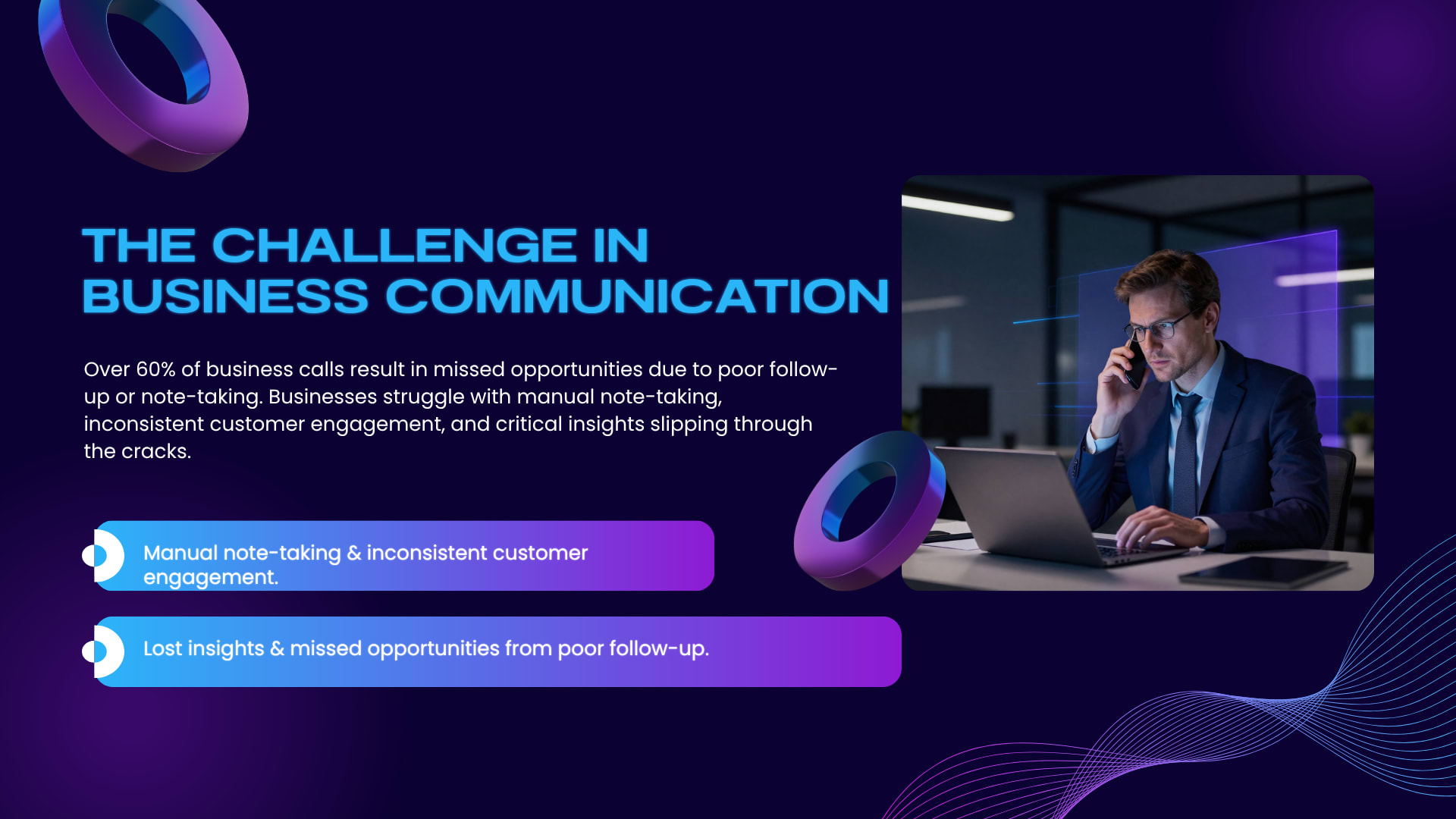
Voice AI Agents are software systems that use artificial intelligence to communicate with people through spoken language. They combine technologies such as speech recognition, natural language processing, language models, text-to-speech, business rules, and integrations to understand calls and respond according to a defined objective.
Unlike a traditional automated phone menu, a voice AI agent can interpret conversational requests instead of requiring callers to follow a rigid sequence of numbered options. A caller might explain a problem in ordinary language, and the system can identify the intent, ask a follow-up question, retrieve relevant information, and continue the conversation.
A typical voice AI workflow can be understood in four basic stages:
The caller speaks.
Speech recognition converts the audio into usable text or meaning.
The AI interprets the request and determines an appropriate response.
Text-to-speech technology converts the response into spoken language.
The agent may also interact with business systems during the conversation. For example, an appointment-focused agent could check available slots, collect customer details, confirm the selected time, and update the appropriate system if the required integration is available.
What makes a voice AI agent different from a basic chatbot?
A basic chatbot generally communicates through typed messages on a website, application, or messaging platform. A voice AI agent communicates through spoken conversation.
That difference matters because phone calls remain important for many situations where typing is inconvenient or where customers prefer direct communication.
A chatbot may ask a customer to type an order number. A voice AI agent can ask the customer to say it. A chatbot may present a booking form. A voice AI agent can conduct the conversation and collect the necessary information verbally.
Voice AI is therefore not simply a chatbot with a microphone. It requires additional capabilities for speech recognition, turn-taking, interruptions, pronunciation, latency, audio quality, and conversational flow.
How do voice recognition and natural language processing work together?
Voice recognition allows an AI system to process spoken language. Natural language processing and related AI capabilities help the system determine what the caller actually means.
For example, a caller might say, “I need to move my appointment from Friday morning to sometime next week.”
The system needs to understand that the caller is not merely mentioning Friday. The caller wants to reschedule an existing appointment.
The AI therefore needs to identify the intent, extract relevant information, ask for anything missing, and determine the next step.
This is where conversational AI becomes more useful than a simple keyword-based phone system.
How do AI-powered phone conversations happen?
A voice conversation generally depends on several connected components.
Speech recognition
The system listens to the caller and converts speech into information that the AI can process. Accuracy can depend on pronunciation, microphone quality, background noise, speaking speed, and the language being used.
Language understanding
The AI interprets the meaning of the caller's words. It can identify questions, requests, intent, and relevant details.
Response generation
The system determines what should happen next. That response may come from predefined business rules, a knowledge base, an AI model, or a combination of these approaches.
Text-to-speech
The final response is converted into spoken language. The quality of the voice, pacing, pauses, pronunciation, and conversational timing all influence how natural the interaction feels.
A well-designed system also understands when it should stop talking and listen. Constantly speaking over the customer can quickly make an AI agent feel unnatural.
Can voice AI agents handle both inbound and outbound calls?
Yes. Voice AI can support both inbound and outbound workflows, although the objectives are usually different.
Inbound call automation is commonly focused on customer service, information requests, appointment scheduling, routing, order questions, and initial support.
Outbound automation can support activities such as lead follow-ups, appointment reminders, confirmations, surveys, notifications, and other approved communication workflows.
The exact use of outbound AI calling depends on the business purpose, customer expectations, and applicable communication and privacy requirements.
How Can Voice AI Agents Improve Business Calls?
Voice AI Agents can improve business calls by handling repetitive conversations quickly, extending communication availability, routing callers intelligently, collecting information, and supporting employees during high call volumes. Their strongest value usually comes from automating predictable tasks while giving human teams control over complex or sensitive conversations.
How can AI agents provide 24/7 call handling?
Human teams have working hours. Customers do not always operate on the same schedule.
A customer may need information early in the morning, after business hours, or during a weekend. A traditional phone system may simply send the caller to voicemail or ask the customer to call again later.
A voice AI agent can provide an immediate response for supported requests outside normal working hours.
For example, a home-service company could use an AI receptionist to collect a customer's service requirement, location, preferred time, and contact information after the human office team has finished for the day.
The next business day, employees can review the information instead of starting from an unanswered voicemail.
Can voice AI agents reduce missed leads and unanswered calls?
They can help reduce the number of opportunities lost because nobody is available to answer a call, provided the system is properly configured.
Consider a real estate business receiving inquiries throughout the day. A sales representative may already be speaking with another prospect when a new buyer calls. If the call goes unanswered, the prospect may try another agency.
A voice AI agent can answer the call, identify the property requirement, ask qualifying questions, collect contact details, and route the conversation according to the business workflow.
The human sales representative can then receive a more useful lead rather than simply seeing a missed-call notification.
How do AI phone agents qualify leads?
Lead qualification is one of the more practical applications of AI phone agents.
The agent can be configured to ask questions relevant to the business. For a real estate company, these might include:
Preferred location
Property type
Approximate budget
Purchase timeline
Financing requirements
Preferred contact time
For a service company, qualification might involve:
Type of service required
Location
Urgency
Preferred appointment time
Existing customer status
The AI does not necessarily need to make the final sales decision. Its role can be to collect structured information and identify which conversations should be transferred to a salesperson.
Can voice AI agents schedule appointments automatically?
Appointment scheduling is particularly suitable for conversational automation because the workflow is often structured.
An AI agent can ask what service the customer needs, identify an available appointment option if connected to the appropriate scheduling system, confirm the customer's details, and communicate the booking information.
For example, a clinic may receive calls asking about appointment availability. A properly designed voice AI workflow could handle routine booking requests while transferring medical questions or sensitive situations to qualified staff.
The distinction matters. Scheduling an appointment is an administrative task. Providing medical advice is a different responsibility.
How does AI call routing improve customer service?
Not every caller needs the same employee.
A customer calling about billing should not necessarily enter the same queue as someone requesting technical support. Intelligent routing can help identify the caller's purpose before transferring the call.
The AI can ask a few questions and determine whether the caller needs:
Sales
Customer support
Billing
Technical assistance
Appointment support
Order information
A specific department
This can reduce unnecessary transfers and give employees more context before the conversation reaches them.
How can businesses automate repetitive customer questions?
Many customer-service teams repeatedly answer the same basic questions.
Customers may ask about:
Business hours
Appointment availability
Delivery status
Return procedures
Service areas
Pricing information that is publicly approved
Basic product information
Booking procedures
Account-related next steps
If the information is clear and the request is appropriate for automation, a voice AI agent can handle the initial interaction.
The human team can then spend more time on unusual problems, complaints, complex requests, and customers who specifically want human assistance.
What role does voice AI play in sales and marketing?
Sales teams often lose time on repetitive follow-ups.
A voice AI workflow can support approved follow-up processes by contacting prospects, asking whether they remain interested, collecting basic information, confirming appointments, or transferring interested prospects to sales representatives.
The important point is that AI calling should be designed around useful conversations rather than simply increasing call volume.
A high number of poorly targeted calls does not automatically create better sales results. A smaller number of relevant, well-timed conversations may be more valuable.
How can voice AI improve business productivity?
Productivity gains can come from reducing repetitive work.
An employee who spends several hours every day answering basic questions, confirming appointments, or collecting the same information may have less time for higher-value responsibilities.
Voice AI can take over suitable parts of those workflows.
That does not mean the employee becomes unnecessary. The employee's role may shift toward escalation handling, relationship management, decision-making, customer retention, and quality control.
The result is a human-AI workflow rather than a simple human-versus-AI replacement model.
Are Voice AI Agents Better Than Traditional Call Centers and Chatbots?
Voice AI agents are not automatically better than traditional call centers or chatbots. Each approach serves different communication needs. Voice AI is particularly useful when customers need immediate spoken interaction, when call volumes are repetitive, or when businesses need automation across phone-based workflows.
Voice AI Agents vs Traditional Call Centers vs Basic Chatbots
FeatureVoice AI AgentsTraditional Call CentersBasic ChatbotsCommunicationSpoken conversationHuman conversationText conversationAvailabilityCan operate continuouslyDepends on staffingUsually continuousRoutine questionsHighly suitableHuman agents handle themHighly suitableComplex conversationsHuman handoff recommendedStrongMay be limitedLead qualificationSuitable for structured workflowsHuman-ledSuitable through chatAppointment bookingSuitable with appropriate systemsHuman-ledSuitableEmotional conversationsHuman handoff often preferredStrongUsually limitedScalabilityHigh for repetitive workflowsRequires more staffingHighCustomer preferenceDepends on contextStrong for human preferenceConvenient for text usersBest roleAutomation plus human escalationComplex and relationship-driven supportText-based assistance
The comparison shows why businesses should not treat voice AI as a universal replacement.
When should a business use voice AI instead of a chatbot?
Voice AI can be useful when phone communication is already an important part of the customer journey.
A customer who is driving, working, elderly, uncomfortable with online forms, or simply accustomed to calling may prefer voice communication.
It can also be useful when the conversation requires several questions. Instead of navigating multiple screens, the customer can simply explain the request.
Chatbots remain useful when customers need links, documents, visual information, product comparisons, or text-based interaction.
Many businesses may eventually use both.
Where are human employees still essential?
Human employees remain valuable when conversations require judgment, empathy, negotiation, creativity, or responsibility.
Examples include:
Angry or distressed customers
Complex complaints
Sensitive financial matters
Medical concerns
High-value sales negotiations
Exceptions to standard policies
Legal or compliance-sensitive situations
Requests outside the AI's knowledge
Customers who explicitly request human support
A strong voice AI system should therefore make human handoff easy rather than treating escalation as a failure.
How much can businesses save with voice AI?
The financial impact depends heavily on the business, call volume, workflow complexity, technology costs, integration requirements, and the percentage of calls suitable for automation.
A business should avoid assuming a fixed percentage of cost reduction before analyzing its actual operations.
A better approach is to calculate:
Current call volume.
Average handling time.
Employee cost associated with those calls.
Percentage of calls that are repetitive.
Percentage suitable for automation.
Technology and integration costs.
Cost of human escalation.
Revenue impact of faster response and better lead handling.
This produces a more realistic business case than relying on generic AI savings claims.
What customer experience factors should businesses consider?
Customers do not necessarily care whether a call is handled by AI. They care whether the interaction solves their problem.
A voice AI agent can create a poor experience if it:
Repeats the same question
Speaks too quickly
Misunderstands simple requests
Makes customers navigate endless menus
Refuses to transfer to a human
Provides incorrect information
Sounds unnatural
Collects unnecessary information
The technology should therefore be evaluated from the customer's perspective, not only from the company's perspective.
What Can Voice AI Agents Do for Different Industries?
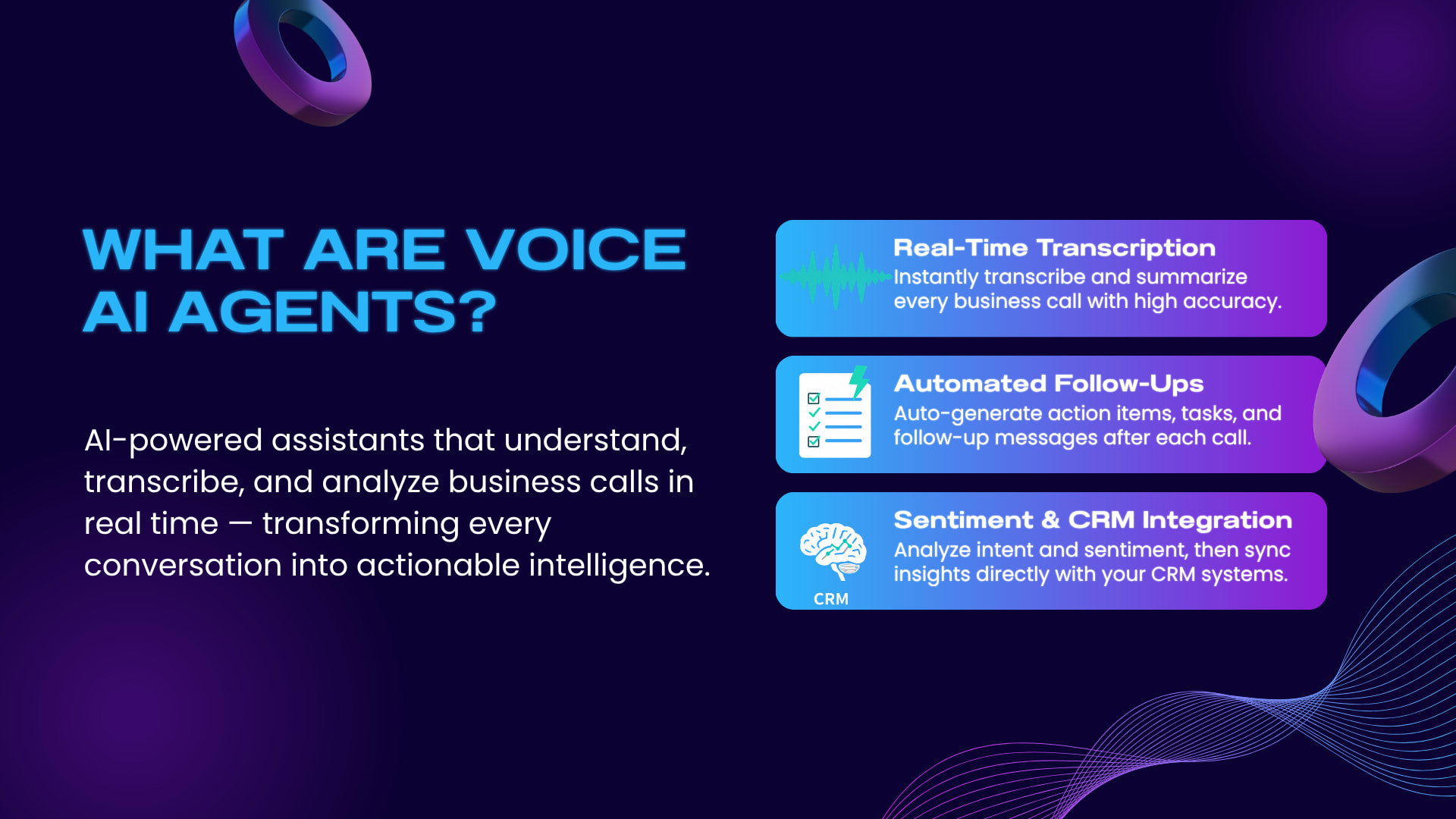
Voice AI Agents can support many industries because the underlying principle is not tied to one sector: repetitive, structured, high-volume conversations can often be partially automated. However, the exact workflow must reflect the industry's customer expectations, data requirements, operational processes, and regulatory responsibilities.
How can healthcare businesses use voice AI?
Healthcare organizations often receive calls about appointments, clinic hours, directions, basic administrative questions, reminders, and scheduling.
A voice AI agent could support administrative communication by collecting appointment requests, confirming details, providing approved general information, and routing calls to the appropriate staff.
Sensitive medical conversations require greater care. An AI phone agent should not be treated as a substitute for qualified medical professionals.
Privacy, security, consent, record handling, and applicable healthcare regulations must be considered before deployment.
How can real estate companies use AI phone agents?
Real estate teams frequently deal with inquiries from buyers, renters, property owners, and investors.
An AI agent can collect basic requirements such as location, budget, property type, number of bedrooms, and purchase timeline.
The information can then be passed to a salesperson or CRM workflow where appropriate.
This can be especially useful when agents are unavailable to answer every inquiry immediately.
How can e-commerce businesses automate customer calls?
E-commerce companies can receive large numbers of questions about orders, delivery, returns, exchanges, product availability, and basic policies.
Voice AI can support structured customer-service workflows where the necessary information is available and access is properly controlled.
For example, a customer may call to ask about an order status. Instead of waiting for a support representative, an AI agent could authenticate the customer through an appropriate process and provide the approved status information.
How can financial services use conversational voice AI?
Financial businesses can use conversational AI for certain administrative and customer-service workflows, but financial data requires strong security and compliance controls.
Potential use cases may include appointment requests, general service information, reminders, routing, and structured customer-support workflows.
High-risk financial decisions should not be casually delegated to an AI phone agent.
Businesses operating in regulated environments should assess applicable requirements before collecting, processing, or communicating sensitive information through AI systems.
How can hotels and hospitality businesses use voice AI?
Hotels receive many routine calls.
Guests may ask about check-in times, amenities, reservations, directions, restaurant hours, transportation, or room-related requests.
A voice AI receptionist can support selected administrative questions and route more complex requests to hotel employees.
This can help staff spend more time on guests who require personal attention while routine information remains accessible.
How can educational institutions use AI calling?
Schools, universities, training companies, and education platforms manage calls related to admissions, courses, application procedures, schedules, fees, events, and general inquiries.
An AI agent can answer approved questions, collect prospective student information, schedule counseling calls, or route inquiries to admissions teams.
The system should clearly distinguish between general information and decisions that require authorized staff.
How can travel businesses use automated phone calls?
Travel companies can use voice AI for reservation inquiries, itinerary questions, reminders, basic service information, and customer routing.
Travel conversations can become complex quickly, especially when cancellations, disruptions, refunds, or special circumstances are involved.
A good system therefore needs a clear escalation path.
How can automotive businesses use voice AI?
Automotive businesses can use AI receptionists for service appointment requests, basic dealership information, test-drive scheduling, service reminders, and lead qualification.
A customer interested in purchasing a vehicle can provide basic preferences before being transferred to a salesperson.
A service department can similarly collect vehicle details and the reason for the visit before an appointment is confirmed or passed to staff.
How can home-service companies use AI receptionists?
Plumbers, electricians, cleaning companies, HVAC providers, repair businesses, and other service companies often depend on phone inquiries.
An AI receptionist can collect the service type, location, urgency, preferred time, and contact details.
For emergencies or situations requiring immediate professional judgment, the system should follow a carefully defined escalation process.
How can SaaS and professional-service companies use voice AI?
SaaS companies can use voice AI for lead qualification, demo scheduling, support routing, and basic product questions.
Professional-service companies may use it for appointment requests, initial inquiries, customer routing, and information collection.
In both cases, the goal is usually not to automate the entire customer relationship. It is to remove friction from the first stage of communication.
Are Voice AI Agents Secure and What Challenges Should Businesses Expect?
Voice AI implementation involves more than choosing a natural-sounding voice. Businesses must consider privacy, security, data access, accuracy, integrations, human escalation, monitoring, customer expectations, and industry-specific requirements. Responsible AI deployment requires organizations to identify and manage risks throughout the system lifecycle. NIST's AI Risk Management Framework provides a voluntary framework for managing AI risks and improving trustworthy AI practices.
How should businesses approach voice AI privacy and data security?
A voice conversation can contain personal, financial, business, or other sensitive information.
Businesses should understand:
What information the system collects
Where information is stored
Who can access it
How long it is retained
Which third-party services process it
How data is protected
When recordings or transcripts are created
Whether customers are appropriately informed
Security should be considered during design rather than added after launch.
NIST identifies security, privacy, transparency, reliability, and related characteristics as important elements of trustworthy AI.
What happens when an AI agent misunderstands a caller?
Misunderstanding is one of the most important limitations of voice AI.
A caller may speak quickly, use an unfamiliar phrase, switch languages, have a strong accent, or describe a complicated problem.
The AI may interpret the request incorrectly.
A reliable system should recognize uncertainty instead of confidently giving an incorrect answer.
It can ask a clarification question:
“Could the caller confirm whether the request is about an existing appointment or a new booking?”
If the system still cannot understand the request, it should offer a human transfer.
Can voice AI handle accents, background noise, and emotional conversations?
Modern speech systems can handle a wide range of voices, but performance is not perfect.
Background conversations, traffic noise, poor phone connections, interruptions, uncommon words, pronunciation differences, and emotional speech can create challenges.
Businesses should test the system with realistic audio conditions rather than evaluating it only in a quiet demonstration.
Emotional conversations require even more care. An angry customer may not want an automated response. A human employee may be the better option.
Why is human handoff important?
Human handoff provides a safety net.
When an AI agent cannot complete a task, the caller should have a clear path to a person.
The transfer should ideally include relevant context so the customer does not need to repeat everything.
For example, if the AI already collected the customer's name, reason for calling, order number, and issue, the human employee should receive that context where the technical setup and privacy controls allow it.
This creates a more practical division of responsibilities.
What integration challenges can businesses face?
Voice AI becomes more useful when it can interact with business systems, but integrations can also introduce complexity.
Potential systems include:
CRM platforms
Appointment calendars
Help desks
Customer databases
Order-management systems
Communication platforms
Internal knowledge bases
Analytics systems
The business must determine what the AI should be allowed to read, what it can update, and which actions require human approval.
Giving an AI unrestricted access to business systems is not a sensible default.
What compliance issues should businesses consider?
Compliance requirements vary according to location, industry, customer data, communication type, and use case.
Businesses should consider applicable requirements related to:
Privacy
Call recording
Consent
Data retention
Consumer communications
Marketing calls
Sensitive personal information
Industry-specific regulation
A voice AI project should involve appropriate legal, security, and compliance review where necessary.
How should businesses monitor and improve voice AI agents?
Launching an AI phone agent is not the final step.
The system should be monitored regularly.
Useful performance indicators can include:
Call completion rate
Successful task completion
Transfer rate
Abandonment rate
Misunderstanding rate
Appointment completion
Lead qualification quality
Customer feedback
Average conversation duration
Escalation reasons
Conversation reviews can reveal problems that were not visible during testing.
If customers repeatedly ask a question that the system cannot answer, the knowledge base or workflow may need improvement.
If customers frequently request human support at a particular point, that stage may need redesigning.
NIST's AI RMF emphasizes ongoing consideration of trustworthy AI characteristics across design, development, deployment, use, and evaluation rather than treating risk management as a one-time activity.
How Can Businesses Adopt Voice AI Agents Successfully?
Businesses can adopt voice AI more successfully by starting with a narrow, measurable use case rather than attempting to automate every phone conversation at once. A practical implementation begins with workflow analysis, followed by conversation design, system integration, testing, human escalation, monitoring, and continuous improvement.
What should businesses automate first?
The best first use case is usually predictable and repetitive.
Good starting points may include:
Appointment booking
Appointment reminders
Frequently asked questions
Lead qualification
Call routing
Order-status requests
Basic information requests
Initial inquiry collection
Complex complaint handling or highly sensitive conversations are usually poor first projects.
The simpler the initial workflow, the easier it is to measure whether the technology actually works.
How should a business design the AI call workflow?
Before selecting technology, the business should map the conversation.
A basic workflow might look like this:
The AI greets the caller.
It asks why the caller is calling.
It identifies the intent.
It asks relevant follow-up questions.
It checks approved information.
It completes the supported action.
It confirms the result.
It offers human assistance when needed.
It records appropriate information for follow-up.
The workflow should also define what happens when something goes wrong.
What if the customer cannot provide the required information?
What if the requested appointment is unavailable?
What if the caller becomes frustrated?
What if the AI does not understand the request?
These situations should be designed before deployment.
What data should a voice AI agent have access to?
Only the information necessary for the assigned task should generally be made available.
For an appointment agent, that might mean access to availability and basic customer information.
For an FAQ agent, it might only need access to an approved knowledge base.
For a lead qualification agent, it may need to write structured information into a CRM.
The system should not receive unnecessary access simply because the technology makes it possible.
How should businesses test an AI voice agent before launch?
Testing should involve realistic conversations rather than a few scripted demonstrations.
Businesses should test:
Different accents
Different speaking speeds
Interruptions
Background noise
Unclear requests
Unexpected questions
Repeated questions
Angry customers
Customers requesting humans
Missing information
Incorrect information
System failures
Integration failures
The objective is not to prove that the AI never makes mistakes. The objective is to understand where it can safely operate and where it should stop and involve a person.
How can businesses measure voice AI performance?
The right metrics depend on the use case.
For appointment scheduling, the business may measure completed bookings and failed booking attempts.
For lead qualification, it may examine the quality of qualified leads and the percentage successfully transferred to sales.
For customer service, it may measure resolution rates, escalation reasons, customer feedback, and response time.
The business should connect AI performance to operational outcomes rather than focusing only on technical metrics.
When should a business work with a voice AI development partner?
A development partner can be useful when a business needs a customized workflow, multiple system integrations, specialized security requirements, or a solution that goes beyond an off-the-shelf AI phone service.
The partner should understand both the technology and the business process.
A successful project is not simply about creating an AI voice that sounds human. It is about building a system that understands the business objective, handles realistic conversations, protects information, integrates with existing workflows, and provides a reliable human handoff.
How can AMZSoft Innovexa help businesses explore AI automation?
AMZSoft Innovexa positions itself around software development, AI automation, fintech platforms, and digital growth services. Its official website identifies an AI Automation hub covering website chat, WhatsApp, omnichannel inboxes, and voice agents, alongside conversational automation and human handoff capabilities.
The company also describes a security-first delivery approach that includes encryption, access control, secure software-development practices, data-handling considerations, monitoring, and documented delivery processes.
For a business exploring voice AI, this type of technology partner can be useful when the requirement involves more than a standalone phone bot. A customized project can begin with identifying the business problem, mapping the call journey, determining which conversations should be automated, defining human escalation points, and planning the required technology architecture.
AMZSoft Innovexa's stated delivery process follows a sequence of discovery, design, build, and launch-and-grow stages, which can provide a structured framework for organizations evaluating a customized AI automation project.
Businesses considering a voice AI project can explore the technology, workflow, integration, security, and implementation requirements with AMZSoft Innovexa before deciding how much of the communication process should be automated. The appropriate solution will depend on the company's industry, call volume, existing systems, customer expectations, and operational goals.
What Is the Future of Voice AI Agents for Business?
The future of Voice AI Agents is likely to focus less on simply making machines speak and more on making business conversations useful, contextual, secure, and connected to real workflows. Improvements in language understanding, multilingual communication, system integrations, analytics, and human handoff could make voice AI increasingly practical across different business functions.
Will voice AI conversations become more natural?
Voice AI is already moving beyond rigid question-and-answer systems.
Future systems are expected to continue improving their ability to understand context, interruptions, conversational intent, and natural speech patterns.
The most useful progress will not necessarily be a voice that sounds indistinguishable from a human. It will be an agent that understands when to ask a question, when to remain silent, when to clarify, when to act, and when to transfer the conversation.
How will multilingual voice AI change customer communication?
Businesses serving customers across regions often face language barriers.
Multilingual voice AI could make it easier to support customers in different languages without requiring a separate full-time team for every language.
However, language support should not be judged only by whether an AI can translate words. Natural communication also depends on pronunciation, cultural context, terminology, and the ability to understand regional speech patterns.
Can voice AI connect more deeply with CRM systems?
CRM integration is one of the most important directions for business voice automation.
A future workflow could allow an AI agent to understand who the customer is, review permitted information, identify the reason for the call, update a record, schedule the next action, and provide the human sales or support team with a conversation summary.
The value comes from connecting the conversation to the business process.
A phone call that ends without any useful record may still create manual work. A call that automatically produces structured, accurate information can become part of the broader customer journey.
What role will real-time analytics play?
Businesses increasingly want to understand not only how many calls they receive but also what customers are asking for.
Voice AI systems could help organizations identify common questions, frequent failure points, repeated complaints, popular services, lead requirements, and reasons for escalation.
These insights can influence product development, customer support, marketing, staffing, and sales processes.
However, analytics must be handled responsibly, particularly when conversations contain personal or sensitive information.
Will voice AI replace human customer-service teams?
Voice AI is more likely to change the role of customer-service teams than eliminate the need for humans altogether.
Routine questions can be automated.
Simple bookings can be automated.
Basic information collection can be automated.
Initial lead qualification can be automated.
But customers still need people when situations become complicated, emotional, sensitive, or commercially important.
The strongest model is therefore likely to be a combination of AI and human expertise.
AI handles predictable volume.
People handle judgment and relationships.
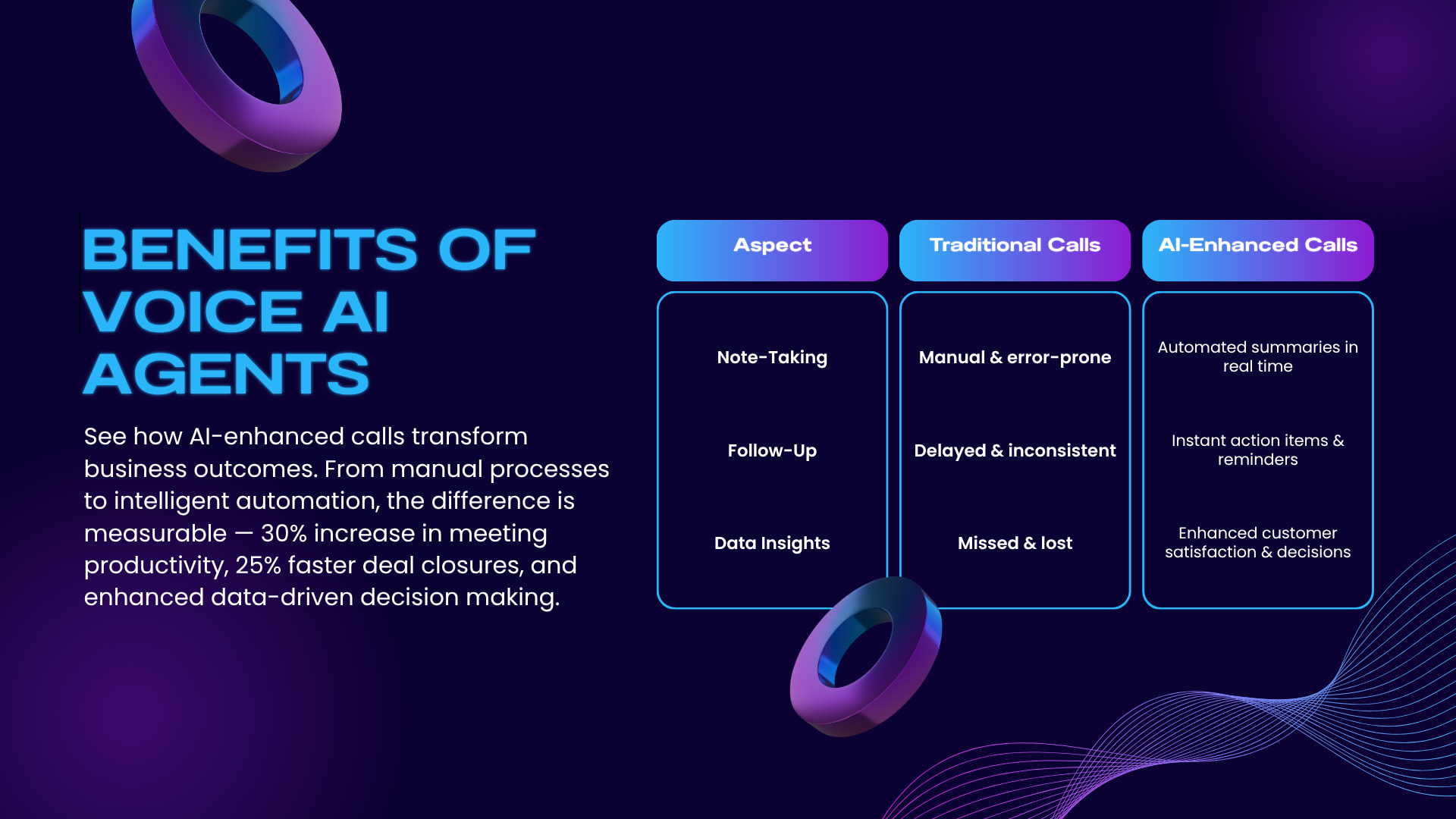
What should businesses prepare for next?
Businesses considering voice AI should start by understanding their existing call workflows.
They should identify which conversations consume employee time, which calls are repetitive, where leads are lost, and where customers experience unnecessary delays.
From there, a controlled pilot can be created around one measurable use case.
The future of voice AI will not be determined only by how advanced the underlying AI model becomes. It will also depend on how intelligently businesses design the surrounding workflow.
What Does Smarter Business Calling Really Mean?
Voice AI agents represent a shift from phone systems that simply connect callers with employees toward communication systems that can understand, respond, collect information, and perform defined tasks.
The technology can help businesses answer calls outside normal working hours, reduce repetitive workload, qualify leads, schedule appointments, route conversations, handle basic customer questions, and support outbound communication workflows.
But automation alone is not the goal.
A poorly designed AI phone agent can frustrate customers just as quickly as a poorly designed website or phone menu. Accuracy, privacy, security, conversation design, system integration, monitoring, and human handoff all influence whether the experience actually works.
Businesses should therefore start with practical questions:
Which calls are repetitive?
Which calls are frequently missed?
Which tasks can be standardized?
Which conversations require a human?
What information does the AI actually need?
How will customer data be protected?
How will performance be measured?
What happens when the AI cannot help?
The answers provide a stronger foundation than simply asking whether a company should “use AI.”
Voice AI Agents can become a valuable part of modern business communication when they are deployed with a clear purpose. They can take care of routine conversations while human employees focus on the interactions where human judgment matters most.
For businesses exploring customized AI automation, AMZSoft Innovexa provides a relevant starting point for discussing software, AI automation, conversational systems, and voice-agent requirements. Its official platform highlights voice agents within its AI automation capabilities and describes a delivery model covering discovery, design, development, launch, and ongoing support.
The next step for a business is not necessarily to automate every call. It is to find the right conversation to automate first, test it carefully, measure the outcome, and expand only when the workflow proves useful.
That is where voice AI becomes more than a technology trend. It becomes a practical business communication tool.
Tags
Amzsoft Innovexa
Engineering and delivery notes from the Amzsoft Innovexa team — fintech platforms, AI automation, and product engineering.